
NEWS
Al-Sisi’s Genocide Charge Guards Egypt’s Sinai Red Line
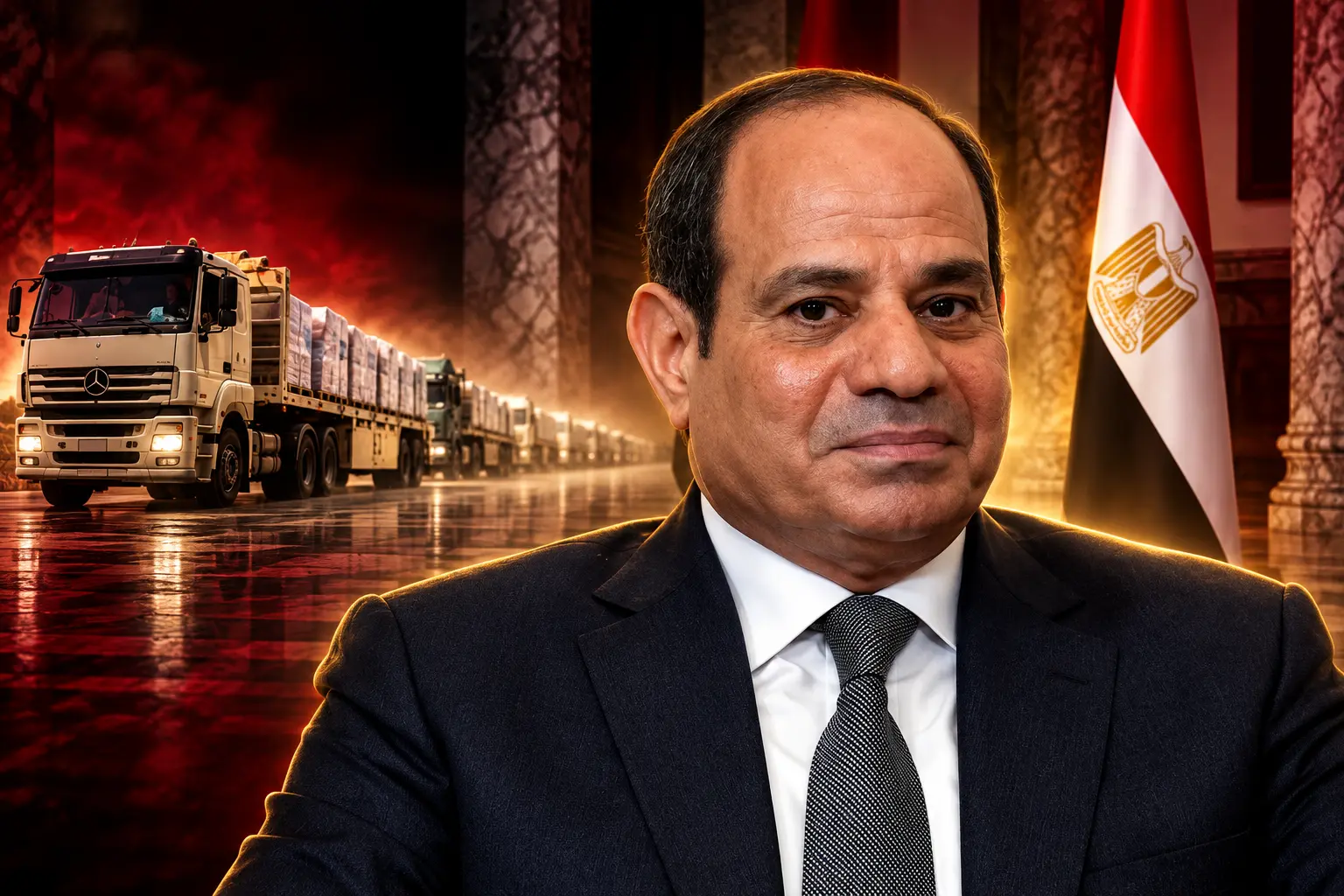
Al-Sisi’s Gaza genocide charge on August 5, 2025 doubled as Egypt’s veto on a Sinai transfer, with more than 5,000 aid trucks waiting on Egyptian soil.

On August 5, 2025, Abdel Fattah Al-Sisi called Israel’s war in Gaza a campaign of starvation, genocide, and liquidation of the Palestinian cause. He spoke at Al-Ittihadiya Palace in Cairo with Vietnamese President Luong Cuong beside him, and he put more than 5,000 stranded aid trucks on the record.
The same remarks closed a door Egypt has treated as a security file since the first week of the war. Cairo will try to feed Gaza, Al-Sisi said, and it will not become a new home for Gazans.
Al-Sisi Named Starvation and Genocide in One Breath
The Egyptian president told the room the fighting was no longer a war for political goals or for hostages. He said it had gone past any logic or justification and become a war of starvation and genocide, with a systematic campaign to wipe out the Palestinian cause. He also said Palestinian lives in Gaza, and perhaps in the West Bank, were being used as a bargaining chip while the world watched.
He warned that history would hold many countries to account for their stance, and that the world’s conscience would not stay quiet for long. He asked President Donald Trump, by name, to stop the war. Marco Rubio, then the U.S. secretary of state, had already told British and French counterparts that Washington was pushing for a ceasefire and was deeply concerned by the spiral.
Gaza’s Health Ministry, on that Tuesday, put the 24-hour toll at 87 Palestinians killed and 644 wounded. The ministry’s running count since October 7, 2023, stood at 61,020 dead and 150,671 wounded. Israeli minister Yisrael Katz said the army would carry out policy once the cabinet decided; officials in Jerusalem were arguing over a fuller occupation of the Strip after indirect talks with Hamas collapsed.
Al-Sisi’s language was the harshest Cairo had used in public on this war. It was also tightly scripted. The genocide line and the Sinai line arrived as a pair.
Egypt’s Veto on a Sinai Transfer
He left little room on the second point.
We are ready to bring in humanitarian aid at any time. However, we are not prepared to accept or resettle Palestinians on our land. There are those who aim to deflect attention from the perpetrator of this tragedy.
Abdel Fattah Al-Sisi, President of Egypt, joint press conference with Vietnamese President Luong Cuong, Cairo
He said Egypt would remain a gateway for aid and would not become a gateway for the displacement of the Palestinian people. That formula is older than the press conference. From October 7, 2023, Cairo named any forced move of Gazans into Sinai a red line. State information chief Diaa Rashwan later restated the pair as Egypt’s two fixed limits: no transfer of Palestinians, and no threat to Egyptian national security.
In January 2025 the Trump White House floated the idea that Egypt and Jordan might host people cleared out of Gaza. Arab governments rejected it at once. Al-Sisi’s August remarks were a public restatement of that refusal, aimed at Washington, at Israel, and at anyone trying to park the Palestinian file on the Egyptian side of the fence.
EGYPT’S THREE PILLARS ON GAZA
- The transfer ban: Palestinians stay on Palestinian land, including during any rebuild, with Sinai closed as a destination.
- The aid claim: Egypt says the Rafah gate on its own soil stayed open and that the stoppage sits on the Palestinian side, which Israeli forces seized in May 2024.
- The mediator seat: Cairo works ceasefires with Qatar and the United States and wants a Palestinian state on the 1967 lines with East Jerusalem as capital.
Those three points explain why a head of state used the word genocide and, in the next breath, talked about trucks and about who would not be allowed in. The audience was not only in Gaza. It was in Sinai, in the 1979 peace treaty with Israel, and in any postwar map that tried to empty the Strip eastward.
More Than 5,000 Trucks Sat Inside Egypt
Al-Sisi said only one of Gaza’s five crossings sits under Egyptian administration. He said the Egyptian side of Rafah had never been closed in this war, that the terminal had been wrecked four times and rebuilt each time, and that Israeli forces on the far side were what stopped the cargo. More than 5,000 loaded trucks, he said, were waiting on Egyptian territory, from Egypt and from other countries. Before the war, he said, 600 to 700 trucks a day used to enter from Egypt to supply 2.3 million people. Cut that flow to almost nothing over 21 months, he told the room, and you get the hunger now on screen.
He put Egypt’s share of aid that did get in at more than 70 percent. He called accusations that Cairo was helping starve Gaza bankrupt and strange. Jan Egeland, secretary-general of the Norwegian Refugee Council, was saying Israel was breaking international law daily and that crossings had to reopen to stop famine. The argument in Cairo was that the lock was not on Egypt’s keyring.
THE AID FLOW PUT ON THE RECORD
| Flow | Figure | Period and source |
|---|---|---|
| Daily trucks from Egypt into Gaza | 600 to 700 | Before October 2023, per Al-Sisi on August 5, 2025 |
| Trucks waiting on Egyptian soil | more than 5,000 | August 5, 2025, per Al-Sisi |
| Loaded UNRWA trucks stuck outside Gaza | 6,000 | August 1, 2025, UNRWA, warehouses in Egypt and Jordan |
| Daily trucks during the early 2025 ceasefire | 500 to 600 | UNRWA, the pause earlier that year |
Four days before the palace briefing, UNRWA Commissioner-General Philippe Lazzarini said airdrops were at least 100 times costlier than road convoys, that trucks carry twice what planes carry, and that the agency had 6,000 loaded trucks stuck outside Gaza waiting for a green light. During the ceasefire earlier in 2025, he said, the UN and partners had moved 500 to 600 trucks a day. The 6,000 figure is a wider pile than Al-Sisi’s 5,000, because it counts stock in Jordan as well as Egypt. Both describe cargo that was packed and still not inside the Strip.
Gaza’s Health Ministry also logged 95 cases of Guillain-Barre syndrome, 45 of them in children, and three recent deaths, two of them children. Doctors there tied the cluster to dirty water and hunger under the blockade. It is a rare nerve illness. A jump like that, in a place short of food and clean water, is the medical record of a siege, not a side note.
Cairo Came to Rebut a Charge of Complicity
The press conference was also a rebuttal. In the weeks before it, Egyptian missions abroad had faced sit-ins that demanded Rafah be opened faster. Khalil al-Hayya, a senior Hamas figure, had called the crossing a gateway to death and starvation and asked Egyptians how they could let their brothers die at the border. He told crowds to surround Egyptian embassies. One protest even went up outside the embassy in Tel Aviv, which Egypt’s Journalists Syndicate denounced as a betrayal.
That charge is the one Al-Sisi spent the hour answering. Rafah is the only Gaza gate that does not sit wholly inside Israel’s fence, so it is the place where Egypt can be accused of sharing the siege. The standing complaint from Palestinians who reached the Egyptian side is that leaving Gaza through that gate has been a tightly rationed privilege, not an open corridor, while the 1979 treaty still lets Israeli travelers enter Egypt with none of that friction. Cairo’s answer is that the Palestinian half of the terminal has been under Israeli control since May 7, 2024, and that trucks which do move are often pushed toward Karm Abu Salem (Kerem Shalom) for Israeli inspection before they go in.
Egypt also policed its own street. Opposition parties asked to protest outside the Israeli embassy in Cairo on August 8. Madhet El-Zahad, head of the Socialist Popular Alliance Party, said the march would be a peaceful show of solidarity and would not touch domestic politics. Cairo’s Emergency Affairs Court said no. The state that called the war a genocide would not allow a crowd at the Israeli mission in its own capital.
So the political geometry is tight. Egypt needs to be seen feeding Gaza, needs the 1979 treaty intact, needs Hamas kept out of Sinai, and needs no sudden city of refugees on its own soil. Insults from Hamas and sit-ins at embassies press the first of those needs. Israeli talk of occupying the whole Strip presses the rest. The genocide charge let Al-Sisi answer all four at once.
Why Arab States Backed a Stay-Put Rebuild
The hidden stake had already been written down in March. On March 4, 2025, an emergency Arab League summit in Cairo endorsed an Egyptian plan to rebuild Gaza in place, as a reply to Trump’s idea of moving the population out and redeveloping the coast. Al-Sisi told the opening session that Palestinians had been offered annihilation or imposed exile, and he asked the room to adopt Egypt’s alternative. The league did.
THE STAY-PUT PLAN ARAB LEADERS ADOPTED
- The price and span: About $53 billion over five years, in three phases, with early recovery first and heavier building later.
- The housing idea: Temporary shelter at seven sites inside Gaza for about 1.5 million people while rubble is cleared and homes go back up on Palestinian land.
- The politics: A committee of Palestinian technocrats for a short transition, Hamas out of government, and a path for the Palestinian Authority to return, with Egypt and Jordan training a police force.
The plan was Egypt’s way of saying reconstruction is allowed and mass removal is not. It also put Cairo in line for a central role if money ever follows the drawings. Six days after Al-Sisi’s August briefing, Norway’s sovereign wealth fund, run by Norges Bank Investment Management, sold 11 off-index Israeli holdings and pulled the rest of that book in-house. The fund had held 61 Israeli companies at the end of the first half of 2025. CEO Nicolai Tangen said the situation in Gaza was a serious humanitarian crisis and that the fund was invested in firms operating in a country at war. Norway’s finance ministry had asked for the review. It was not an Egyptian win. It was the same file, moving in a different capital.
Cairo’s Seat After the October Ceasefire
On August 8, 2025, Al-Sisi took a call from Palestinian President Mahmoud Abbas and again refused any uprooting of Palestinians from their land. On August 20 he told French President Emmanuel Macron the same thing, and the Egyptian State Information Service recorded that he rejected any attempt to uproot Palestinians while still pushing a ceasefire, hostage releases, and a faster rebuild. The August 5 speech was one hour in a longer campaign.
EGYPT’S TRACK ON THE GAZA FILE
- October 7, 2023: Cairo names any forced move of Gazans into Sinai a red line from the first day of the war.
- November 2023: Egypt and Qatar mediate a short truce with hostage-prisoner swaps and a brief rise in aid.
- May 2024: Israeli forces take the Palestinian side of Rafah. Egypt says it will not accept a change in the crossing’s status.
- January 15, 2025: Egypt, Qatar, and the United States mediate a formal ceasefire, with exchanges, a partial Israeli pullback, and more aid.
- March 4, 2025: Arab leaders in Cairo endorse Egypt’s $53 billion stay-put rebuild plan.
- August 5, 2025: Al-Sisi, with Luong Cuong, calls the war starvation and genocide and restates the transfer ban.
- October 9 to 13, 2025: A first-phase ceasefire under a U.S. plan takes hold, with a summit in Sharm El-Sheikh.
By October, Egypt was back where it wants to sit: in the room, on the border, and on paper as a sponsor of postwar stabilization of the Gaza Strip. Foreign Minister Badr Abdelatty had already urged Hamas to take the U.S. proposal and disarm. Cairo’s bet is mediation plus the canal plus a working economy for more than 100 million people, not a second front. That is why the 1979 treaty still binds the map even when the president uses the word genocide.
The trucks did not vanish when the speeches ended. The Egyptian Red Crescent’s Zad Al-Ezza convoys, launched on July 27, 2025, were still running a year later. The 286th convoy began entering on September 29, 2026, through the secondary gate of the Rafah land port, heading for Karm Abu Salem and Israeli inspection before delivery. In late September 2026 Al-Sisi said attempts to uproot Gaza’s residents had not ended and would not end. He had also been lined up for a later Washington meeting with Trump, on a docket that still included Gaza.
The August 5 charge did not reopen Rafah on Egyptian terms, and it did not move the Israeli line off the far side of the gate. It did fix, in public, the bargain Cairo had already made with itself. Aid is the export. People are not. The trucks that still roll toward Karm Abu Salem travel inside that rule.

Christa Pike Survived the Execution Tennessee Would Not Pause

Musk’s Oligarch Charge Hits a Queue of Three

Circle Puts USDC and EURC Into SAP Pay Workflows

Ring’s First Smart Lock Skips Home Wi-Fi for Sidewalk

GTA 6 Puts Cash Back on the Story Path

Salah Captained Egypt to Their First World Cup Win

Aramco Crash Kills 14 Two Days After Oil Restart

Apple Labor Day Deals Hide June’s Memory Price Hike

Zelda’s 40th Switch 2 Ships Without a Zelda Game

Palworld 1.0.4 Adds Palpedia Search After the 1.0 Launch
-
 NEWS5 months ago
Salah Captained Egypt to Their First World Cup Win
-
 BUSINESS4 months ago
Aramco Crash Kills 14 Two Days After Oil Restart
-
 NEWS2 months ago
Apple Labor Day Deals Hide June’s Memory Price Hike
-
 GAMING1 month ago
Zelda’s 40th Switch 2 Ships Without a Zelda Game
-
 GAMING1 month ago
Palworld 1.0.4 Adds Palpedia Search After the 1.0 Launch
-

 NEWS4 months ago
El Niño Puts Israel’s Needed Winter Rain on a Flood Clock
-

 BUSINESS8 months ago
Egypt Bets EGP 638 Billion Can Open Sinai to Investors
-

 BUSINESS8 months ago
BAE’s 60-Year Saudi Franchise Now Runs Through Taif