
BUSINESS
Exchanges Urge the CFTC to Block Kalshi Oil Perps
CMC asked the CFTC to deny Kalshi’s WTI oil perpetual, even as overnight crude already trades on offshore perp venues.

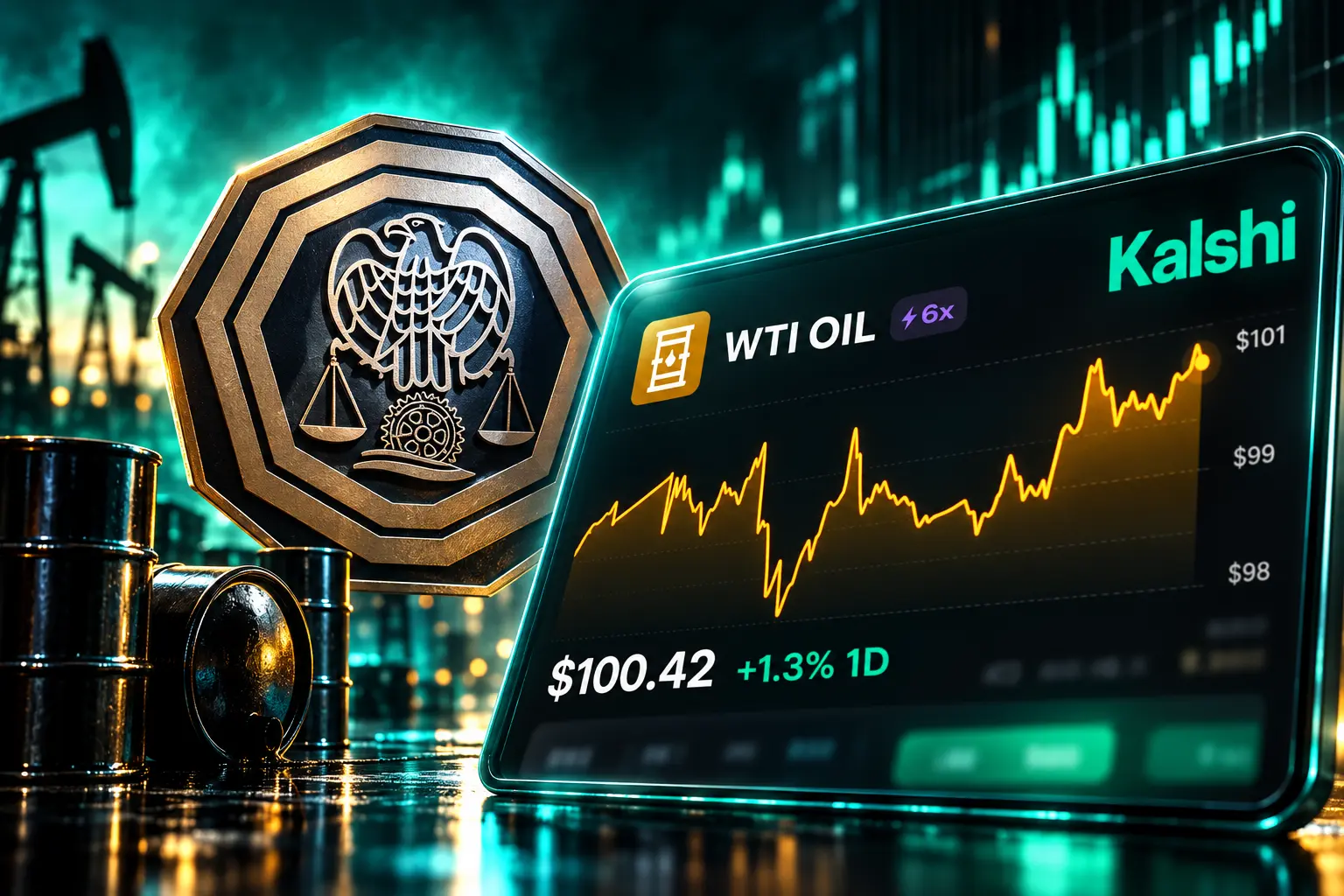
The Commodity Markets Council told the CFTC on October 22 to reject Kalshi’s never-expiring WTI oil perpetual. The group, whose members include CME Group and large trading houses, also asked the agency to shut a path that lets U.S. retail traders reach offshore derivatives books through VPNs.
Kalshi filed the WTIPERP contract on October 20. The ask lands after CME Group pulled its own all-hours oil future on October 2, and after offshore venues had already built a round-the-clock crude book the council cannot supervise.
Kalshi Already Lists a Decade-Long Oil Future
The fight is not about whether Kalshi can touch oil. It already does. On October 7 the prediction-market exchange self-certified WTIFUTURE, a West Texas Intermediate contract that expires after 10 years and uses a funding rate to keep the price glued to the benchmark.
Kalshi told the commission that product is “not a perpetual” because it still has an end date. Traders treat it like one anyway. Kalshi’s own market page showed about $57 million in daily volume and leverage of up to 5.9x.
In that October 7 filing, Kalshi argued that a single long-dated oil contract with a funding mechanism is “structurally superior to a strip of near-dated contracts” for anyone whose crude exposure has no clean stop date. It said the design cuts roll costs, removes the chance of an accidental delivery obligation at Cushing, Oklahoma, and parks liquidity in one instrument.
WTIPERP is the next step. The October 20 filing asks the CFTC to approve a contract that tracks the front-month NYMEX WTI future and never expires. Because true perps sit under heavier review than event contracts, Kalshi did not self-certify this one. The commission has at least 45 days, and as many as 90 days, to allow it or stop it.
KALSHI’S TWO OIL CONTRACTS
| Contract | Status | Expiry | Hours | Leverage |
|---|---|---|---|---|
| WTIFUTURE | Live after the October 7 self-certification | 10 years | NYMEX hours | Up to 5.9x |
| WTIPERP | Filed October 20, awaiting CFTC action | None | NYMEX hours | Not in the public filing extracts |
Those hours matter. For both contracts, Kalshi copied the NYMEX WTI session: 23 hours a day on weekdays, and after 6 p.m. ET on Sunday. That is not a weekend oil market. It is a weekday oil market with no monthly roll.
Kalshi already lists CFTC-reviewed perpetuals on Bitcoin, ether, XRP, HYPE, gold and silver, plus a U.S. 500 perpetual. Oil is the first energy benchmark on that list. In the WTIPERP filing, Kalshi said a U.S. listing would pull perpetual energy trading under the commission instead of leaving it on decentralized venues such as Hyperliquid. “This activity exists and occurs today outside the commission’s supervision,” the filing said.
What the Commodity Markets Council Wants Blocked
The Commodity Markets Council wants the CFTC to withhold approval of Kalshi’s WTIPERP contract and to work with foreign regulators so U.S. retail traders cannot reach offshore derivatives platforms through VPNs. The group warned that perpetual futures pose risks to market integrity, and it sent that message two days after Kalshi filed.
The letter is not a ruling. It is a trade group asking a regulator to use the only window that still exists, the 45-to-90-day review on a voluntary product filing. WTIFUTURE is already on the screen. WTIPERP is the contract the council can still try to stop.
THE COUNCIL’S TWO ASKS
- The Kalshi product: Withhold approval of the never-expiring WTI perpetual, ticker WTIPERP, rather than let it list after the review window.
- The offshore path: Close a loophole the group says lets U.S. retail traders reach foreign derivatives platforms through VPNs.
- The integrity claim: Treat perpetual futures as a threat to how oil prices are formed, cleared, and watched under the Commodity Exchange Act.
The VPN half of that letter is a flow argument dressed as a location argument. If a CFTC-supervised oil perp gives retail traders a way to hold crude with no expiry, the overnight business that now sits on foreign books has a legal U.S. screen. Blocking Kalshi keeps that flow off the supervised venue. It does not delete the foreign books.
Leverage is the part of the warning that does not depend on turf. Oil is a physical market with storage, pipelines, and delivery points. A thin, round-the-clock retail book can move when the people who hedge barrels are asleep. That concern can be true and still fail as a reason to keep the only supervised version off the market.
A Weekend Staffing Fight Killed CME’s Oil Plan
CME Group already tried to answer the same overnight problem from the other side. It designed a cash-settled 10-barrel crude contract, one-tenth the size of its Micro WTI future, that would have traded through weekends and holidays on Globex. The CFTC stayed that self-certified listing in July. On October 2, CME withdrew it.
Chairman and CEO Terry Duffy said commercial clients did not want a second desk staffed on Saturday. He also said the contract had been built as a U.S. answer to oil products that already trade all day on prediction markets and on offshore perpetuals.
We created and planned to launch a 10-Barrel oil contract to provide a transparent, regulated alternative to the 24/7 oil contracts that other venues have introduced in the marketplace. Whether as onshore prediction markets or offshore perpetuals, which are illegal for U.S. participants but may be accessed despite their illegality via virtual private networks, these energy products already trade around the clock, primarily for retail participants.
Terry Duffy, Chairman and CEO, CME Group statement, October 2, 2026
In the same statement, Duffy said CME was a transparent, regulated alternative to 24/7 oil that it would not list after those talks. He asked the CFTC to “address the inequity” and to make every derivatives product meet Commodity Exchange Act core principles.
That sequence is the bind. CME said weekend oil already exists, mostly for retail, on venues it calls illegal for U.S. users. Then it pulled the contract it had offered as the legal substitute, after hedgers refused to staff the hours. Three weeks later the same industry channel asked the CFTC to stop Kalshi from listing a weekday oil perpetual that never expires.
CME has a separate case in federal court over Kalshi’s crypto perps. On October 16 the CFTC asked a judge to throw that suit out. “CME does not allege that it has suffered any concrete financial injury because of perpetual futures,” the commission said, adding that CME’s public data show digital-asset futures volumes higher than they were before those products were approved.
Offshore Books Already Hold the WTI Perp Tape
The oil perpetual the council wants to keep off a U.S. screen is not a thought experiment. It is a live market. DefiLlama’s tracker of WTI perpetual open interest and volume put the global book at $961.64 million of open interest, with $2.062 billion traded in 24 hours and $50.355 billion over 30 days, across 25 markets on 23 venues. Decentralized venues held 25.3% of that open interest.
WHERE THE WTI PERP BOOK SITS
| Venue | Open interest | 24-hour volume | Max leverage |
|---|---|---|---|
| Binance (CL-USDT) | $309.85 million | $1.176 billion | Not listed on the tracker |
| trade[XYZ] / xyz:CL | $188.09 million | $228.67 million | 20x |
| Gate (CL-USDT) | $180.4 million | $130.6 million | 100x |
| OKX (CL-USDT) | $58.78 million | $154.53 million | 50x |
| Bybit (CL-USDT) | $39.93 million | $174.6 million | 150x |
The xyz:CL book is a builder-deployed HIP-3 market that references one barrel of WTI and runs on Hyperliquid’s chain. That is the unsupervised cousin of the contract Kalshi wants the CFTC to bless. Kalshi’s live oil future caps leverage at 5.9x. xyz:CL allows 20x. Gate lists 100x. Bybit lists 150x.
Hyperliquid’s Terms of Use, last updated June 15, 2026, already treat anyone who lives in, sits in, or is incorporated in the United States as a Restricted Person under §1.6(a). Section 3.1.5(a) bans VPNs and other tools used to hide location. Founder Jeff Yan has said U.S. users should not use a VPN to get around that wall.
The terms do not retire the CMC’s fear. The CFTC said in a September 7, 2023 enforcement order against DeFi operators that blocking U.S. internet addresses was “not sufficient to actually block U.S. users,” and that leveraged perpetual contracts offered to retail belong on a registered exchange. Duffy’s October 2 statement made the same point in plainer language: the products trade, and some U.S. accounts still find them.
Saturday crude is the cleanest proof. When NYMEX is dark, the offshore perp is one of the few places a headline can print a price. A Kalshi denial does not erase that print. It only keeps it off a CFTC-supervised screen that still closes for the weekend.
Payward Filed a Regulated Path Onto Hyperliquid
The same month CME walked away from weekend oil, Washington moved toward bringing perp venues into the country rather than pretending they can be walled off. On August 19, President Donald Trump said CFTC Chairman Michael Selig was working to bring Hyperliquid into the United States “in a fully compliant and legal fashion.”
On September 16, Payward, the parent of Kraken, said it intends to deploy onchain perpetual futures for US clients as Hyperliquid HIP-3 markets, subject to regulatory approval. Bitnomial Exchange would create and own the markets as a designated contract market. Bitnomial Clearinghouse would clear them. NinjaTrader Clearing would hold customer accounts. Only names on both firms’ allowlists could trade.
Co-CEO Arjun Sethi said no registered U.S. exchange or clearinghouse had yet deployed a market there, and that Payward intends to be first, “holding the keys and carrying the regulatory obligations.” Yan has argued that U.S. rules should sit on the firms that deploy markets, not on the chain. “The deployers are the ones that exercise these controls,” he said.
That design would not open the public Hyperliquid app to U.S. residents. It would put a permissioned slice of the same matching engine behind a CFTC-registered broker. The CMC letter still treats offshore access as a hole to close. Payward is asking to turn part of that hole into a licensed door.
The commission already opened an optional lane for retail crypto leverage on a parallel track. That work does not decide the oil filing. It does show which way the agency has been walking since it approved Kalshi’s Bitcoin perpetual in the spring.
THE 2026 PATH TO THE OIL PERP FIGHT
- May 29, 2026: The CFTC approves KalshiEX’s BTCPERP, the first true perpetual listed on a U.S. designated contract market.
- July 2026: The CFTC stays CME’s self-certified 10-barrel 24/7 crude contract the day before launch.
- August 19, 2026: Trump says Selig is working to bring Hyperliquid into the United States in a compliant way.
- September 16, 2026: Payward says it intends to deploy HIP-3 perps for U.S. clients through Bitnomial and NinjaTrader Clearing, subject to approval.
- October 2, 2026: CME withdraws the 10-barrel oil filing after talks with commercial clients.
- October 7, 2026: Kalshi self-certifies WTIFUTURE, the 10-year WTI contract with a funding rate.
- October 20, 2026: Kalshi files WTIPERP for commission review.
- October 22, 2026: The Commodity Markets Council asks the CFTC to deny that filing and to curb offshore retail access.
On October 5, between CME’s retreat and Kalshi’s 10-year listing, the CFTC published an advance notice on crypto asset markets and on leveraged retail crypto trades. Comments on that notice are due December 14, 2026. It is not a rule, and it is not an oil order. It is the agency writing down how it wants perpetual-style retail products to live inside the Commodity Exchange Act.
A Denial Leaves Overnight Crude Offshore
Put the dates next to the volumes and the letter’s own logic starts to fold. CME would not run a weekend oil contract because hedgers would not staff it. Kalshi is not even asking for Saturday. It is asking for a weekday WTI perpetual that never rolls, on NYMEX hours, under CFTC review. The unsupervised books already offer WTI with no expiry, higher leverage, and no weekend close.
If the CFTC denies WTIPERP, Kalshi still has the 10-year future. CME still has the main NYMEX pit. Binance, Gate, Bybit, and the xyz:CL book still have a 24-hour crude price. U.S. retail that wants that price still has the same messy choices Duffy named on October 2: stay out, or find a VPN the foreign venue says it forbids.
WHAT WE KNOW
- The letter: On October 22 the Commodity Markets Council asked the CFTC to withhold approval of Kalshi’s WTIPERP contract and to limit retail access to offshore platforms through VPNs.
- The live product: WTIFUTURE has been trading since the October 7 self-certification, with about $57 million in daily volume and leverage up to 5.9x, on NYMEX hours.
- The pending product: WTIPERP, filed October 20, would never expire and still needs commission approval inside a 45-to-90-day window.
- The offshore book: WTI perps held $961.64 million of open interest and traded $2.062 billion in 24 hours across 23 venues on the DefiLlama tracker.
WHAT IS UNCONFIRMED
- The CFTC decision: No public order yet on WTIPERP, and the review can run to 90 days.
- The Payward launch: The Hyperliquid HIP-3 plan for U.S. clients is an intent letter, not an approved listing, and Hyperliquid’s public terms still bar U.S. persons.
- The VPN clamp: No public plan from the CFTC or foreign regulators on how a U.S. retail ban on offshore oil perps would be enforced against a chain that already writes the ban into its own terms.
A supervised oil perpetual with 5.9x leverage would not make the 20x xyz:CL book safer. It would give the commission a venue it can actually call. Denying that venue leaves the overnight crude tape where it already is, on books the October 22 letter cannot see.
Disclaimer: This article is news reporting and analysis of public filings, market data, and official statements. It is informational only and is not a recommendation to trade futures, perpetual contracts, prediction-market contracts, or any other derivative. It is not investment, trading, or legal advice. Readers who are considering these products should consult a licensed futures broker, commodities counsel, or other qualified professional who can review their facts before they act. Contract status, review clocks, leverage caps, and volume figures reflect the filings and trackers cited on the dates named in the piece and can change as the CFTC, the exchanges, and the offshore venues update their products.

Cook Hands Democrats the House as Crypto’s Bill Stays Dead

Wicker’s Broken Bed Was the Short Story’s Punch Line

Nvidia’s $500 Billion Financing Plan Draws a $180 Sell

Maserati Bets the Grecale V6 Can Fill Porsche’s Gap

EV Cable Theft Follows the Old Railway Copper Playbook

Aramco Crash Kills 14 Two Days After Oil Restart

Salah Captained Egypt to Their First World Cup Win

Zelda’s 40th Switch 2 Ships Without a Zelda Game

Apple Labor Day Deals Hide June’s Memory Price Hike

Palworld 1.0.4 Adds Palpedia Search After the 1.0 Launch
-
 BUSINESS4 months ago
Aramco Crash Kills 14 Two Days After Oil Restart
-
 NEWS5 months ago
Salah Captained Egypt to Their First World Cup Win
-
 GAMING2 months ago
Zelda’s 40th Switch 2 Ships Without a Zelda Game
-
 NEWS2 months ago
Apple Labor Day Deals Hide June’s Memory Price Hike
-
 GAMING2 months ago
Palworld 1.0.4 Adds Palpedia Search After the 1.0 Launch
-

 NEWS4 months ago
El Niño Puts Israel’s Needed Winter Rain on a Flood Clock
-

 BUSINESS8 months ago
BAE’s 60-Year Saudi Franchise Now Runs Through Taif
-

 BUSINESS8 months ago
Egypt Bets EGP 638 Billion Can Open Sinai to Investors