
NEWS
Egypt’s Shark Graveyard Is a Phosphate Mine’s Ledger
Fourteen shark teeth from Egypt’s Abu-Tartur phosphate mine add five Late Cretaceous species, a time-averaged ore ledger rather than a mass grave.

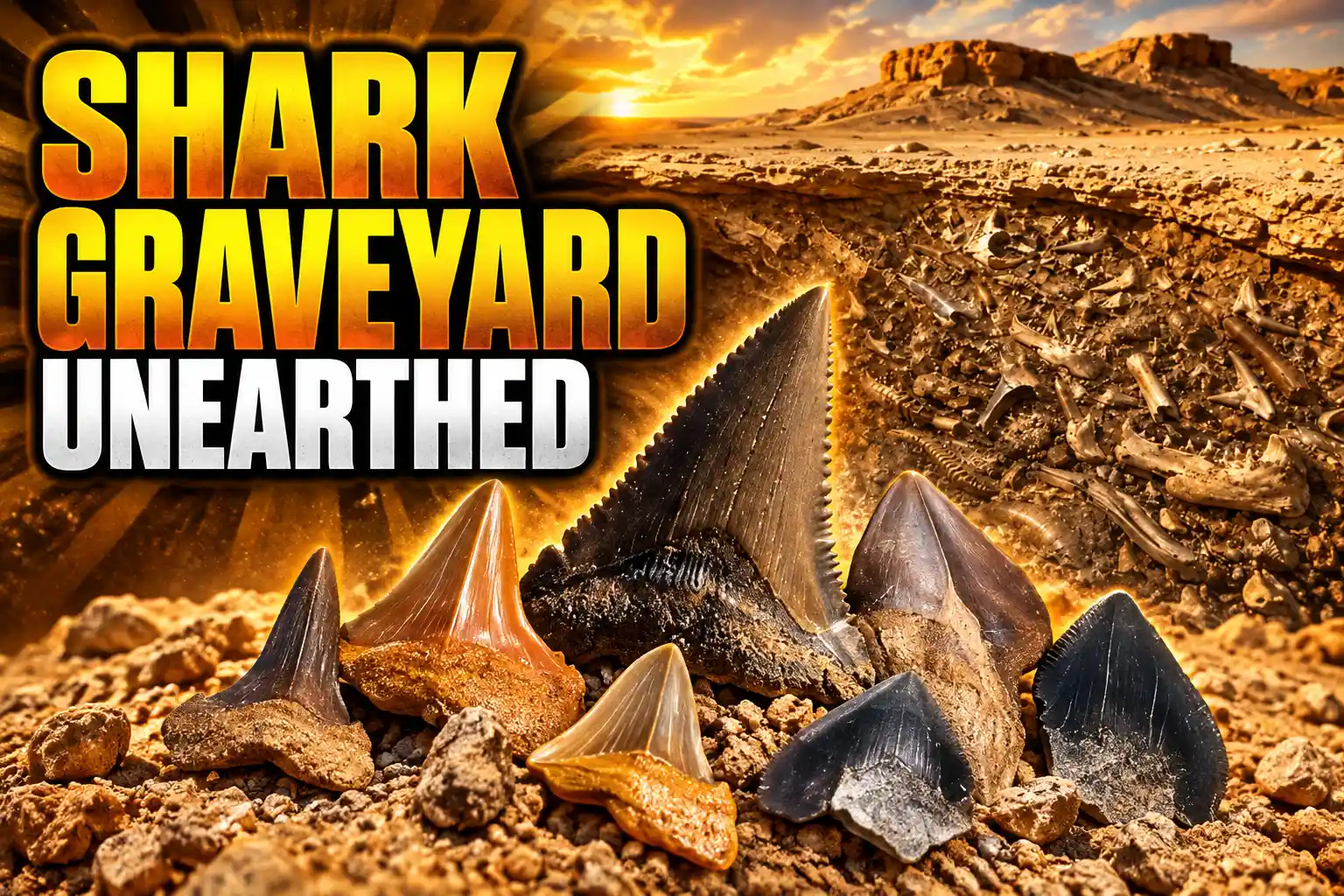
Fourteen isolated shark teeth from a phosphate mine on Egypt’s Abu-Tartur Plateau add five Late Cretaceous lamniform species to a working ore bed. Tarek Yassin of Cairo University and colleagues published the find as a short communication in Cretaceous Research, online 18 August 2026, from black and yellow layers of the Duwi Formation in the Maghrabi-Liffiya sector.
The paper’s own title calls the site a shark graveyard. Its sedimentology describes a condensed phosphate interval that mixed animals from several niches over time, which is also the ore Misr Phosphate Company still cuts between the Dakhla and Kharga oases.
Fourteen Teeth Came Out of a Mine Cut
Yassin and Alhussein Ibrahim surface-collected the teeth from both colour bands of the phosphate bed, a split the team ties to oxidation of the ore rather than to two seas. The fossils now sit in the Vertebrate Palaeontology Laboratory at Cairo University’s Geology Department, catalogued from CUAT50 upward, and were identified against published descriptions and specimens held in Swiss collections.
Co-authors are Jorge D. Carrillo-Briceño, René Kindlimann, Ibrahim and Mohamed K. AbdelGawad. In the acknowledgments they thank Cairo University for logistics and Misr Phosphate Company for access at the Abu Tartur phosphate mine in New Valley Governorate, which is the practical reason a short faunal note exists at all.
The Duwi Formation marks the start of fully marine conditions in this part of Egypt during the Late Cretaceous transgression. It rests on the Quseir Formation (lower to middle Campanian) and is capped by the Dakhla Formation (Maastrichtian to Palaeocene). Micropaleontology on the black shale that overlies the phosphorite assigns that cover to the late Campanian, the younger end of a stage the International Commission on Stratigraphy’s chart places from Campanian stage spans 83.6 to 72.2 million years ago.
Round public figures of 70 million or 100 million years smear that stage into a dinosaur-age postcard. The bed the teeth came from is the late Campanian phosphate, not the whole Cretaceous.
Cretalamna, Crow Sharks and a Goblin Relative
The new names are Cretalamna cf. C. maroccana, Scapanorhynchus cf. S. raphiodon, Serratolamna cf. S. serrata, Squalicorax bassanii and Squalicorax pristodontus. All five are new to Abu-Tartur. The paper’s final remarks treat the first three as first records for Egypt; the Scapanorhynchus assignment may be a first for Egypt as well as for Africa, and could be the youngest report of that taxon, if later work keeps the name.
Three of those five names carry “cf.”, open nomenclature that flags a close comparison rather than a locked species. Squalicorax pristodontus was already on the Egyptian list from Gebel Duwi in the Eastern Desert, so its Abu-Tartur appearance widens a known range instead of opening a new country record.
THE FIVE NAMES ON THE ORE
| Species | Status in this paper | Tooth character |
|---|---|---|
| Cretalamna cf. C. maroccana | First for Abu-Tartur and for Egypt | Four teeth, 13.8 mm to 19 mm high, narrow pointed triangular cusps |
| Scapanorhynchus cf. S. raphiodon | Possible first for Egypt and Africa; possible youngest record | Tall, slender, needle-like central cusps |
| Serratolamna cf. S. serrata | First for Abu-Tartur and for Egypt | Broader form suited to slicing |
| Squalicorax bassanii | First for Abu-Tartur and for Egypt | Broader triangular crowns with serrated edges |
| Squalicorax pristodontus | New to Abu-Tartur; already known from Gebel Duwi | Broad serrated cutting crowns |
Scapanorhynchus belongs with the living goblin shark, a lineage built around a long snout and awl-like teeth. Older records of S. raphiodon sit in Albian through early Campanian rocks in Europe, Asia, the Middle East and North America. The Abu-Tartur teeth, if the comparison holds, would push the last appearance into later Campanian water. The authors say more specimens and taxonomic revisions are needed before that claim hardens.
The Phosphate Bed Mixed Different Niches
Needle crowns, serrated triangles and at least one strongly curved tooth are the sort of kit that headlines read as a crowded hunting ground. The deposit itself argues for a slower bookkeeping. Phosphorite on this shelf formed where little mud arrived and a lot of organic debris did, so remains from more than one setting settled into the same thin ore.
The phosphatic nature of the deposit demonstrates that this interval represents a condensed section, formed during phases of low sedimentation but high biogenic input, resulting in time-averaged fossil accumulations that integrate taxa from multiple ecological niches.
Tarek Yassin and colleagues, Cretaceous Research
Yassin’s team reads Squalicorax as a hint of nearshore and inner-shelf water, Scapanorhynchus as outer-shelf and slope conditions, and Cretalamna and Serratolamna as open-shelf animals. Those habitats can sit a few kilometres apart, or they can stack in the same bed because the sea repeatedly reworked its own floor.
A 2015 sedimentology study of the same plateau already argued for reworking and redeposition in the Duwi beds, mixing classic upwelling phosphogenesis with high-energy events that lifted grains and dumped them again. The teeth inherit that history. They are a ledger of a productive shelf, not a single die-off on one afternoon.
The authors still describe “a nutrient-enriched, high-productivity marine ecosystem along a phosphogenic shelf margin,” most likely during a transgressive systems tract. That is the Duwi phosphogenic shelf already reconstructed from these rocks. The new paper’s job is narrower: it puts names on 14 teeth and then warns that the names do not all share one moment.
What the First Abu-Tartur Paper Already Found
This is the second lamniform note from the same cut. In Historical Biology, published online 29 November 2024, Yassin’s group described the first Lamniformes from Abu Tartur: 49 isolated teeth assigned to Scapanorhynchus rapax and Cretoxyrhina mantelli, again from yellow and black phosphate in Maghrabi-Liffiya, mostly by surface sampling.
That earlier paper already treated the Duwi as the onset of fully marine conditions and argued that the Cretoxyrhina material was the youngest record of that species in Africa and the Middle East, and perhaps the youngest worldwide. The new collection does not replace those two sharks. It adds five more, bringing the published lamniform list from the plateau to at least seven species.
The arithmetic is lopsided on purpose. Forty-nine teeth yielded two names; fourteen teeth yielded five. The second pass was a search for morphological outliers once the common forms were already on the table, and it is why a modest bag can move a country list farther than a larger one that repeats the same two animals.
Western Desert Cretaceous rocks were never empty of vertebrates. Hybodont sharks from Bahariya, elasmobranch teeth from the Dakhla Formation near Farafra, and several Squalicorax species from Gebel Duwi already sketched a Tethyan margin. Abu-Tartur’s contribution is a phosphate mine that concentrates the record in a few benches instead of scattering it through thick shale.
The Same Plateau Is Being Turned Into Acid
On 19 August 2026, the day after the shark paper went online, Egyptian officials laid the foundation stone for a phosphoric acid complex on the Abu Tartour Plateau. Petroleum minister Karim Badawi presented the project at a ceremony with New Valley Governor Hanan Magdy. First-phase capacity is 250,000 tons a year of high-concentration commercial phosphoric acid, a feedstock for fertilizer, with a reported investment of $658 million.
THE WEEK THE MINE SHOWED BOTH FACES
- 29 November 2024: Historical Biology posts the first Abu-Tartur lamniform paper, 49 teeth and two species.
- 18 August 2026: Cretaceous Research posts the second paper, 14 teeth and five species, as article 106476 in volume 189.
- 19 August 2026: Officials lay the foundation stone for the Abu Tartour phosphoric acid plant on the same plateau.
Misr Phosphate, also styled Phosphate Misr, is the operator the paleontologists thank. Chairman Nasser Shaheen has put company-wide ore capacity at 7 million tons a year across Abu Tartour, El-Sebaiya and the Red Sea. The company’s own site lists the Abu Tartour mines separately at 5 million tons a year, geological reserves of 1 billion tons, ore up to 31 percent P2O5, and a 220 square kilometre concession.
WHAT THE ORE COMPANY PUTS ON THE SAME GROUND
- Access: Misr Phosphate hosted the Cairo University team inside the Abu Tartur phosphate mine.
- Grade: The company lists Abu Tartour ore at up to 31 percent P2O5.
- Site output: Five million tons a year at Abu Tartour, against 7 million tons a year for the whole company.
- Downstream: A planned 250,000-ton phosphoric acid line on the plateau, with Misr Phosphate holding a 25 percent stake.
A 2026 geophysical survey of the Abu Tartur mine treated the plateau as a planning problem for extraction, mapping subsurface structure so the benches can be cut more cleanly. The shark teeth are a scientific by-product of that industrial surface. Colour on the fossils tracks the ore: black, gray and yellow as weathering solutions move through the phosphate, the same chemistry that decides what a crusher sees.
Late Campanian Sharks Already Lined the Tethyan Belt
None of this requires a new ocean. Northern Africa sat on the southern margin of the Tethys in the Campanian, and phosphate belts from Morocco through Egypt into Jordan and Syria have produced shark teeth for decades. Yassin’s comparison tables sit Abu-Tartur beside those faunas. Several of the same genera already turn up in Morocco, Syria, Palestine and Jordan, which is what a connected shelf should look like.
The surprise the paper actually claims is local and cautious: three Egypt firsts, a possible African first for a goblin-shark relative, and a possible last appearance moved younger, all from a mine that was already famous for phosphate. That is an enrichment of a map, not a rewrite of paleogeography.
HOW THE TEETH DIVIDE THE WATER
- Nearshore cutters: Squalicorax teeth, the crow-shark set, point toward inner-shelf water and a slicing bite.
- Deeper needles: Scapanorhynchus teeth match outer-shelf and slope hunting, the goblin-shark body plan.
- Open-shelf generalists: Cretalamna and Serratolamna fit a stable open shelf with mixed prey.
The seven-species list is therefore a stacked sample of that margin. Cretoxyrhina from the 2025 paper still sits near the top of the local food web; the new teeth fill the ranks below it. Marine reptiles, turtles and bony fish from the same Western Desert succession fill the rest of the roster, which the shark papers cite rather than redescribe.
Until more teeth pin down the “cf.” names, Abu-Tartur’s fame belongs as much to the phosphate benches as to the sharks. The 14 specimens are in a Cairo laboratory. The mine is still an ore body, and the acid plant’s first phase is designed around 250,000 tons a year from the same plateau that held the needle crowns and the serrated blades.

Cook Hands Democrats the House as Crypto’s Bill Stays Dead

Wicker’s Broken Bed Was the Short Story’s Punch Line

Nvidia’s $500 Billion Financing Plan Draws a $180 Sell

Maserati Bets the Grecale V6 Can Fill Porsche’s Gap

EV Cable Theft Follows the Old Railway Copper Playbook

Aramco Crash Kills 14 Two Days After Oil Restart

Salah Captained Egypt to Their First World Cup Win

Zelda’s 40th Switch 2 Ships Without a Zelda Game

Apple Labor Day Deals Hide June’s Memory Price Hike

Palworld 1.0.4 Adds Palpedia Search After the 1.0 Launch
-
 BUSINESS4 months ago
Aramco Crash Kills 14 Two Days After Oil Restart
-
 NEWS5 months ago
Salah Captained Egypt to Their First World Cup Win
-
 GAMING2 months ago
Zelda’s 40th Switch 2 Ships Without a Zelda Game
-
 NEWS2 months ago
Apple Labor Day Deals Hide June’s Memory Price Hike
-
 GAMING2 months ago
Palworld 1.0.4 Adds Palpedia Search After the 1.0 Launch
-

 NEWS4 months ago
El Niño Puts Israel’s Needed Winter Rain on a Flood Clock
-

 BUSINESS8 months ago
BAE’s 60-Year Saudi Franchise Now Runs Through Taif
-

 ENTERTAINMENT2 months ago
King Charles Letter Keeps Harry and Meghan as Private Citizens