
BUSINESS
Arafat’s New Water Mains Finish After the Next Hajj
NWC’s 13.01 km Arafat water mains sit on a 22-month clock that lands after Hajj 1448, while peak-day pumping already exceeds 1 million cubic meters.

Saudi Arabia’s National Water Company put Phase 1 of the Arafat Main Distribution Water Pipelines and Operational Storage Project out to bid on 20 July 2025. The job covers 13.01 km of mains, 800 mm to 3,000 mm across, for Arafat areas 1, 6 and 7 in Makkah. Bids closed on 18 September 2025.
NWC timed the work for Hajj demand, yet it set a 22-month clock from site handover. Hajj 1448’s Day of Arafah is expected on Saturday, 15 May 2027, before that window can close if handover followed the bid round.
Arafat Areas 1, 6 and 7 Get 13.01 km of Mains
The package is an engineering, procurement and construction tender, listed as competition 2184524 and project P1558-2. NWC’s Western Cluster desk in Jeddah took the bids through its supplier portal, with a 3:00 p.m. cutoff on 18 September 2025.
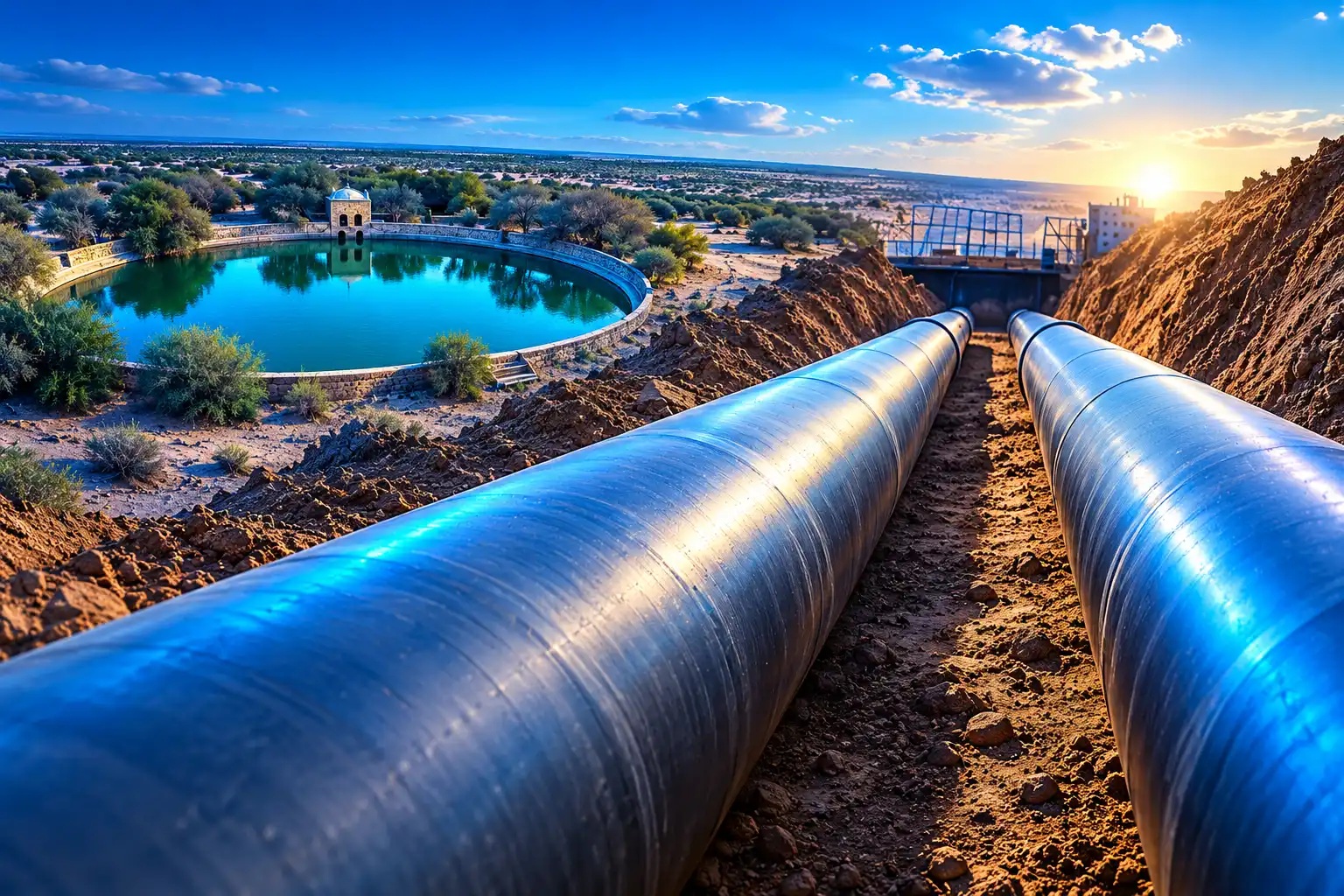
The company’s own listing says the work will lay 13.01 km of main distribution lines in carbon steel and ductile iron, plus 210 m of horizontal drilling. Pipe sizes run from 800 mm to 3,000 mm. The stated aim is a more reliable feed to Arafat areas 1, 6 and 7, “especially during the Hajj season.”
PHASE 1 AT A GLANCE
| Item | Figure |
|---|---|
| Length | 13.01 km |
| Pipe diameters | 800 mm to 3,000 mm |
| Materials | Carbon steel and ductile iron |
| Horizontal drilling | 210 m |
| Service area | Arafat 1, 6 and 7 |
| Contract form | EPC, 22 months from site handover |
That 3,000 mm bore is a trunk, not a neighborhood service line. It sits in the same size class as the separate South Arafat feed NWC tendered earlier in 2025, a 2,500 mm carbon-steel main designed for 800,000 cubic meters a day.
NWC Set the Job at 22 Months From Site Handover
People tracking the tender in August 2025 expected an award in December 2025. NWC’s listing does not name a winner, a price, or a handover date. It only binds the contractor to 22 months once the site is handed over.
Twenty-two months from a handover in late 2025 or early 2026 runs into late 2027. That is the calendar that matters more than the bid headline, because Hajj does not wait on a contractor’s start letter.
WHAT WE KNOW
- The bid window: NWC published the tender on 20 July 2025 and closed offers on 18 September 2025 at 3:00 p.m.
- The written duration: Execution is 22 months from the date the site is received, not from the bid date.
- The scope on paper: 13.01 km of mains, 800 mm to 3,000 mm, carbon steel and ductile iron, 210 m of horizontal drilling, areas 1, 6 and 7.
WHAT IS UNCONFIRMED
- The winner: NWC has not posted a named contractor or contract value on this package in its English newsroom.
- The handover date: The 22-month clock does not start until the site is received, and that date is not public.
- Build status: No official progress share has been issued for these Arafat mains.
That silence is ordinary for a Western Cluster EPC file. It still leaves the Hajj calendar as the only public test of whether the new mains can serve the next peak in Arafat.
How Much Water Arafat Uses on Its Peak Day
Arafat is a short, violent spike in demand. Pilgrims spend the Day of Arafah on the plain, then move. Water, cooling, toilets, fire mains and tent networks all hit at once, in heat that has killed people on this ground in recent seasons.
For Hajj 2025, NWC said it would hold some 3.5 million cubic meters in operational and strategic storage and pump more than 760,000 cubic meters a day on a normal Hajj day. On the Day of Arafah and Eid Al-Adha, it said pumping would exceed 1 million cubic meters, with more than 2,000 staff on the plan.
From an early stage, we developed strategies and plans, drawing on lessons from previous seasons to improve the quality of services provided to the guests of Allah. We have ensured the availability of the necessary water quantities to be supplied and distributed to Makkah and the Holy Sites, with a combined operational and strategic storage capacity of some 3.5 million cubic meters, and an average daily pumping volume exceeding 760,000 cubic meters. On the Day of Arafah and Eid Al-Adha, however, water pumping will exceed 1 million cubic meters, executed by a qualified workforce of more than 2,000 employees.
National Water Company, Hajj 2025 operational plan
The 1447 season in May 2026 used the same storage figure, 3.5 million cubic meters, and the same peak of about 1 million cubic meters on Arafat and Eid. NWC said more than 2,400 people ran the plan that year, on water networks spanning 5,700 kilometers, with more than 4,000 daily lab tests.
Those peak-day volumes already move through the existing Arafat grid. The new 13.01 km package is a thicker set of mains for three districts, not the first pipe that makes Hajj possible.
Hajj 1447 Closed With 12 Finished Holy-Site Projects
Before Hajj 1447, NWC said it had finished 12 capital and operational projects in Makkah and the holy sites at a cost above SAR 821 million ($219 million), with more than 24,000 meters of lines and networks. That package is the work that actually sat in the ground for the 1447 peak. The Arafat Phase 1 mains were not on that list.
WHAT THOSE 12 JOBS COVERED
- Mina sewage: New sanitary lines to raise the capacity of the existing networks in Mina.
- Holy-site distribution: Water projects to strengthen pumping and supply in the holy sites and some Makkah districts.
- Pressure control: Gear to keep operating pressures stable when demand jumps.
- Meters and monitors: More devices to measure pressure and flow in the networks.
- Remote valves: New and upgraded cocks tied into systems that can be watched and run from a control room.
A year earlier, the Western Cluster had completed 18 capital and operational jobs for Hajj 2025 at about SAR 400 million, including a 190,000 cubic meter steel tank and work on storage, pumps, valve rooms, fire and cooling networks. That is the pattern: NWC adds a holy-site package every season, then runs Hajj on what is already commissioned.
After Hajj 1447, NWC said it had distributed more than 45 million cubic meters in Makkah and the holy sites from 1 Dhul Qi’dah through the end of the season, treated more than 31 million cubic meters, and run more than 100,000 lab tests. It also said it had already started work for Hajj 1448.
The Wider Water Chain Was Built Upstream
The reason a 13.01 km district main can trail the next Hajj is that production, transmission and storage were scaled first. On 17 May 2026, the Saudi Water Authority said the 1447 plan was ready across that whole chain, in one of the densest water-use settings on earth for a short number of days.
SWA said it had raised production above 3.8 million cubic meters a day, 18 percent higher than Hajj 1446, and lifted transmission above 2.3 million cubic meters a day, a 32 percent rise. Storage went above 8.8 million cubic meters, more than 49 percent higher than the previous season. Distribution capacity rose 10 percent, to more than 1.3 million cubic meters a day.
SWA HAJJ 1447 CAPACITY LIFTS
- Production: More than 3.8 million cubic meters a day, up 18 percent from Hajj 1446.
- Transmission: More than 2.3 million cubic meters a day, up 32 percent.
- Storage: More than 8.8 million cubic meters, up more than 49 percent.
- Distribution capacity: More than 1.3 million cubic meters a day, up 10 percent.
Those storage and distribution figures are system-wide. They are not the same as NWC’s 3.5 million cubic meters of operational and strategic storage, or its plan to pump about 1 million cubic meters on Arafat and Eid. One is the national water system’s headroom. The other is the company that actually pushes water through Makkah’s pipes.
SWA also said it had adopted a single operating code for water services in the holy sites, run field tests with more than 18 agencies, and planned supply chains for more than 4,100 facilities. Abdullah bin Ibrahim Al-Abdulkarim, SWA’s president, later said that from 1 Dhul Hijjah through the 10th, more than 8 billion liters moved through Makkah and the holy sites. That 10-day total is 8 million cubic meters, a slice of NWC’s longer season figure of more than 45 million cubic meters.
A 2,500 mm Line Already Points at South Arafat
Phase 1 is not the only Arafat water file NWC opened in 2025. A separate tender, RFQ2114443, covers a 5.4 km, 2,500 mm carbon-steel link from the desalination mains at Al-Mughammas to the South Arafat tank. NWC listed a design capacity of 800,000 cubic meters a day on that line, and a 22-month duration, with bids due on 9 April 2025.
Eight hundred thousand cubic meters a day is most of NWC’s 1 million cubic meter Arafat-and-Eid peak. That feed is a transmission-to-tank job. Phase 1 is the district mains that take water onward into areas 1, 6 and 7. One without the other leaves a tank that cannot empty fast enough, or streets that cannot take a full tank.
Public talk around Arafat water still orbits the peak day, the heat, and the million-cubic-meter pumping plan. The 13.01 km trunk barely shows up in that talk, because pilgrims feel a tap, a mist line, or a dry ablution block, not a 3,000 mm weld in district 6. The quiet file is the one that decides whether those districts have spare capacity after 2027.
District Supply Still Waits on the 2027 Window
Hajj 1448 is expected to peak on Saturday, 15 May 2027, on the Umm al-Qura calendar, subject to the Dhul Hijjah moon. That date sits 46 days before the third quarter of 2027 even begins. If NWC’s 22-month clock starts after a late-2025 or early-2026 handover, the new mains are a Hajj 1449 asset, when the Day of Arafah is expected around 4 May 2028.
THE ARAFAT WATER CLOCK
- 20 July 2025: NWC publishes tender 2184524 for Phase 1 of the Arafat mains and operational storage.
- 18 September 2025: Bids close at 3:00 p.m. through the Western Cluster supplier page in Jeddah.
- May 2026: Hajj 1447 runs on the existing network, with NWC pumping about 1 million cubic meters on Arafat and Eid.
- 15 May 2027: Expected Day of Arafah for Hajj 1448, before a 22-month build from a 2026 handover can finish.
- 4 May 2028: Expected Day of Arafah for Hajj 1449, the first Hajj after a late-2027 finish.
None of that makes the tender a wasted job. Arafat districts need year-round supply for residents, workers and Umrah traffic, and NWC said as much when when bidding first opened on the Arafat mains. The Hajj language in the tender is still the load case that sizes a 3,000 mm pipe. The load case arrives every year. The pipe, on NWC’s own duration, arrives after the next one.
Until handover starts the 22-month clock, Arafat areas 1, 6 and 7 stay on the grid that already carried Hajj 1447. That grid held a 1 million cubic meter peak. The new mains are the next layer, not the layer that made the last peak possible.

Christa Pike Survived the Execution Tennessee Would Not Pause

Musk’s Oligarch Charge Hits a Queue of Three

Circle Puts USDC and EURC Into SAP Pay Workflows

Ring’s First Smart Lock Skips Home Wi-Fi for Sidewalk

GTA 6 Puts Cash Back on the Story Path

Salah Captained Egypt to Their First World Cup Win

Aramco Crash Kills 14 Two Days After Oil Restart

Apple Labor Day Deals Hide June’s Memory Price Hike

Zelda’s 40th Switch 2 Ships Without a Zelda Game

Palworld 1.0.4 Adds Palpedia Search After the 1.0 Launch
-
 NEWS5 months ago
Salah Captained Egypt to Their First World Cup Win
-
 BUSINESS4 months ago
Aramco Crash Kills 14 Two Days After Oil Restart
-
 NEWS2 months ago
Apple Labor Day Deals Hide June’s Memory Price Hike
-
 GAMING1 month ago
Zelda’s 40th Switch 2 Ships Without a Zelda Game
-
 GAMING1 month ago
Palworld 1.0.4 Adds Palpedia Search After the 1.0 Launch
-

 NEWS3 months ago
El Niño Puts Israel’s Needed Winter Rain on a Flood Clock
-

 ENTERTAINMENT1 month ago
King Charles Letter Keeps Harry and Meghan as Private Citizens
-

 ENTERTAINMENT4 months ago
A Thousand and One Drops Off Riyadh’s October Calendar