
NEWS
EV Cable Theft Follows the Old Railway Copper Playbook
Formula Space’s CableGuard V4 sleeve tries to slow angle-grinder gangs as copper theft jumps from railways and phone lines onto Europe’s public EV chargers.

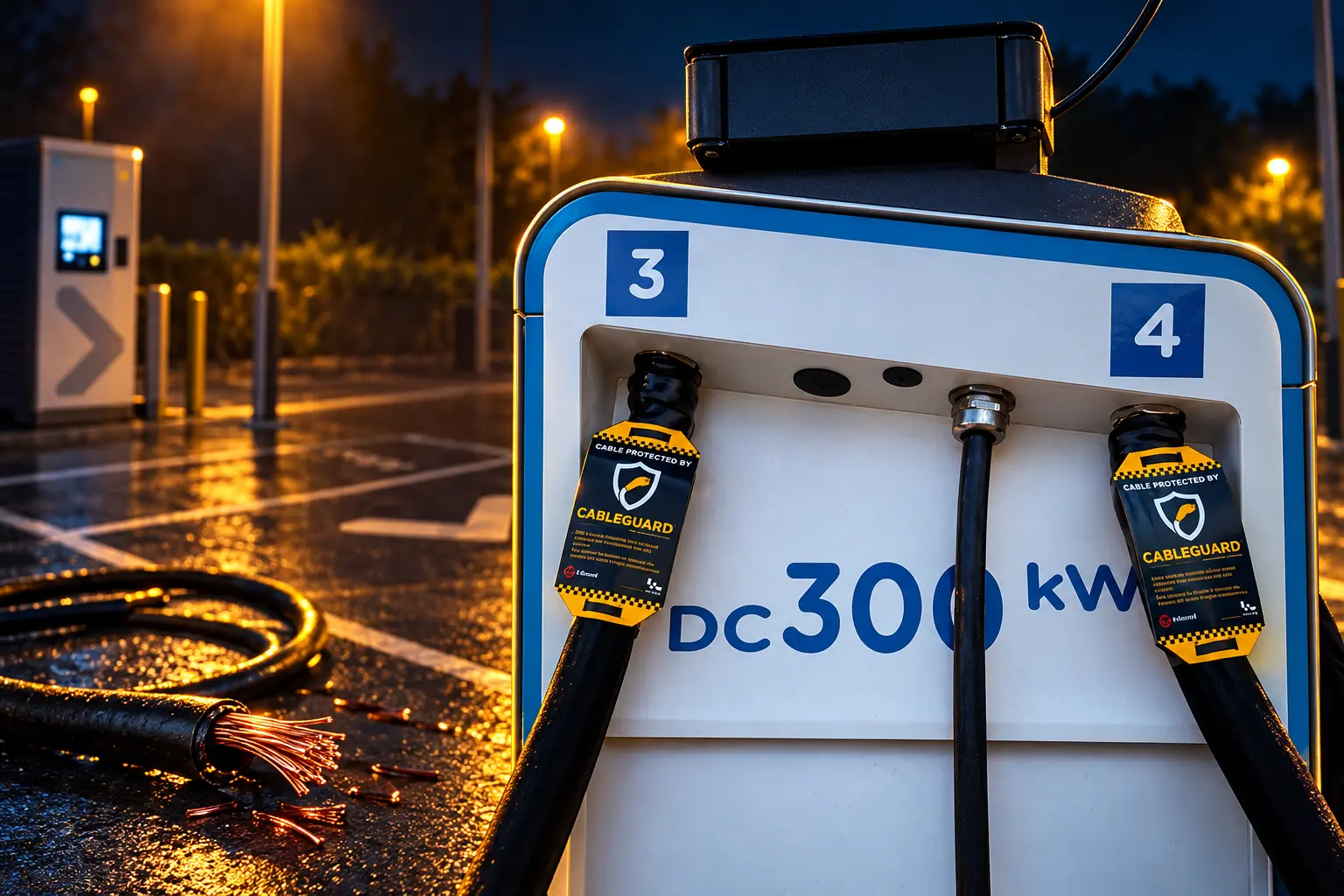
Formula Space has launched CableGuard V4, a 20-minute retrofit sleeve meant to blunt angle grinders used in organised EV cable theft across Europe. The kit fits cables already in the field and is supposed to leave them flexible enough for drivers to plug in.
The copper in a fast-charge lead is worth about €50 at a yard. Britain’s railway paid £6.8 million in delay compensation in 2025/26 for theft of the same metal.
Organised Gangs Now Treat Chargers Like Copper Stores
A couple once rolled up to a charging bay on a mobility scooter, in daylight, with a hacksaw, and cut the leads while a bus camera rolled. That version of the crime is dated. Vern Pollard, a cable-theft specialist and director at the Canterbury firm Formula Space, says crews now arrive in stolen cars, cover their faces, and work as a unit. High-powered cutters finish the job fast, and a single group can hit 5 or more sites in one night.
Police contacts have told the company that some of those crews already move stolen copper from phone networks. The charging bay is a new stop on an old round.
THE THEFT TALLY SO FAR
- United Kingdom: InstaVolt lost about 260 cables from 130 chargers in 2025.
- Germany: EnBW recorded more than 900 cable thefts at more than 130 fast-charge sites in 2025, with damage in the low single-digit millions of euros.
- France: At least 650 stations have been hit since the start of 2026, with losses put at more than €14 million.
- Spain: Police have held thieves after the removal of 34 kilometres of copper charging cable.
Energy Saving Trust, citing the National Intelligence Portal that works for police forces in England and Wales, found that theft and vandalism more than doubled in 2024 against 2023. Reports since then have not shown a retreat, and Zapmap counted 124,738 public EV chargers in the UK at the end of September 2026, up 9% on a year earlier, with 15,335 of them ultra-rapid units at 150kW or more.
Each extra hub in a dark corner of a retail park is another unattended coil of copper. Gary Higgins, director of security and risk at forensic firm DeterTech, has described the habit that follows: crews come back for the replacement lead after the first one is restored.
What a Stolen Cable Is Worth
London Metal Exchange cash copper was $14,415 a tonne on 23 October 2026. UK scrap boards on 22 October listed 80% cable at £6.75 a kilo and dry bright wire, the stripped grade, at £10.01 a kilo. That is the price list that makes a night in a car park pay.
EnBW, Germany’s largest fast-charge operator, says a high-power lead holds four to ten kilograms of copper. At the yard that metal is worth about €50. Putting the charger back into service, including parts, labour and the legal retest German columns need after damage, costs €5,000 to €8,000 per incident. In the UK, operators put hardware for one replacement cable at about £1,200, before lost sessions and call-outs.
SCRAP VALUE AGAINST THE REPAIR BILL
| Target | What the copper fetches | What the owner pays | Recent count |
|---|---|---|---|
| German fast-charge cable (EnBW) | About €50 at the scrap yard | €5,000 to €8,000 to restore, including retest | More than 900 thefts at more than 130 sites in 2025 |
| UK rapid cable hardware | Sold into the cable and bright-wire grades above | About £1,200 for parts alone | About 260 cables from 130 InstaVolt chargers in 2025 |
| UK railway signalling cable | Copper sold on to dealers | £6.8 million in delay payments in 2025/26 | 111 delay-causing thefts, 128,252 delay minutes |
The mismatch is the business model. A crew that empties several bays in a night still leaves with a car-boot of metal. The network is left with dead plugs, a parts wait, and drivers who will not trust the next stall.
The Same Crime Already Stopped Britain’s Trains
Railway copper theft is not a metaphor for the charging problem. It is the same trade, measured in delay minutes rather than empty bays. Network Rail recorded 111 delay-causing cable thefts in 2025/26. Those incidents produced 128,252 delay minutes, more than 2,100 hours, and £6.8 million in Schedule 8 payments to train operators. Delay hours rose 84% on the year. The delay bill more than doubled, up 103%.
Trespass crime including cable theft, vandalism and obstruction cost the industry more than £10 million in delay payments in the same year and took more than 3,300 hours out of the timetable. The railway fails safe when a signalling cable is cut, so trains stop. Charging sites fail quiet: the bay is simply dead when a driver arrives.
Behind every one of these delays caused by railway crime is someone not being able to get home to their family, another person late to a job interview, or food stuck on its way to a supermarket shelf. Cable theft, vandalism and obstruction aren’t victimless crimes, they’re crimes against the millions of people who rely on the rail network every day.
Anit Chandarana, Director for System Operator, Network Rail
Network Rail now hides tracking beads in cables in the North West, flies drones, and uses smart cameras. British Transport Police Superintendent Darren Malpas has called the offences a danger to anyone on the tracks as well as a bill for passengers. That has not priced the metal out of the crime.
COPPER THEFT FROM THE CASH BAN TO V4
- 2013: The UK Scrap Metal Dealers Act bans cash for scrap, forcing bank transfers and identity checks.
- 2013: Belgium bans cash for used copper cable, then spends a decade watching the trade adapt.
- 31 March 2024: Belgium extends the cash ban to all scrap metal under a law published on 9 February 2024.
- 2024: Theft and vandalism aimed at EV chargers in England and Wales more than doubles on 2023.
- 2025/26: Network Rail logs 111 delay-causing cable thefts and a £6.8 million delay bill.
- 1 October 2026: Formula Space launches CableGuard V4 for angle-grinder attacks on charging leads.
- 20 October 2026: A Bruges court convicts 10 men over 92 tonnes of stolen copper, sold into the Netherlands.
The charging industry is walking into a market the railway never left. Phone cabinets, vacant offices, and now public chargers sit on the same price of copper.
Quiet Corners Keep Getting Hit Overnight
Pollard says thieves care less about the brand on the pillar than about the car park around it. The bays that go first sit away from passing traffic and buildings, with weak lighting and no one watching the cameras. A stall tucked into the far corner of a supermarket or gym lot is easier work than a lit hub on a trunk road.
Replacement is not a fix if the site still looks like easy copper. At one UK site, thieves came back within 24 hours of each new cable, taking the replacements three times in a row. Some groups, Pollard says, watch a location to learn when the new leads go on. InstaVolt has answered that loop with CableGuard, site cameras, and GPS tags from Trackit247 that ping every 3 seconds once a cable leaves a geo-fence.
The same pattern shows up on the railway and in German supermarket and DIY-store fast bays: repair, reopen, get cut again. Cologne operator TankE saw about 60 cables taken from January to October 2025 after only five in the whole of 2024. The lesson operators keep paying for is that an unattended, poorly lit bay teaches the crew to return.
CableGuard V4 Turns a Quick Cut Into a Wait
Formula Space’s answer is a cut-resistant sleeve with forensic liquid, built so a thief has to stay longer in the open. CableGuard won Best New Product at the 2025 EVie Awards. The company says it is already on thousands of sites, including chargers run by TotalEnergies, Atlante, InstaVolt, Allego, E.ON, RAW Charging and Sainsbury’s Smart Charge. Nidec, Wallbox and Kempower have checked that the sleeve can sit on their hardware. Kempower cleared it on CCS2 cables up to 300A and 5 metres, and on CHAdeMO leads up to 5 metres, after an eight-week test.
V4 is the cut layer aimed at grinders and other power tools. Earlier jackets were built for hand tools. Crews brought machines. The new sleeve is meant to blunt those discs, stretching a job that used to take seconds into a noisy wait. Formula Space says a fit takes about 20 minutes and does not need the cable pulled off the charger. Optional extras include forensic spray that marks skin, clothes, tools and vans under UV light, plus tracking.
Any cable protection has to leave the cable flexible and easy for drivers to use, so with this constraint we believe no design can make theft impossible. CableGuard is designed to make an attack slow enough that the time on site and the risk of being caught outweigh what the copper is worth.
Vern Pollard, Director, Formula Space
That limit is already visible in the field. On some protected sites, thieves have learned to open the outer jacket, leave a chain looking intact, and pull the copper without a clean cut that trips the spray. By February 2026, CableGuard-fitted cables were being taken in Polish cities, and large shares of the public network in Łódź sat dead. V4 is the firm’s reply to that turn toward grinders and bypasses, not a claim that the metal has become unstealable. Pollard still says determined crews with time and the right kit have removed protected leads. At one monitored bay, a hand-tool attack ran so long that a 24-hour watch desk called the police, who found the cutter still in the offender’s hand.
On a busy hub the company has described in detail, six cables went in one night in early March and the remaining ten followed 14 days later. Night guards covered the site until CableGuard went on in July. Formula Space says that location has had no further thefts since.
Cash Bans Did Not Close the Yard Gate
Europe did try to choke the market. Britain banned cash for scrap in 2013. Belgium banned cash for copper cable the same year, then, from 31 March 2024, banned cash for all scrap metal. Dealers buying from private sellers in Belgium already had to identify them. Recyclers warned that Belgian metal would roll into the Netherlands, Germany and Luxembourg, where cash for old metal still exists, and that about half of Belgian consumers live within 50 kilometres of a border.
HOW STOLEN CABLE STILL REACHES A YARD
- Strip and chop: Insulation comes off, and the copper is cut into short lengths that no longer look like a charging lead.
- Melt to ingots: Pollard says some groups melt cable so site marks disappear.
- Mix the load: Processed metal is folded into larger lots of legitimate scrap and moved across a border.
- Soft dealers: A minority of yards, he says, still take material without proper checks.
- Volume over one cable: Five or more sites in a night makes a thin per-kilo price add up.
On 20 October 2026 a court in Bruges convicted 10 Romanian men over a copper run that included Infrabel railway cable. Investigators put the haul at 92 tonnes, worth about €750,000, sold to a Dutch scrap dealer. Two ringleaders received 5-year terms. Infrabel is claiming more than €1.6 million. The cash ban did not keep that metal inside Belgium, and it did not keep it on the railway.
Robin Edwards, a metal-crime specialist, said cable-related crime in August 2026 was 92% higher than in August 2025, in line with a 43% rise in the copper price over the same stretch. The 2013 Act is still the law. The price is still the lure.
Dead Bays Hurt Drivers Before They Hurt Thieves
Delvin Lane, chief executive of InstaVolt UK, has backed CableGuard as a network tool, not a novelty. InstaVolt helped develop earlier versions and has been rolling the sleeve out with cameras and the GPS tags. Lane has said the copper itself is not a serious payday, and that the people who feel the crime first are drivers, including emergency crews, who pull into a stall that no longer works.
Each cut is a bay off the map while parts, labour and tests catch up. France’s 650-plus hits and EnBW’s 900-plus thefts in 2025 are downtime tallies as much as scrap tallies. National media stories about dead cables, Formula Space notes on its own product page, have started to dent confidence in public charging just as the UK added 8,686 public chargers in the first nine months of 2026.
The operator that lost three sets of cables in 24 hours later fitted Formula Space’s highest CableGuard spec. Pollard says that bay has stayed intact for the three months since. The copper is still on the price board. The rest of the car park is still dark at 2am.

Cook Hands Democrats the House as Crypto’s Bill Stays Dead

Wicker’s Broken Bed Was the Short Story’s Punch Line

Nvidia’s $500 Billion Financing Plan Draws a $180 Sell

Maserati Bets the Grecale V6 Can Fill Porsche’s Gap

EV Cable Theft Follows the Old Railway Copper Playbook

Aramco Crash Kills 14 Two Days After Oil Restart

Salah Captained Egypt to Their First World Cup Win

Zelda’s 40th Switch 2 Ships Without a Zelda Game

Apple Labor Day Deals Hide June’s Memory Price Hike

Palworld 1.0.4 Adds Palpedia Search After the 1.0 Launch
-
 BUSINESS4 months ago
Aramco Crash Kills 14 Two Days After Oil Restart
-
 NEWS5 months ago
Salah Captained Egypt to Their First World Cup Win
-
 GAMING2 months ago
Zelda’s 40th Switch 2 Ships Without a Zelda Game
-
 NEWS2 months ago
Apple Labor Day Deals Hide June’s Memory Price Hike
-
 GAMING2 months ago
Palworld 1.0.4 Adds Palpedia Search After the 1.0 Launch
-

 NEWS4 months ago
El Niño Puts Israel’s Needed Winter Rain on a Flood Clock
-

 BUSINESS8 months ago
BAE’s 60-Year Saudi Franchise Now Runs Through Taif
-

 BUSINESS8 months ago
Egypt Bets EGP 638 Billion Can Open Sinai to Investors