
NEWS
El Sisi’s Washington Visit Never Reached the White House
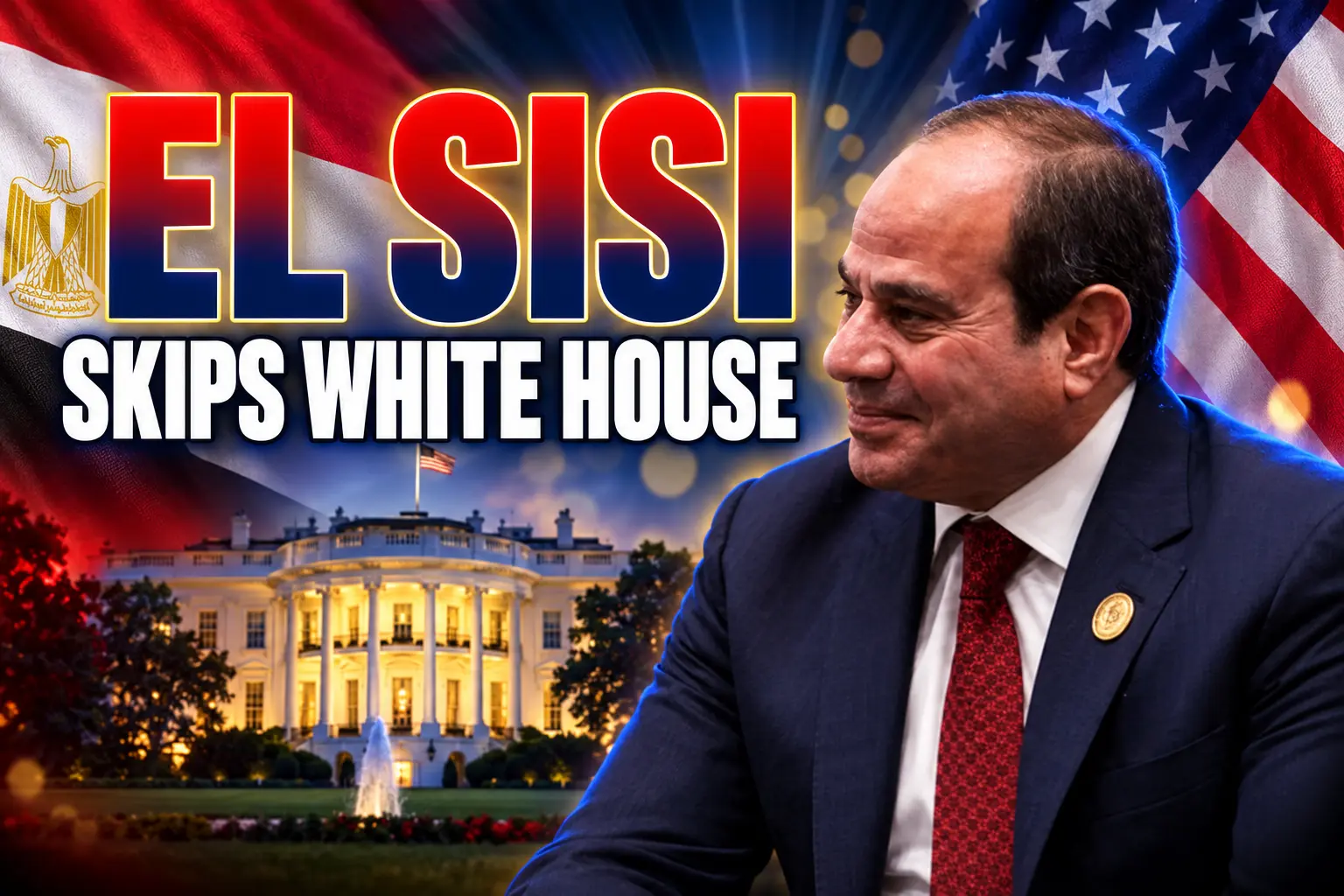
El Sisi never made the December White House trip. He got a Nile letter, Davos and G7 talks, and an Iran-tied $320 million waiver as Egypt and Ethiopia expelled.

Egyptian President Abdel Fattah El Sisi never made the December 2025 Washington trip that was supposed to lock in talks with Donald Trump on Gaza and the Nile. People preparing the file had cast it as the repair after Cairo killed an earlier visit over Trump’s plan to move Palestinians into Egypt. The two men met instead on the sidelines in Davos and at the G7 in France. On October 1, Egypt and Ethiopia expelled diplomats on a 48-hour clock, and Washington unblocked military aid on an Iran memo.
The December Trip Never Reached Pennsylvania Avenue
El Sisi had been due at the White House on February 18, 2025. That date died after he refused to take part in what he called the injustice of displacing Palestinians, and after Trump’s public talk of moving Gazans into Egypt and Jordan. Officials in Cairo described the freeze as the worst in three decades. The Gaza file then moved, and with it the calendar.
On October 13, 2025, Trump and El Sisi co-chaired the Sharm El-Sheikh peace summit, where they signed the ceasefire declaration with Turkey and Qatar while Israel and Hamas stayed off the stage. Trump had brokered a phone call that morning between El Sisi and Israeli Prime Minister Benjamin Netanyahu, the first since the Gaza war began. Netanyahu accepted an invitation, then pulled out, citing the holiday of Simchat Torah. Eight days later he sat in Jerusalem with Major General Hassan Rashad, Egypt’s intelligence chief, to talk Trump’s plan and the 1979 peace.
By December 12, Egyptian officials were again describing a December Washington trip, with a possible Netanyahu overlap. No date landed on the public White House schedule. On December 18, Trump called El Sisi a friend and said he was keen to host him at the White House in the near future, which was a polite way of saying the meeting had not happened. The next time the two presidents sat together was January 21, 2026, in Switzerland, not on Pennsylvania Avenue.
THE SISI-TRUMP MEETING TRAIL
| Date | Place | What happened |
|---|---|---|
| February 18, 2025 | Washington, planned | Postponed after the Gaza relocation fight |
| October 13, 2025 | Sharm El-Sheikh | Peace summit co-chaired; Netanyahu stays away |
| December 2025 | Washington, planned | Floated again; Trump still talking about a future hosting |
| January 21, 2026 | Davos | First bilateral after Phase Two; GERD and Board of Peace |
| June 17, 2026 | Evian, G7 | Another sideline; Nile letter restated |
They have kept finding rooms in Europe. They have not put El Sisi in the Oval Office on the public record of this term.
What Cairo Collected Instead of a White House Visit
The relationship did not stall. It just never cashed the photo that Cairo had wanted in Washington. El Sisi used Davos to praise Trump on Gaza, to take a seat on the Board of Peace, and to drag the Grand Ethiopian Renaissance Dam, the GERD, back onto a US microphone. Trump, for his part, called El Sisi a great general and a great president and said Egypt has been among the most useful partners on the ceasefire.
WHAT CAIRO TOOK HOME
- A Board of Peace seat: El Sisi accepted Trump’s invitation on January 21 and said Egypt was happy to back the board’s work on Gaza and beyond.
- A Nile letter: Dated January 16 on White House stationery, it offered to restart US talks on Nile water sharing and was copied to Saudi, Emirati, Ethiopian, and Sudanese leaders.
- An intelligence slot on Gaza: Hassan Rashad was named to the Gaza Executive Board that sits under the Board of Peace, beside Steve Witkoff, Jared Kushner, and Turkey’s Hakan Fidan.
- A larger military aid line: The 2026 appropriations act set total US aid to Egypt at $1.5 billion, with Foreign Military Financing at $1.375 billion, $75 million above the old baseline.
- A $320 million waiver: Secretary of State Marco Rubio lifted human-rights holds on FY2025 military financing, citing Egypt’s helpful role after Operation Epic Fury, the US campaign against Iran.
That is a real haul for a mediator. It is also a different haul from the one implied in December, when the live questions were a White House arrival, a Netanyahu handshake, and American muscle on the Nile. Netanyahu still has not had that public meeting with El Sisi. The dam still has no signed operating deal.
Trump’s Nile Letter Met a Finished Dam
Ethiopia inaugurated the GERD on September 9, 2025, after 14 years of building. Congressional researchers put the project at $4.2 billion on the Blue Nile. Egypt’s annual water share under the old allocation is 55.5 billion cubic metres. Water Minister Hani Sewilam has said the country needs about 123 billion cubic metres. Foreign Minister Badr Abdelatty, speaking after a meeting El Sisi chaired with military commanders on September 30, said Egypt needs to double its share, not only protect it. Those two figures are not the same claim: one is a need estimate, the other is a political demand to double the 55.5 billion cubic metre line.
EGYPT’S WATER MATH
- River dependence: More than 98 percent of Egypt’s renewable fresh water comes from the Nile, almost all of it originating beyond the border.
- Scarcity line: Per-capita supply sits at 472 cubic metres a year, under the 500-cubic-metre mark used as the absolute scarcity threshold.
- The dam: Cairo still wants a legally binding deal on filling and operation; Addis Ababa runs the plant as sovereign infrastructure.
- The US offer: Trump wrote that no state should unilaterally control Nile resources, and that talks could lock in predictable drought releases for Egypt and Sudan while Ethiopia sells “very substantial amounts of electricity.”
In the January 16 letter he went further, saying he was ready to restart US mediation “to responsibly resolve the question of ‘The Nile Water Sharing’ once and for all,” and that GERD tensions sat “at the very top of my agenda.” He also wrote that he hoped the dispute would not lead to a major military conflict. Five days later, in a remarks to reporters in Davos at 5:32 p.m. at the Congress Centre, he treated the dam as a live danger and offered to bring El Sisi together with Ethiopia’s president, Taye Atske Selassie.
They built a dam where somebody is not getting the water that they are supposed to get and that they’ve gotten for a million years. And all of a sudden, the water flow is blocked by a very massive dam. I wouldn’t be happy about it.
Donald Trump, US president, Davos Congress Centre, January 21, 2026
El Sisi thanked him on the spot for an “existential issue,” and reminded the room that Trump had almost had a deal in his first term. That earlier US track stalled in 2020 after Ethiopia rejected a draft associated with then-Treasury Secretary Steven Mnuchin and accused Washington of bias toward Egypt. The 2026 letter is the same bet in new stationery.
Trump also told reporters the dam “was financed by the United States.” That is his wording, not a financing record Egypt or Ethiopia has put on the table. He said he would try to get talks “back on track.” At the G7 in Evian on June 17, the White House posted the two men together again and restated the January Nile language, including the line about assuring water needs for Egypt, Sudan, and Ethiopia “long into the future.”
.@POTUS meets with Egyptian President Abdel Fattah El-Sisi at the G7 summit in France: "Our relationship has been very strong for a long time… we'll discuss many things, including trade. We do a lot of business with Egypt." pic.twitter.com/C8yRANzehB
— Rapid Response 47 (@RapidResponse47) June 17, 2026
Addis Ababa treats the GERD as a finished power plant and the old water split as the argument that remains. Cairo treats a signed operating deal as the minimum, and it has started saying out loud that it will not accept new dams. Those two positions have not moved since the letter. In September, a joint statement during Chinese President Xi Jinping’s state visit to Cairo recorded Beijing’s recognition of Egypt’s right to safeguard water and food security, a reminder that Cairo is not waiting on one mediator.
Sisi Is Still Asking for Phase Two
The Gaza file is the one Washington is willing to pay for in public. Phase one of Trump’s 20-point plan ran from October 2025 into January 2026, with Egyptian intelligence shuttling among Israel, Hamas, and the Palestinian Authority on the makeup of a new Gaza administration, the Rafah crossing, and Hamas disarmament. On January 15 the National Committee for the Administration of Gaza was formed, with Dr. Ali Shaath as chief commissioner. The White House the next day called that step the start of Phase Two of the Gaza plan, tied to UN Security Council Resolution 2803 of November 17, 2025, and named Major General Jasper Jeffers to command an International Stabilization Force.
El Sisi told Trump at Davos that without him there would have been no Gaza agreement, then switched into English to say “Argue. Argue,” before asking that the plan “should be implemented fully.” He is still asking. On September 20 he told CIA Director John Ratcliffe, with Rashad in the room, that the second phase had to be carried through, that civilians had to be protected, and that aid had to keep moving. Palestinian officials on the committee have been meeting in Cairo. One diplomat’s private warning, recorded by congressional researchers, was that they would not enter Gaza until they had the tools to govern it.
That is the limit of the Sharm win. Egypt trained up a political role, put its intelligence chief on the Gaza board, and kept Rafah in its hands. Reconstruction still sits on funding, access, and a security force that has not fully deployed. El Sisi can claim the ceasefire. He cannot yet claim the rebuild.
The $320 Million Came Through an Iran Memo
The cash that moved in early October was not a Nile dividend. A State Department letter to congressional committees dated September 21 said Rubio had waived the certification requirement on $320 million in FY2025 Foreign Military Financing. An accompanying memo, dated September 4 and signed by Rubio, said the waiver was essential “particularly in light of Egypt’s helpful role following Operation Epic Fury.” The department later said the decision was in the interest of US national security and that human-rights talks with Cairo would continue. The $320 million is a held slice of last year’s account, not a new Nile fund, and it sits beside the separate 2026 appropriation that set Egypt’s $1.375 billion military aid line.
TWO AMERICAN TRACKS IN THE HORN
| Track | Date | What Washington did |
|---|---|---|
| Egypt, military financing | September 4 to October 1, 2026 | Waived rights conditions on $320 million, citing Iran |
| Egypt, 2026 aid act | Fiscal 2026 | $1.5 billion total, $1.375 billion in grants, $75 million above the old baseline |
| Ethiopia, training | August 17, 2026 | A Rhode Island US defense team began work at Ethiopia’s peacekeeping center |
| Ethiopia, Pentagon talks | August 19 and 20, 2026 | Addis Ababa said both sides agreed to elevate defense ties to comprehensive strategic cooperation |
The Ethiopian delegation was led by Major General Teshome Gemechu. The US side was co-led by Brian J. Ellis, the deputy assistant secretary of defense for African affairs. Ethiopia’s foreign ministry said the new framework would cover national interests, trust, and Horn security, and that both sides wanted it implemented quickly. American personnel in Addis, and a Pentagon upgrade with the state that built the dam, is the part of the US relationship Cairo cannot clap for.
The split is blunt. Egypt is paid and praised as a Gaza and Iran partner. Ethiopia is trained and courted as a Horn security partner. The Nile, which El Sisi called existential in front of Trump, sits between those files as a letter and a talking point.
Forty-Eight Hours for Two Diplomats
On October 1, Ethiopia’s foreign ministry declared Ahmed Moharam Ahmed Soliman, a member of Egypt’s embassy staff in Addis Ababa, persona non grata and gave him 48 hours to leave, citing the Vienna Convention and offering no public charge. Cairo answered the same day. An official Egyptian source called the Ethiopian move unfortunate and unjustified, said Egypt does not interfere in other countries’ internal affairs, and said a counsellor at the Ethiopian embassy had been declared persona non grata on the same 48-hour clock. Foreign ministry spokesperson Nader Zaki said reciprocity is the currency of diplomacy.
The expulsions landed next to a wider Horn rupture. Ethiopia ordered its embassy in Eritrea closed and declared 10 Eritrean diplomats persona non grata; Asmara cut ties. Addis Ababa has accused Eritrea, Sudan, and Egypt of backing a Tigray opposition alliance. Cairo denies it. El Sisi, at the Strategic Command headquarters on September 29, said Egypt would keep choosing diplomacy on the dam, and that this would not come “at the expense of Egypt’s existence and its people.” Abdelatty told the same circle Egypt would not allow additional dams or a repeat of what happened with the GERD.
That is where the December Washington story actually ended. El Sisi never got the White House meeting that was supposed to turn Gaza mediation into US weight on the Nile. He got Davos, Evian, a letter, a board seat, and an Iran-tagged waiver. The dam is generating power. The diplomats had two days to pack. No new Washington date is on the public schedule.

Ninja Theory Staff Face Redundancy After Two Xbox Sales Collapse

Amazon Sells the MacBook Air at Its Pre-Hike Price

U.S. Slows Jet Parts to Squeeze China’s Flying Fleets

PEGI Pulled the GTA 6 Age Rating After Cocaine Details

Northwestern’s Smaller Ryan Field Gave Penn State Nowhere to Hide

Aramco Crash Kills 14 Two Days After Oil Restart

Salah Captained Egypt to Their First World Cup Win

Apple Labor Day Deals Hide June’s Memory Price Hike

Palworld 1.0.4 Adds Palpedia Search After the 1.0 Launch

Zelda’s 40th Switch 2 Ships Without a Zelda Game
-
 BUSINESS3 months ago
Aramco Crash Kills 14 Two Days After Oil Restart
-
 NEWS4 months ago
Salah Captained Egypt to Their First World Cup Win
-
 NEWS1 month ago
Apple Labor Day Deals Hide June’s Memory Price Hike
-
 GAMING4 weeks ago
Palworld 1.0.4 Adds Palpedia Search After the 1.0 Launch
-
 GAMING4 weeks ago
Zelda’s 40th Switch 2 Ships Without a Zelda Game
-

 NEWS3 months ago
El Niño Puts Israel’s Needed Winter Rain on a Flood Clock
-

 BUSINESS8 months ago
Egypt Bets EGP 638 Billion Can Open Sinai to Investors
-

 ENTERTAINMENT4 weeks ago
King Charles Letter Keeps Harry and Meghan as Private Citizens