
NEWS
Jordan’s Sanaa Flights Test Who Controls the Airport
Riyadh backed Jordan’s Amman-Sanaa flights after an Iranian jet tested Sanaa airport, but the Houthis who hold the terminal refused.

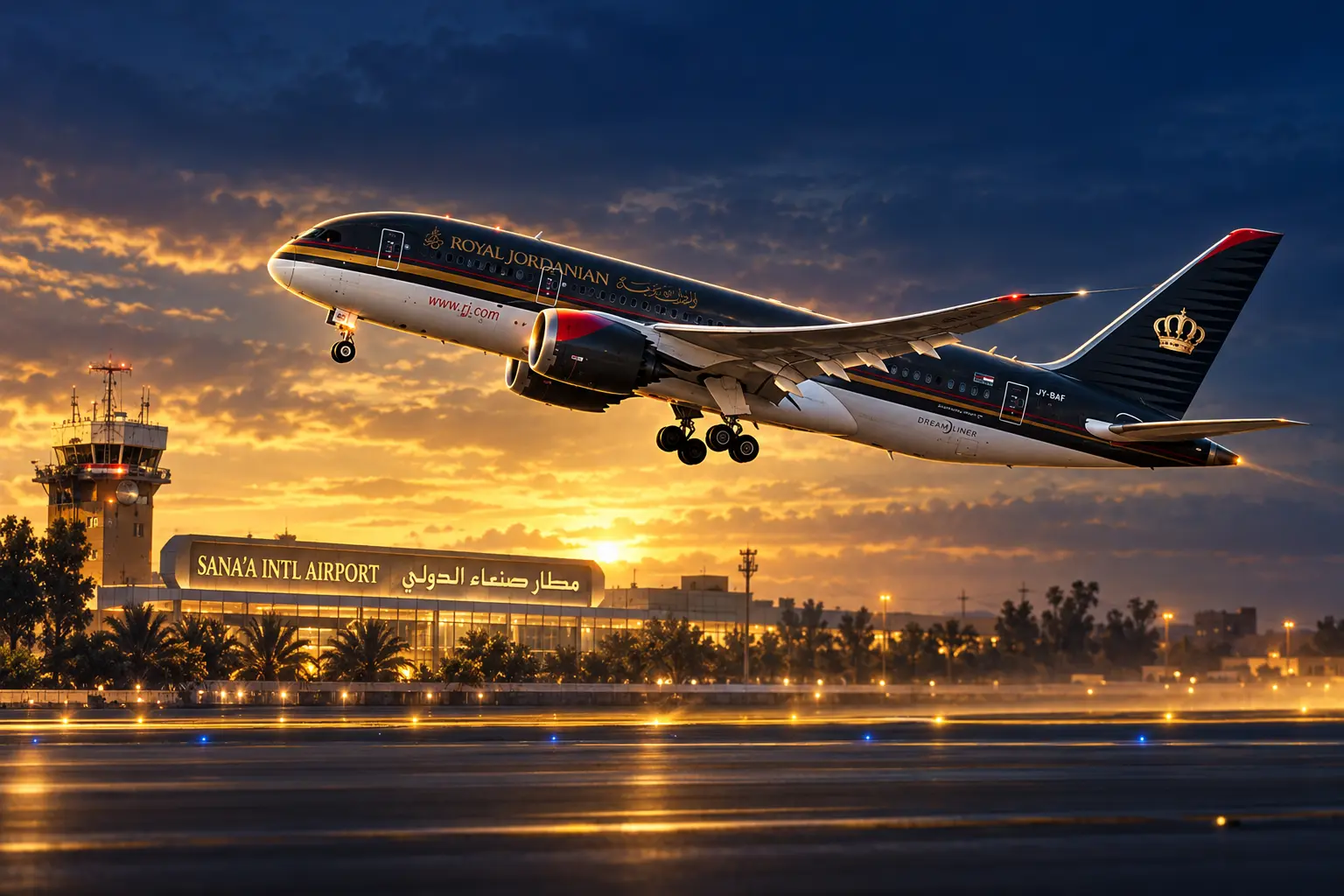
Saudi Arabia backed Jordan’s plan for Royal Jordanian commercial flights between Amman and Sanaa, four days after the same runway was bombed to stop an Iranian jet. Jordan’s foreign ministry named the airline on Friday, July 17, 2026, and gave no start date.
The language was humanitarian. The sequence was not. An Iranian airliner had already landed at Houthi-held Sanaa, Yemen’s government had cratered the strip to block its return, and the new Jordanian flag was being planted on a corridor Yemenia already flies.
Riyadh Welcomes a Route It Does Not Control
The Ministry of Foreign and Expatriates Affairs in Amman said Royal Jordanian would operate regular commercial flights between Amman and Sana’a in response to civilian need in Yemen, in support of Saudi peace work, and in line with older talks on Jordan-Yemen air service. Technical and ground arrangements, it said, were still being finished.
The statement named no first day, no weekly frequency, and no aircraft. Royal Jordanian itself did not add a timetable.
أعلنت وزارة الخارجية وشؤون المغتربين أنّه استجابةً للاحتياجات الإنسانية للأشقاء في الجمهورية اليمنية الشقيقة، ودعمًا لجهود المملكة العربية السعودية الشقيقة في دعم مسار السلام في اليمن، وتنفيذًا للتفاهمات السابقة حول تسيير رحلات تجارية بين الأردن واليمن، فإنّ الخطوط الملكية… pic.twitter.com/psjuXQvVNO
— وزارة الخارجية وشؤون المغتربين الأردنية (@ForeignMinistry) July 17, 2026
Saudi Arabia’s foreign ministry welcomed the Jordanian initiative the same night in Riyadh, dated July 18, 2026. The Kingdom said the route should ease civilian movement and help meet humanitarian need. It praised Yemen’s government for backing the step, then turned the rest of the text on the Houthis, who hold the capital and the terminal.
Saudi Arabia urged the Houthis to engage positively with the initiative and cease escalatory practices that exacerbate the country’s crisis.
Saudi Ministry of Foreign Affairs, statement, Riyadh
Yemen’s internationally recognized government, which sits in Aden, said it would help the plan succeed so long as state control of airspace and airports was not traded away. It cast the Jordanian offer as a match for earlier bids to run Sanaa International Airport through Yemenia, the national carrier, or other airlines it authorizes, to destinations both sides accept. It accused the Houthis of blocking those bids, holding Yemenia funds and assets, and using airports for political and military ends.
The Iranian Jet That Forced the Issue
The Jordanian notice arrived four days after Yemen’s Defense Ministry said its forces struck the Sanaa runway on July 13, 2026. The target was a Mahan Air flight from Tehran, due to bring home a Houthi delegation that had gone to the funeral of Iran’s late supreme leader, Ali Khamenei.
That return leg was not the first Iranian landing. On July 3, 2026, a Mahan Air aircraft reached Sanaa, the first publicly acknowledged Tehran-Sanaa passenger service in years. Houthi officials said the inbound flight carried more than 200 patients, wounded people, and stranded Yemenis, then left with a senior delegation. Yemen’s Presidential Leadership Council, chaired by Rashad al-Alimi, called the landing a “flagrant violation of Yemen’s sovereignty.”
Iran asked, through the Saudi-led coalition, to fly the group home on Mahan Air. Al-Alimi said the government refused and offered a Yemenia charter instead. The Houthis insisted on the Iranian aircraft. Defense Minister Taher al-Aqili said diplomatic channels failed, so the runway was hit. The Mahan Air jet diverted and landed at Hodeidah, also under Houthi control.
Houthi officials blamed Saudi warplanes, not Yemeni ones. Footage on Al-Masirah showed explosions on the airport compound. Military spokesman Yahya Saree said the strike had ended the lull in place since 2022 and “will not go unanswered.” Houthi forces then fired on Abha airport in southern Saudi Arabia.
THE JULY FIGHT OVER SANAA AIRPORT
- July 3, 2026: A Mahan Air flight lands at Sanaa, then carries a Houthi delegation to Tehran.
- July 13, 2026: Yemen’s Defense Ministry says it bombs the Sanaa runway to stop the return flight; the jet diverts to Hodeidah; Houthis hit Abha.
- July 15, 2026: Mohammed Quhim, transport minister in the Houthi administration, says the field is repaired and navigation is back.
- July 17, 2026: Jordan names Royal Jordanian for scheduled Amman-Sanaa service, with no date.
- July 18, 2026: Saudi Arabia welcomes the plan and tells the Houthis to cooperate.
Sanaa authorities said engineering teams from the roads corporation and the civil aviation body in the capital had restored the runways to technical standard. That claim, if true, still leaves the political lock. A foreign jet can only park if the people who run the terminal allow it.
Houthis Want Every Destination Open
Abdulwahid Abu Ras, deputy foreign minister in the unrecognized Houthi administration, treated the airline notices as noise. He said announcements about resuming flights to Sanaa were the companies’ own business and “merely trivial grandstanding at a sensitive time.” The movement, he added, would “secure all of its rights, not just air services, without begging anyone.”
Flights to Sanaa would be welcomed only if they were operated under an agreement with the Houthi authorities in Sanaa and without restrictions or prior conditions.
Houthi negotiating source, to Al-Masirah
That source demanded the airport open to all international destinations, not an Amman-only slot, and tied aviation to public-sector salaries in Houthi-held areas. The Royal Jordanian plan, the source said, was a temporary patch that Riyadh could kill “through a phone call from the Saudi regime.”
The argument on the ground is blunt. Extra seats from Queen Alia do not give the Houthis what they took from the July 3 landing: a visible air bridge to Tehran. A limited Jordanian schedule, blessed in Riyadh and Aden, would lock the field back onto a route the coalition can pause. That is why a foreign flag on a familiar city pair reads in Sanaa as a political instrument, and why the Saudi welcome itself landed as a claim of say over an airport the Kingdom does not hold.
Abdelmalik al-Mekhlafi, a former Yemeni deputy prime minister, wrote that if the Houthis wrecked the Jordanian flights and chased Tehran service instead, they would have put military and political aims ahead of Yemeni travelers, and would own the consequences.
The Only Civilian Corridor Left
Sanaa has not been empty of passenger aircraft through the war. Yemenia restarted Sanaa-Amman flights in May 2022, under arrangements tied to the United Nations truce, after civilian traffic stopped in 2015. The Amman run became the main way out for patients, students, and other travelers from Houthi-held areas.
That corridor has been fragile. Israeli strikes on May 6, 2025, wrecked terminal buildings and aircraft on the ground after Houthi attacks toward Israel. Yemenia got a flight from Amman back onto the field on May 17, 2025, 11 days later. Houthi officials had also, in an earlier dispute, held Yemenia’s active fleet, which stopped the Amman service for weeks.
Royal Jordanian would be a foreign carrier on a city pair the national airline already claims. That is the political load. Aden wants Sanaa flown under state authority. The Houthis want the same concrete without a Saudi or Aden veto, including Iranian airlines. Jordan is offering a third flag that both Arab capitals can live with, and that Sanaa has already refused in its limited form.
WHO WOULD FLY THE SANAA RUNWAY
| Carrier | Route | Status | The catch in practice |
|---|---|---|---|
| Yemenia | Sanaa-Amman | Restarted May 2022 | Main wartime exit for patients and students |
| Yemenia | Sanaa-Cairo, Mumbai | Announced 2024 | Plans were uneven after the aircraft seizures and later strikes |
| Mahan Air | Tehran-Sanaa | Landed July 3, 2026 | Return flight blocked July 13; diverted to Hodeidah |
| Royal Jordanian | Amman-Sanaa | Announced July 17, 2026 | No start date; Houthis rejected a limited opening |
Yemenia is the airline Aden keeps pointing to, because a national jet can be framed as state aviation even when it lands in a rebel capital. A Jordanian jet does something else. It puts another country’s operating certificate, insurers, and crew on a field the Houthis run, under a political blessing from Riyadh.
What Has to Happen Before Royal Jordanian Lands
The airline still has no date. It needs a usable runway, a willing authority in Sanaa, and a legal chain Aden will accept. The Houthis say they will take flights only with no limits on destinations.
Jordan said the remaining work was technical and logistical. That is the smallest part. A scheduled foreign service into a combat zone also needs parking, fuel, handling, overflight, and a political green light from the people who actually control the terminal.
WHAT STILL BLOCKS A TAKEOFF
- The terminal: The Houthis hold Sanaa airport and have already called a limited Amman service trivial unless every destination is opened.
- The legal chain: Aden says the state alone authorizes Yemen’s airspace, and it wants Yemenia or carriers it approves, not a fait accompli with Iran.
- The strip: The runway Royal Jordanian would use is the one hit on July 13, after earlier Israeli damage in May 2025, even if Sanaa says it was patched.
- The risk map: Operators are still told to avoid the Sanaa flight information region at all altitudes, with the July 13 strike listed among recent events.
Those four items do not move because a foreign ministry in Amman issues a notice. Royal Jordanian can finish paperwork in Jordan and still have nowhere legal, or nowhere safe, to park in Yemen.
Why Amman Became the Test Route
Amman has been the wartime gate since Yemenia restarted there in May 2022. Jordan framed the new Royal Jordanian service as support for Saudi peace work and as the next step in older air talks, four days after the Iranian return flight was blocked.
Queen Alia is close, familiar to Yemeni families, and already staffed for medical cases that cannot be treated in Sanaa. A Jordanian jet on that same pair lets Riyadh and Aden say civilian traffic is open, while keeping Tehran off the schedule. It also lets Amman show it is useful to Saudi diplomacy without sending troops.
The older understandings Jordan cited were never published in the July notice. What was public is the pattern: Sanaa-Amman as the allowed humanitarian hole in a closed sky, with Yemenia as the usual operator, and with every attempt to widen the hole into a normal network colliding with the same fight over who signs the landing slot.
By October, Sanaa Was Under Fire Again
No Royal Jordanian timetable followed the July 17 notice. No frequency was posted. The people who would have to accept the aircraft had already described the offer as grandstanding.
The wider fight did not pause for a boarding call. Houthi forces and Yemeni government units went back to heavy clashes later in the summer, including around Taiz, and in early October government aircraft struck Houthi targets while Houthi media reported raids on the capital. That is a worse setting for a new foreign schedule than the week the notice went out.
Royal Jordanian never published a Sanaa timetable. The people who would have to park the jet still want a different airline on the same concrete.

Christa Pike Survived the Execution Tennessee Would Not Pause

Musk’s Oligarch Charge Hits a Queue of Three

Circle Puts USDC and EURC Into SAP Pay Workflows

Ring’s First Smart Lock Skips Home Wi-Fi for Sidewalk

GTA 6 Puts Cash Back on the Story Path

Salah Captained Egypt to Their First World Cup Win

Aramco Crash Kills 14 Two Days After Oil Restart

Zelda’s 40th Switch 2 Ships Without a Zelda Game

Apple Labor Day Deals Hide June’s Memory Price Hike

Palworld 1.0.4 Adds Palpedia Search After the 1.0 Launch
-
 NEWS5 months ago
Salah Captained Egypt to Their First World Cup Win
-
 BUSINESS4 months ago
Aramco Crash Kills 14 Two Days After Oil Restart
-
 GAMING1 month ago
Zelda’s 40th Switch 2 Ships Without a Zelda Game
-
 NEWS2 months ago
Apple Labor Day Deals Hide June’s Memory Price Hike
-
 GAMING1 month ago
Palworld 1.0.4 Adds Palpedia Search After the 1.0 Launch
-

 NEWS4 months ago
El Niño Puts Israel’s Needed Winter Rain on a Flood Clock
-

 BUSINESS8 months ago
BAE’s 60-Year Saudi Franchise Now Runs Through Taif
-

 BUSINESS8 months ago
Egypt Bets EGP 638 Billion Can Open Sinai to Investors