
ENTERTAINMENT
Clayface Opens as Gunn’s Cheap Horror Bet
Clayface opened as a $44 million DC horror bet this weekend, while Greta Gerwig’s $280 million Narnia trailer starts on the origin book.

Clayface took in $9.5 million on Friday, including $3.5 million from Thursday previews, at 3,458 theaters. The R-rated DC Studios movie cost $44 million to make before marketing and is tracking to a $23 million to $25 million opening. It is the third live-action film in James Gunn and Peter Safran’s DC Universe, and Batman does not appear.
That price is the whole experiment. Supergirl, which opened in the summer at $37.1 million on a $170 million budget and finished at $126.4 million worldwide, taught the studio what a cape movie costs when it stalls. Clayface is the cheap next step: a body-horror origin about a disfigured actor, sold like a Halloween picture, not like a universe pillar.
Clayface Was Never on Gunn’s Original Slate
Gunn has said he did not plan a Clayface movie. Mike Flanagan, the Midnight Mass and Doctor Sleep filmmaker, wanted one anyway. In January 2021 he said he was keen to treat the shapeshifter as a horror, thriller, and tragedy, a take he had already floated at Warner Bros. and watched go nowhere. In March 2023 he pitched Gunn and Safran. DC Studios greenlit the film in December 2024 from Flanagan’s script, then lost him to The Exorcist: Martyrs and a Carrie series, and hired James Watkins, the Speak No Evil director, in February 2025.
Hossein Amini, who had made McMafia with Watkins, came on for a rewrite. Watkins later said Flanagan’s drafts had “mythic things within the shape-shifting world” of Matt Hagen, then changed once Amini joined. Tom Rhys Harries, a relative newcomer, won the lead in June 2025 after what Safran called a search of hundreds of actors. The official DC page now sells the picture as a horror thriller from director James Watkins, with Hagen’s rise from Gotham street kid to leading man cut short by a crime boss, then warped by a treatment that restores his face and wrecks his hold on reality.
The trailer that carried that pitch is the one Warner put in front of ticket buyers.
THE PATH TO A $44 MILLION VILLAIN MOVIE
- January 2021: Flanagan says he wants a standalone Clayface film as a horror, thriller, and tragedy.
- March 2023: He pitches Gunn and Safran on a version that does not treat the character as a comic-book villain.
- December 2024: DC Studios greenlights the movie; Flanagan cannot direct.
- February 2025: Watkins enters talks after presenting to Gunn.
- June 2025: Harries is cast as Matt Hagen.
- August 31, 2025: Filming starts in Liverpool under the working title Corinthians, then moves to Warner Bros. Studios Leavesden; Harries works the shoot on a torn ACL. Cameras stop November 1.
- October 13, 2026: The film premieres at the Hollywood Legion Theater in Los Angeles, then opens in the United States on October 23.
Safran compared the tone to The Fly (1986) and said the studio wanted an origin for a classic Batman villain it could keep. Gunn also said the story sits before Superman (2025) and before Creature Commandos, and that Alan Tudyk’s animated Clayface is the same person, just not this face. Matt Reeves and Lynn Harris produced with Gunn and Safran, which is how a DCU title still carries fingerprints from The Batman camp without borrowing its hero.
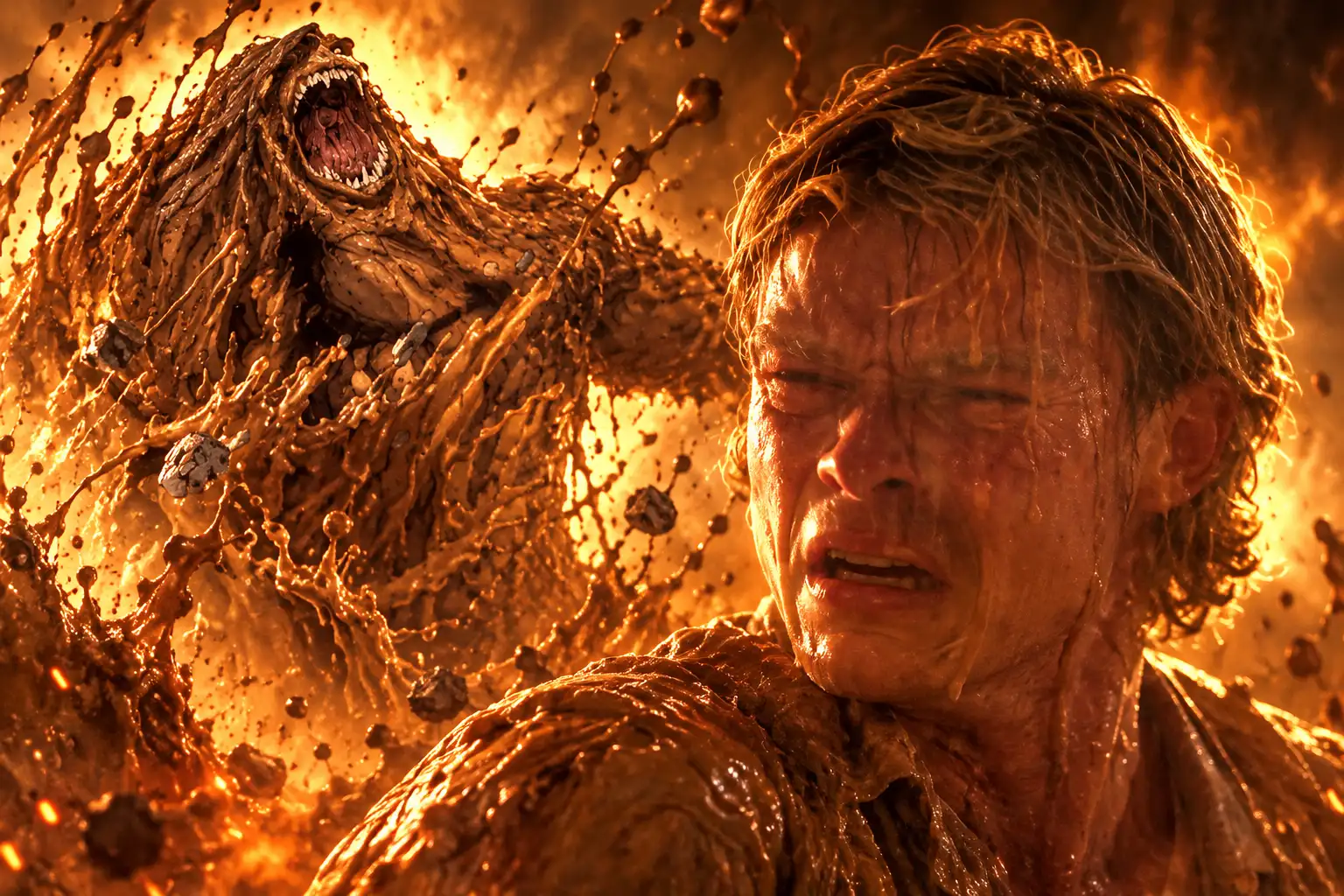
The $44 Million Movie Took $9.5 Million Friday
Friday’s $9.5 million includes the $3.5 million preview session that began at 2 p.m. Thursday. The domestic box office for Clayface is still an opening-weekend estimate, not a final audited figure, and the live range is $23 million to $25 million. That would land near Smile ($22.6 million) and a little under last year’s Black Phone 2 ($27.2 million), which is the neighborhood Watkins was shooting for.
DCU THEATRICAL OPENERS
| Film | Production cost | Thursday previews | Domestic opening | Worldwide |
|---|---|---|---|---|
| Superman (2025) | $225 million | $22.5 million | $125 million | $618.7 million |
| Supergirl (2026) | $170 million | $7.8 million | $37.1 million | $126.4 million |
| Clayface (2026) | $44 million before P&A | $3.5 million | $23 million to $25 million (est.) | Still counting |
A $25 million weekend would not recoup a $44 million production cost plus prints and ads on Saturday night, and no one in the trades is pretending otherwise. It would, however, put a much larger share of the production cost on the board than Supergirl managed in its entire domestic opening. Street Fighter, last weekend’s $31 million No. 1 for the newly combined Paramount-Warner Bros. operation, is already in a 79 percent Friday drop. Clayface is trying to give that same distribution machine a second straight chart-topper at horror scale.
WHAT WE KNOW
- Thursday previews: $3.5 million, ahead of Kraven the Hunter’s $2 million and in line with Other Mommy’s $3.6 million.
- Friday gross: $9.5 million, including those previews, from 3,458 theaters.
- Night-one grades: 4 1/2 stars on PostTrak, a 94 percent audience score on Rotten Tomatoes, and an A- CinemaScore.
- Critics: 76 percent of 149 reviews positive on Rotten Tomatoes (average 6.6/10); Metacritic 59 out of 100 from 44 critics.
WHAT IS UNCONFIRMED
- Weekend total: studio tracking is $23 million to $25 million through Sunday, and the three-day number is not locked.
- Overseas: the film began international play on October 21, and early markets have been softer than the domestic previews.
People who paid Thursday night liked it more than the critic mix implies. The Rotten Tomatoes blurb says the movie takes time to get going, then turns into “an icky and satisfying revenge thriller,” which is a polite way of saying the first hour is a Hollywood tragedy and the last act is the monster movie.
Watkins Shot a Horror Film Without Batman
The 108-minute picture is the thing Gunn hoped would play for horror crowds who do not care about DC. Hagen, played by Harries, is a rising actor who sleeps with the wrong woman at a party, has his face cut up by a mobster, and turns to Dr. Caitlyn Corr, played by Naomi Ackie, for a nanite treatment that heals tissue and then will not stop. Max Minghella is the detective in Corr’s life. David Dencik is the crime boss. Eddie Marsan is the manager. Aaron Paul’s father cameo was cut down in the edit after the filmmakers moved the story off generational trauma and onto revenge.
Watkins and Gunn wanted Gotham dirty and colored, not murky, and they lit it with tungsten that reads like sodium street lamps. Harries said the job was to establish a Gotham that feels vibrant and dark and gothic, and he gave the city’s people a local accent so the place would feel inhabited even with Batman off the call sheet. Location work in Liverpool doubled courts, docks, and a hospital; Leavesden took the stages.
THE HORROR MOVIES WATKINS POINTED AT
- The Fly (1986): the model for how Hagen’s body keeps changing after the cure.
- The Invisible Man (1933): one of the facial coverings Hagen wears while he still looks human.
- House of Wax (1953): the other covering, a dummy’s idea of a face.
- Frankenstein (1931): the first scarring, before the clay takes over.
Viewers who have already seen it keep saying the same thing in different words: the movie is at its best when Harries is changing shape and killing people, and slower when it is still a career-in-ruins drama. That is not a secret social-media trend. It is the same split the critics already printed. The RelishMix read of the trailer conversation was that people treated the quiet, almost wordless horror ads as a template other villain movies should have used, and that they were already nominating Mr. Freeze, Scarecrow, and Poison Ivy for the same lane.
Who Asked for a Clayface Movie?
Two weeks before release, a Threads user asked Gunn who had asked for this film. Gunn answered with a list, then with the process that actually put Clayface on a calendar.
Who tf asked for Back to the Future? Casablanca? There’s Something About Mary? Pan’s Labyrinth? Fury Road? Weapons? The Matrix? Although it may seem like it, Hollywood isn’t a place where the only way to make a movie is the public voting on what IP they want to see that they’ve seen countless times before.
James Gunn, DC Studios co-CEO, on Threads
He posted again that Flanagan, then Watkins and Amini, had been “inspired by a relatively little-known fictional character” and built a story around it, and that he would take that “a thousand times over” a listless script about a famous hero. That is the honest version of the wager: DC spent $44 million on a writer’s obsession, not on a character the public had already voted in.
The louder objection this week is not the character. It is the process. Gunn took the DC job promising he would not shoot until the scripts were finished and good. Flanagan still left. Amini still rewrote. Watkins still said the drafts evolved. Those are facts on the production timeline, and they sit beside a 76 percent critics score and an A- from opening-night crowds. A $44 million horror movie can survive a messy path. A $170 million Supergirl cannot, and that is why this one exists at this size.
Gerwig Starts Narnia on the Obscure Book
Nine days before Clayface’s Thursday previews, Netflix put out the first trailer for Greta Gerwig’s Narnia: The Magician’s Nephew. It is the first-ever adaptation of the 1955 novel, the sixth Narnia book published and the one set decades before The Lion, the Witch and the Wardrobe (1950). The film opens in theaters on February 12, 2027, with IMAX-only sneaks on February 10, then lands on Netflix on April 2. Netflix is distributing in North America; Sony Pictures has the rest of the world.
By October 20 the official trailer had 76.9 million YouTube views. Gerwig scored it to Led Zeppelin’s “Stairway to Heaven,” a track the band had never licensed for a trailer. She asked Robert Plant and Jimmy Page herself, and told Stephen Colbert the song is “a narrative about a spiritual journey” that matched the movie. Meryl Streep voices Aslan. Daniel Craig is Uncle Andrew, the magician. David McKenna and Beatrice Campbell are Digory and Polly. Emma Mackey is Jadis. Carey Mulligan, Ciarán Hinds, Kobna Holdbrook-Smith, Denise Gough, and Susan Wokoma round out the company. Mark Ronson and Andrew Wyatt, Gerwig’s Barbie composers, are on the score.
I was a child when I first read The Magician’s Nephew, and I fell in love with the gorgeously improbable but completely brilliant concept of a cosmic lion singing the world of Narnia to life. I didn’t know that I would grow up to make films, but a universe built out of music is an idea that always lived in my heart.
Greta Gerwig, writer-director, Netflix Tudum
She reread Lewis and the books that fed him, then went to Oxford, Cambridge, and Belfast “trying to align myself with what his interior life would be.” The seven Narnia books have sold more than 120 million copies in 70 countries. Cinematographer Seamus McGarvey, who shot the film, said on a podcast that the production budget was $280 million. Netflix has not confirmed the number. If it holds, the movie sits behind only The Electric State ($320 million) among Netflix productions, and it costs more than any of the three Walden Narnia films, including Prince Caspian’s $225 million.
The trailer is doing the same work Clayface’s ads did, only at the other end of the price list. It opens on a wardrobe, then leaves the lamp-post behind for rings, other worlds, and a lion assembled out of stars. That is why the clip split people who wanted a children’s book from people who wanted Gerwig’s rock-opera version of a creation myth. McGarvey called the shoot “the biggest budget hand-knitted project.” The public is arguing about whether the knitting looks like Lewis or like a Marvel origin.
Two Bets, Two Price Tags
Gunn’s third movie and Gerwig’s first Narnia are not the same kind of stubbornness, even if both skip the famous chapter. One is an R-rated $44 million monster picture already selling tickets. The other is a family fantasy whose cinematographer put the cost north of $280 million, with a trailer as its only public proof.
WHAT THE TWO WAGERS LOOK LIKE ON PAPER
| Clayface | Narnia: The Magician’s Nephew | |
|---|---|---|
| Who is paying | DC Studios / Warner Bros. | Netflix (Sony overseas) |
| Director | James Watkins | Greta Gerwig |
| Cost | $44 million net, before P&A | $280 million, per Seamus McGarvey |
| When the public can see it | Opened October 23, 2026 | Theaters February 12, 2027; Netflix April 2 |
| The unfamous door in | A Batman villain, no Batman | The 1955 origin book, not the wardrobe tale |
| Early public grade | 76% critics, A- CinemaScore, $9.5 million Friday | 76.9 million trailer views by October 20, no film yet |
McGarvey’s figure is more than six times Watkins’s production cost. Gerwig earned that swing with Barbie. Gunn earned this smaller one the other way: Superman made $618.7 million worldwide, then Supergirl did not, so the third title shrank until it looked like a Blumhouse date. Flanagan asked for a tragedy in 2021. Watkins delivered a revenge picture with a melting face. Whether that is “fine” or a new DCU lane depends on whether $23 million to $25 million holds through Sunday, and on whether anyone still wants Freeze or Ivy done the same way in 2027.
The Next Ticket Is Still Superman
Man of Tomorrow, Gunn’s Superman sequel, is dated July 9, 2027, with David Corenswet and Nicholas Hoult back and Lars Eidinger as Brainiac. That is the expensive film the studio still has to get right. Clayface is the $44 million test running in front of it, 108 minutes, R-rated, already in 3,458 theaters, with an A- from the people who showed up Thursday. Gerwig’s Narnia does not open for another three and a half months, and it will have to turn a polarizing, Stairway-scored trailer into a $280 million opening without the wardrobe everyone already knows.

Cook Hands Democrats the House as Crypto’s Bill Stays Dead

Wicker’s Broken Bed Was the Short Story’s Punch Line

Nvidia’s $500 Billion Financing Plan Draws a $180 Sell

Maserati Bets the Grecale V6 Can Fill Porsche’s Gap

EV Cable Theft Follows the Old Railway Copper Playbook

Aramco Crash Kills 14 Two Days After Oil Restart

Salah Captained Egypt to Their First World Cup Win

Zelda’s 40th Switch 2 Ships Without a Zelda Game

Apple Labor Day Deals Hide June’s Memory Price Hike

Palworld 1.0.4 Adds Palpedia Search After the 1.0 Launch
-
 BUSINESS4 months ago
Aramco Crash Kills 14 Two Days After Oil Restart
-
 NEWS5 months ago
Salah Captained Egypt to Their First World Cup Win
-
 GAMING2 months ago
Zelda’s 40th Switch 2 Ships Without a Zelda Game
-
 NEWS2 months ago
Apple Labor Day Deals Hide June’s Memory Price Hike
-
 GAMING2 months ago
Palworld 1.0.4 Adds Palpedia Search After the 1.0 Launch
-

 NEWS4 months ago
El Niño Puts Israel’s Needed Winter Rain on a Flood Clock
-

 BUSINESS8 months ago
BAE’s 60-Year Saudi Franchise Now Runs Through Taif
-

 BUSINESS8 months ago
Egypt Bets EGP 638 Billion Can Open Sinai to Investors