
ENTERTAINMENT
Wicker’s Broken Bed Was the Short Story’s Punch Line
Alexander Skarsgård says Wicker’s bed-breaking scene felt like a rollercoaster, but the gag was already in Ursula Wills’s 14-page fable.

Alexander Skarsgård says filming Wicker’s bed-breaking sex scene felt like a rollercoaster. He and Olivia Colman shot the steamy passages on the second or third day, he said, while he wore a practical wicker suit that was “literally hot.” The film opened in the United States on Oct. 23.
The snap was not a happy accident. Writer-directors Alex Huston Fischer and Eleanor Wilson had already found the broken bed in Ursula Wills’s 14-page fable and decided to put it on camera. Skarsgård, 50, still talks about the tenderness. The trailer talks about the mattress.
A 14-Page Story Already Broke the Bed
Wills, a Gloucestershire writer, has been circulating The Wicker Husband short story for years. In 2020 the Watermill Theatre in Newbury even turned it into a musical. Producer Justin Lothrop handed the 14 pages to Fischer and Wilson, the married pair behind the 2020 comedy Save Yourselves!, and they kept the story’s five-act bones.
After the first night of marriage, the woven husband in the fable does not boast. He asks for a tool.
The bed is broken. Bring me a chisel. I will fix it.
Alex Huston Fischer, co-writer and co-director, quoting Ursula Wills
Wilson noted that the story never describes the night before. Fischer said they read the line and asked why they should not show the bed breaking. That choice became the clip that sold the movie. Black Bear’s listing still boils the plot down to an outcast who commissions a husband made from wicker and upsets a conservative town.
The official trailer is the same bet, played loud.
Wētā Printed the Husband in 50 Pieces
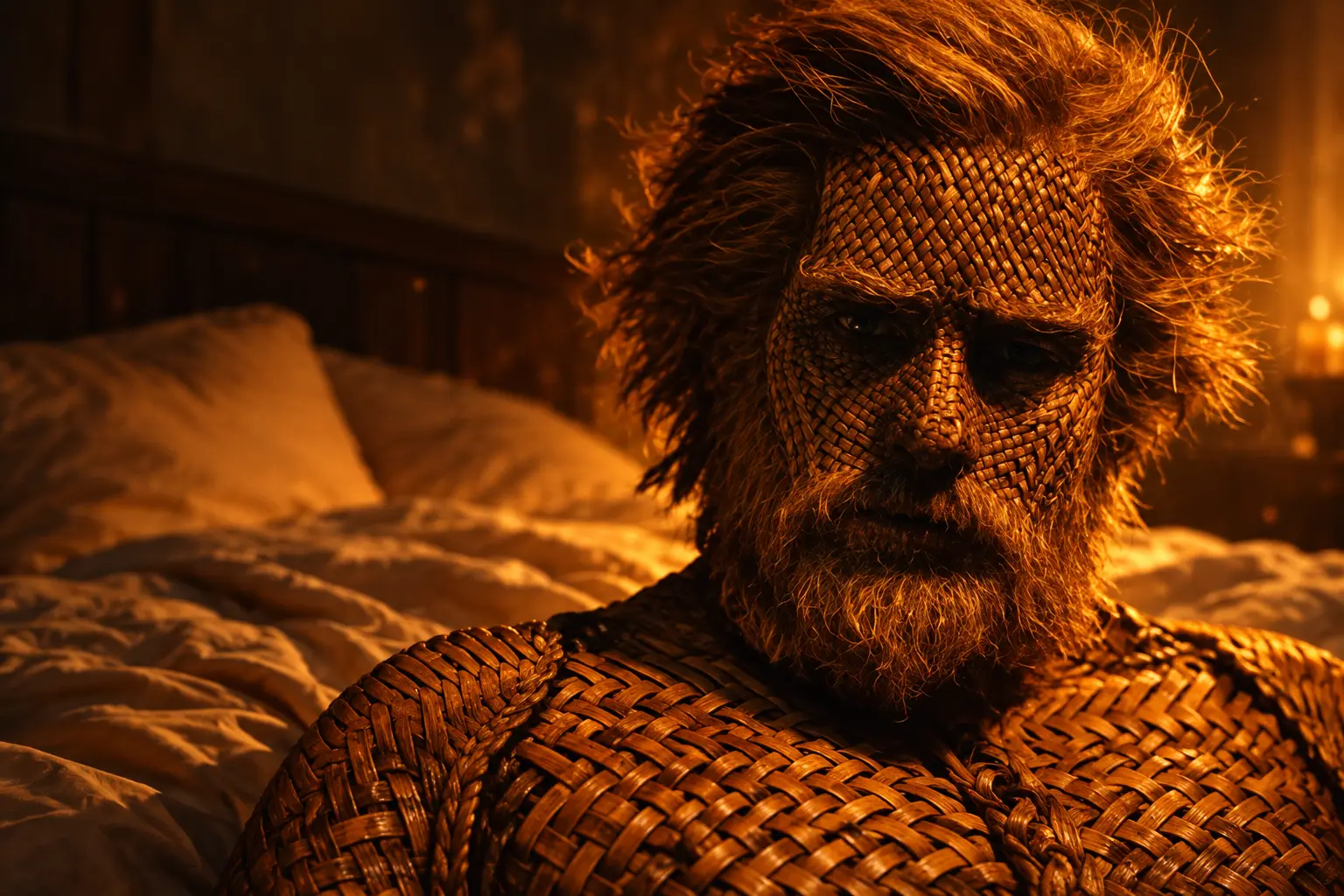
Skarsgård’s body is not a digital double. Wētā Workshop in New Zealand spent 18 months on research and tests after Fischer and Wilson asked for a practical build. Prosthetic designer Joe Dunckley and lead makeup effects artist Sarah Rubano started from a full-body scan so the weave would sit on his actual frame.
Standard foam and gel skins imitate flesh. A man made of basketwork does not. The team moved to 3D sculpting and a powder-bed laser process that fuses plastic strand by strand, so the weave can flex like muscle instead of sitting as a rigid cage. Dunckley said the finished surface feels close to real wicker. It is not straw. Colman was not picking splinters out of her palms.
THE SUIT, IN PIECES
| Part | What Went On Skarsgård |
|---|---|
| Body | 50 printed appliances, painted and stitched onto soft spandex |
| Face | 10 pieces, including lips, jaw, brow, ears and eye bags |
| Hair and lashes | Muka fiber from the harakeke plant, knotted into the weave |
| Get-in time | Cut to 90 minutes by the end of the shoot |
| Digital work | Mostly to make the figure look hollow, not to draw the man |
Wilson said the face plates were glued on, which is a hard way to play a love scene. Rubano said Skarsgård runs hot, the suit runs hot, and they were working a hot Hungarian stretch. He sat still in the chair anyway. Dunckley called him a team player. Costume designers András Dániel Tóth and Attila Godena-Juhász had about a week to finish the lower half, including the full-body river shot, after the directors decided late that the husband should be seen naked in the water.
Wētā’s own post, once the film was in U.S. theaters, told people to go look at its leading wicker man. Skarsgård has been stressing the same point in interviews: almost no CGI on the body, a little light through the forearms, and flax lashes as the last touch before a close-up.
Why the Sex Scenes Played as Comedy
Wilson said they always treated the sex as the film’s comedy. The scenes were meant to get laughs, and they do. Then Skarsgård got into the suit, Colman got in the bed, and intimacy coordinator Ita O’Brien started shaping the work. Wilson said that is when the passages turned sexier than the couple had planned.
Colman, 52, said the bed really did go, and the laugh was “proper full on.” Humor, she said, made the days less awkward and closer to real life. Serious lovemaking, she added, would have been cripplingly embarrassing. Skarsgård described the crew waiting for the crash.
It was like a rollercoaster. We’re anticipating it like, ‘It’s coming.’ So, that was fun.
Alexander Skarsgård, actor
He was also learning the costume in public. Those early days, he said, were about how to move in a full practical build with very little CGI. Colman joked that she would have asked for breaks. He joked back that he was secretly crying on the mat.
The internet did not hear the mat. It heard the splinters. Black Bear leaned into that joke in the shop, and the trailer trained first-time viewers to expect a noisy romp. Fischer said the pair are not on TikTok, and that the viral loop still surprised them after the camera tests, when the crew had already fallen for the couple on set.
The Village Names You by Your Job
The film runs 105 minutes. Colman plays the Fisherwoman, an outcast on the edge of a seaside village, mocked for being single and for smelling like her catch. Fed up, she asks the local Basket Weaver, Peter Dinklage, to make her a spouse. A month later Skarsgård arrives, woven, devoted, and better in the house than the married men down the lane.
Elizabeth Debicki plays the Tailor’s Wife, who cannot abide a woman stepping outside the local script while stuck in her own sour match. Nabhaan Rizwan is the Tailor. Richard E. Grant is the village doctor. Marli Siu, Gustav Lindh, Ella Bruccoleri, Ben Ashenden and Kiell Smith-Bynoe fill out a town where men are their trades and women are someone’s wife.
WHO HOLDS THE FABLE
- The Fisherwoman: Colman, also a producer through South of the River Pictures, as the woman who places the order.
- The Wicker Husband: Skarsgård as the made-to-measure spouse, designed to look like him, not like a monster.
- The Basket Weaver: Dinklage as the craftsman who treats the commission as an act of care.
- The Tailor’s Wife: Debicki as the neighbor who polices the match and cannot leave her own.
Fischer told interviewers the short story read as a witty allegory about jealousy. He and Wilson used it to needle marriage itself, including the bar habit of bad-mouthing a partner because that is the talk the room expects. Skarsgård said even the antagonist made sense to him. He felt she was trapped in the system.
Lol Crawley shot it. Anna Meredith wrote the score. Sofi Marshall cut it. Topic Studios and Tango Entertainment financed with Votiv, Yoki, and Colman’s company. Dev Patel was attached first and later dropped out. Wilson’s brief to Wētā was blunt: the husband had to be strikingly beautiful, and the actor’s face had to survive the weave, because the village’s panic only works if he is a catch.
They Called the Film Unpitchable
Fischer said the project felt unpitchable. Wilson wanted less money and more control. They did not shop it to big studios. Lothrop asked whether they wanted a pitch or a spec script with a little development cash. They wrote the thing they could defend, then went to financiers they already knew.
Colman said yes after a call that, by their account, drifted into talk about kids. Fischer called her the jet fuel. They locked Wētā early, during a 2023 stretch when original films were a hard ask coming out of the writers’ strike, and only then went looking for the rest of the money. Wilson said they got just enough to make the movie they wanted.
FROM FABLE TO OPENING WEEKEND
- 2020: The Watermill Theatre stages a musical drawn from Wills’s story.
- 2021: Fischer and Wilson write the first draft, about five years before their October press tour.
- 2023: Colman attaches, Wētā starts the body, and Black Bear begins selling the title.
- 2024: The shoot lands in Hungary, with the suit already dictating how scenes can move.
- January 24, 2026: Wicker premieres at Sundance in Park City.
- February 2026: Black Bear takes North American rights at the European Film Market.
- October 18, 2026: The film closes the Sitges festival, then holds its Los Angeles premiere on Oct. 20.
- October 23, 2026: It opens in the United States in 1,471 theaters.
Britain follows on Oct. 30. Roadshow Films has Australia on Nov. 5. Wills has seen a preview and, on her site, called it amazing. She says an ebook and audiobook of the story are coming, with a fuller collection after that.
Skarsgård Signed On for the Tenderness
Ask the actor what pulled him in and he does not start with the crash. “It was incredibly romantic,” he said. He was moved by the sweetness and the humor, and by how Fischer and Wilson handled the whole walk through the village. No one felt like a cliché to him, including the woman trying to stop the match.
That is the split the rollout keeps widening. Fischer wanted a tactile film, a husband who occupied the same light as Colman. Wilson has called it a sex-positive story about female pleasure and a look at masculinity. The trailer, and a lot of the jokes around it, sell a woven hunk and a wrecked frame. Both things are in the picture. Only one of them fits in a fifteen-second clip.
On opening day Rotten Tomatoes posted the film as Certified Fresh. By the next morning the tally sat at 94 percent of 104 reviews, with an average of 7.7 out of 10. Metacritic’s weighted score was 70 from 31 critics. The American rating is R for sexual content, language and brief full nudity. For the British cinema release, the BBFC’s advice flags strong sex, language, sex references and injury detail, including a wooden character set alight.
THE OPENING SNAPSHOT
- Runtime: 105 minutes, with the cinema cut timed at 105 minutes 23 seconds.
- U.S. footprint: 1,471 theaters as of the Oct. 23 opening.
- Critics: 94 percent of 104 reviews positive, Metacritic 70.
- Next date: United Kingdom on Oct. 30, Australia on Nov. 5.
Black Bear’s shop now offers an Anti-Splinter Kit for $35 beside a $149 eight-inch Wicker Husband figure. The bed had already broken on the page. The merch is just catching the joke the directors chose to stage.

Cook Hands Democrats the House as Crypto’s Bill Stays Dead

Wicker’s Broken Bed Was the Short Story’s Punch Line

Nvidia’s $500 Billion Financing Plan Draws a $180 Sell

Maserati Bets the Grecale V6 Can Fill Porsche’s Gap

EV Cable Theft Follows the Old Railway Copper Playbook

Aramco Crash Kills 14 Two Days After Oil Restart

Salah Captained Egypt to Their First World Cup Win

Zelda’s 40th Switch 2 Ships Without a Zelda Game

Apple Labor Day Deals Hide June’s Memory Price Hike

Palworld 1.0.4 Adds Palpedia Search After the 1.0 Launch
-
 BUSINESS4 months ago
Aramco Crash Kills 14 Two Days After Oil Restart
-
 NEWS5 months ago
Salah Captained Egypt to Their First World Cup Win
-
 GAMING2 months ago
Zelda’s 40th Switch 2 Ships Without a Zelda Game
-
 NEWS2 months ago
Apple Labor Day Deals Hide June’s Memory Price Hike
-
 GAMING2 months ago
Palworld 1.0.4 Adds Palpedia Search After the 1.0 Launch
-

 NEWS4 months ago
El Niño Puts Israel’s Needed Winter Rain on a Flood Clock
-

 BUSINESS8 months ago
BAE’s 60-Year Saudi Franchise Now Runs Through Taif
-

 BUSINESS8 months ago
Egypt Bets EGP 638 Billion Can Open Sinai to Investors