
NEWS
New Egypt Pyramid Studies Keep Solving Different Jobs
Minya’s tapering tombs joined a lost Nile map, a disputed water lift, and an edge-ramp model, each solving a different part of pyramid construction.

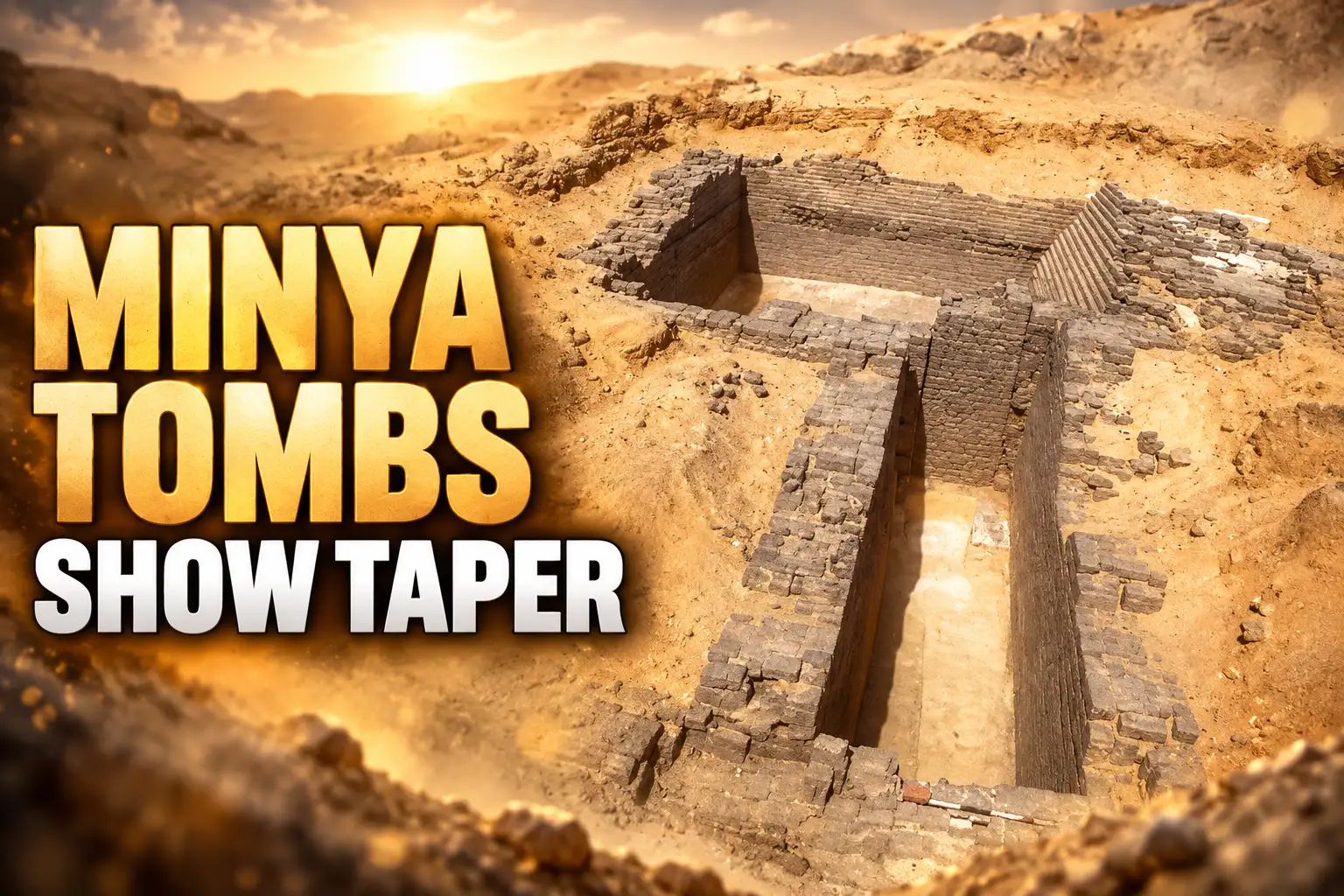
Egyptian crews in June 2026 opened two Early Dynastic tombs at Jabal Al-Tayr whose stone walls thin toward the top. The antiquities ministry said that taper may be an early stage of the geometric thought that later produced pyramids.
Headlines called the find a rewrite of pyramid construction. Roland Enmarch, a reader in Egyptology at the University of Liverpool, said most colleagues see no direct link.
Minya Tombs and King Den’s Abydos Plan
The briefing came on June 20, 2026, from Minister of Tourism and Antiquities Sherif Fathy after a Supreme Council of Antiquities mission dug at Jabal Al-Tayr in Minya, on the Nile’s east bank. The team found two Early Dynastic tombs plus burials from the Predynastic period and the Late Period, a cemetery used for a very long stretch of Egyptian history.
Hisham El-Leithy, secretary-general of the council, called the first tomb a rare find because of its geometric design. He said both tombs resemble the tomb of King Den at Abydos, a First Dynasty royal grave far to the south. Mohamed Abdel-Badi, head of the Egyptian Antiquities Sector, pointed to walls that are thicker at the base and grow thinner as they rise, a way of stacking stone that puts more mass where the load is greatest.
Abdel-Badi said that idea may represent an early stage in the thinking that later produced step pyramids and then true pyramids. He did not call the Minya chambers pyramids, and they are not. They are underground tombs whose builders already knew that a wall should not be the same thickness from floor to roof.
WHAT THE MINYA TOMBS ACTUALLY HOLD
- The pair: Two Early Dynastic tombs, with the southern one better preserved because later crews did not quarry it for stone.
- The taper: Walls that start thick at the base and slim toward the top, the detail that drove the pyramid headlines.
- The joinery: Large wooden supports set into the masonry, some running the length of a wall, plus oxidised cutting marks that guided the stonework.
- The parallel: A layout close to King Den’s tomb at Abydos, evidence that provincial elites shared royal burial ideas while the state was still young.
- The long use: Extra graves from before the dynasties and from the Late Period, so the hill was a burial ground for millennia, not a one-season royal project.
Enmarch called the tombs extremely interesting in their own right, because elite Early Dynastic graves in Middle Egypt had been scarce. He also noted that stepped mud-brick interiors of this kind have already been seen inside Early Dynastic tombs at Saqqara. The Minya walls add a provincial chapter. They do not move the argument about how Khufu’s crews got stone to the sky.
The Ministry Stopped Short of a Rewrite
The ministry’s own wording was narrower than the coverage. The press statement said the architectural style “may represent an early stage in the development of geometric thought that later led to the appearance of the terraced pyramid, then the full pyramid.” Several stories dropped the “may” and wrote “rewrite” or “redefine.”
Enmarch has watched that inflation for years. The pyramids sit so early in recorded building, and they are so large, that the public treats every new trench as a master key.
The pyramids are such an astonishing achievement, and they are so early in the history of human civilization that people have always wondered how on earth did they do something that astonishingly huge, so long ago, with the relatively primitive technologies that were available to the people at the time.
Roland Enmarch, reader in Egyptology, University of Liverpool
On the Minya taper he was cooler. Egyptologists, he said, are divided on whether such tombs are the prehistory of the pyramid as a form, and “the current opinion is that, most likely, there isn’t a direct link.” That is the gap the rewrite line refused to print. A cautious field note became a solved origin story because origin stories travel farther than provincial tombs.
The same gap now repeats across three technical papers that do not even claim the same job. One maps a river. One models a water shaft at Saqqara. One tests a helical lane on Khufu’s faces. Each can be useful. None can stand in for the others.
Along 64 Kilometers, 31 Pyramids Met a River
In May 2024, Eman Ghoneim of the University of North Carolina Wilmington and colleagues published the first continuous map of a buried Nile channel they named the Ahramat Branch, Arabic for pyramids. Radar, geophysics, and soil cores traced about 64 kilometers of channel from south of Lisht to Giza, sitting 2.5 to 10.25 kilometers west of today’s river.
The paper places 31 pyramids along that course, from the Third Dynasty through the Thirteenth, a span the authors date 2686 to 1649 B.C. The channel is 200 to 700 meters wide and 2 to 8 meters deep at the surface, in the same class as a working Nile arm. Many pyramid causeways run straight at the old bank and end in valley temples that could have served as harbors.
Ghoneim’s team argues that this lost Ahramat Nile branch carried workers and building stone while it still flowed. Enmarch does not fight the hydrology. Ancient Egypt was full of canals, he said, and some of them almost certainly moved stone. He also said a river at the foot of the plateau still leaves the hard question untouched: how more than two million blocks climbed the pyramid itself.
That is the first split. The 2024 map answers siting and haulage along the desert edge. It does not lift an 80-tonne granite beam over Khufu’s burial chamber, and it does not explain a tapering wall in Minya. Treating it as “how the pyramids were built” collapses a logistics paper into a lifting paper.
Why the Water Lift Split Egyptologists
A French team led by Xavier Landreau of Paleotechnic in Paris offered a lifting answer on August 5, 2024, and aimed it at Djoser’s step pyramid, not Giza. Their PLOS ONE paper reads Gisr el-Mudir west of Saqqara as a check dam, treats a rock-cut “Deep Trench” as a settling works, and argues that water could have filled shafts inside the monument so a float could raise stone from the center.
Landreau has described about 7 kilometers of pipes cut in the rock some 28 meters down. The model’s own bound is tight: from the filled shaft bottom, a single filling cycle cannot lift higher than 17 meters, so extra height would need the platform to lock while the float drops. An upper-bound water budget for building the whole step pyramid that way runs to 18 million cubic meters. The authors present a hydraulic lift at Djoser’s pyramid as a new research line, not a closed case for Khufu.
WHERE EXPERTS DISAGREE
- The Paleotechnic team: The north shaft and granite boxes look like an inlet for a float that built the step pyramid from the inside, “in a volcano fashion.”
- Roland Enmarch: He is not an engineer, he said, but after reading the paper he could not see how the physics works, “because the heights we’re talking about are not as different as they would need to be.”
- Zahi Hawass: The former antiquities minister said the theory is completely wrong and that no pyramid in Egypt has evidence of water used to move stones.
Landreau has suggested hidden shafts at Khufu or Khafre as a next test, because a moderate lift, in his account, could raise 50 to 100 tonnes. That extension is a hope, not a find. Enmarch’s objection sits on the height drop the water would need. Until someone shows that drop in the ground, the water paper remains a Saqqara hypothesis that the people who dig pyramids for a living have not adopted.
Khufu’s Reign Leaves Room for an Edge Ramp
If water is the disputed lift, ramps remain the working family. Straight outer ramps eat more volume than the pyramid. Spiral wraps hide the corners a surveyor has to see. In March 2026, Vicente Luis Rosell Roig tested a third path in npj Heritage Science: an edge-ramp model for Khufu that leaves a helical lane in the perimeter courses and fills it on the way down.
The Great Pyramid in that model stands 146.6 meters high on a base about 230 meters a side and holds about 2.3 million blocks. Finishing it inside Khufu’s reign of about 27 years implies an average placement near one block every 3 minutes. The simulated lane is about 3.8 meters wide and 4.26 meters high, held near a 7 degree grade. An adaptive set of ramps, the paper says, can dispatch a block every 4 to 6 minutes.
THE EDGE-RAMP CLOCK
- On-site assembly: A median of 13.8 to 20.6 years, inside the reign if the crews can hold that pace.
- Full project: 20 to 27 years once quarrying, river transport, and seasonal pauses go back into the calendar.
- The empty lane: A 3 by 6 mask of omitted face blocks, packed later so no giant outer ramp has to survive in the sand.
- The test: Edge-fill scars and corner wear the model says excavators should be able to find, plus a loose fit with cavities already seen by muon imaging.
Enmarch called the arithmetic plausible on the assumptions it uses, and said he personally suspects some wraparound ramp is right, because cranes of that age are a fantasy and a single long ramp would dwarf the pyramid. He also said a few shifted variables can blow a complex calculation apart. He has seen real haulage kit in the field: steep ramps, stairs, and post holes from Hatnub quarry stone haulage dated to Khufu’s time, used to drag alabaster on slopes of 20 percent or more. That is evidence for ramps as a technology. It is not a preserved helical lane on Giza’s faces.
FOUR STUDIES, FOUR JOBS
| Study | When | Job it targets | What it leaves open |
|---|---|---|---|
| Jabal Al-Tayr tombs | June 2026 | Early wall taper and a Den-like plan in Middle Egypt | How Giza’s blocks were raised |
| Ahramat Branch | May 2024 | A 64 km waterway beside 31 pyramids | The climb from harbor to capstone |
| Hydraulic lift | August 2024 | A water float inside Djoser’s shafts | Physics, field support, and any use at Khufu |
| Integrated edge-ramp | March 2026 | A helical lane that can fit a 27-year reign | An actual ramp still in the masonry |
Read across, the papers are not rivals for one vacant throne. They are four tools hung on four nails. The rewrite habit hangs them on a single hook labeled mystery, then declares the hook still empty when they do not overlap.
How the True Pyramid Appeared in a Few Reigns
The form itself did not crawl out of those Minya walls over a thousand years. Enmarch dates the pyramid idea to a few generations between the 27th and 26th centuries B.C., after centuries in which kings used mastabas, the bench-like mud-brick tombs with sloping sides. Djoser, founder of the Third Dynasty, broke that habit between about 2670 and 2650 B.C.
He built the mastaba in stone, then, with his architect Imhotep, stacked smaller stages on top until Saqqara held the first step pyramid and the first surrounding complex made entirely of stone. Enmarch calls that a step-change as well as a step pyramid. From Djoser’s first year to the start of Khufu’s building run is about 90 years.
FROM MASTABA TO GIZA
- 31st century B.C.: Egypt unifies. Royal tombs are rich below ground and still modest above it.
- Early Dynastic: Provincial tombs at Jabal Al-Tayr share a plan with King Den at Abydos and already taper their stone walls.
- 2670 to 2650 B.C.: Djoser and Imhotep raise the first all-stone step pyramid at Saqqara.
- About 2610 B.C.: Sneferu’s Meidum pyramid begins as a step structure; casing later fills the steps.
- Bent Pyramid, then about 2595 B.C.: The slope changes midway on one Dahshur pyramid; the Red Pyramid, about 105 meters high, is the first successful true pyramid and the third-largest in Egypt.
- 2580 to 2560 B.C.: Khufu, Sneferu’s son, builds the Great Pyramid in a 20-year construction window inside a reign of about 27 years.
That sequence is craft under state pressure, not a lost machine waiting in a Minya hillside. Average casing blocks at Giza weigh 1.5 to 5 tonnes, a load a small crew can drag on a lubricated sledge. The 80-tonne granite beams over the burial chamber are the ugly exception, which is why exotic lifts keep getting invented for them. The ordinary stone does not require aliens, and it does not require a river to run uphill.
Over 130 Pyramids and No Shared Method
A 2015 survey by engineer Glen Dash and archaeologist Mark Lehner put a number on the “mystery” that is really a measuring problem. The Great Pyramid’s west side is about 2.9 inches longer than the east, and the south about 2.2 inches longer than the north, on a base near 230 meters. Dash’s line was that the crews were better at distance than at perfect right angles, using wood, rope, copper, and stone. Enmarch’s shorter version is that you can do more than people imagine with basic technology.
The open web still prefers one trick that built every pyramid, which is why alien masons, overnight robots, and a pump in the king’s chamber keep circulating beside the PDFs. That appetite is the other half of the rewrite problem. A paper that maps a river, a paper that fills a shaft, a paper that cuts a helical lane, and a tomb with thinning walls can all be true in their lanes and still starve that appetite, because none of them is a universal key.
Enmarch’s labor picture is as plain as the tools. The Old Kingdom could organise a huge workforce and collect tax as labor from peasants; whether any of those people were slaves is still argued. Egypt had building stone underfoot, unlike Mesopotamia. The remaining puzzle he names is physical: how to raise an artificial mountain of blocks. On present evidence that is a ramp configuration problem, not a missing civilisation.
More than 130 pyramids still stand. The June 2026 briefing said digging at Jabal Al-Tayr was ongoing. Later seasons may add mastabas. They will add another early wall before they add a single method that built them all.

Christa Pike Survived the Execution Tennessee Would Not Pause

Musk’s Oligarch Charge Hits a Queue of Three

Circle Puts USDC and EURC Into SAP Pay Workflows

Ring’s First Smart Lock Skips Home Wi-Fi for Sidewalk

GTA 6 Puts Cash Back on the Story Path

Aramco Crash Kills 14 Two Days After Oil Restart

Salah Captained Egypt to Their First World Cup Win

Apple Labor Day Deals Hide June’s Memory Price Hike

Zelda’s 40th Switch 2 Ships Without a Zelda Game

Palworld 1.0.4 Adds Palpedia Search After the 1.0 Launch
-
 BUSINESS3 months ago
Aramco Crash Kills 14 Two Days After Oil Restart
-
 NEWS4 months ago
Salah Captained Egypt to Their First World Cup Win
-
 NEWS1 month ago
Apple Labor Day Deals Hide June’s Memory Price Hike
-
 GAMING4 weeks ago
Zelda’s 40th Switch 2 Ships Without a Zelda Game
-
 GAMING4 weeks ago
Palworld 1.0.4 Adds Palpedia Search After the 1.0 Launch
-

 NEWS3 months ago
El Niño Puts Israel’s Needed Winter Rain on a Flood Clock
-

 ENTERTAINMENT3 months ago
A Thousand and One Drops Off Riyadh’s October Calendar
-

 ENTERTAINMENT1 month ago
King Charles Letter Keeps Harry and Meghan as Private Citizens