
NEWS
Saturn Stands Opposite the Sun While Hubble Tracks a Wave
On October 4 Saturn reaches opposition, while Hubble tracks a strengthening ten-sided wave at the south pole and moonlight trims the Orionids.

Saturn reaches opposition on October 4, rising at sunset and staying in the sky for much of the night. NASA’s Jet Propulsion Laboratory folded that date into its monthly skywatching briefing, then pointed to a harder target: a ten-sided atmospheric wave Hubble found around the planet’s south pole.
Raquel Villanueva, speaking for JPL, also flagged a thin crescent beside Jupiter on October 6, the Orionid meteor shower on October 21 and 22, and the Moon sliding past the Pleiades on October 27 and 28. The ringed planet is the easy win. The new wave is not.
Saturn Rises at Sunset on October 4
Opposition is a geometry, not a flare. Earth slips between the Sun and Saturn, so the planet sits opposite the Sun in our sky. It rises around sunset and stays visible for much of the night, climbing in the east toward 9 p.m. and standing highest around local midnight in Cetus.
The planet is about 1.26 billion kilometers (784 million miles) away that day, with opposition listed at 12:00 UTC, and it shines near magnitude 0.3. To the unaided eye it is a steady pale point, not a disc. The rings need glass.
JPL posted a 2-minute 42-second briefing that walks through the month’s charts, including Saturn low in the east on October 4.
A small telescope will show the rings as an oval, not a straight line. Saturn’s south pole is the side tipped toward Earth, by about 7 degrees, so the southern face of the globe and the underside of the rings are the parts in view. That tilt is why this opposition looks different from last year’s edge-on season, and it is the same seasonal window that let Hubble stare at the south pole long enough to catch a new shape.
SATURN AT OPPOSITION
- The clock: Opposition falls on October 4 at 12:00 UTC, with the planet up from dusk until dawn.
- The range: Saturn sits about 1.26 billion kilometers (784 million miles) from Earth, its closest stretch of 2026.
- The glow: Brightness is about magnitude 0.3, on par with the brighter stars, as a steady pale point.
- The tilt: The southern hemisphere faces Earth by about 7 degrees, so the south pole and the rings’ southern face are the side on view.
NASA’s Night Sky Network, a coalition of more than 400 amateur clubs, keeps a public calendar of local astronomy club events across the U.S. if you want a loaner telescope rather than a guess at the eyepiece.
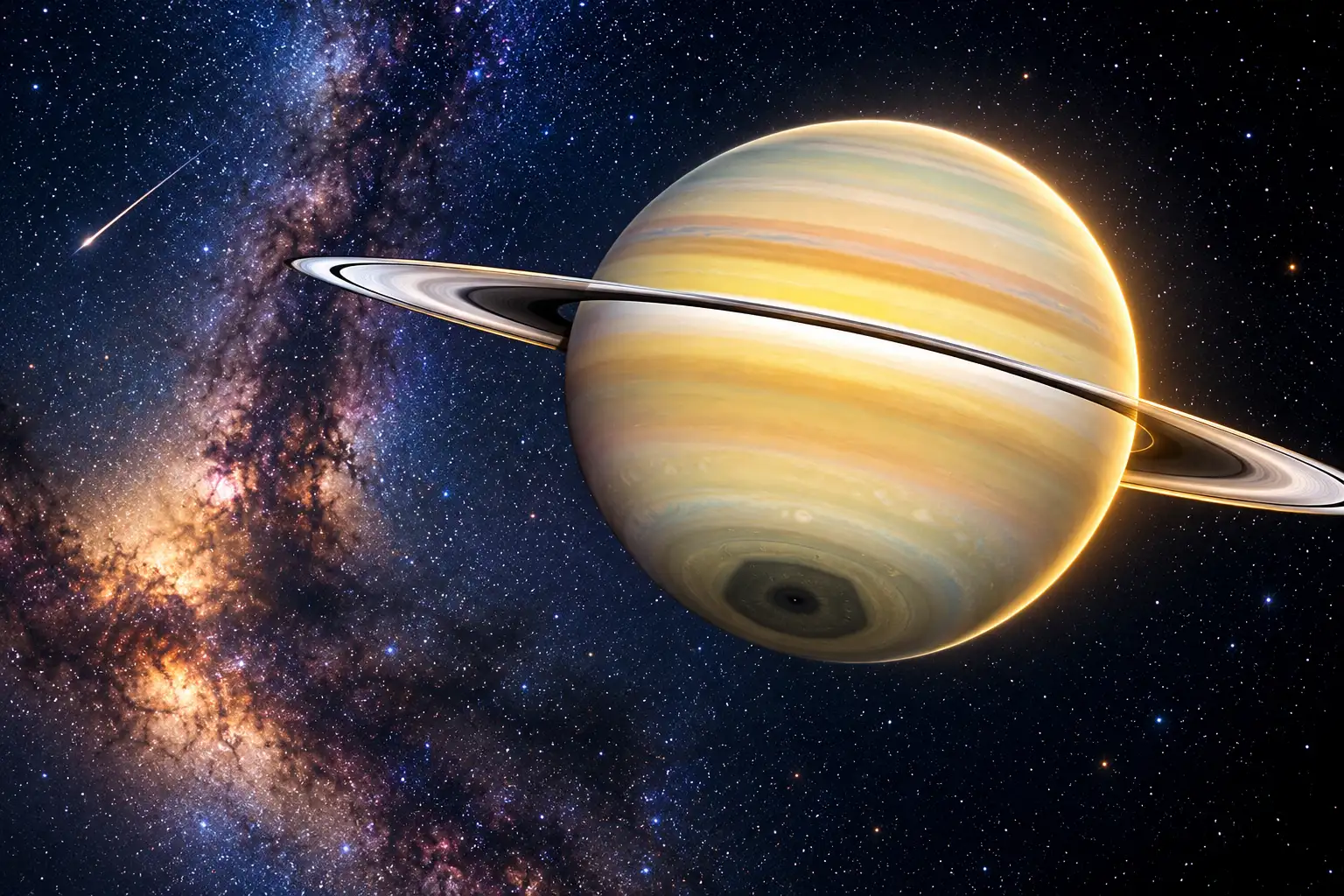
A Ten-Sided Wave at the South Pole
Astronomers have long known a hexagon-shaped jet stream that spans nearly 20,000 miles across Saturn’s north pole. In early September, Hubble images showed a ten-sided atmospheric wave at Saturn’s south pole, the first large regular-sided jet pattern confirmed in that hemisphere.
The study published in Science Advances on September 2 traces the feature through Hubble’s Outer Planet Atmospheres Legacy program, which has photographed the outer planets each year for more than a decade. Frames from 2023 already held faint vertices. By 2025 the ten sides had sharpened.
We’ve never seen anything quite like this in Saturn’s southern hemisphere.
Amy Simon, OPAL principal investigator, NASA Goddard Space Flight Center
Simon, who co-authored the paper, said the northern hexagon has been there every time researchers have looked for more than 40 years. The southern feature appears to be strengthening, which is the rare part. Cassini, in orbit from 2004 to 2017, saw no long-lived southern polygon. A brief polygonal ripple showed up in 2004 near 60.5 degrees south and lasted only days. The new wave is a different object: it sits near 63 degrees south, extends through more than one layer of air, and is still changing.
Agustín Sánchez-Lavega, lead author at the University of the Basque Country, said his team had been hunting a southern counterpart in Hubble images since 1990, given how neatly Saturn’s north-south jet streams mirror each other. “Images from NASA’s Cassini spacecraft, which orbited Saturn between 2004 and 2017, showed no inkling of a long-lived formation, either,” he said. Hubble then confirmed the new wave back to 2023.
HOW THE SOUTH POLE WAVE SHOWED UP
- 1980: Voyager frames show the six-sided jet around Saturn’s north pole, a feature still there more than 40 years later.
- 2004 to 2017: Cassini maps the south and finds no lasting polygon, only a days-long ripple near 60.5 degrees south.
- 2018: Hubble’s OPAL program begins yearly Saturn portraits after Cassini’s end.
- 2023: Hubble already shows early vertices of a ten-sided wave near 63 degrees south.
- 2024: Amateur cameras logging into a Spanish planetary archive catch a clear undulation along the southern jet.
- 2025: All ten vertices sharpen; a compact anticyclone near 55 degrees south darkens just as the wave becomes obvious.
- September 2, 2026: The team reports the decagon in Science Advances; NASA’s October briefing then ties it to opposition weekend.
Michael Wong, a University of California, Berkeley researcher on the paper, put the surprise in one line: “A few years ago, this feature wasn’t there.” The visible part of the wave sits in the upper troposphere, with winds near 400 kilometers per hour. Hubble’s filters probe different altitudes, and the outline shifts slightly from filter to filter, which is how the team knows it is a tall structure, not a skin of cloud.
Why Saturn’s Tilt Opened This View
Saturn’s seasons are long. The planet’s axis leans, and for years at a stretch one pole hides from Earth while the other faces us. NASA said the south pole came back into view as those seasons turned, which is what made the new wave measurable from here. Opposition on October 4 is one night inside that longer window, not the night the shape was born.
That is the second fact hiding under the skywatching calendar. Backyard observers get rings that are finally open again after an edge-on year. Hubble gets a clean look at the same southern jet that grew a decagon between 2023 and 2025. Simon asked the question the October briefing does not: why did the wave form now, when no one had seen a lasting southern polygon before?
The team has a suspect, not a verdict. A compact anticyclone about 4,000 kilometers across, centered near 55 degrees south, was tracked from 2023 to 2025 and darkened hard in 2025, just as the ten sides locked in. Wong said the vortex may have started the ripple, with the jet then holding a decagon in place. They want Hubble and the James Webb Space Telescope, plus thicker computer models, to test whether the shape settles like the northern hexagon or keeps evolving.
Amateur Photographs Filled the Yearly Gaps
Hubble does not stare at Saturn every week. OPAL’s strength is a yearly, sharp portrait. The gaps between those visits were filled from the ground. Sánchez-Lavega’s group runs the Planetary Virtual Observatory Laboratory, which collects ground-based planetary images from around the world. In 2024, amateur astronomers Trevor Barry and Jean-Paul Oger logged a subtle undulating band along the southern pole. Extra 2025 ground frames made the ten-sided outline harder to ignore, and that is when the Hubble stack became the proof.
Wong said a lot of OPAL findings rest on years of data, not one lucky night. Regular looks, from space and from driveways with serious cameras, are what turned a faint 2023 hint into a named wave. Visual observers with a 3-inch or 6-inch telescope will not see ten clean sides. The polygon is a map you build from many rotations and several filters, not a Halloween stencil in the eyepiece.
WHAT EACH SETUP ACTUALLY SHOWS
- Naked eye: Saturn is a steady pale point in Cetus; the Pleiades are a fuzzy knot of 6 to 7 stars; Orionid meteors are fast streaks anywhere in the sky.
- Small telescope: The rings separate from the globe, the south pole is the face on view, and a dark gap in the rings can show in steady air.
- Hubble and large cameras: The ten-sided jet, its height through several layers, and the nearby anticyclone are measurable; they are not a weekend sight.
Calling the wave a storm you can see on October 4 mixes two stories. The planet is bright and up all night. The geometry that makes the rings easy is the same geometry that let professional and amateur cameras catch a pattern still being born. The eyepiece gets the rings. The archive gets the decagon.
When Do the Orionids Peak in 2026?
The Orionid meteor shower peaks on the night of October 21 into the morning of October 22. The meteors are tiny bits of debris from Halley’s Comet, which returns to the inner solar system every 75 to 76 years and is next due in 2061. They appear to radiate from Orion and can streak across any part of the sky, hitting the air at about 66 kilometers per second, fast enough to leave brief glowing trains.
A waxing gibbous Moon will wash out some of the fainter meteors this year. Full Moon follows on October 26, so the peak nights are already bright. NASA’s advice is blunt: the best chance is in the hours before dawn, after the Moon sets. Find a dark site, give your eyes time, and look up, not at the radiant. Under a truly dark sky after moonset, counts often reach about 20 an hour; moonlight and city glow cut that number fast.
The shower is already active from October 2 to November 7, so a cloudy peak is not the whole season. The Draconids around October 8 and 9 are a weaker October shower under a darker Moon, but they are a different stream and a thinner show.
OCTOBER 2026 NIGHT SKY DATES
| Date | Target | How to watch |
|---|---|---|
| October 4 | Saturn at opposition | East at dusk, up all night, rings in a small telescope |
| October 6 | Moon near Jupiter | Thin crescent and Jupiter before sunrise |
| October 21 to 22 | Orionid meteor shower | After moonset, before dawn, dark sky, unaided eye |
| October 27 to 28 | Moon near the Pleiades | Look east in the evening, around 11 p.m., binoculars help |
Halley also feeds the Eta Aquariids in May. October’s share is the one that has to fight moonlight in 2026.
Look East for the Moon and the Pleiades
On the night of October 27 into the 28th, the Moon passes close to the Pleiades, the cluster often called the Seven Sisters. NASA notes that many older cultures kept stories about the group, in part because it can be seen from almost everywhere on Earth. The pairing is the month’s most honest naked-eye scene: no Hubble filter, no moonset alarm clock.
Look east in the evening as the Moon and cluster climb. A JPL chart for October 27 puts them in the east around 11 p.m. The Pleiades show as a slightly fuzzy grouping of 6 to 7 stars. They are visible without gear. Binoculars or a telescope pull more stars out of the haze and turn the “seven” into a small crowd.
The Moon will be bright that night, days after full, so the cluster will sit in glare. That is still a cleaner view than a meteor shower under a gibbous Moon, because the Pleiades are a fixed knot, not faint streaks.
A Thin Crescent Beside Jupiter at Dawn
Before any of the late-month events, a thin crescent Moon appears close to bright Jupiter before sunrise on October 6. That is a waning crescent, two days after Saturn’s all-night stand, and it is a short appointment. You have to be up while the pair is still above the horizon and the sky is not yet washed out.
JPL’s month, laid out by Villanueva, is a split bill. Saturn on October 4 is the public planet, up for hours, rings in reach of a small scope. Hubble’s ten-sided wave is the science that the same south-facing season made possible, already tracked from 2023 through 2025 and still not settled. The Orionids ask for a pre-dawn gap after moonset. The Moon and the Pleiades close the month in the east.
On October 4 the planet is up all night. The new shape at the south pole is not. Hubble, Webb, and the next round of amateur frames will show whether the decagon locks in like the northern hexagon or keeps changing while people keep looking at the rings.

Cook Hands Democrats the House as Crypto’s Bill Stays Dead

Wicker’s Broken Bed Was the Short Story’s Punch Line

Nvidia’s $500 Billion Financing Plan Draws a $180 Sell

Maserati Bets the Grecale V6 Can Fill Porsche’s Gap

EV Cable Theft Follows the Old Railway Copper Playbook

Aramco Crash Kills 14 Two Days After Oil Restart

Salah Captained Egypt to Their First World Cup Win

Zelda’s 40th Switch 2 Ships Without a Zelda Game

Apple Labor Day Deals Hide June’s Memory Price Hike

Palworld 1.0.4 Adds Palpedia Search After the 1.0 Launch
-
 BUSINESS4 months ago
Aramco Crash Kills 14 Two Days After Oil Restart
-
 NEWS5 months ago
Salah Captained Egypt to Their First World Cup Win
-
 GAMING2 months ago
Zelda’s 40th Switch 2 Ships Without a Zelda Game
-
 NEWS2 months ago
Apple Labor Day Deals Hide June’s Memory Price Hike
-
 GAMING2 months ago
Palworld 1.0.4 Adds Palpedia Search After the 1.0 Launch
-

 NEWS4 months ago
El Niño Puts Israel’s Needed Winter Rain on a Flood Clock
-

 BUSINESS8 months ago
BAE’s 60-Year Saudi Franchise Now Runs Through Taif
-

 BUSINESS8 months ago
Egypt Bets EGP 638 Billion Can Open Sinai to Investors