
BUSINESS
BAE’s 60-Year Saudi Franchise Now Runs Through Taif
BAE’s 7,000-strong Saudi workforce and new Taif Typhoon shop now matter more than an extra-jet order that remains unsigned.

BAE Systems employs 7,000 people across 11 sites in Saudi Arabia, and 80% of them are Saudi nationals. That payroll, 60 years after the first British fighters arrived, is now doing heavy Typhoon work that used to leave the Kingdom.
Steve Clutton, managing director of BAE Systems Saudi Arabia, is still backing government talks on more Eurofighter Typhoons. Those talks have no signature. Washington has since put 48 stealth jets on the same desk.
Sixty Years in, Extra Typhoons Remain Unsigned
The British foothold began in the 1960s, when the UK supplied English Electric Lightning interceptors and BAC Strikemaster trainers under the Magic Carpet package. BAE later fielded Tornado strike aircraft, Hawk trainers, and 72 Typhoons through Project Salam, with the Typhoons entering service from 2008.
Under the Saudi-British Defence Cooperation Programme, BAE won a five-year contract in 2022 to keep supporting the Tornado fleet and to train Royal Saudi Air Force crews on Hawk aircraft. Typhoon support and maintenance run through long-term arrangements to the end of 2027.
A further 48 Typhoons have been in view since a March 2018 memorandum of intent. Converted, that would take the Salam fleet from 72 toward 120. Eight years on, Clutton is still choosing his words. At the World Defense Show near Riyadh, held 8-12 February 2026, he said BAE was “still supporting the UK government in responding to the requirement for new Typhoons.” He added, “Discussions are ongoing, and it has been a great opportunity at the show this week.”
He said a repeat order would be tied to a “substantial industrialisation package,” including final assembly in the Kingdom. That is the offer sitting behind the unsigned follow-on Typhoon talks with Riyadh. The company marked 60 years in the Kingdom at the same show, with group chief executive Charles Woodburn and Clutton receiving Defence Minister Prince Khalid bin Salman at the stand.
HOW THE BRITISH AIR FRANCHISE WAS BUILT
- 1960s: The UK supplies Lightnings and Strikemasters under Magic Carpet and opens a foothold with the Saudi air arm.
- 2008: Project Salam Typhoons begin entering Royal Saudi Air Force service, against a contracted fleet of 72.
- March 2018: Riyadh and London sign a memorandum of intent for 48 more Typhoons; no follow-on contract follows.
- 2022: BAE secures a five-year SBDCP contract for Tornado support and Hawk aircrew training.
- 8-12 February 2026: BAE marks 60 years at the World Defense Show; Clutton says Typhoon talks remain government-to-government.
- 21 June 2026: Joint teams finish the first 2,500-hour Typhoon major scheduled servicing outside the manufacturing nations, at King Fahd Air Base West Sector.
- 17 September 2026: The US State Department clears a possible sale of 48 F-35s, estimated at $24.3 billion, for congressional review.
The naval side of the same SBDCP file is quieter and stickier. BAE still trains technicians and supplies logistics for the Al Jawf minehunters, versions of the UK Sandown class, and Clutton said the company continues to support UK talks with the Royal Saudi Naval Forces on future needs.
Taif Took a Heavy Job Europe Used to Keep
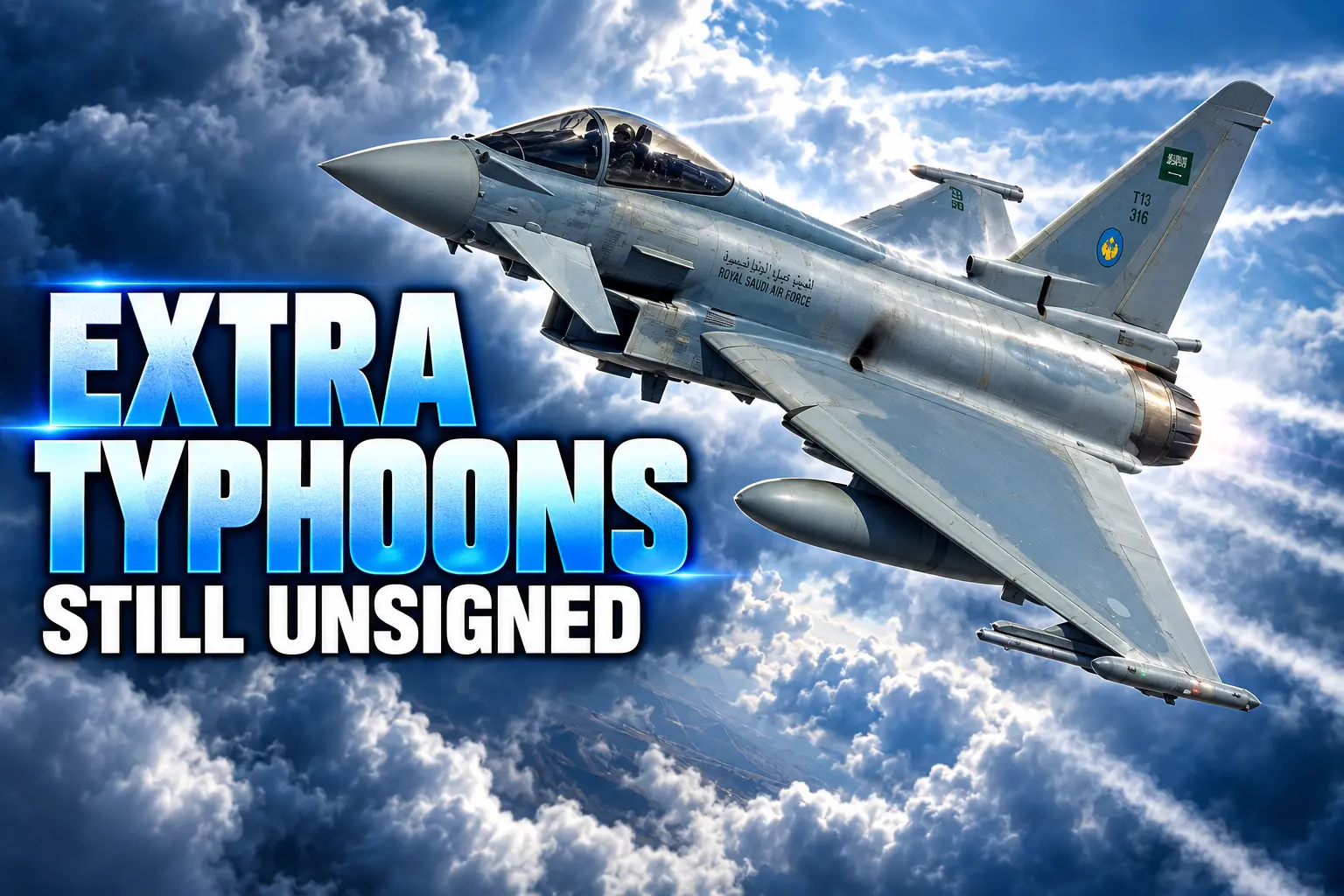
On 21 June 2026, BAE Systems Saudi Arabia said joint engineering teams had completed a 2,500-hour Major Scheduled Servicing on a Typhoon in 180 days at King Fahd Air Base West Sector. The company called it the first such job finished outside the manufacturing nations, a direct move of depot-level work into Taif, where the air force’s Typhoon wing is based.
For the first time outside the manufacturing nations, the 2,500 Flying Hour Major Scheduled Servicing (MSU) for a Typhoon has been completed successfully in Saudi Arabia. Joint engineering teams delivered it in 180 days at King Fahd Air Base West Sector, a major step that cements…
— BAE Systems KSA (@BAESystemsKSA) June 21, 2026
That is the hinge the jet-order story usually skips. Riyadh can now put a Typhoon through a heavy cycle on home ground. BAE still owns the manuals, the tooling pedigree, and the government channel. The Kingdom owns more of the hours.
World Defense Show 2026 reflects how far our partnership with the Kingdom has matured. This year is about more than showcasing capability, it’s about investing in Saudi talent, strengthening local industry, and building a defense ecosystem that is ready for the future. The future of defense in the Kingdom starts with developing Saudi capability today.
Steve Clutton, Managing Director, BAE Systems Saudi Arabia, World Defense Show 2026
Clutton also said more than 100 aircraft parts are already made locally as part of the support package, and that raising that share “is a big part of our offer.” He noted that 22 of the air force’s Hawk 165 trainers were assembled at Dhahran under an earlier deal. Final assembly of new Typhoons, if it comes, would sit on top of a shop that has already done a 2,500-hour cycle.
Washington Cleared 48 Stealth Jets in September
The State Department on 17 September 2026 approved a possible $24.3 billion F-35 package for Saudi Arabia, transmittal 26-69. The request covers 48 conventional-takeoff F-35 Lightning II aircraft and 49 Pratt & Whitney F135-PW-100 engines, 48 installed and one spare, plus training, spares, software, and support. Lockheed Martin Aeronautics in Fort Worth and Pratt & Whitney Military Engines in East Hartford would be the prime contractors.
A clearance is not a contract. The notice goes to Congress, quantities can move in later talks, and the department said it was not aware of any offset agreement at the time of the filing. Any offset, it said, would be defined between the buyer and the contractor. That clause matters in a country whose industrial policy is built on offsets.
The department said the sale would “not alter the military balance in the region,” and that Saudi Arabia would have “no difficulty absorbing this equipment and services into its armed forces.” If the sale is completed, the Kingdom would become the second Middle East operator of the type after Israel. Treating the notice as a purchase, which circulated quickly in public posts the same day, skips that review.
THE FIGHTER FILE ON THE DESK
| Programme | What is on the table | Status |
|---|---|---|
| Project Salam Typhoon | 72 aircraft, fielded from 2008 | Delivered |
| Follow-on Typhoon | 48 aircraft in the March 2018 memorandum | Unsigned |
| Typhoon support | Maintenance through long-term arrangements | In force through the end of 2027 |
| Tornado and Hawk SBDCP | Fleet support and aircrew training | Five-year contract from 2022 |
| Local Typhoon MSS | 2,500-hour servicing at King Fahd Air Base West Sector | Completed 21 June 2026 in 180 days |
| F-35 possible FMS | 48 jets, 49 engines, estimated $24.3 billion | State notice 17 September 2026, not a signed buy |
The British offer Clutton described in February is industrialisation, including assembly in-country. The American notice, as filed, names no offset yet. Riyadh can hold both papers at once. The air force already flies Typhoons with BAE support alongside other combat types, so a stealth buy would add another training and spares pyramid rather than swap one fleet for another.
What 7,000 Saudi Jobs Buy for BAE
Vision 2030 asks foreign contractors to put work, skills, and payroll inside the Kingdom. The General Authority for Military Industries reported military spending localisation of 24.89% by the end of 2024, toward a goal of more than 50% by 2030, leaving a gap of about 25 points. BAE’s Saudi headcount is one of the few Western defence payrolls large enough to show up in that ledger.
Company figures used around the 2026 show put the workforce at 7,000 people in 11 locations, 80% Saudi, including staff at partner companies BAE Systems Arabian Industries and International Systems Engineering. Female representation has reached around 400 women on the Saudi payroll. Clutton signed a University of Tabuk deal for an Industry 4.0 laboratory with the university president, Professor Dr Abdulaziz Salem Saeed Al-Ghamdi, to train students on engineering and digital tools.
BAE was a principal partner of the show’s Future Talent Programme for a third edition, and for the first time the programme ran across all five days. Industry minister Bandar bin Ibrahim Al-Khorayef also visited the stand, a reminder that the customer for this franchise is as much the industrial brief as the air staff.
WHAT BAE HAS ALREADY PUT ON THE GROUND
- Local payroll: 7,000 people at 11 locations, with 80% Saudi nationals in the 2026 company figures.
- Partner firms: Arabian Industries on training and logistics, and International Systems Engineering on sovereign digital work.
- Hawk assembly: 22 Hawk 165 trainers put together at Dhahran, per Clutton.
- Parts load: More than 100 aircraft parts already manufactured in the Kingdom, with a higher share in the Typhoon offer.
- Depot work: A 2,500-hour Typhoon major servicing completed at Taif in 180 days on 21 June 2026.
Those items are harder to unwind than an unsigned memorandum. They also cut the other way. Once Saudi crews can do a 2,500-hour cycle at Taif, the next airframe buy is a choice among suppliers, not a necessity to keep the present fleet in the air.
Warton Still Needs a Saudi Signature
The overlooked party on the British side is the Typhoon line that feeds GCAP, the UK-Italy-Japan next combat aircraft. A House of Commons Library briefing puts the UK industrial workshare on Typhoon at 37% and counts 20,800 UK jobs on Typhoon, with an Oxford Economics study for BAE estimating a £1.6 billion contribution to UK GDP in 2020.
In October 2025 Turkey agreed to buy 20 Typhoons in a deal worth up to £8 billion, the first UK export order for the type since 2017, with first delivery expected in 2030. Woodburn said the Turkish contract would “preserve crucial sovereign skills which underpin the UK’s defence and security.” Luke Pollard, then minister for defence readiness and industry, told the Commons the Türkiye order “helps fill a gap in the production line between our current Typhoon orders and the production of GCAP platforms in the future.”
A Saudi follow-on of 48 aircraft would have been a larger fill. It still would. Germany, Spain, and Italy have placed their own extra-Typhoon orders, and UK workshare on those jets follows the same 37% split. None of that converts the 2018 Saudi memorandum. Clutton’s brief in Riyadh remains to keep the government channel open while the Taif shop proves the industrial chapter of Vision 2030 without a new airframe lot.
The 2027 Support Clock Is Already in View
Two British clocks now share a year. Typhoon support runs through the end of 2027. The 2022 Tornado and Hawk training contract is a five-year deal, so that file comes due in the same window. Renewal is where the 7,000-person workforce, the Taif servicing line, and the unsigned 48-jet memorandum meet the F-35 notice.
WHAT WE KNOW
- The fleet: 72 Salam Typhoons were contracted and fielded from 2008, with support arrangements running through the end of 2027.
- The memorandum: 48 extra Typhoons have been in government talks since March 2018 and were still unsigned at the February 2026 show.
- The shop: The 2,500-hour Typhoon servicing at King Fahd Air Base West Sector was completed on 21 June 2026 in 180 days.
- The US notice: 48 F-35s and 49 engines, estimated at $24.3 billion, were cleared on 17 September 2026 as a possible sale, with no offset named in the filing.
WHAT IS UNCONFIRMED
- The follow-on: Whether London and Riyadh convert the 2018 memorandum, and whether any deal includes in-country Typhoon final assembly.
- The stealth track: Whether the F-35 notice survives Congress and becomes a signed Foreign Military Sale, and on what offset terms.
- The 2027 files: The duration, scope, and localisation terms of any Typhoon, Tornado, and Hawk support that replaces the arrangements now in force.
Clutton is still, in his own words, supporting the UK government on a requirement that has been in motion since 2018. The shop in Taif can now do work that used to leave the Kingdom. Washington has put 48 stealth jets on the table with no offset yet named. The 2027 support file is the next one that has a date on it.

Cook Hands Democrats the House as Crypto’s Bill Stays Dead

Wicker’s Broken Bed Was the Short Story’s Punch Line

Nvidia’s $500 Billion Financing Plan Draws a $180 Sell

Maserati Bets the Grecale V6 Can Fill Porsche’s Gap

EV Cable Theft Follows the Old Railway Copper Playbook

Aramco Crash Kills 14 Two Days After Oil Restart

Salah Captained Egypt to Their First World Cup Win

Zelda’s 40th Switch 2 Ships Without a Zelda Game

Apple Labor Day Deals Hide June’s Memory Price Hike

Palworld 1.0.4 Adds Palpedia Search After the 1.0 Launch
-
 BUSINESS4 months ago
Aramco Crash Kills 14 Two Days After Oil Restart
-
 NEWS5 months ago
Salah Captained Egypt to Their First World Cup Win
-
 GAMING2 months ago
Zelda’s 40th Switch 2 Ships Without a Zelda Game
-
 NEWS2 months ago
Apple Labor Day Deals Hide June’s Memory Price Hike
-

 NEWS4 months ago
El Niño Puts Israel’s Needed Winter Rain on a Flood Clock
-
 GAMING2 months ago
Palworld 1.0.4 Adds Palpedia Search After the 1.0 Launch
-

 BUSINESS8 months ago
Egypt Bets EGP 638 Billion Can Open Sinai to Investors
-

 ENTERTAINMENT2 months ago
King Charles Letter Keeps Harry and Meghan as Private Citizens