
AUTO
Hyundai’s Next Porter Grows a Nose After EV Sales Slip
A camouflaged Porter EV on European roads is the rebuild of Korea’s 1-ton truck, not a first electric, after cabover range and sales both slipped.

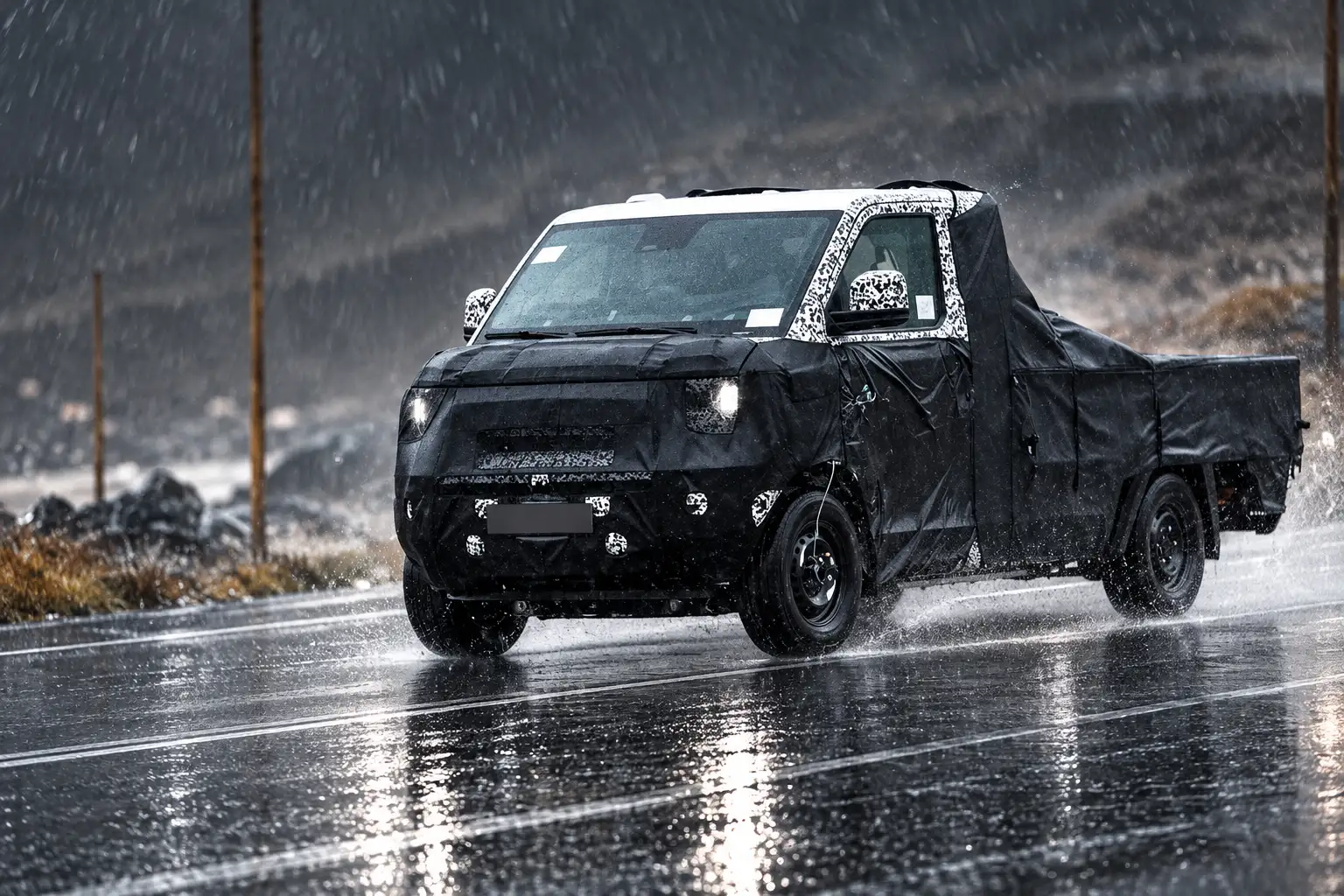
A camouflaged Hyundai Porter EV test mule has been photographed on a wet European road, with a longer nose than the cabover truck Korea still sells. The shots, credited to Baldauf and published on October 21 and 22, 2026, look like a cheap mini pickup teaser. They are better read as the first public view of a truck Hyundai has to replace.
The Porter, also badged H-100, has been Hyundai’s small cabover workhorse since 1977. The fourth generation has been on sale since 2004, and an electric version has been in Korean showrooms since December 2019. The mule is an all-new shape, not a first attempt at a plug.
The Mule on a Wet European Road
Most of the body is wrapped. A tarp covers the bed. Even so, the silhouette has already moved away from the flat-faced cabover that still defines the Porter II. The front sits more like a small van than a truck with the driver over the axle, a change SlashGear’s gallery compared with a Ford Transit snout.
Photographers caught the truck plugged into a charger, which is the cleanest sign the prototype is electric. They did not get a look at the charger screen, so charge speed is still a guess. Writing on a chassis rail has been read as four-wheel drive, which would be new for the electric Porter Korea sells now.
WHAT THE WRAPS STILL SHOW
- Longer nose: The cab sits behind a short crumple zone instead of over the front wheels.
- Boxier glass: A flat windshield and upright side windows replace the old cabover’s rounded greenhouse.
- Square lamps: Headlight cutouts and small intakes are visible under the camouflage.
- Long bed, small cab: The photographed truck looks like an extended-cab, long-bed work spec, not a lifestyle pickup.
A gasoline twin has been floated as the volume model for markets that still want a cheap 1-tonner. Hyundai has not confirmed that, or a European on-sale date. The location of the test still matters, because the new nose is the shape Europe now requires.
Korea Already Sells an Electric Porter
Call the mule a surprise only if the current truck has stayed off your map. Hyundai Motor Group put a refreshed 2025 Porter II Electric on sale on March 12, 2025, with a 60.4 kWh lithium-ion pack, a claimed 217 km of range, and a 135 kW motor. The English catalog quotes 395 Nm of torque and calls the model an electric truck optimized for urban use.
The 2025 update was a running change on a cabover, not a new platform. Hyundai thickened high-voltage cables so a 150 kW charger could cut fast charging to 32 minutes from 10 to 80 percent, down from 47 minutes. Range rose 6 km. Battery ground clearance went up 10 mm after rural buyers scraped packs on dirt roads, and Hyundai added a lamp over the charge port for night plugging.
2025 PORTER II ELECTRIC IN KOREA
| Trim | Price (won) | What Hyundai changed |
|---|---|---|
| Style Special | 43.25 million | New cheaper trim, some heat and paint items removed |
| Smart Special | 44.60 million | Mid spec; Style undercuts it by 1.35 million won |
| Premium Special | 46.20 million | Top cab spec on the extra-long super cab |
| Battery / range | 60.4 kWh / 217 km | Lighter cells, 6 km more than the prior pack |
| DC charge | 32 min, 10 to 80% | 150 kW charger, thicker high-voltage wiring |
Those prices sit far above the LPG Porter. Hyundai still sells the fossil cabover as the cheap truck. The electric one is the urban, subsidy-sensitive spec, and even with a new bargain trim it has not held the volume the diesel years produced.
The National Truck Has Lost Its Peak
In Korea the Porter is still called a national truck, the 1-ton workhorse of shops, farms, and last-mile depots. That status has been shrinking in a straight line. Hyundai sold 97,675 Porters in 2023, then 69,267 in 2024, a 29 percent drop. Full-year 2025 sales were 56,538, down another 18.4 percent, leaving the nameplate eighth in the Korean ranking.
The electric half fell faster. Porter EV sales went from 25,799 in 2023 to 11,212 in 2024. Hyundai cut the 2025 production target to 80,000 trucks, 24 percent below the 105,600 target it had used the year before, after building 82,570 in 2024. Focus2move’s 2026 tally through September still has the Porter ninth among Korean models, down 13.4 percent, so the slide has not reversed.
PORTER SALES IN KOREA
| Year | Porter sales | Change |
|---|---|---|
| 2023 | 97,675 | Peak recent year |
| 2024 | 69,267 | Down 29 percent; EV 11,212 |
| 2025 | 56,538 | Down 18.4 percent; eighth overall |
Koo Kwang-bon, the Hyundai director in charge of Porter production at Ulsan, put the causes on a plant notice in early 2025: weaker orders from small firms, the switch off diesel onto LPG, and electric-truck safety worries. The fourth generation has been asked to absorb all three hits without a new cab or a new pack layout. The Europe mule is what a company photographs when that strategy runs out.
Why the New Cab Grows a Nose
An electric Porter does not need a long hood for an engine. It still needs one if Hyundai wants the next truck past European crash law. Regulation (EU) 2019/2144, the General Safety Regulation, now treats light commercial vehicles like small trucks, not farm tools. Stage C rules for new types took effect on July 7, 2024. From July 7, 2026, they apply to every vehicle registered for the first time.
Among those rules is an enlarged head impact protection zone for cars and light commercial vehicles, written through UN Regulation No. 127, so a pedestrian or cyclist hitting the front has a designed crush structure instead of a vertical cab face. The same stage asks automatic emergency braking to see people and bikes, not only other cars. A cabover with the driver over the axle has almost no room for that structure.
THE CRASH RULES THAT FORCE THE SNOUT
- July 6, 2022: The General Safety Regulation becomes mandatory across EU member states.
- July 7, 2024: Stage C applies to all new vehicle types, including the bigger pedestrian head-impact zone.
- July 7, 2026: Stage C applies to all vehicles registered for the first time, which is the gate a new Porter would have to clear.
That timetable is why a Korean 1-tonner is wearing a van nose on a European public road. Testing there is the cheapest way to prove the new cab. It is not, by itself, a launch plan for France or Germany. Current Porter markets still run through Korea, Chile, Peru, Brazil, and other parts of Asia and Africa, where the old cabover remains legal and cheap to build.
The Sister Van Taking Electric Deliveries
Inside Hyundai Motor Group, the electric work has already moved. Kia’s PV5, a purpose-built van on the group’s E-GMP.S skateboard, is on sale with 51.5 kWh and 71.2 kWh long-range battery packs. The long-range van is rated at 416 km on the WLTP cycle, with a 120 kW motor, 250 Nm, and DC charging up to 150 kW. Kia has said a chassis-cab PV5 follows in 2026, which is the body a bed or box installer actually wants.
Spy coverage of the Porter mule says it may pick up parts from that van. Treat that as a hunch until Hyundai shows a cutaway. What is not a hunch is the product split: the PV5 was designed as an electric commercial from the floor up, while the Porter II Electric is still a 2004 cabover with a pack underneath. Kia is aiming at 150,000 PV5s a year by 2030. The Porter EV, in the same group, just came off a year of 11,212 Korean sales.
Ford’s Fathom, the $28,350 electric pickup due in 2027, sits in a different argument. That truck is a lifestyle midsize aimed at American crossover buyers. The Porter is a 1-ton tool. Comparing them because both are “cheap EVs” flattens two jobs into one headline. Hyundai’s problem is the tool, and the tool is being beaten at home by a van from its sister brand.
217 km Leaves Little Spare for a Workday
Hyundai’s own catalog frames the current electric Porter as a city truck, and the 217 km rating shows why. A loaded 1-ton route that runs past 200 km leaves almost no buffer for cold weather, a fridge box, or a detour. Buyers who used to fill a diesel tank and disappear for a day now have to plan a mid-shift plug. That is a hard sell when time is the profit.
Sales have been falling due to the decline in purchasing power caused by the slowdown in income growth of small business owners last year, the decline in sales since the conversion to LPG, and electric vehicle safety issues.
Koo Kwang-bon, Hyundai Motor director in charge of Porter production, Ulsan plant notice
The 2025 wiring fix and the 10 mm pack lift were answers to complaints, not a new truck. Charging in 32 minutes helps a depot that has a 150 kW post. It does not give a shop owner a second shift of range. If the Europe mule shares the PV5’s larger packs, the next Porter could finally treat 217 km as the floor it never should have been. If it keeps the old cabover battery in a new nose, the crash cab will have been expensive theater.
Hyundai Has Not Confirmed a European On-Sale Date
Nothing in the wraps says the next Porter will be sold in Western Europe, and Hyundai has not issued a product brief. The United States is an even thinner case. The company already builds the Santa Cruz as its compact pickup there, and a 1-ton cab-forward truck has no obvious dealer slot. Weirder exports have happened. This one would still need a crash cab, a charging plan, and a price that undercuts vans already on the ground.
WHAT WE KNOW
- The mule is electric: It has been photographed on a charger in Europe in October 2026.
- The cab is new: The front is longer and more van-like than the 2004 cabover.
- An EV Porter already exists: Korea has sold one since December 2019; the 2025 truck uses a 60.4 kWh pack and is rated at 217 km.
- The old truck is shrinking: Korean Porter sales fell from 97,675 in 2023 to 56,538 in 2025.
WHAT IS UNCONFIRMED
- Europe on sale: Testing there proves crash work, not a dealer plan.
- Shared PV5 hardware: E-GMP.S parts are a reasonable guess, not a specification.
- Four-wheel drive: Chassis-rail notes have been read that way; Hyundai has not said so.
- A gasoline twin: Spy coverage expects one; there is no brochure.
The next Porter has to do a job the 2004 truck can no longer do: carry a 1-ton load, clear a European crash test, and finish a workday without a second plug. The wet, wrapped mule with the new snout is the first picture of that rebuild, not a cute first EV.

Cook Hands Democrats the House as Crypto’s Bill Stays Dead

Wicker’s Broken Bed Was the Short Story’s Punch Line

Nvidia’s $500 Billion Financing Plan Draws a $180 Sell

Maserati Bets the Grecale V6 Can Fill Porsche’s Gap

EV Cable Theft Follows the Old Railway Copper Playbook

Aramco Crash Kills 14 Two Days After Oil Restart

Salah Captained Egypt to Their First World Cup Win

Zelda’s 40th Switch 2 Ships Without a Zelda Game

Apple Labor Day Deals Hide June’s Memory Price Hike

Palworld 1.0.4 Adds Palpedia Search After the 1.0 Launch
-
 BUSINESS4 months ago
Aramco Crash Kills 14 Two Days After Oil Restart
-
 NEWS5 months ago
Salah Captained Egypt to Their First World Cup Win
-
 GAMING2 months ago
Zelda’s 40th Switch 2 Ships Without a Zelda Game
-
 NEWS2 months ago
Apple Labor Day Deals Hide June’s Memory Price Hike
-
 GAMING2 months ago
Palworld 1.0.4 Adds Palpedia Search After the 1.0 Launch
-

 NEWS4 months ago
El Niño Puts Israel’s Needed Winter Rain on a Flood Clock
-

 BUSINESS8 months ago
BAE’s 60-Year Saudi Franchise Now Runs Through Taif
-

 BUSINESS8 months ago
Egypt Bets EGP 638 Billion Can Open Sinai to Investors