
NEWS
iPhone Duo Screens Are Cracking Along the Hinge on Day One
Launch-day iPhone Duo units are splitting along the hinge, the same weak point that delayed Samsung’s first Fold, while Apple Stores swap phones on the spot.

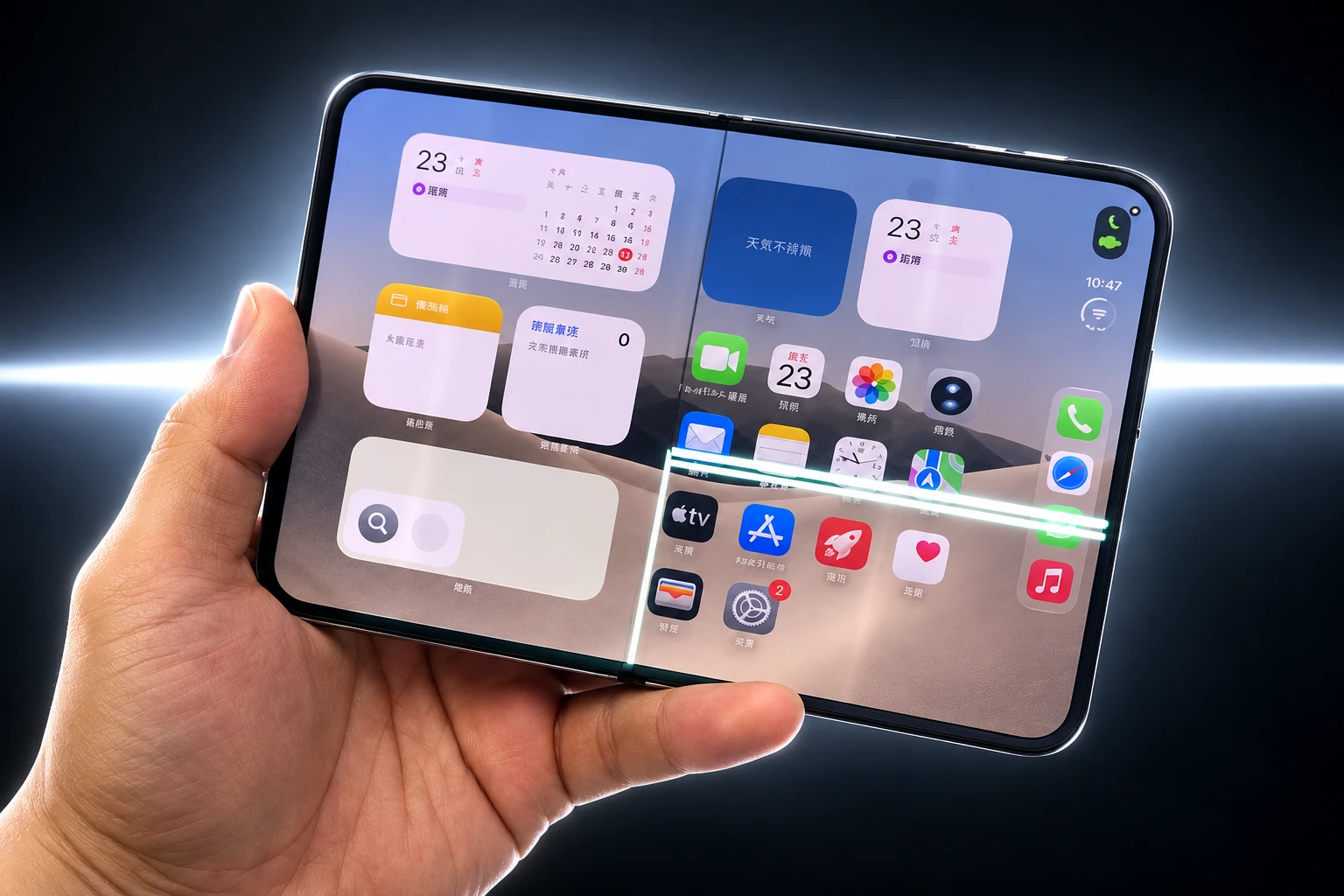
A handful of iPhone Duo inner screens cracked along the hinge on Oct. 23, the phone’s first day on sale, after as few as 20 folds. The damage sits in the same place on each unit: a split down the fold and a bright line of dead pixels running across the right half of the 7.6-inch display.
An owner in Australia had the phone about six hours. An Apple Store swapped it before closing. Apple issued no public comment on Oct. 23 or Oct. 24, and nobody has shown how common the fault is.
Inner Screens Are Splitting Along the Hinge
The pattern is ugly because it is boring. Photos from Australia, China, the United States, Canada, and Japan show the inner panel failing along the crease, then throwing a bright band toward the right edge. Demo units in some Chinese stores have shown the same line.
The clearest account came from a Reddit user posting as Midnight_Slump, whose broken phone and replacement paperwork were later checked by r/iPhoneDuo moderators. They marked the claim verified. They did not claim they could prove why the glass failed.
Had my iPhone Duo for about six hours and had probably opened it fewer than 20 times. I was showing it to a friend, and as I opened it, I felt something around the internal hinge, underneath the screen. As I continued opening it, I heard an audible crack, and the screen broke right along the hinge. There were no marks or damage on the inner screen’s surface or the external hinge to suggest anything had been caught or damaged.
Midnight_Slump, iPhone Duo owner, r/iPhoneDuo
The owner called Apple first and was offered an express replacement that required a hold for the full cost of the phone, with no promised arrival date. The store path was faster. Staff saw the unit, apologised, and put a new Duo in the owner’s hands that night.
“Day zero, six hours of ownership, and already on my second phone,” the owner wrote. Most of that first evening had gone to restoring iCloud data. The crack arrived while the phone was being shown to a friend, not after a drop. A lead technician said Apple would inspect the failed unit, which is how the company studies early field failures on a new product.
Other owner photos match the same geography of damage even when the write-ups are thinner. One Reddit user collected several of those pictures in a single thread. A separate post added a video of another broken inner screen. Viral posts treated that pile as a wave. The documented pile is still a handful of phones plus some store demos, which is not a recall file. It is also not nothing, because the break is repeating in one place.
The 2019 Fold Failed in the Same Place
Samsung’s first Galaxy Fold, a nearly $2,000 book-style phone, did this in public seven years ago. Review units went out in April 2019. Within a day or two, inner screens were flickering, tearing, or going dark. Samsung delayed the April 26, 2019 launch, pulled the samples, and spent months on a redesign.
The kill shots were not mystery software. Samsung said early inspections pointed to impact on exposed areas at the top and bottom of the hinge, and to substances that had gotten inside and affected the display. iFixit’s teardown of that phone found a 7 mm gap at the fold and called out debris under a folding OLED as a short path to a dead panel. OLED stacks fail as a sheet once the thin encapsulation layer is breached. A bulge under the crease was enough, on at least one unit, to press through and kill the image.
Midnight_Slump’s “something around the internal hinge, underneath the screen” is that sequence in plainer clothes. Feel a lump, hear a crack, watch a bright line bloom along the fold. The chemistry of a folding OLED has not been repealed because the badge on the hinge cover now says Apple.
THE FIRST FOLDABLE SCREEN FAILURES
- April 2019: Galaxy Fold review units fail within one or two days, with hinge-line damage, flickering, and at least one bulge under the crease.
- April 26, 2019: Samsung delays the public launch and takes the samples back to reseal the hinge and protect the panel.
- Sept. 9, 2026: Apple unveils iPhone Duo and sells a Grade 5 titanium foldable as built for daily wear, with no published fold-cycle rating.
- Oct. 23, 2026: iPhone Duo goes on sale. Owner photos show inner screens splitting along the hinge after a few hours and fewer than 20 opens.
- Oct. 24, 2026: Apple still has issued no public comment. A separate torture-test video stresses the same crease and hinge gap.
Samsung’s delay was the expensive lesson of that first cycle: ship a folding OLED before the hinge is sealed and you will do your durability testing on camera. Apple waited until 2026, then put the phone in customers’ hands on a Friday. The failure mode that showed up by nightfall is not a new species of bug. It is the old one, arriving after the unboxing instead of before the launch party.
Apple Built a Hinge With 100 Parts
Apple did not sell iPhone Duo as a fragile prototype. The company priced the 256GB model from $1,999 and wrapped the fold in the same durability language it uses on slab iPhones.
The newsroom pitch is specific. The frame is Grade 5 titanium. The hinge cover is 3D-printed from 100% recycled titanium, and the enclosure uses 85% recycled titanium. Ceramic Shield 2 sits on the outer front, Ceramic Shield on the back. The phone is rated IP68 to a maximum depth of 6 meters for up to 30 minutes. Open, it is 5.2 mm thick. Closed, it is 11.3 mm. It weighs 254 g. The hinge is engineered from more than 100 components to control the open-close feel and support the center of the display.
The inner screen is a 7.6-inch Super Retina XDR OLED, 1878-by-2670 pixels at 430 ppi, with a nano-texture finish. Apple says that panel is made of more than 10 ultrathin layers. A custom polymer cover, described as up to 40% stiffer than other materials used in the industry, sits over high-strength glass above and below the folding stack, with adhesives meant to let those layers slide like pages in a book, and a titanium plate underneath. The company told buyers the inner display is designed to withstand the wear of everyday use.
Tom Marieb, Apple’s vice president of hardware engineering, went further in September. Asked whether the crease would become more obvious with age, he invited the test.
Hold us accountable to that, please.
Tom Marieb, vice president of hardware engineering, Apple
He said the matte nano-texture was chosen in part because a glossy panel makes small changes in the surface easy to see, and because the dull finish should be more forgiving if the hinge area shifts over time. He also said he was especially proud of the hinge, and that Apple spent a long time on the torque so the open and close would feel solid, like shutting a high-end car door. Apple’s own product page still answers “Is iPhone Duo a durable foldable phone?” with a yes. It lists the titanium, the IP68 rating, and Ceramic Shield. It does not list a fold-cycle number.
A crease getting easier to see over months is the question Marieb volunteered to own. A panel that splits after six hours and fewer than 20 opens is a different question. Everyday use, on at least one sold unit, did not last a day.
The Repair Menu Runs From $49 to $1,499
Apple published U.S. service estimates before the phone went on sale, and they split the folding screen into two very different bills. A scuffed cover layer is a cheap, named job. Damage through to the inner display is half the price of the phone.
THE IPHONE DUO SERVICE MENU
| Repair | Without AppleCare+ | With AppleCare+ |
|---|---|---|
| Cover layer | $49 | $19 |
| Outer display | $379 | $29 |
| Inner display | $999 | $99 |
| Other damage | $1,499 | $99 |
AppleCare+ for iPhone Duo is $19.99 a month, $199.99 a year, or $399 up front in the U.S. The $99 inner-display fee is the number that makes the plan look cheap the first time the crease fails. Skip the plan and the same part is priced as inner display damage at $999, which is 50% of the $1,999 starting price. The “other damage” cap is 75% of that price.
INNER DISPLAY FEE AGAINST OTHER FOLDABLES
| Phone | Inner display repair |
|---|---|
| iPhone Duo | $999 |
| Pixel 11 Pro Fold | $568 |
| Galaxy Z Fold 8 | $579 or $419 |
iFixit’s comparison used Apple’s list, Google’s repair estimator, and Samsung’s two official screen options for the Z Fold 8. Apple’s folding panel is the expensive one in that set, which is another way of saying the part is hard to make and hard to swap. Independent shops will not be cheaper until they can buy the assembly and learn the job. For now the official door is Apple, and Apple’s hinge guide does not pretend there is a software trick. Technicians are told there are no diagnostics or software remedies for hinge trouble. If cleaning, case removal, and a look for dust do not fix it, the step is to replace the inner display assembly.
Stores Swapped Phones the Same Night
The Australian case is also a map of Apple’s two support tracks. Phone support treated the failure like a mail-in exchange: authorize a hold for the full price, wait for a box, hope the calendar is kind. The Apple Store treated it like a defective new phone and cut a replacement before close, at no charge.
That is the piece Samsung did not have in April 2019. The Fold never reached a Friday night retail floor in that first form. Apple already has stores, inventory, and a one-year limited warranty sitting on top of a 14-day return window. Several other owners who took a cracked Duo into a store also left with a new one the same day, according to their own posts. One U.S. shop told a customer it was the first broken Duo they had seen that day, which is a useful sentence and a useless statistic. It confirms the staff had a process. It does not tell you the rate.
The hold on the phone’s full cost is not a repair fee. It is collateral while Apple ships a replacement. People who cannot float $1,999 on a card, or who do not live near a store, get the slower path. People who can walk in get the 2019 problem with a 2026 concierge. That gap will matter more than any press line if the fault is more than a bad batch, because the expensive part is the inner display and the cheap part is a swap from a drawer in the back.
Apple collecting the broken units is the other quiet tell. Early field failure analysis is how a company decides whether it is looking at a few pinched panels, a hinge-tolerance miss, or debris that the IP68 seals did not stop at the crease. Until that work is done, every confident claim about “design defect” or “user error” is guessing.
How a Bright Line Changes the Bill
The photos are easy to misread. A white band can look like a reflection, which is why Midnight_Slump had to keep saying it was a band of dead pixels, not a fluorescent tube in the room. It can also look like a scratch on the replaceable cover layer, which is the $49 job, when it is actually the $999 panel underneath. Apple’s hinge page already tells technicians to look for particles or dust along the hinge and for dents on the enclosure. That checklist exists because a folding phone has places a slab phone does not.
IF THE INNER SCREEN SHOWS A LINE
- Stop folding it: Another open-close cycle is how a bulge under the crease becomes a full split.
- Shoot the evidence: Photograph the line, the hinge with no marks, and a short video of the open motion, then keep the box and receipt.
- Skip the mail-in hold if you can: A store visit is what turned a full-price authorization into a same-night swap in the verified Australian case.
- Name the part: A scuffed cover layer and a cracked inner display are different repairs on Apple’s menu, and mixing them up is how a warranty visit turns into an accidental-damage quote.
- Use the return window: Apple’s standard 14-day return still applies to a phone this new, which is a cleaner exit than arguing about a hinge after the mood in the store changes.
A manufacturing crack from normal folding should be a warranty conversation, not an AppleCare+ claim. Accidental damage is the other door, and that is the door with the four-figure prices. The owner’s job is to make the first visit look like the first thing. No pocket grit story, no drop, no third-party case fighting the hinge. Apple’s own steps already ask whether a case or a screen protector is in the way.
Grit in the Hinge and Green Test Lines
A separate video from JerryRigEverything circulated on Oct. 24 and got folded into the same panic, which is sloppy. That clip is a torture test, not a launch-day unboxing. In it, the inner panel marked under a light pick, grit in the hinge stopped a clean close, and a bend test left green lines on the fold. Those are abuse results. They still land on the same two parts every first foldable has struggled to protect: a polymer-covered OLED and a hinge that has to move without eating dust.
The loud public take, including on X, is that nobody should buy a version-one foldable. Samsung owners have been repeating that joke since Friday night. The quieter take is more useful. Play4Index and similar posts described phones “breaking in large numbers” after “a few days.” The verified clock is hours, and the counted cases are still a handful plus demos. Stretching that into a wave is how a real hardware rhyme with 2019 becomes a fake recall.
WHAT WE KNOW
- The break: Inner screens are splitting along the hinge and throwing a bright line across the right half of the 7.6-inch panel.
- The clock: One verified owner had the phone about six hours and opened it fewer than 20 times, with no marks on the surface or outer hinge.
- The fix Apple used: At least one Apple Store replaced the phone on the spot at no charge after phone support asked for a full-price hold.
- The official path: Apple’s hinge guide ends in a new inner display assembly, not a software patch.
WHAT IS UNCONFIRMED
- The rate: No public count of failed units, and no way to separate a bad batch from a design miss.
- The cause: Debris, a pinch in the stack, a hinge-tolerance error, or something else. Moderators verified the Australian phone, not the physics.
- A product change: Apple has not said whether it is revising the inner display assembly or the hinge.
- A company line: Apple issued no public comment on Oct. 23 or Oct. 24.
The Australian owner left the store on a Friday night still signing into apps, on a second Duo, with the first one headed for inspection. That is the whole launch so far: a $1,999 foldable that can die along the crease in an evening, and a retail machine ready to pretend the evening never happened.

Cook Hands Democrats the House as Crypto’s Bill Stays Dead

Wicker’s Broken Bed Was the Short Story’s Punch Line

Nvidia’s $500 Billion Financing Plan Draws a $180 Sell

Maserati Bets the Grecale V6 Can Fill Porsche’s Gap

EV Cable Theft Follows the Old Railway Copper Playbook

Aramco Crash Kills 14 Two Days After Oil Restart

Salah Captained Egypt to Their First World Cup Win

Zelda’s 40th Switch 2 Ships Without a Zelda Game

Apple Labor Day Deals Hide June’s Memory Price Hike

Palworld 1.0.4 Adds Palpedia Search After the 1.0 Launch
-
 BUSINESS4 months ago
Aramco Crash Kills 14 Two Days After Oil Restart
-
 NEWS5 months ago
Salah Captained Egypt to Their First World Cup Win
-
 GAMING2 months ago
Zelda’s 40th Switch 2 Ships Without a Zelda Game
-
 NEWS2 months ago
Apple Labor Day Deals Hide June’s Memory Price Hike
-
 GAMING2 months ago
Palworld 1.0.4 Adds Palpedia Search After the 1.0 Launch
-

 NEWS4 months ago
El Niño Puts Israel’s Needed Winter Rain on a Flood Clock
-

 BUSINESS8 months ago
BAE’s 60-Year Saudi Franchise Now Runs Through Taif
-

 BUSINESS8 months ago
Egypt Bets EGP 638 Billion Can Open Sinai to Investors