
LIFESTYLE
Nadine El Scottish-Egyptian Modest Fashion: How to Build the Look
Nadine El Scottish-Egyptian modest fashion starts with a plain base, then one tartan piece and one Egyptian accessory, so the mashup stays easy to read.

You keep seeing modest fashion in one mood, soft pink and very feminine. Nadine El Scottish-Egyptian modest fashion takes another route: a plain base, one tartan piece, and one Egyptian piece.
She grew up in Kilmarnock with Egyptian parents, and the modest pictures online never looked like her life. She later styled three outfits in Zamalek that show the mix in real clothes. This page covers her story, how to build the look, what sits in each outfit, where those pieces come from, and who it suits.
What This Modest Look Is Made Of
Modest fashion, in the modest fashion in UK working life project at London College of Fashion, means religiously related dress and behaviour, including for women whose own belief is not why that code is in the room. On Nadine El the code is personal. She covers her hair, keeps the shapes modest, and still wants the clothes to sound like her.
The version she kept meeting online was soft pastels, pinks and a hyper-feminine finish. She has said she never related to that, and that wearing the headscarf felt as if it would cost her a bit of her personality. Around 2020 she started wearing it anyway, and she built the outfits from the two places she already had.
THE TWO ANCHORS
- The base: A plain T-shirt, quiet trousers or a simple dress, in a colour that does not fight the pattern you add.
- Scotland: One tartan piece, the way her third outfit uses a tartan skirt, and then no second check.
- Egypt: One coin belt, coin skirt, souq necklace or ankh, so the eye has a single place to land.
She puts it in one line of her own: she sees her identity through her clothes. Tartan does the Scottish job, coin belts and jewellery do the Egyptian job, and the layering is what makes a Glasgow winter look dressed on purpose.
A Kilmarnock Childhood With Two Sets of Clothes
Kilmarnock is a small town outside Glasgow, and her family settled there when the Egyptian community was almost nonexistent. She calls the childhood a very niche and interesting experience, the kind that makes people pause when they hear her speak and only then clock that she is both Scottish and Egyptian.
School made the split obvious. She remembers it as her, her sister, “two Iraqi sisters and two Pakistani sisters” among about a thousand students. Home was conservative. The school around her was white and Scottish. She has called the identity crisis real, and also character building.
With too much personality and not enough local company, she went online and stayed there. She describes herself as an internet kid who has been chronically online for as long as she can remember, living in Twitter, Tumblr, fan pages and group chats. A Justin Bieber follow on one of those fan accounts is the small story she tells about those years. Online she also found Egyptians and Muslims who knew the daily work of belonging, which the town had not offered her.
Fashion was already a love, and she says she did not use it on purpose until the headscarf. The clothes became the place where the two halves could sit in the same outfit without a speech attached. That is why the later Zamalek shoot is full of markets, vintage rails and high-street basics, rather than one designer’s idea of modest dress.
How to Put the Pieces on a Plain Base
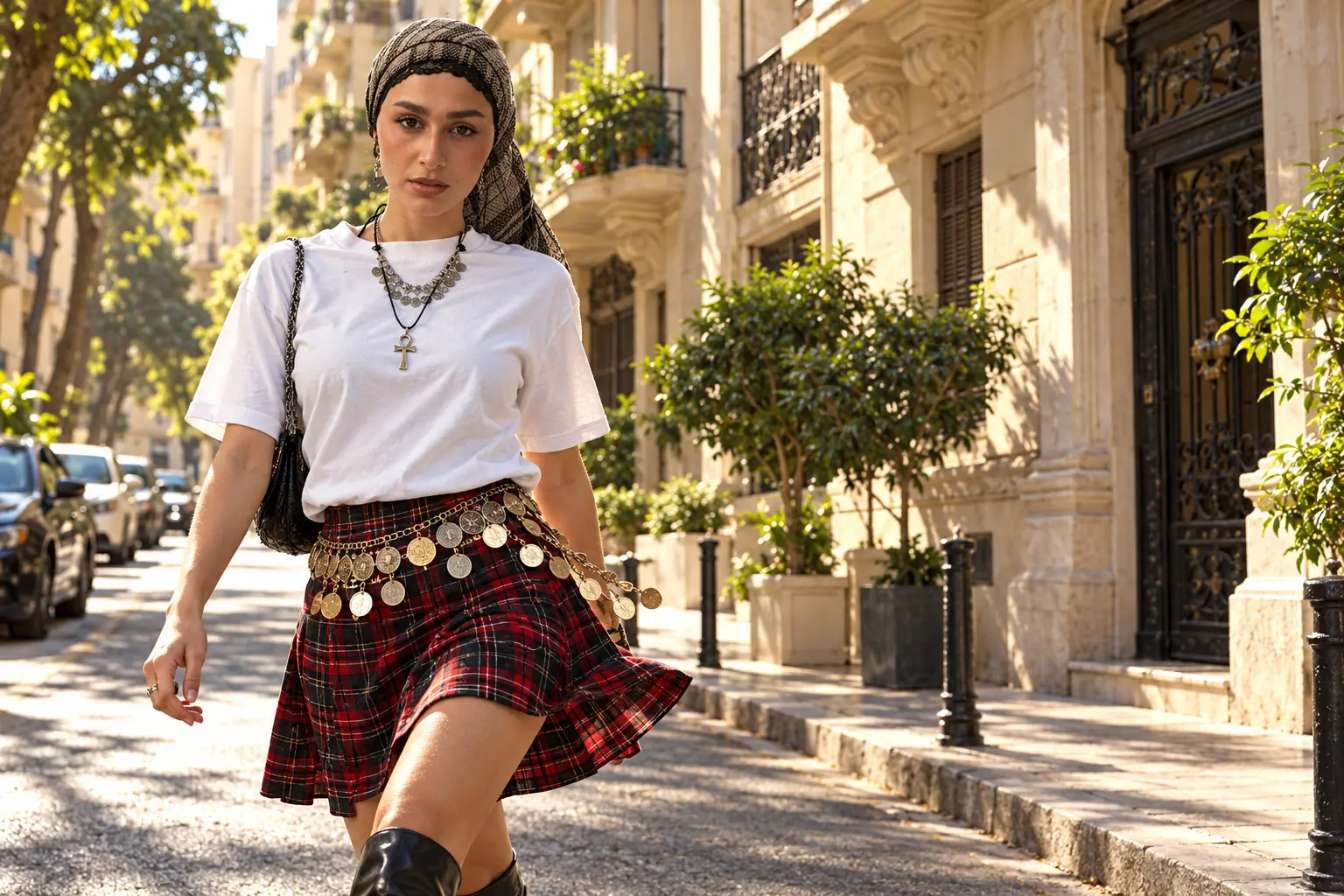
The third outfit is the clearest lesson, because the credit list is long and the sentence she wrote about it is short. She pairs tartan details with a traditional coin belt, and she grounds them with a simple base so those cultural pieces take the lead. If you copy every line of the credits, you get three skirts and two necklaces. If you copy the sentence, you get a look someone else can read.
- Start with a plain base you would wear with nothing on it, such as the H&M T-shirt in that third outfit, plus boots you can walk in.
- Add one Scottish piece. For her that is tartan, because Kilmarnock is the Scottish half of the childhood, not a theme she borrowed.
- Add one Egyptian piece in a different texture: a coin belt, a coin skirt, or an ankh from Khan el-Khalili.
- Check the base again. If a third pattern has crept in, take it off so the T-shirt or the trousers can stay quiet.
- Walk in it. She wants people to do a double take and say they are not sure they like it, which is a test of nerve, not a test of how many cultures you can stack.
Use the full credit list when you want the photographed version, with the black layered skirt and the extra necklace. Use the two-anchor version on a normal day, when you only own one tartan thing and one metal belt. Both are hers. The second one is the one that survives outside a styled shoot.
Three Outfits From the Zamalek Shoot
In a July 2026 feature she styled three looks against Zamalek, using the old apartment blocks and the street energy as the brief. A short film of those outfits shows how the layers move, which a still photograph crops away.
Each look has a job. The first is Cairo’s noise, held at a comfortable volume. The second is Zamalek tailoring with a market edge. The third is the Scottish-Egyptian sentence in clothes.
Cairo Chaos in the First Outfit
She took Cairo’s layered chaos, the mix of textures, prints and energy, and turned it into a balance of feminine and masculine that still felt comfortable. Comfort is the brake. Without it, “layered chaos” is just a pile of prints.
- The zipper: A zipper piece from the London streetwear line at Zidouri, the London brand she names in the credits.
- The lace: A lace dress and vest from ASOS, which supplies the feminine side of the balance.
- The trousers: Lotus balloon trousers from Free People, loose enough that the lace does not become a costume.
- The finds: A necklace and a bag thrifted from souqs in Marrakesh, and shoes from Vinted.
If you rebuild this one at home, keep the loose trouser and one delicate layer, then stop. A second print on the shoes or the bag will shout over the zipper she used as the strange note.
Zamalek Tailoring in the Second Outfit
Zamalek, in her telling, has an understated old-world elegance that feels refined and timeless. She wanted that old-money mood in classic tailoring, then a modern edge from the accessories so the suit feeling stayed personal.
KEEP THE SUIT QUIET
- The tailoring: A jacket from Vinted, trousers from Weekday and a skirt from ASOS do the old-money part.
- The edge: A black belt from a Marrakesh souq and a chain belt thrifted at a market in Maadi are the modern part.
- The finish: Boots from Cairo Vintage Store, and a bag from the Egyptian label Mise en Place.
The skirt over the trousers is already a lot of cloth. The belts earn their place because the jacket and the trousers stay classic. Swap the jacket for a logo piece and the old-money idea disappears, even if the chain belt stays.
Tartan and a Coin Belt in the Third Outfit
This is the identity outfit, and the credits show how far a styled version can go while the idea stays simple. The headscarf is thrifted. The T-shirt is H&M. The coin skirt is from a Marrakesh souq, the black layered skirt is from Vinted, and the tartan skirt is from Cairo Vintage Store, which also supplied the boots. A necklace comes from a Marrakesh souq, and the ankh comes from Khan el-Khalili.
Worn as a recipe for a weekday, it shrinks.
- Put on the plain T-shirt and the thrifted headscarf if you wear one.
- Choose either the tartan skirt or a smaller tartan detail, not both a tartan skirt and a tartan scarf.
- Add the coin skirt or the coin belt, not the coin piece plus the ankh plus the second necklace.
- Keep the boots, because they stop the market jewellery from looking like a holiday costume.
The ankh can be the Egyptian piece on a day when you do not own a coin belt. It cannot be the third voice on a day when the coin skirt is already speaking.
Shops and Markets Behind the Three Looks
Nothing in the credits depends on a single rare drop. The map is high street, secondhand apps, and markets she can actually stand in. That is useful if you are dressing in Glasgow on a Tuesday or in Cairo on a hot weekend.
- High street: H&M for the T-shirt, ASOS for the lace set and one skirt, Weekday for the tailored trousers, Free People for the balloon trousers.
- Secondhand: Vinted shows up for a jacket, shoes, a black layered skirt and the habit of the wardrobe. A thrifted headscarf is in the third look.
- Markets: Marrakesh souqs for the coin skirt, a black belt, and necklaces. A Maadi market for the chain belt. Khan el-Khalili for the ankh.
- Cairo shops: Cairo Vintage Store in Zamalek for the tartan skirt and the boots. Mise en Place for the bag in the tailored look.
- London: Zidouri for the zipper piece that keeps the first outfit from reading as only lace and balloons.
If you are shopping in Scotland, the Marrakesh and Khan el-Khalili lines are the hard part, not the tartan. A secondhand metal belt does the coin job, which is already how the Maadi chain belt works in the second outfit. One ankh on a plain neckline does the same job with even less bulk.
Who This Modest Mix Is For
The look suits you if you cover, or you like modest lengths, and the soft pastel feed makes you feel edited out of your own clothes. It also suits a cold city, because the layers were built for a Glasgow winter and then carried to Cairo as a style, not as a climate rule. She loves a trend and will joke that you should not come for her about it. People stay because there is a point of view under the trend, not because every piece is brand new.
It is a worse fit if you need every stranger to approve. She has said that if you are pleasing everyone, you are not being true to yourself. The outfits are sometimes strange and often funny, and she builds them so that someone might not know if they like them. That is a deliberate difficulty, not an accident of shopping.
I think the only reason I continue to do what I do is seeing the feedback and seeing girls say to me, ‘I’ve kept the headscarf on because I found a way that can also fit myself.’
Nadine El, fashion creator, July 2026 interview
The people who should be careful are the ones using the mix as a costume of someone else’s childhood. Tartan plus a coin belt means something on her because both places are hers. If neither place is yours, swapping in the two cultures you actually live in, still on a plain base, keeps the method and drops the fancy-dress risk.
One Accessory Instead of a Full Stack
In that same feature she describes her fashion as less about maximal layering and more about shape, proportion and the power of one good accessory. The Zamalek credits still stack skirts and belts, so the photographs are the louder archive. The sentence about one accessory is the later rule, and it matches the simple base she already asked for in the tartan look.
She names Japan, Copenhagen, Korea, Scotland and Egypt as references, and the clothes stay hers rather than a tour of those cities. You can borrow the edit without borrowing the cities. Pick the reference that changes the shape, a wider trouser or a stricter jacket, and let one accessory from your own life do the rest.
Comments have questioned whether she is modest enough, and she goes back to why she liked fashion in the first place when that happens. The test she uses is not a unanimous yes. It is whether another girl can see a way to stay covered and still look like herself.
Frequently Asked Questions
Does Nadine El Sell Her Own Clothes?
No label of her own appears in the July 2026 outfit credits. Every piece is named to a shop, a market or a thrift app, which is why you can follow the method with clothes already for sale in your city instead of waiting on a collection.
How Does This Modest Look Work in the Heat?
Leave the extra skirts for cold weather. Keep the loose base and one anchor, either the tartan detail or the coin piece, and let shape do the work she now ranks above a tall stack of layers. The balloon trouser in the first outfit is the hot-weather clue already in the credits.
Where Can You Find a Coin Belt Without a Souq?
Use the path she already used for the chain belt in the second outfit: a market find, or a secondhand metal belt from the same kind of app as Vinted. One ankh, or one heavy chain, on a plain neckline does the Egyptian job when a full coin skirt is out of reach.
Can You Build the Look If You Do Not Wear a Headscarf?
Only the third outfit lists a headscarf, and the credit calls it thrifted. The first two outfits do their modest work with length, a vest, layers and boots. You can keep the plain base and the two anchors with whatever covering you already use.
On a cold morning the plain base is a T-shirt and boots, the tartan skirt is the Scottish piece, and the coin belt is the Egyptian one. On a hot afternoon the extra skirt stays on the chair. Those two pieces, on a shirt you already own, are what her third outfit asks you to see.

Cook Hands Democrats the House as Crypto’s Bill Stays Dead

Wicker’s Broken Bed Was the Short Story’s Punch Line

Nvidia’s $500 Billion Financing Plan Draws a $180 Sell

Maserati Bets the Grecale V6 Can Fill Porsche’s Gap

EV Cable Theft Follows the Old Railway Copper Playbook

Aramco Crash Kills 14 Two Days After Oil Restart

Salah Captained Egypt to Their First World Cup Win

Zelda’s 40th Switch 2 Ships Without a Zelda Game

Apple Labor Day Deals Hide June’s Memory Price Hike

El Niño Puts Israel’s Needed Winter Rain on a Flood Clock
-
 BUSINESS4 months ago
Aramco Crash Kills 14 Two Days After Oil Restart
-
 NEWS5 months ago
Salah Captained Egypt to Their First World Cup Win
-
 GAMING2 months ago
Zelda’s 40th Switch 2 Ships Without a Zelda Game
-
 NEWS2 months ago
Apple Labor Day Deals Hide June’s Memory Price Hike
-
 NEWS4 months ago
El Niño Puts Israel’s Needed Winter Rain on a Flood Clock
-

 GAMING2 months ago
Palworld 1.0.4 Adds Palpedia Search After the 1.0 Launch
-

 BUSINESS9 months ago
BAE’s 60-Year Saudi Franchise Now Runs Through Taif
-

 BUSINESS9 months ago
Egypt Bets EGP 638 Billion Can Open Sinai to Investors