
BUSINESS
Beijing Holds the Veto on Musk’s $3.6 Trillion Merger
Elon Musk’s boards are studying a $3.6 trillion Tesla-SpaceX merger, but JPMorgan says China’s grip on Shanghai and Starlink, not Tesla holders, is the block.

Elon Musk’s boards are studying a $3.6 trillion merger of SpaceX and Tesla that would put cars, rockets and satellites under one vote. Tesla then posted flat third-quarter sales on October 21. The harder veto sits in Beijing, where Tesla builds most of its cars and Starlink has no license.
Special committees of independent directors on both sides have not agreed terms. Musk, who runs both companies, called himself a conflicted party and said a deal is not certain. JPMorgan analyst Rajat Gupta wrote the same week that China, not Tesla holders, is the larger block.
A $3.6 Trillion Company Under One Vote
At current prices SpaceX is worth about $2.1 trillion and Tesla about $1.5 trillion. Added together that is about $3.6 trillion, enough to sit with Nvidia, Apple, Alphabet and Microsoft. Analyst forecasts compiled for the two firms point to about 150,000 staff and about $150 billion of revenue in a combined year.
The product list is already a pile. SpaceX would bring launch, Starlink and the Super Intelligence computing business it just reported. Tesla would bring cars, energy storage, robotaxis and the Optimus humanoid line. Chatbots and social media sit in the same Musk orbit after SpaceX took in xAI. One listed vehicle would hold all of it.
TESLA AND SPACEX ON THE DAY THE TALK WENT PUBLIC
| Tesla | SpaceX | |
|---|---|---|
| Market value | about $1.5 trillion | about $2.1 trillion |
| Musk equity stake | 19.8% as of September 30 | 48.4% as of June 30 |
| Musk voting power | 19.8% (one share, one vote) | more than 82% |
| Q3 2026 revenue | $28.05 billion, flat | $14.6 billion, up 161% |
| Q3 2026 net income | $787 million, down 43% | $4.4 billion (first listed profit) |
| China exposure | about 20% of revenue; largest plant in Shanghai | Starlink unlicensed; U.S. defense contractor |
Barclays analyst Dan Levy has said SpaceX is the likelier buyer in an all-stock swap, because it is the larger of the two and already uses super-voting stock. No ratio has been set. Levy’s illustrative math used about 0.7 SpaceX shares per Tesla share before any premium.
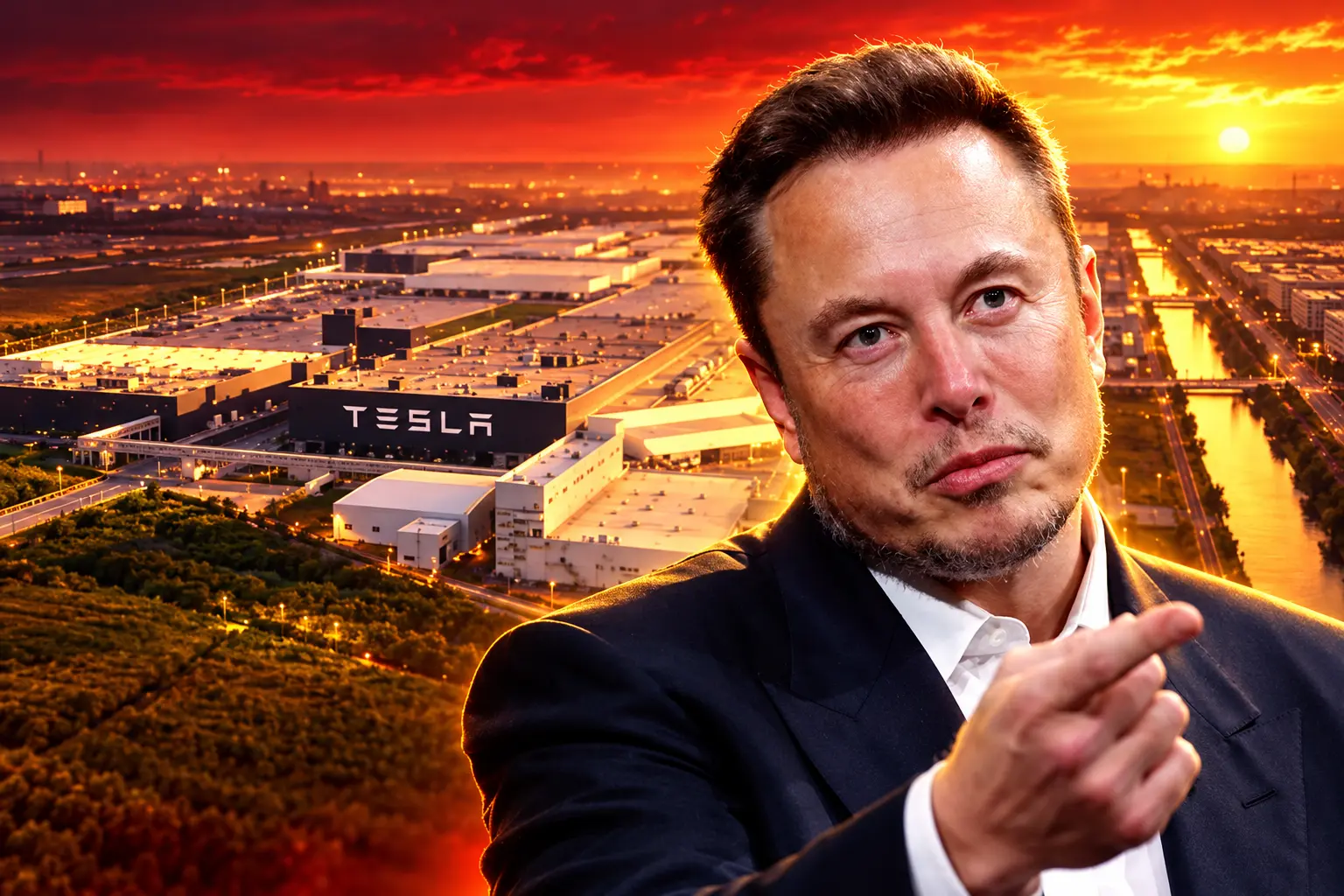
A Merger Would Give Musk Voting Control
The industrial pitch is chips, robots, connectivity and mass to orbit. The voting math is simpler. Tesla has one class of common stock, and Tesla’s October 19 proxy filing credits Musk with 19.8 percent as of September 30, ahead of Vanguard at 5.3 percent. SpaceX does not work that way.
A SpaceX filing as of June 30 put his economic stake at 48.4 percent and his voting power at more than 82 percent through super-voting shares. As of July 28 the same company listed 7.7 billion Class A and 5.5 billion Class B shares (7,696,293,669 and 5,485,486,276). Fold Tesla into that structure and Musk’s say jumps from a fifth of Tesla to a majority of the whole.
Bill Birmingham, head of research at REX Financial, puts the combined voting stake at about 57 percent. Ryan Zurrer, founder of Dialectic, puts it at 58 percent on Levy’s 0.7 illustration. Levy’s own buyer case lands at about 56 percent of the votes and about 37 percent of the equity. The working band is about 56 to 58 percent, depending on the swap. That is well above the 25 percent Tesla stake Musk has long said he wants before he leans harder into AI and robotics.
If Tesla holders took ordinary SpaceX Class A stock while Class B stayed in place, a large slice of the economics could carry a much smaller slice of the votes. No committee has published a class mix. That silence is the point of the next fight.
Why Tesla Holders Face a High Bar
On SpaceX’s October 20 call Musk said Tesla would need a 50 percent vote of all shares, not just shares that are cast. Uncast ballots would count against a deal. He called that quite a high hurdle. SpaceX, where he already holds more than 82 percent of the votes, is the easier room.
At the end of the day, the shareholders have to be supportive of this. And particularly on the Tesla side, we will need a 50 percent vote of all shares, not just those who vote, but of all shareholders. And that’s quite a high hurdle to try to achieve.
Elon Musk, chief executive, SpaceX third-quarter 2026 earnings call
Tesla already ran a version of this test. In 2025 the board asked holders to drop supermajority rules in the certificate and bylaws. Tesla’s October 19 proxy filing records that the proposal won only 39.4 percent of all shares entitled to vote. Musk’s 19.8 percent was not enough on its own, and a board-backed item still fell short of half the register.
THE WEEK THE MERGER BECAME A PROCESS
- February 2026: Ira Ehrenpreis, who chairs Tesla’s compensation and governance committees, joins the SpaceX board. Tesla still lists him as independent.
- June 12, 2026: SpaceX begins trading on Nasdaq at $135 a share after an IPO that raised about $85.7 billion.
- October 19, 2026: Tesla files its proxy for a December 3 annual meeting at Gigafactory Texas. The ballot re-elects Musk, chair Robyn Denholm and JB Straubel. It has no merger item.
- October 20, 2026: Musk says both boards have formed special committees at holders’ request, that he cannot sit on them, and that no terms exist.
- October 21, 2026: Tesla reports a flat quarter. Gupta’s JPMorgan note calls China clearance the larger obstacle and sketches a TikTok-style split of the China car business.
Three of Tesla’s nine directors now have a SpaceX tie: Musk, his brother Kimbal Musk, and Ehrenpreis. Levy has called a tie-up the consensus expectation on the Street, and some clients have been told an announcement could come before December 3. The proxy says otherwise for that meeting. Any live deal would need a later special meeting, and turnout would decide it as much as preference. The public argument among Tesla holders is already the swap ratio, how much of SpaceX they would own, and whether the committees are a legal wrapper on a result Musk wants. China barely appears in that argument.
Shanghai Builds Most of Tesla’s Cars
Gupta’s October 21 note puts China at about 20 percent of Tesla revenue and a larger share of earnings and free cash flow, yet only about 10 percent of the bank’s roughly $1.7 trillion sum-of-the-parts value. Giga Shanghai, the only wholly foreign-owned car plant of its kind in China, builds more than half of the cars Tesla sells worldwide. Christopher Tang, a supply-chain professor at UCLA Anderson, notes those China-built cars use more than 95 percent local parts from over 400 suppliers.
SpaceX is the other half of the collision. Tang writes that about a fifth of its 2025 revenue came from the U.S. government. In August the rocket company began auditing suppliers worldwide and told them to keep Chinese-made equipment and Chinese nationals away from SpaceX work. A merger would ask Beijing to bless a Pentagon contractor that is already trying to scrub Chinese inputs, while Tesla’s cheapest plant still runs on Chinese parts.
WHAT BEIJING CAN USE AGAINST A DEAL
- Merger review: China’s competition authorities can delay or condition clearance, or simply not move, which is how Intel’s $5.4 billion Tower Semiconductor purchase died in 2023.
- The Shanghai plant: Tesla is the only wholly foreign-owned automaker in China, and Giga Shanghai builds more than half of the cars it sells worldwide.
- Local parts: Those cars use more than 95 percent local content from over 400 suppliers, so a paper split of the factory would not cut the parts web.
- Starlink: SpaceX has no telecom license from the Ministry of Industry and Information Technology, and the service is treated as a security risk.
- Minerals and tools: A rare-earth licensing truce from October 2025 expires on November 10, 2026, and Beijing has already blocked some high-end solar tools headed for Tesla.
Domestic Tesla retail in China has been sliding even as Shanghai’s export lines have grown. That mix makes the plant more valuable as a factory for the rest of the world, and more awkward to drop. Musk has called reports of a China spin-off, sale or closure absurdly fake news. Ring-fencing is the path banks keep drawing instead.
Starlink Has No License in China
Starlink cannot be sold or used lawfully on the mainland. SpaceX holds no MIIT basic or value-added license, and no pending application shows in the public register. Starlink’s own coverage map lists no service date for mainland China. Chinese law routes satellite traffic through domestic gateways; Starlink sends traffic to foreign ones. Beijing has called that a security problem, and it has started fining ships that keep dishes on in Chinese waters.
Ukraine made the military case visible. Chinese defense researchers have treated the constellation as a U.S. space asset, not a consumer broadband brand. Folding Tesla into the same listed company as Starlink would put Giga Shanghai and two million-odd Chinese Tesla drivers under a roof that already runs a network China bans. That is the national-security file, not a side letter.
The Supply Chain Beijing Still Holds
Even a clean legal split of the Shanghai plant would not take China out of the hardware. Tang’s point is that the bind sits one or two tiers up, in nickel, rare earths, magnets, gallium and solar tools. SpaceX has lined up Korean alloy supply and non-Chinese polysilicon, and it is pushing U.S. solar making. The Korean alloy still traces nickel to an Indonesian project tied to China’s Tsingshan. China refines more than 90 percent of the world’s rare earths.
In January Musk pledged 100 gigawatts a year of U.S. solar-cell capacity. By March Tesla was talking about $2.9 billion of Chinese solar equipment. In May Beijing blocked high-end tools from Suzhou Maxwell. This month China proposed banning exports of the know-how for next-generation perovskite and tandem cells while still selling the cells. The pattern is consistent. China will sell Musk products. It is slower to sell him the machines that make them.
Tesla Profit Fell 43% After SpaceX’s First Gain
The merger talk landed on two very different quarters. SpaceX, in its revenue of $14.6 billion, up 161 percent from $5.6 billion, posted net income of $4.4 billion against a $1.1 billion loss a year earlier, its first profit as a listed company. Adjusted EBITDA was $8.8 billion, up 306 percent. Super Intelligence revenue was $7.6 billion, up from $813 million, and overtook Starlink. Connectivity, the Starlink line, was $5.2 billion, up 69 percent, with 13.6 million consumer subscribers paying an average $69 a month. Nameplate compute reached 1.7 gigawatts. Capital spending in the quarter was $19.6 billion. Shares rose about 8 percent in extended trading after the call.
Tesla’s print the next day was flatter. The company posted Tesla’s third-quarter 2026 financial results with revenue of $28.05 billion, unchanged from a year earlier. GAAP net income was $787 million, down 43 percent. Automotive revenue was $20.6 billion, down 3 percent. Energy generation and storage revenue was $2.88 billion, down 16 percent, which Tesla partly blamed on tariff-related customer refunds even though storage deployments rose to 13.7 GWh. Regulatory credits fell to $113 million from $417 million. Deliveries were 486,532, down 2.1 percent from 497,099 a year earlier, and production was 464,391. Free cash flow was $1.53 billion. Cash and investments were over $45 billion. Full-year capital spending guidance was cut to about $20 billion from more than $25 billion, a fifth less. Tesla shares had risen about 1.8 percent after the SpaceX call, a much smaller move than SpaceX itself.
— Tesla (@Tesla) October 21, 2026
Musk told Tesla’s own call that demand is growing rapidly and is exceeding production. The shareholder letter said battery supply, not orders, limited car volumes, and that the passenger backlog was the largest in four years. That is the car company he wants to plug into a rocket-and-compute group that just spent $19.6 billion in a single quarter. It is also a car company whose profit is shrinking as it funds AI and robots, which is why a SpaceX paper that already prints $4.4 billion of net income looks like the senior partner.
A Ringfence Modeled on TikTok’s U.S. Deal
Gupta’s workaround is explicit. He assumes a 30 to 35 percent premium that would keep Musk’s voting control above 50 percent, then treats China clearance as the step that can still break the structure. The fix he sketches is a mirror of the U.S. TikTok arrangement: wall off Tesla’s China business, or hand control to a China-based consortium, and keep Tesla on licensing fees for the brand, a walled-off Full Self-Driving stack, and later Optimus deals.
We believe one such avenue would be to ring-fence TSLA’s China business or transfer control (a potential mirror image of the US/TikTok arrangement).
Rajat Gupta, analyst, JPMorgan note, October 21, 2026
That would be a deal inside the deal. Tesla would still need a majority of all outstanding shares. Europe’s antitrust staff would still look at a company that already spans cars, satellites and compute. U.S. defense customers would still want to know what of SpaceX sits in the same group as a Shanghai plant. And Beijing could approve with conditions on driver data, or wait, or use minerals and tool licenses to set the pace even if the legal entity is split.
Levy can call the merger the consensus on Wall Street. Musk can keep saying it might not happen. The committees can take months to write a ratio. That does not answer the party that does not have a seat in Austin or Starbase. Intel waited on Tower until the clock ran out. Tesla’s China plant is larger, cheaper and harder to replace than that chip asset was. Until Beijing speaks, the $3.6 trillion combination is a vote that has not been called and a clearance that has not been asked for.
Disclaimer: This article is news reporting and analysis for general information only. It is not investment advice, a solicitation to buy or sell Tesla, SpaceX or any other security, or a recommendation of any merger, vote or portfolio action. Readers should consult a licensed financial adviser or other qualified investment professional about their own holdings and any decision tied to these companies. Market values, stakes, earnings figures and deal status are those published by the companies, filings and named analysts cited above and can change with new prints, votes or regulatory steps.

Cook Hands Democrats the House as Crypto’s Bill Stays Dead

Wicker’s Broken Bed Was the Short Story’s Punch Line

Nvidia’s $500 Billion Financing Plan Draws a $180 Sell

Maserati Bets the Grecale V6 Can Fill Porsche’s Gap

EV Cable Theft Follows the Old Railway Copper Playbook

Aramco Crash Kills 14 Two Days After Oil Restart

Salah Captained Egypt to Their First World Cup Win

Zelda’s 40th Switch 2 Ships Without a Zelda Game

Apple Labor Day Deals Hide June’s Memory Price Hike

Palworld 1.0.4 Adds Palpedia Search After the 1.0 Launch
-
 BUSINESS4 months ago
Aramco Crash Kills 14 Two Days After Oil Restart
-
 NEWS5 months ago
Salah Captained Egypt to Their First World Cup Win
-
 GAMING2 months ago
Zelda’s 40th Switch 2 Ships Without a Zelda Game
-
 NEWS2 months ago
Apple Labor Day Deals Hide June’s Memory Price Hike
-
 GAMING2 months ago
Palworld 1.0.4 Adds Palpedia Search After the 1.0 Launch
-

 NEWS4 months ago
El Niño Puts Israel’s Needed Winter Rain on a Flood Clock
-

 BUSINESS8 months ago
BAE’s 60-Year Saudi Franchise Now Runs Through Taif
-

 BUSINESS8 months ago
Egypt Bets EGP 638 Billion Can Open Sinai to Investors