
NEWS
Debris and Airspace Rules Now Govern Saudi Transit Safety
Riyadh and Jeddah still move connecting passengers, but EASA’s Jeddah FIR polygon and falling interceptor debris now set the real transit risk.

European airlines were told on Sept. 30 to stay out of a slice of Saudi airspace through Nov. 16, even as Riyadh and Jeddah kept moving passengers. The March 27 Iranian strike on Prince Sultan Air Base wrecked U.S. tankers and a surveillance jet south of the capital. That is a different problem from a connection through King Khalid International.
Civilian terminals never took that blow. The live constraint on transit through Riyadh and Jeddah is falling interceptor debris, a European no-fly polygon in the Jeddah Flight Information Region, and a Houthi campaign that has already put fire beside the capital’s main airport.
Iranian Missiles Hit a Tanker Base, Not the Terminals
U.S. and Saudi officials said an Iranian missile and drone strike on March 27 damaged several U.S. refueling aircraft at Prince Sultan Air Base, a U.S. operating location in the Saudi interior about 600 km from the Iranian coast. Open-source imagery circulating that day showed heat on the apron. Photos posted afterward showed U.S. Air Force E-3G Sentry 81-0005, an airborne warning jet, as a burned-out hull. Several KC-135 tankers were hit in the same raid.
A U.S. official put the wounded at 12, with two in critical condition. Other U.S. and Saudi officials described at least 10 injured. U.S. Central Command had not commented that night. The same base had already taken tanker damage earlier in March. President Donald Trump said four of five earlier hits had “virtually no damage” and that one had “slightly more damage.”
The raid sat inside a wider Iranian barrage across the Gulf. The Saudi Defense Ministry said a ballistic missile aimed at Riyadh was intercepted and destroyed in flight. Bahrain’s interior minister said a facility caught fire after a missile strike. The United Arab Emirates reported incoming ballistic missiles and drones, then two fires in Abu Dhabi from falling shrapnel, and told residents to stay clear of those sites.
The Defense Ministry asserts that the sounds heard are the result of Air Defense Systems engaging missiles, and the Fighters are intercepting cruise missiles and UAVs.
United Arab Emirates Defense Ministry, March 27, 2026 statement
The Islamic Revolutionary Guard Corps had warned civilians to leave areas hosting U.S. forces, saying American troops were using people as human shields, and said it would carry out its “duty to eliminate the American terrorist forces.” That warning was aimed at bases, not at King Khalid’s terminals or Jeddah’s Hajj halls. Passengers asking whether the March raid closed Saudi transit have been asking about the wrong airfield.
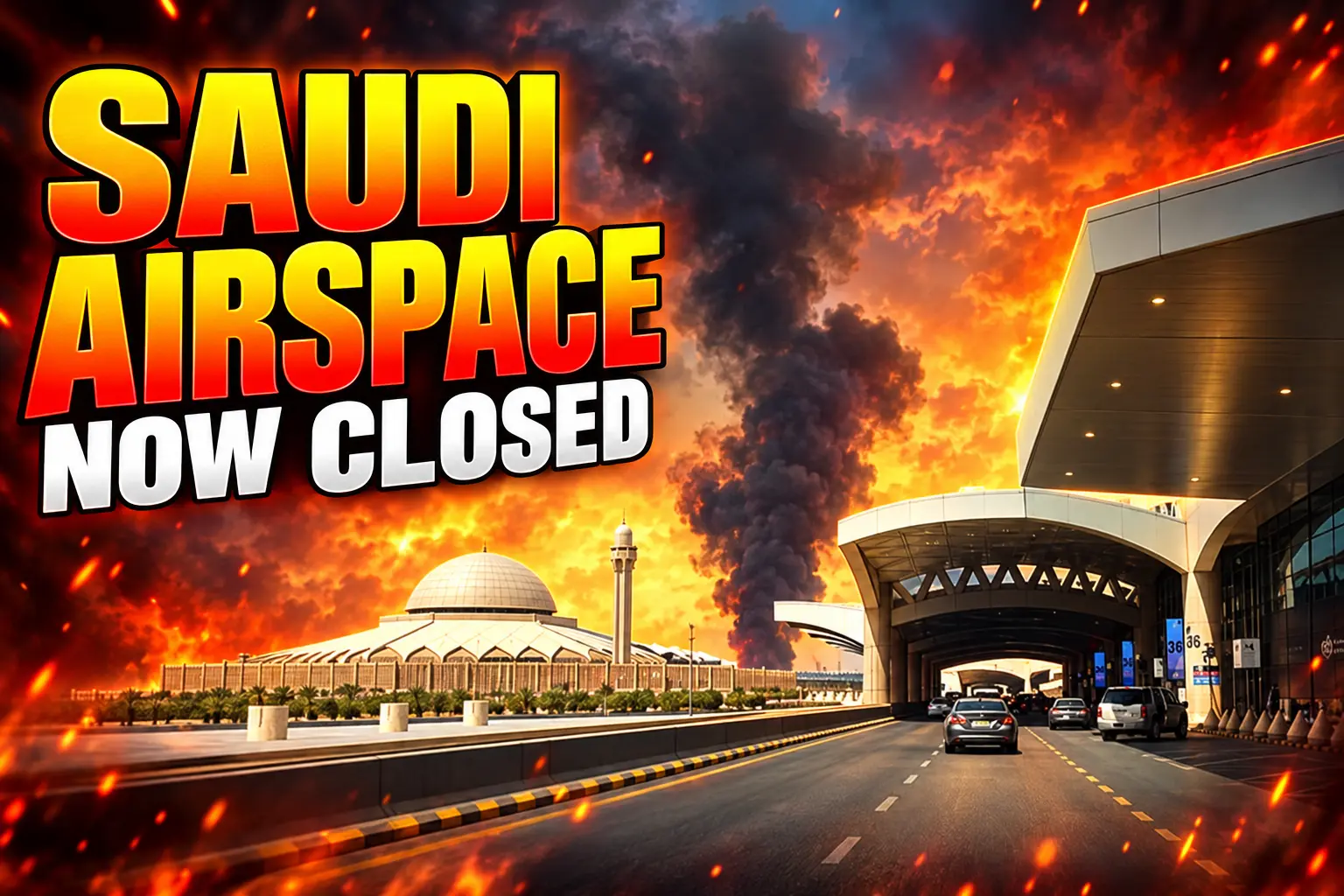
Smoke Rose From the Fuel Farm at King Khalid
The event that actually sat next to civil traffic came on Sept. 19, and it was not Iranian. Coalition spokesman Maj. Gen. Turki al-Maliki said Saudi air defenses “successfully intercepted and destroyed a ballistic missile launched by the Houthi terrorist militia towards the city of Riyadh at dawn on Saturday.” He said attempts against Bisha, Taif, Farasan and Yanbu were stopped as well. Houthi military spokesman Yahya Saree claimed attacks on “sensitive sites” in Riyadh and on Aramco facilities at Yanbu.
Saudi Civil Defense had sent overnight phone alerts for Riyadh and Al-Kharj, the city that hosts Prince Sultan Air Base, then issued an all-clear in the morning. By then a large plume of black smoke was rising from the fuel storage area at King Khalid International Airport. Firefighters put out a blaze on a tank bearing the Aramco logo. Flightradar24 placed the airport at 5.0, the top of its disruption scale, meaning long delays and multiple cancellations. Arrivals and departures were paused, then traffic resumed the same day.
Clips of that smoke were still circulating in early October as if the capital had just been hit again. People living near the airport said they had heard nothing new. Verified activity on Oct. 1 sat in the south: the coalition said it intercepted two ballistic missiles and four drones toward Khamis Mushait and Jazan, with debris damaging buildings and vehicles and no casualties reported.
WHAT WE KNOW
- The intercept: Al-Maliki said one ballistic missile aimed at Riyadh was destroyed at dawn on Sept. 19.
- The fire: An Aramco-logo tank at the depot beside King Khalid International burned; Civil Defense later issued an all-clear.
- The airport: King Khalid International stayed open after a peak disruption score of 5.0 on Flightradar24.
WHAT IS UNCONFIRMED
- The ignition: Coalition statements did not say whether the tank burned from a warhead, from interceptor debris, or from a separate hit on the farm.
- Oct. 1 Riyadh claims: Videos offered as a fresh capital strike matched the September fire; no Saudi confirmation followed.
King Khalid International, north of Riyadh, is not King Khalid Air Base at Khamis Mushait. The names get swapped in argument threads, which is how a southern military field gets written into a Riyadh connection. The civilian airport’s fuel farm sits close enough to the terminals that the smoke stood behind the departures road in photographs taken that morning.
What EASA Tells Airlines About the Jeddah FIR
Saudi Arabia has not closed its airspace. The European Union Aviation Safety Agency did something narrower, and it is the document that now moves European timetables. Conflict Zone Information Bulletin CZIB-2026-09, issued Sept. 30 and valid until Nov. 16 unless reviewed earlier, tells operators under EU rules, and third-country operators flying to, from or within the EU, to stay out of a defined Jeddah FIR slice at every altitude.
The hard avoid is the airspace bounded by the line connecting navigation points RIBOK, BOSUT, ISLAM, DEKLO, OBSAM and SILPA and the FIR Jeddah boundary. Operators are told to exercise caution in the rest of the FIR, keep a current risk assessment, and be ready for short-notice instructions. EASA said the Houthis had widened attacks in September to maritime, energy, military and aviation-related sites, and that recent strikes showed they could reach Riyadh, Tabuk and Yanbu. It warned of misidentification of civil aircraft, missile and drone overflights, interception activity and falling debris. It also said Saudi Arabia has shown it can manage the FIR, including through tactical deconfliction and Emergency Security Control of Air Traffic measures, while the environment can still deteriorate fast.
Reading that bulletin as a blockade overstates it. Saudia, flynas and flyadeal have kept flying. The FIR is open. France’s own notice, issued the same day and valid through Oct. 14, told French operators to stay out of a southern portion of the FIR except on specified high-level routes or when operating to or from Jeddah. Italy has a separate notice running into late November. Those national files sit beside EASA’s, which is why a passenger’s routing depends on the airline’s flag, not only on whether the jet bridge at Riyadh is staffed.
WHO IS WARNING WHOM
| Authority | What it tells operators or travelers | Window |
|---|---|---|
| EASA CZIB-2026-09 | Do not operate in the RIBOK-SILPA polygon; caution in the rest of FIR Jeddah | Sept. 30 to Nov. 16 |
| France NOTAM LFFF F1996/26 | Stay out of a southern slice of OEJD except on named high-level routes or Jeddah flights | Sept. 30 to Oct. 14 |
| U.S. State Department | Level 3, reconsider travel; commercial flights operational, often disrupted | Issued Sept. 16, in force |
| UK FCDO | No blanket warning for Riyadh or Jeddah; Yemen-border bands plus Abha and Khamis Mushait | Updated Sept. 20, current Oct. 2 |
A tracker of current national warnings for Saudi airspace still lists older U.S. and Saudi notices on Houthi drones as well. The stack is what a dispatcher actually files against, not a single red-or-green map.
Washington Says Reconsider; London Leaves Riyadh Open
The U.S. Embassy in Riyadh posted a Level 3 Reconsider Travel advisory dated Sept. 16. It cites Iranian drone and missile targeting of American interests, armed conflict, terrorism, exit bans and local laws on social media. Hostilities between the United States and Iran began on Feb. 28, 2026. The advisory says Iran has already struck cities, infrastructure, airports, military bases, diplomatic posts and energy sites inside the kingdom, and that commercial flights “are operational from Saudi Arabia, though they have been significantly disrupted at times.”
U.S. government employees may not travel within 20 miles of the Yemen border, need special authorization for Jizan, Asir, Najran and Qatif, and as of Sept. 20 also need it for Taif and Yanbu. Family members have been allowed to join employees in the country since Aug. 30. The Yemen border itself is Level 4, do not travel.
Britain draws the line in a different place. The Foreign, Commonwealth and Development Office, still current on Oct. 2, advises against all travel within 10 km of the Yemen border and against all but essential travel to Abha and Khamis Mushait, plus the 10-to-80 km band along that frontier. It does not advise against travel to Riyadh, Jeddah or AlUla. It notes that since July 13 the Houthis have fired missiles and drones at cities, airports, military and energy sites including Abha, Jizan, Najran, Riyadh, Jeddah and Yanbu, and at shipping in the Red Sea.
A connecting passenger holding a U.S. passport and one holding a British passport are therefore reading two different maps of the same layover. The American document treats the whole kingdom as a reconsider. The British document treats the capital and the Red Sea pilgrimage airports as open ground and puts the hard language on the southern fringe.
Falling Debris Is the Risk at Ground Level
The U.S. advisory states the civilian mechanism in one sentence: falling debris from intercepted drones and missiles is also a risk, and people living or working near energy sites and military bases, especially closer to Yemen, sit closer to that fall line. EASA says the same thing from the cockpit side. Activation of air defenses raises the chance that a civil aircraft is misidentified, that a missile or drone overflies a route, and that wreckage comes down along the intercept path.
That is what Abu Dhabi already showed on March 27, when shrapnel from an intercept started two fires. It is the most plausible way a Riyadh fuel tank burns while the coalition says the missile itself was destroyed. It is also why an airport can post a 5.0 disruption score without a crater on the runway. The hazard for a passenger in a jetway is not a tanker parked at Al-Kharj. It is metal falling around the field that fuels the airplane.
WHAT A CONNECTION ACTUALLY EXPOSES
- The intercept path: Ballistic shots at Riyadh have already produced alerts over the capital and Al-Kharj, then smoke at the airport fuel farm.
- The southern FIR: EASA’s polygon and France’s NOTAM sit over the approaches most exposed to Houthi fire from Yemen.
- The airline’s flag: An EU operator must treat CZIB-2026-09 as a planning constraint; a Saudi carrier is still flying the same city pair.
- Ground time: Civil Defense alerts tell people to stay indoors; a long layover during an overnight warning is a shelter problem, not a runway problem.
U.S. officials said in early October that two extra Patriot batteries went to the Gulf in September, one to a Saudi oil site and one to a Qatari gas site, because Washington may need Saudi airspace if President Trump resumes major strikes. He has said new bombing is possible after Nov. 3. The USS Theodore Roosevelt left San Diego bound for the region and is expected around mid-November. Those moves do not close King Khalid. They do mean the FIR can tighten again on short notice, which is the contingency EASA already told operators to hold.
The South Carries a Harder Travel Line
Abha and Khamis Mushait are not connection airports for most long-haul itineraries, and they now sit inside Britain’s all-but-essential band. They are also where debris from intercepts has already hit houses and cars. A traveler whose ticket only ever touches Riyadh or Jeddah is not in that band. A traveler adding a domestic hop to Aseer is.
THE YEAR THAT RESHAPED THE FIR
- Feb. 28, 2026: The United States and Iran enter open hostilities; the U.S. advisory dates the drone and missile threat from this night.
- March 27, 2026: Iran hits Prince Sultan Air Base with at least one missile and drones, damages tankers and destroys E-3G 81-0005, and the Gulf sees intercepts over Riyadh, Abu Dhabi and Bahrain.
- July 13, 2026: The FCDO dates the renewed Houthi missile and drone campaign against Saudi cities, airports, military and energy sites from this day.
- Sept. 16, 2026: Washington publishes the Level 3 advisory; commercial flights are described as operating with disruptions.
- Sept. 19, 2026: A Houthi ballistic missile toward Riyadh is intercepted; an Aramco tank burns beside King Khalid International; Flightradar24 hits 5.0.
- Sept. 20, 2026: London extends all-but-essential advice to Abha and Khamis Mushait; the U.S. Mission adds Taif and Yanbu to the authorization list for employees.
- Sept. 30, 2026: EASA issues CZIB-2026-09 for FIR Jeddah, valid until Nov. 16.
- Oct. 1, 2026: Two ballistic missiles and four drones are intercepted over Khamis Mushait and Jazan; debris causes limited damage and no deaths.
Jeddah’s King Abdulaziz International began opening a new terminal in late September while this sequence was still running. The kingdom is still trying to sell itself as a hub. The southern cities on the FCDO list are the ones that no longer sit inside that sales pitch.
Hub Traffic Pays First When Europe Reroutes
Saudia and the low-cost Saudi carriers have kept the main trunk routes. European schedules split. At least one major carrier kept Frankfurt-Riyadh going through the weekend of the fuel fire. Others pulled Riyadh for weeks. That split is the second-order cost: a passenger whose ticket was filed on an EU operator can lose the sector even though the airport is open and a Saudi metal is still pushing back from the next stand.
Insurance and crew-duty rules follow the bulletin, not the photograph of a quiet terminal. Dispatchers already treat the Tehran FIR as a write-off. Baghdad is technically open and still avoided by European advice. The Jeddah FIR is now in that family of airspace that can be flown, with a hole cut out of it, until Nov. 16. If Trump orders a new round of strikes, the hole can grow. If the Houthis keep missing the capital and hitting the south, the polygon may stay where it is and Riyadh connections will look ordinary again, except on the nights Civil Defense lights up phones.
The March tanker raid answered a military question about whether U.S. aircraft parked in the open at Al-Kharj could be found. It did not answer whether a passenger changing planes at Riyadh should. That answer now sits in CZIB-2026-09, in the Sept. 19 fire beside the fuel farm, and in two governments that still cannot agree whether the capital is a reconsider or an open city. EASA’s clock runs to Nov. 16. The Roosevelt is due in the same stretch. Until those dates move, the layover is a routing problem dressed up as a safety slogan.

Ninja Theory Staff Face Redundancy After Two Xbox Sales Collapse

Amazon Sells the MacBook Air at Its Pre-Hike Price

U.S. Slows Jet Parts to Squeeze China’s Flying Fleets

PEGI Pulled the GTA 6 Age Rating After Cocaine Details

Northwestern’s Smaller Ryan Field Gave Penn State Nowhere to Hide

Aramco Crash Kills 14 Two Days After Oil Restart

Salah Captained Egypt to Their First World Cup Win

Apple Labor Day Deals Hide June’s Memory Price Hike

Palworld 1.0.4 Adds Palpedia Search After the 1.0 Launch

Zelda’s 40th Switch 2 Ships Without a Zelda Game
-
 BUSINESS3 months ago
Aramco Crash Kills 14 Two Days After Oil Restart
-
 NEWS4 months ago
Salah Captained Egypt to Their First World Cup Win
-
 NEWS1 month ago
Apple Labor Day Deals Hide June’s Memory Price Hike
-
 GAMING4 weeks ago
Palworld 1.0.4 Adds Palpedia Search After the 1.0 Launch
-
 GAMING4 weeks ago
Zelda’s 40th Switch 2 Ships Without a Zelda Game
-

 NEWS3 months ago
El Niño Puts Israel’s Needed Winter Rain on a Flood Clock
-

 BUSINESS8 months ago
Egypt Bets EGP 638 Billion Can Open Sinai to Investors
-

 ENTERTAINMENT4 weeks ago
King Charles Letter Keeps Harry and Meghan as Private Citizens