
NEWS
Rubio’s Al-Aqsa Denial Leaves Jordan’s King Exposed
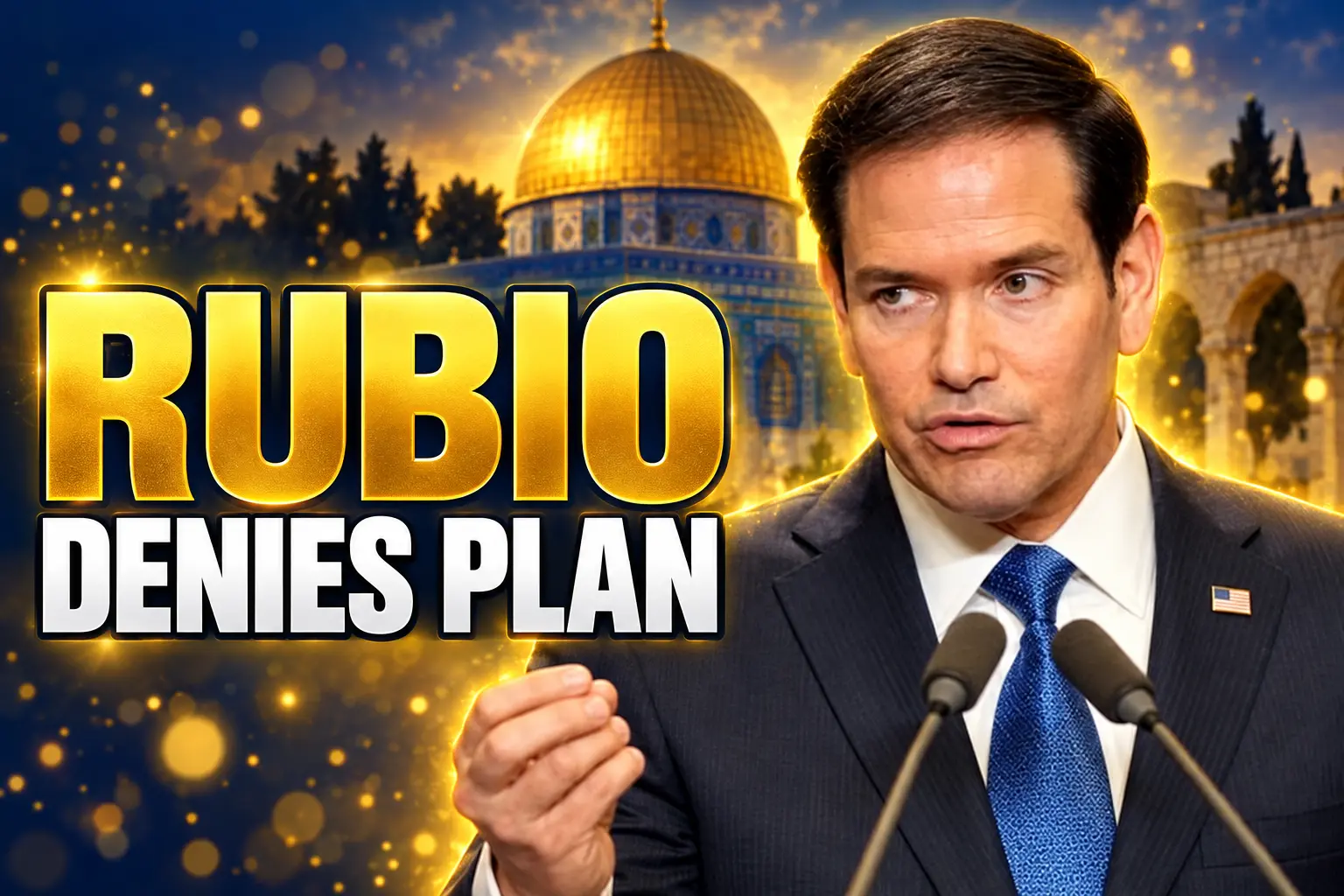
Rubio told the Senate he had never heard of ending Jordan’s Al-Aqsa role, a claim that lands on King Abdullah’s throne far harder than on Foggy Bottom.

US Secretary of State Marco Rubio told senators on June 2, 2026, he had never heard of a plan to end Jordan’s Al-Aqsa custodianship. Democratic Sen. Chris Van Hollen of Maryland had just asked him to knock the reports down.
Rubio praised the US-Jordan relationship and asked whether the websites were credible. In Amman, the same rumor hits the monarchy where it is weakest, on the holy compound the Hashemites still claim to guard.
Rubio Said He Had Never Heard of It
The exchange came near the end of a Senate Foreign Relations Committee session in the Dirksen Senate Office Building and lasted about 40 seconds. Van Hollen said there had been several media reports that the United States was working with Israel to take away the Kingdom of Jordan’s role over the Al-Aqsa Mosque complex in East Jerusalem, and he asked Rubio to confirm there was no truth to them.
Rubio cut in before the question was finished.
Yeah, no, I’ve never even heard that. That’s the first time I even hear anybody discuss that.
Marco Rubio, US secretary of state, Senate Foreign Relations Committee, June 2, 2026
He added that Washington has a great relationship with Jordan, asked Van Hollen to send him the article, and wondered aloud whether it came from a credible website. Van Hollen said he was glad to hear there was no truth to the reports. Rubio repeated that he had never heard the matter discussed by anybody.
The clip moved through Washington as a gag about senators who quote unnamed websites. That is a comfortable fight for a secretary of state. It is the wrong fight for the king who still pays the Waqf that runs the compound.
A Draft Paper Named Kushner and Huckabee
Eight days before the hearing, unnamed US, Jordanian and Palestinian officials, along with Western and Gulf Arab sources, described an effort they said was already in motion. They tied it to Jared Kushner, President Donald Trump’s son-in-law, who holds no government post, and to Mike Huckabee, the US ambassador to Israel, who they said had pushed Washington to act after he took up the job in 2025.
Israel first floated the idea with the earlier Trump team nearly a decade ago, those officials said. Two US officials said Washington had drafted a paper on the mosque’s future. After the account appeared, a US official called it “totally false.” Rubio, eight days later, said it was the first he had heard anyone discuss it.
THE PLAN AS DESCRIBED TO OFFICIALS
- The Waqf: The Jordanian-backed Islamic Waqf would lose day-to-day authority over the compound.
- A new body: An Israeli-created board would brand Al-Aqsa a multi-faith centre and a tourist draw for the three Abrahamic faiths.
- Prayer rules: Jews would get equal access and formal rights for large-group prayer, which the status quo now bars for non-Muslims.
- The pulpit: Israel would get a say on imams, preachers, senior mosque officials and Friday sermon text.
- Arab rotation: Bahrain, Egypt, Morocco and the United Arab Emirates were said to have been briefed on shared oversight; Saudi Arabia was described as opposed.
The officials said the paper was silent on Christian sites. Jordan also claims care of the Church of the Holy Sepulchre and the Church of the Ascension, and it holds an effective veto on the Greek Orthodox patriarch of Jerusalem, so a Muslim-only rewrite would leave that half of the Hashemite claim in a fog.
Why the Hashemite King Cannot Shrug
For King Abdullah II, Al-Aqsa is not a talking point. The Hashemites took on care of Jerusalem’s Muslim shrines in 1924, after they lost Mecca and Medina to the Al Saud. When King Hussein cut Jordan’s claim to the West Bank in 1988, he left the holy sites and Waqf properties under Amman’s hand. That exception is how a dynasty that no longer rules East Jerusalem still speaks for the compound.
A Jordanian government source, speaking after Rubio’s testimony, said the kingdom’s line on Jerusalem had not moved. Sovereignty over the shrines, in that telling, belongs to the Palestinians. The duty to guard them belongs to the king. Jordan’s official custodianship position states the same split: East Jerusalem as occupied Palestinian land, Hashemite care of the Islamic and Christian sites, and no Israeli right, as the occupying power, to rewrite the status quo.
Mustafa Abu Sway, deputy head of the Waqf council, would not be drawn on whether Jordan’s day-to-day grip in the Old City is slipping. He did say what the role is worth to people who live with the compound.
The Hashemite Custodianship is a cornerstone for stability in the region, undermining it is tantamount to undermining the very principles for peace.
Mustafa Abu Sway, deputy head of the Jerusalem Waqf council
He called the arrangement a lifeline for Palestinians and noted that Jordan has defended the old rules at UNESCO. The Jerusalem Governorate said it had not been told of any such proposal and rejected it entirely, pointing to tighter limits on Waqf guards and more settler walks through the site.
On September 22, 2026, three months after Rubio’s shrug, the king told the 81st United Nations General Assembly that Jordan would keep the Hashemite role and the historic and legal status quo at Muslim and Christian holy sites in Jerusalem. Patriarch Theophilos III, the Greek Orthodox patriarch of Jerusalem, backed that line the next day and called the king a safeguard for Christians in the city.
His Majesty @KingAbdullahII: We will continue to uphold the Hashemite Custodianship and historic and legal status quo at Muslim and Christian holy sites in Jerusalem.#Jordan #UNGA
— RHC (@RHCJO) September 22, 2026
Van Hollen, in a June 3 interview, said he would work to protect Jordan’s current Hashemite role, called the reports disturbing, and said any change would be a terrible mistake. On June 26, the parliamentary union of the Organisation of Islamic Cooperation, meeting in Baku for its 20th conference, put the same Hashemite role into its final communiqué.
The 1994 Treaty and the 2013 Amman Pact
Israel does not have to like the Hashemite claim to be bound to a version of it. The 1994 Israel-Jordan peace treaty is on file with the United Nations. Article 9 says Israel “respects the present special role of the Hashemite Kingdom of Jordan in Muslim Holy shrines in Jerusalem” and will give that historic role “high priority” when permanent-status talks are held. The clause does not hand Jordan sovereignty. It is the hook Amman uses every time the Waqf is shoved.
HOW THE ROLE WAS WRITTEN DOWN
- 1924: The Supreme Muslim Council in Mandate Palestine affirms Sharif Hussein bin Ali as custodian of Al-Aqsa, and the duty passes down the Hashemite line.
- 1967: Israel takes East Jerusalem. Moshe Dayan’s post-war arrangement leaves the Waqf in charge inside the compound, Israeli forces on the perimeter, Muslim prayer in place, and non-Muslim visits without prayer.
- 1988: Jordan drops its claim to the West Bank and keeps the holy sites and Waqf properties.
- October 26, 1994: Article 9 of the peace treaty records Israel’s respect for Jordan’s special role and a promise of high priority in final talks.
- March 31, 2013: King Abdullah II and Palestinian President Mahmoud Abbas sign a pact in Amman. Abbas affirms the king as custodian. Al-Aqsa is defined as the entire al-Haram al-Sharif, 144 dunums. Palestinian sovereignty is stated; the two sides pledge to consult on the shrines.
That 2013 text is how Amman and Ramallah stopped arguing over who speaks for the stones. The Palestinians get the flag. The king gets the keys. A rumor that a new Israeli board will hire the imams cuts both deals at once.
Riyadh Called Custodianship a Pillar of Stability
If the Waqf fell, the winners would not be sitting in the State Department press shop. They would be the Israeli ministers and Temple Mount groups who already walk the compound and want Jewish prayer made legal, plus an American ambassador who has long backed settlements. The losers would be the king, the Waqf payroll, and a Jordanian public that treats Al-Aqsa as a domestic test of the throne.
WHAT WE KNOW
- The denials: A US official called the May 25 account totally false, and Rubio told the Senate on June 2, 2026 he had never heard it discussed.
- The paper trail: Article 9 and the 2013 Amman pact are public, signed texts, not leaks.
- The king’s line: Abdullah restated Hashemite care of the sites at the UN on September 22, 2026.
- The October call: Rubio’s public note of his October 2 talk with the king did not mention Jerusalem.
WHAT IS UNCONFIRMED
- The draft paper: No White House, Israeli or Jordanian text has been released.
- Huckabee’s lobbying: The claim that he repeatedly asked Washington to follow through sits with unnamed officials, not with a public cable.
- Rotational oversight: Briefings to Bahrain, Egypt, Morocco and the UAE have not been acknowledged by those governments.
- Sermon control: Israeli sign-off on Friday sermons remains an allegation, not a posted rule.
Gulf Arab sources said Saudi Arabia would not stay quiet if the Hashemite role were actually lifted, and that Riyadh still treats that role as a pillar of regional stability. One source said any move against it would inflame the region. The same sources were less sure what Abu Dhabi or Manama would do if asked to take a rotating seat, given how closely both have moved toward Israel since 2020. Emirati “multi-faith” projects, including a 2023 complex with a mosque, a church and a synagogue, are exactly the language Palestinian and Jordanian officials fear will be stretched over Al-Aqsa.
What a Split Shrine Already Looks Like
Jordanian and Palestinian officials said the alleged new rules looked loosely like Hebron. After a 1994 massacre at the Ibrahimi Mosque, Israel divided that shrine. Jewish worship was given 63 percent of the site and Muslims 37 percent, even though Muslims, Christians and Jews all revere it as the burial place of Abraham.
Al-Aqsa is larger, hotter, and watched on live video across the Muslim world every Friday. Non-Muslims may visit at set hours. They may not pray. Israeli police raids, settler processions, and ministers who talk about Jewish prayer have already convinced Waqf officials that the 1967 bargain is being walked back a step at a time. Ending the Waqf in one stroke would not be a tweak to visiting hours. It would be Hebron’s split, written onto Islam’s third holiest site, with the king’s name taken off the door.
Washington Kept Writing Cheques to Amman
Rubio’s “great relationship” line is not empty. A 2021 defense cooperation deal gives US forces access to 12 facilities in Jordan, including 5 air bases. In 2026 the kingdom was in line for $425 million in military financing, $845 million in direct budget support, and close to $200 million in other aid. On August 4, Ambassador Jim Holtsnider and Planning Minister Zeina Toukan signed a four-year strategic objective deal that obligates $354.6 million in U.S. assistance, with Jordanian co-investment and a path toward less reliance on Washington.
THE 2026 US-JORDAN BILL
- Foreign Military Financing: $425 million budgeted for 2026.
- Budget support: $845 million in direct funds for the same year.
- Other aid: Close to $200 million more in 2026 accounts.
- August pact: $354.6 million obligated over four years under the new strategic objective deal.
Those figures buy basing rights, interceptors, and a partner that has helped stop Iranian projectiles headed toward Israel. They do not buy the king an answer when his public asks who holds Al-Aqsa. A source familiar with Amman’s thinking said Americans have been angry that Jordanians cite the custodianship and then complain about Israeli conduct at the site. That complaint is the job. Strip the job, and the cheque still clears, but the throne looks smaller.
On October 2, 2026, Rubio spoke with King Abdullah again. State Department spokesman Tommy Pigott said they discussed Lebanon’s Trilateral Framework, disarming Hizballah, and Syria, and that the secretary thanked the king for Jordan’s role in regional security. The note did not mention Jerusalem, Al-Aqsa, or the Waqf. Four months after the Senate hearing, the public record still had Rubio’s shrug, a second US denial, and a king who has to keep saying the same sentence about a compound he does not physically control.

Ninja Theory Staff Face Redundancy After Two Xbox Sales Collapse

Amazon Sells the MacBook Air at Its Pre-Hike Price

U.S. Slows Jet Parts to Squeeze China’s Flying Fleets

PEGI Pulled the GTA 6 Age Rating After Cocaine Details

Northwestern’s Smaller Ryan Field Gave Penn State Nowhere to Hide

Aramco Crash Kills 14 Two Days After Oil Restart

Salah Captained Egypt to Their First World Cup Win

Apple Labor Day Deals Hide June’s Memory Price Hike

Palworld 1.0.4 Adds Palpedia Search After the 1.0 Launch

Zelda’s 40th Switch 2 Ships Without a Zelda Game
-
 BUSINESS3 months ago
Aramco Crash Kills 14 Two Days After Oil Restart
-
 NEWS4 months ago
Salah Captained Egypt to Their First World Cup Win
-
 NEWS1 month ago
Apple Labor Day Deals Hide June’s Memory Price Hike
-
 GAMING4 weeks ago
Palworld 1.0.4 Adds Palpedia Search After the 1.0 Launch
-
 GAMING4 weeks ago
Zelda’s 40th Switch 2 Ships Without a Zelda Game
-

 NEWS3 months ago
El Niño Puts Israel’s Needed Winter Rain on a Flood Clock
-

 BUSINESS8 months ago
Egypt Bets EGP 638 Billion Can Open Sinai to Investors
-

 BUSINESS2 months ago
Egypt Seeks Two Extra El-Dabaa Reactors Before First Power