
BUSINESS
Egypt’s Pound Settles Near 52 After the War Shock
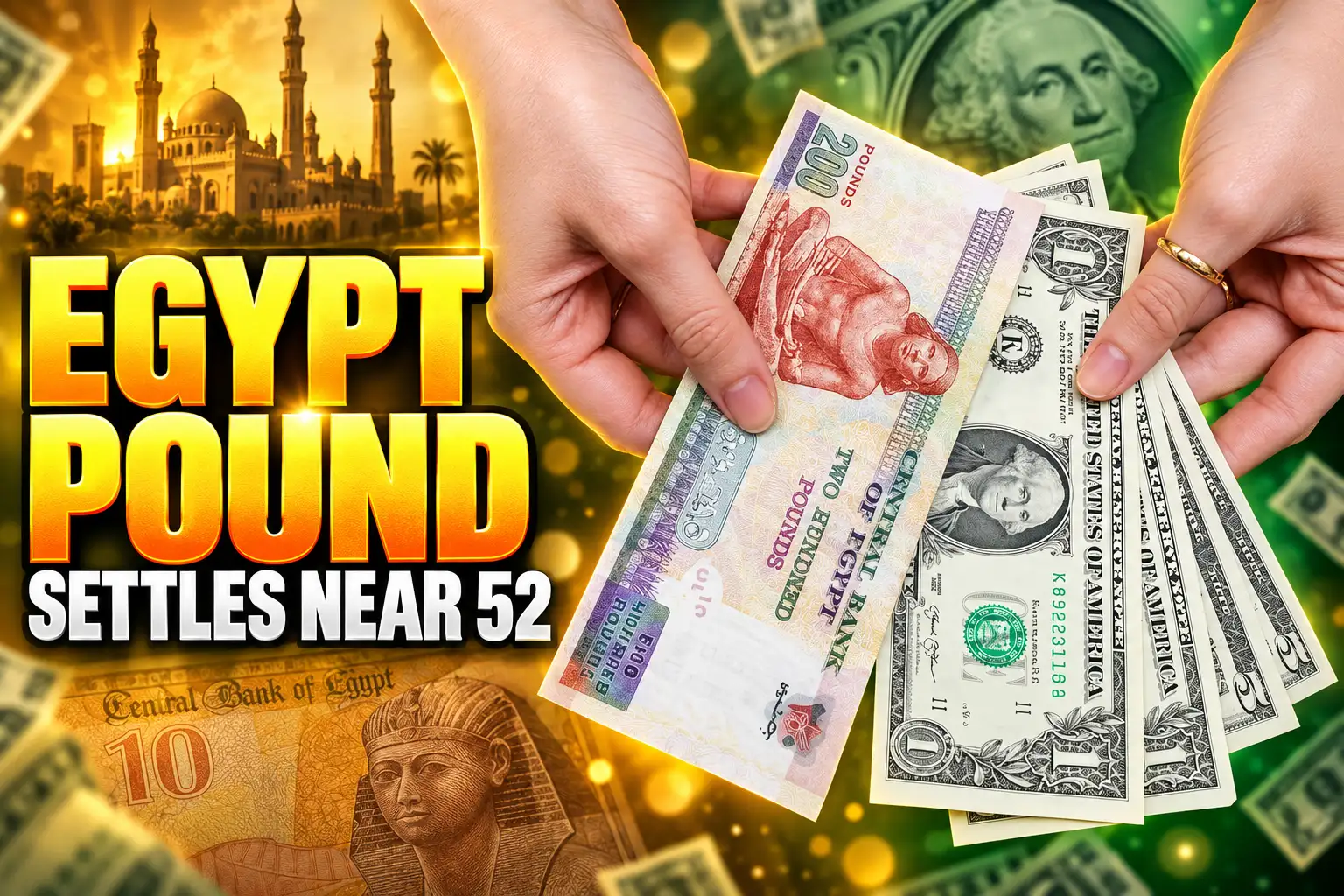
Egypt’s pound is back near 52 per dollar after a wartime slide and a rebound below 50, as Cairo’s last IMF review and the 52-pound wager come due.

On 11 June 2026, Egypt’s four largest banks all posted the dollar at 51.93 pounds to buy and 52.03 to sell. Abu Dhabi Islamic Bank sat 23 piastres higher. That 10-piastre spread at National Bank of Egypt, Banque Misr, Commercial International Bank, and QNB Alahli looked like a market that had stopped moving.
It had not. The dollar later fell below 50 pounds, then climbed back. On 1 October the Central Bank of Egypt listed 52.2571 pounds to buy a dollar and 52.3971 to sell. Cairo’s wager is that a rate near 52 can still be a float, still clear the last IMF review, and still keep dollars inside the banks.
Four Banks Printed the Same Dollar on June 11
The 11 June close, taken at 16:24 local time, was a wartime print, not a new official peg. The US-Israeli war on Iran had been running since 28 February. Foreign holders of local debt had already headed for the exit. The pound had already taken the hit in March. By mid-June the big state and private lenders were quoting the same number to the piastre.
ADIB, a Gulf-owned lender, was the exception at 52.16/52.26. That 23-piastre gap is how a “unified” market still prices a little extra caution. The rest of the screen looked coordinated because four large books were willing to deal at one pair of prices, with a 10-piastre turn for the bank.
BANK QUOTES ON 11 JUNE AND 2 OCTOBER
| Bank | 11 June buy | 11 June sell | 2 Oct buy | 2 Oct sell |
|---|---|---|---|---|
| National Bank of Egypt | 51.93 | 52.03 | 52.27 | 52.37 |
| Banque Misr | 51.93 | 52.03 | 52.27 | 52.37 |
| CIB | 51.93 | 52.03 | 52.27 | 52.37 |
| QNB Alahli | 51.93 | 52.03 | 52.26 | 52.36 |
| ADIB | 52.16 | 52.26 | 52.40 | 52.50 |
The October column is not a freeze of June. It is the same clustering habit at a slightly weaker pound. ADIB is still the high print. The central bank’s own 1 October pair, 52.2571/52.3971, sits under those commercial screens with a 14-piastre official spread.
The Wartime Slide Toward 54 and the Drop Below 50
Before the conflict, Central Bank of Egypt data put the dollar near 47.99 pounds. IMF staff later described a March peak-to-trough drop of about 14 to 17 percent as portfolio money left. Non-resident holdings of domestic government securities peaked at $39.1 billion on 18 February, then rebuilt to $37.2 billion by the end of June, still $1.9 billion short of that high.
The 11 June cluster at 51.93/52.03 was 8.21 percent weaker than 47.99. Ten days later the dollar was already cheaper again. On 21 June the central bank printed 49.80/49.94, about 3.9 percent weaker than the pre-conflict 47.99 rate and 1.24 pounds better than the prior Sunday’s 51.04/51.18. By 30 June the central bank listed 49.22/49.36, with NBE and Banque Misr at 49.25/49.35. Against the 11 June buy rate, that was a 2.71-pound, 5.22 percent stronger pound in 19 days.
IMF staff recorded a post-conflict high of 48.81 pounds per dollar in early July, then about 50.7 by 27 July as oil prices and regional tension returned. The path went both ways. That is the evidence Cairo now sells as proof the March 2024 shift to a more flexible rate was still in force during the war.
THE POUND’S 2026 PATH
- February 28, 2026: The US-Israeli war on Iran begins, with the dollar still near 47.99 pounds.
- March 2026: The pound’s peak-to-trough drop reaches about 14 to 17 percent, per IMF staff, as hot money leaves local debt.
- May 15, 2026: Fitch Ratings keeps Egypt at B with a stable outlook and says the central bank did not defend the pound.
- June 11, 2026: Four large banks close at 51.93/52.03; ADIB prints 52.16/52.26.
- June 30, 2026: The central bank lists 49.22/49.36 as the dollar falls below 50.
- July 30, 2026: The IMF completes the seventh EFF review and second RSF review, unlocking about $1.8 billion.
- October 1, 2026: The central bank’s official dollar rate is 52.2571/52.3971, 0.63 percent weaker than the 11 June buy print.
- December 15, 2026: The Extended Fund Facility arrangement is due to expire after the eighth review.
A rate that can weaken into the mid-50s implied levels in March and then print 49.22 in June is not a hard 52 peg. It is a managed two-way market that keeps drifting back toward the number banks already know how to quote.
Fitch Treated the Float as Egypt’s Shock Absorber
On 15 May, Fitch Ratings said the float had done the job that a defended rate used to fail. The agency kept the sovereign at B with a stable outlook after the first wave of war outflows. It estimated the pound had weakened about 10 percent against the dollar since late February, after non-resident capital outflows of more than $10 billion.
The Central Bank of Egypt (CBE) has not intervened to support the currency, helping to preserve FX buffers and maintain broad stability in domestic dollarisation.
Fitch Ratings, 15 May 2026 note on Egypt and the Iran conflict
Fitch also said net international reserves were stable at $53 billion at the end of April, with no intervention to support the pound and no gap between the official and parallel rates. Combined net foreign assets at the central bank and the banks had fallen $7 billion in two months, to $22 billion by early April, still $16 billion above the November 2024 level when Fitch last upgraded Egypt to B.
That is Fitch’s case for the flexible pound in one paragraph: let the rate take the outflow, keep the reserves, and do not reopen a black market. The agency still warned that a longer war could hit energy import costs and push reserves toward $50 billion by the end of fiscal 2026/2027 if the Strait of Hormuz reopened only by July. The central bank’s own later bulletin put net international reserves at $53.1 billion at the end of May, covering 6.0 months of merchandise imports.
Gulf Workers Sent $47.3 Billion Through Official Banks
The wager does not clear on Fitch language alone. It clears if dollars keep arriving through banks instead of the street. On 21 September the Central Bank of Egypt said remittances from Egyptians working abroad reached $29.7 billion in the first seven months of 2026, up 28.1 percent from $23.2 billion a year earlier. July alone was $4.5 billion, up 20 percent from $3.8 billion in July 2025.
THE WAGER’S HARD-CURRENCY BACKING
- Full-year remittances: Inflows hit a record $47.3 billion in FY2025/2026, up 29.6 percent from $36.5 billion.
- Seven-month pace: $29.7 billion from January to July 2026, $6.5 billion more than the same stretch of 2025.
- Policy rates: On 24 September the monetary policy committee kept the overnight deposit rate at 19.00 percent, the lending rate at 20.00 percent, and the main operation at 19.50 percent.
- Inflation still high: The IMF put urban headline inflation at 14.3 percent in June; the central bank’s public dashboard later showed headline at 14.5 percent and core at 14.9 percent, against a 7 percent target plus or minus 2 points in the fourth quarter of 2026.
Those yields are why foreign cash rented Egyptian bills before the war, and why some of it returned after the first shock. They are also why a 52-pound dollar still feeds imported inflation. Fitch, in May, had already flagged remittances up 30 percent to $22 billion in the first half of the then-current fiscal year, plus expected Gulf deposits and direct investment. On 29 September the Central Bank of the UAE and the Central Bank of Egypt renewed a five-year currency swap of AED 5 billion, equivalent to 69 billion pounds, at a signing in Abu Dhabi.
The #CentralBankUAEand the Central Bank of Egypt (CBE) today renewed their UAE Dirham(AED)-Egyptian Pound (EGP) currency swap agreement at a signing ceremony held at the CBUAE’s headquarters. With a nominal value of AED 5 billion, equivalent to EGP 69 billion, the agreement is…
— Central Bank of the UAE (@centralbankuae) September 29, 2026
A swap that size is a backstop, not a daily bid. The daily bid is still the worker in Riyadh or Dubai who now sends money through a bank because the official rate and the street rate no longer tell two different stories.
Why the Dollar Is Back Near 52 in October
The 1 October official pair of 52.2571/52.3971 is only 0.3271 pounds, or 0.63 percent, weaker than the 11 June buy print of 51.93. It is about 8.89 percent weaker than the pre-conflict 47.99 rate. The interesting move is the one in between: the dollar’s slide through the high 49s in late June, the 48.81 print in early July, and the grind back up as regional risk and a firm dollar reasserted themselves.
By 2 October, NBE, Banque Misr, and CIB were all at 52.27/52.37. QNB Alahli was 52.26/52.36. ADIB was again the outlier at 52.40/52.50. The central bank’s average market rate that week was 52.2725/52.3725. Four large books still like to sit on one number. One Gulf-owned book still prints a higher dollar.
That habit is what critics call a shadow band. The March-to-June tape is the reply: the band, if it exists, is wide enough to print 49.22 and wide enough to revisit 52. IMF staff, in the seventh-review papers, said the exchange rate “acted as the primary shock absorber” and moved in both directions with external conditions. The Fund also said there had been no recorded gap with the parallel market.
A 0.63 percent drift from 11 June to 1 October is small. A round trip from 47.99 to a 14-to-17 percent March drawdown, then through 49.22, then back to 52.2571 is not small. The bet is that investors will treat the second path as the real one.
Cairo’s Last IMF Review Comes Due in December
On 30 July the IMF Executive Board completed the seventh review under the Extended Fund Facility and the second review under the Resilience and Sustainability Facility, allowing Egypt to about $1.8 billion after two reviews. That was about $1.5 billion (SDR 1.11 billion) from the EFF and about $272 million (SDR 200 million) from the RSF, taking total purchases under the two arrangements to about $7.3 billion.
Nigel Clarke, the Fund’s deputy managing director, said Egypt had entered the Middle East war from a solid macroeconomic position, while still flagging high public debt and large financing needs. Amine Mati, the mission chief, said a lot of the March and June programme targets were met despite a very challenging situation. The Board’s own line in February had already been blunt: a flexible rate is needed to stop external gaps from coming back, with central bank intervention limited to disorderly conditions.
On 1 October, Julie Kozack, the IMF communications director, said the eighth and final EFF review and the third RSF review are expected in the fourth quarter, releasing about $2.3 billion if the Board approves. The EFF arrangement, expanded to $8 billion in March 2024 and stretched from its original calendar, is due to end on 15 December 2026.
WHAT THE LAST REVIEW STILL TESTS
- The rate itself: The Fund still wants the pound set in the market, with intervention only for disorderly moves, not for a quiet 52 handle.
- The reserve buffer: Staff said end-June net international reserves on the programme measure reached $41.6 billion, above the adjusted target of about $37.3 billion.
- The state sale lag: A July supplement recorded $526.3 million of divestment proceeds transferred to the budget by 26 July, including $420 million from selling Gabal El-Zeit wind farm.
- The exit: Cairo has not opened talks on a successor programme and has talked up a national plan after 15 December.
Passing the seventh review during a regional war is the strongest official stamp the 52-pound wager has received. The eighth review is the one that closes the account. If the dollar is still being printed in a tight cluster when that Board meeting lands, Washington will ask whether the cluster is a market or a habit.
A 52-Pound Dollar Shows Up in Ordinary Prices
For households, 52 is not a stability story. It is the price of imports after two years of a more open rate. People counting in shops keep returning to the same comparison: a 500-pound office chair bought in 2020 now costs more than that for a single replacement column, and a decent new chair is quoted around 10,000 pounds. The float closed the parallel gap and pulled remittances into banks. It also locked in a weaker pound as the starting point for every fuel, wheat, and spare-part invoice.
Bank screens in early October still look like 11 June, only a few piastres worse. ADIB is still richer on the dollar than NBE. The central bank is still publishing a two-way official pair instead of a defended single number. The IMF still has one review and about $2.3 billion sitting on that design.
The 11 June close at 51.93/52.03 was never the end of the move. It was a midpoint in a wager that the pound can trade, cluster, recover, and cluster again near 52 without bringing back a second exchange rate. On 1 October that number was 52.2571/52.3971. The last test of whether that is a market or a ceiling is the review due before 15 December.
Disclaimer: This article is news reporting and analysis of published exchange rates, official statements, and programme documents. It is informational only and is not investment, currency-trading, or sovereign-debt advice, and it is not a recommendation to buy, sell, or hold pounds, dollars, Egyptian bills, or any other instrument. Readers who may act on FX or country risk should consult a licensed investment adviser or a qualified banker who can apply current rates, spreads, and controls to their own position. Figures and review calendars here reflect the cited official and rating sources as of the dates named in the piece and can change with the next central bank print or IMF Board decision.

Ninja Theory Staff Face Redundancy After Two Xbox Sales Collapse

Amazon Sells the MacBook Air at Its Pre-Hike Price

U.S. Slows Jet Parts to Squeeze China’s Flying Fleets

PEGI Pulled the GTA 6 Age Rating After Cocaine Details

Northwestern’s Smaller Ryan Field Gave Penn State Nowhere to Hide

Aramco Crash Kills 14 Two Days After Oil Restart

Salah Captained Egypt to Their First World Cup Win

Apple Labor Day Deals Hide June’s Memory Price Hike

Palworld 1.0.4 Adds Palpedia Search After the 1.0 Launch

Zelda’s 40th Switch 2 Ships Without a Zelda Game
-
 BUSINESS3 months ago
Aramco Crash Kills 14 Two Days After Oil Restart
-
 NEWS4 months ago
Salah Captained Egypt to Their First World Cup Win
-
 NEWS1 month ago
Apple Labor Day Deals Hide June’s Memory Price Hike
-
 GAMING4 weeks ago
Palworld 1.0.4 Adds Palpedia Search After the 1.0 Launch
-
 GAMING4 weeks ago
Zelda’s 40th Switch 2 Ships Without a Zelda Game
-

 NEWS3 months ago
El Niño Puts Israel’s Needed Winter Rain on a Flood Clock
-

 BUSINESS8 months ago
Egypt Bets EGP 638 Billion Can Open Sinai to Investors
-

 ENTERTAINMENT4 weeks ago
King Charles Letter Keeps Harry and Meghan as Private Citizens