
NEWS
The Quarry Notes That Rewrote Hatshepsut’s Broken Statues
A 1920s Met dig framed Hatshepsut’s statues as revenge. Archive work finds neck-waist-knee breaks, later reuse, and nine of 18 faces intact.

Nine of 18 freestanding Hatshepsut statues kept their faces, a 24 June 2025 study found in 1920s Deir el-Bahri notes. Jun Yi Wong, a University of Toronto Egyptology doctoral candidate, traced the breaks to neck, waist and knees, then to later reuse as building stone. Herbert Winlock, who led the Metropolitan Museum of Art digs from 1922 to 1928, had already tagged the heap as spite.
Wong’s paper does not cancel the campaign that cut Hatshepsut’s name and image from temple walls after her death around 1458 BC. It splits that chisel work from the quarry dump that made her face look uniquely smashed.
Winlock Called the Fragments Relics of Spite
Winlock’s crews pulled thousands of statue pieces from two pits beside the causeway of Hatshepsut’s mortuary temple, on the west bank of the Nile opposite Luxor. The statues looked ruined. He read the ruin as a verdict on Thutmose III, her nephew and successor, whose sole reign ran from about 1458 to 1425 BC.
In a 1923 report he called the pieces “maddening relics of Thutmose’s spite.” Wong, citing those same reports, records a second line that stuck in textbooks for a century.
Every conceivable indignity had been heaped on the likeness of the fallen Queen.
Herbert Winlock, Metropolitan Museum excavation director, 1920s Deir el-Bahri reports
William Edgerton soon called the statue damage “impulsive,” set against the slower erasure on the walls. Later writers folded both acts into one revenge plot. Wong’s afterlife of Hatshepsut’s statuary study, published in Antiquity volume 99, issue 405, pages 746 to 761, went back to the unpublished field notes, drawings, photographs and letters now held in the Met’s Department of Egyptian Art Archives.
He did that work in 2023 on an Andrew W. Mellon Fellowship at the museum, using Winlock’s Theban excavation volumes and unpublished notes by Dorothea Arnold, curator emerita. The photographs of the joinery were made by Harry Burton in 1929, while restorers were still fitting noses back onto granite.
FROM THE QUARRY TO THE PAPER
- 1922 to 1923: Winlock’s team opens the Hatshepsut Hole, a landscaping pit later sealed under Thutmose III’s causeway.
- 1926 to 1928: The larger quarry north of the avenue yields the bulk of the statue dump, with small pieces above the rim and large ones rolled in.
- 1929: Burton photographs the joins; the Met swaps fragments with Berlin so a seated figure can be rebuilt in New York.
- 24 June 2025: Wong publishes the archive reread in Antiquity, arguing most facial harm post-dates Thutmose III.
The notebooks were never lost. They were waiting for someone to map findspots against which faces survived.
The Hatshepsut Hole Was a Construction Pit
Both hollows were dug for fill when Hatshepsut’s temple was landscaped, not as execution pits. The Hole is the only deposit sealed in Thutmose III’s reign, because his temple causeway was built over it. What went into that fill was mixed on purpose.
WHAT LAY IN THE HATSHEPSUT HOLE
- Kneeling figures: Fragments from seven small kneeling statues, broken at neck, waist and knees; five had undamaged faces and came out complete except for missing bases.
- Sphinx scraps: Mostly uraei, the sacred cobras from the brow, plus claws, and inscribed chips from a limestone sphinx base.
- Osiride chips: Numerous pieces from limestone pillar statues of Hatshepsut in a wrapped, mummy-like pose.
- Temple rubbish: Building stone, votive objects and ostraca dated to Hatshepsut and Thutmose III, with statue parts scattered through the debris as causeway fill.
Winlock himself wrote that the statues were buried “without much deliberation.” Wong’s point is sharper. Once a statue had been broken at its weak points, a single person could carry a fragment, and the least useful bits (heads, claws) were what got dumped as rubble.
In the Hole, five of those kneeling faces were clean. If Thutmose’s crews had wanted to smash every likeness, they had hammers and they used them on necks. They did not need to leave Gallery-ready faces in the fill.
Faces Survived Where Reuse Did Not
Wong sorts the Deir el-Bahri corpus into three kinds of statue, because each was taken apart in a different way. Architectural “Osiride” figures were built in stacked stone courses held with plaster, from 3.13 m to 7.35 m high. Sphinxes lined the avenue, many in sandstone, originally in the hundreds. Freestanding royal figures were cut from single blocks of granite or diorite.
STATUE TYPES AT DEIR EL-BAHRI
| Type | What Wong counted | Faces largely intact |
|---|---|---|
| Architectural Osiride | About 40 recovered; face chips for 22 of 24 Upper Portico pillars; mouth chips for 9 of 10 Upper Court figures; fragments from all 4 sanctuary statues and both Lower Portico statues | 3 (Cairo JE 56259A, 56260, 56261) |
| Sandstone sphinxes | Up to 120 represented, often only by a paw or a head; some recut as column drums | 1 (Cairo JE 53113) |
| Freestanding royal statues | 18 with at least part of the head recovered; 7 of the undamaged group found nearly complete except the base | 9, with no more than minor nose chips |
Heads from the Osirides survive out of proportion to their mass because a wrapped body is a stack of useful blocks, while a face is an awkward leftover. Tool marks show workers hunting the joints under paint. A stone house north-east of the temple court was built largely from those body courses. The heads were harder to sell as masonry, so they stayed in the record, often cracked from the fall when a 7.35 m figure came off its pillar.
Sphinxes lost heads and paws so the barrel of the body could be reused; bases, prized as clean blocks, are scarce. Freestanding statues tell the cleaner story. All were snapped at neck, waist and feet. Hatshepsut’s names on them tend to be whole. The uraeus on the brow was usually cut away, a step also seen on other kings.
Among those 18 heads, nine belong to Wong’s Group A (no facial harm, or only a nick to the nose) and nine to Group B (serious facial harm). Seven of the nine intact figures were found nearly complete, each clustered in the Hole or in neighbouring quarry patches. Group B is never near-complete, and its pieces are spread, some hundreds of metres off, some in layers later than Thutmose III. Every statue found almost whole has an almost whole face. That is the reuse pattern, not a half-finished hate order.
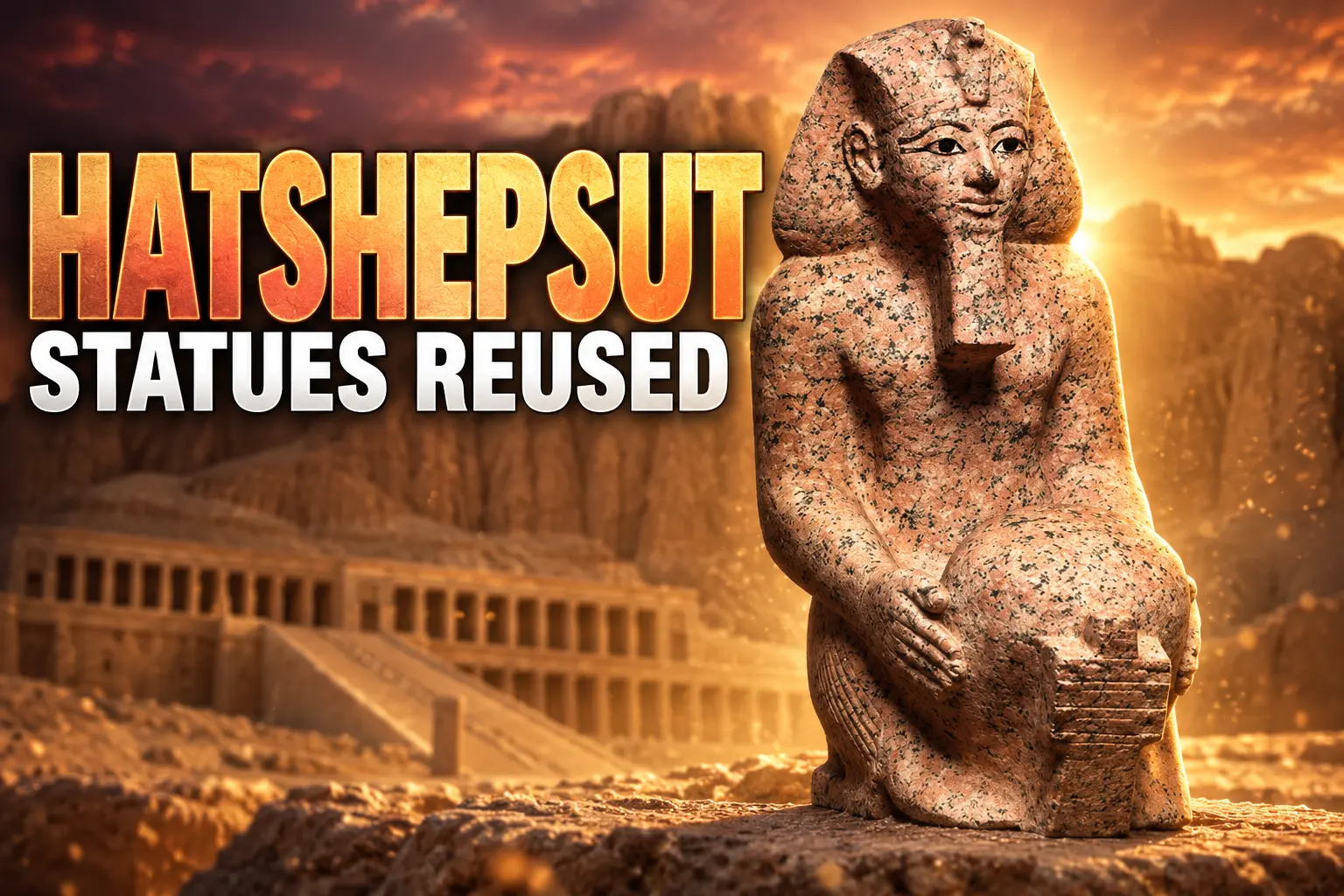
The small kneeling statue with intact face, object 23.3.1, is the plainest exhibit: granite with paint, 61.6 cm high, 32.5 cm wide, 51.5 cm deep, from the Hole in 1922 to 1923, now in Gallery 115. It still offers a nemset jar. Its base is gone.
How Egyptian Statues Were Turned Off
New royal statues were not treated as inert stone. Priests performed the Opening of the Mouth rite to make them able, in Egyptian terms, to eat, breathe and receive offerings. Before a living image could be moved out of a temple, that power had to be shut off. The practical method was to break the figure at the neck, waist and knees, the same weak lines a mason would choose anyway.
WHAT DEACTIVATION LOOKS LIKE
- The breaks: Neck, waist, knees or feet, sometimes a beard snapped as a side effect of the neck blow.
- The face: Often left alone; Wong notes the crews had already proved they could hit a face if they wished.
- The name: Commonly left on the statue once the figure was inert, which fits the intact cartouches at Deir el-Bahri.
- The brow: The uraeus, mark of kingship, usually removed on Hatshepsut’s figures and on other royal statues.
The same breaks show up on statues of Mentuhotep II, Senwosret III, Amenhotep I and Thutmose III at Deir el-Bahri, and in temple caches across Egypt and Nubia. Mentuhotep II’s own temple sits beside Hatshepsut’s; he reigned about 2055 to 2004 BC and was honoured as a unifier, not as a target of hate. The Karnak Cachette of buried royal statues held hundreds of figures treated this way, most of them kings who faced no posthumous attack.
Wong put it in one sentence that cuts the revenge plot down to size. “This treatment does not necessarily denote hostility towards the depicted individual,” he wrote. Popular posts that followed the paper treated that line as a full pardon. It is not. It is a claim about how stone bodies were retired.
Hatshepsut’s Names Were Cut From Temple Walls
Wong is explicit that Hatshepsut, unlike those cache kings, did suffer a programme of persecution, and that “its wider political implications cannot be overstated.” The usual form was the erasure of her name and image from temple walls, an act begun under Thutmose III. Some of those recut scenes were then boxed in by his new building, which dates the start of the campaign to his reign.
“Hatshepsut’s depictions were systematically erased by Thutmose III following her death,” Wong has said, adding that early archaeologists leaned on a stock “evil stepmother” reading, coloured by ideas about her gender. The statues were found in pieces, so the same motive was pasted onto the quarry. His archive map pulls those two files apart.
Once you take away all this later damage, you find that the destruction caused by Thutmose III was limited and very methodical, the statues were broken across specific weak points, in line with what is often described as the deactivation of Egyptian statues.
Jun Yi Wong, Egyptology doctoral candidate, University of Toronto
Reuse kept going long after that reign. Fragments became tools. Some sat near the surface for nineteenth-century visitors. Wong allows later, less orderly attacks by people who still feared a live image, plus quake and decay. He also allows a harder reading, that Thutmose ordered faces smashed and the order was only half carried out, then shows why the findspots make that path unlikely: intact faces travel with complete bodies; smashed faces travel with scattered, missing ones.
The uraeus chopping still looks political, because it strips the mark of kingship. So does the wall campaign. What the Hole does not show is a crew working through a portrait with a grudge and a hammer.
A Met Label Still Blames the Nephew
The museum that holds the notebooks also holds the statues, and its public story has not fully caught up. Conservators Ann Heywood and Anna Serotta, writing on 1 August 2022 about the seated limestone figure 29.3.2, still told readers that after Hatshepsut’s death Thutmose III destroyed her statues to obliterate her memory. That seated figure, from the Senenmut quarry in 1926 to 1928, with Berlin pieces known since 1845, went through major restorations in the 1930s, 1979 and 1993. The last pass rebuilt a left eye from a cast of the right so the face would read as a face again.
Winlock’s spite line and that 2022 sentence are the same plot, written in New York, hanging on objects whose own findspots Wong has now tabulated. The kneeling granite in Gallery 115 never needed that plot. Its face was intact in the Hole. Its waist was not.
Frequently Asked Questions
What Was Hatshepsut’s Throne Name?
Maatkare. On the Met’s seated statue she also carries feminized kingly titles, “the Perfect Goddess, Lady of the Two Lands” and “Bodily Daughter of Re.” After the early death of Thutmose II, her husband and half brother, she served as regent for the young Thutmose III, then took the throne herself about seven years later and used the full titulary of a king.
How Many Small Kneeling Statues Stood in the Upper Court?
At least eight, and perhaps as many as twelve, somewhere in the uppermost court of the Deir el-Bahri temple. They wear the khat headcloth and offer a nemset vessel with a djed pillar on the front, a grouping that has been read as a nod to the Heb Sed, the king’s rejuvenation festival, which Hatshepsut may have meant to celebrate late in her reign.
What Is the Karnak Cachette?
A single deposit at Karnak Temple in Luxor in which hundreds of royal statues were buried. The vast majority had already been broken at the weak points used to retire a living image, even though most of those kings were never attacked after death, which is why Wong uses the cache as a control for Hatshepsut’s quarry.
How Late Were Hatshepsut’s Statue Fragments Reused?
Reuse around Deir el-Bahri ran into the Graeco-Roman period, about 332 BC to AD 95. Some pieces were still near the ground surface when nineteenth-century visitors, including the Prussian expedition under Richard Lepsius, recorded them, which is why facial harm on widely scattered fragments cannot be dated to Thutmose III by default.
The small kneeling granite figure remains on view in Gallery 115 at the Met Fifth Avenue, face whole, base missing, jar still offered. The 2022 conservation note on its seated companion still tells visitors the nephew smashed her statues to wipe her out.

Ninja Theory Staff Face Redundancy After Two Xbox Sales Collapse

Amazon Sells the MacBook Air at Its Pre-Hike Price

U.S. Slows Jet Parts to Squeeze China’s Flying Fleets

PEGI Pulled the GTA 6 Age Rating After Cocaine Details

Northwestern’s Smaller Ryan Field Gave Penn State Nowhere to Hide

Aramco Crash Kills 14 Two Days After Oil Restart

Salah Captained Egypt to Their First World Cup Win

Apple Labor Day Deals Hide June’s Memory Price Hike

Palworld 1.0.4 Adds Palpedia Search After the 1.0 Launch

Zelda’s 40th Switch 2 Ships Without a Zelda Game
-
 BUSINESS3 months ago
Aramco Crash Kills 14 Two Days After Oil Restart
-
 NEWS4 months ago
Salah Captained Egypt to Their First World Cup Win
-
 NEWS1 month ago
Apple Labor Day Deals Hide June’s Memory Price Hike
-
 GAMING4 weeks ago
Palworld 1.0.4 Adds Palpedia Search After the 1.0 Launch
-
 GAMING4 weeks ago
Zelda’s 40th Switch 2 Ships Without a Zelda Game
-

 NEWS3 months ago
El Niño Puts Israel’s Needed Winter Rain on a Flood Clock
-

 BUSINESS8 months ago
Egypt Bets EGP 638 Billion Can Open Sinai to Investors
-

 ENTERTAINMENT4 weeks ago
King Charles Letter Keeps Harry and Meghan as Private Citizens