
BUSINESS
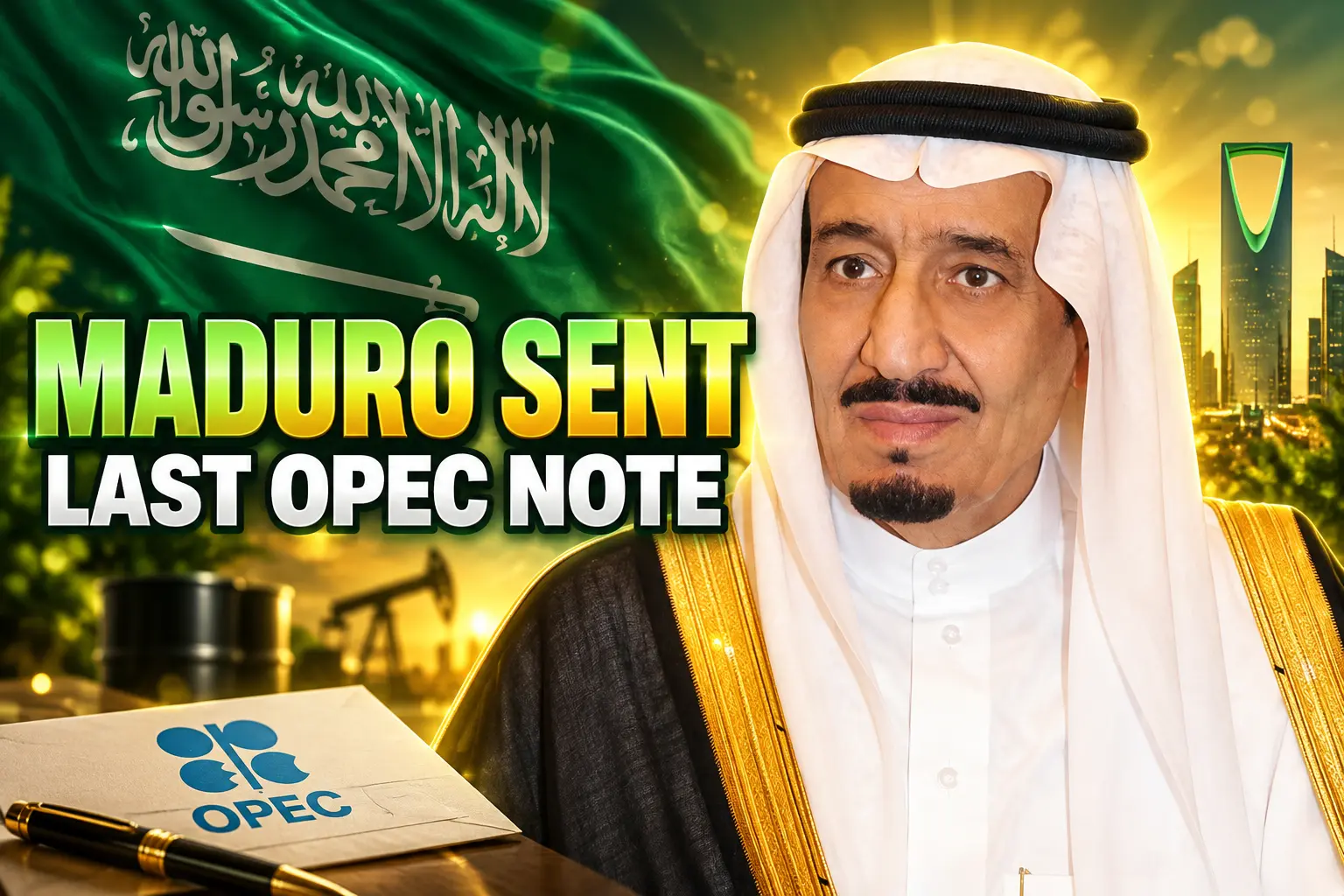
Maduro’s Letter to King Salman Was the Last OPEC Handshake
King Salman took Maduro’s June 2025 letter on closer ties. Six months later the US seized Maduro and Caracas began examining an OPEC exit.

King Salman received a written message from Venezuelan President Nicolás Maduro on June 22, 2025, just over six months before US forces seized Maduro in Caracas. The Saudi Press Agency said the note concerned closer ties in various fields. It read like OPEC courtesy. It was the last Maduro-era appeal to the cartel’s swing producer.
Vice Minister of Foreign Affairs Waleed Elkhereiji took the envelope the same Sunday from Ambassador David Velasquez Caraballo. By January 2026 that channel sat on the far side of a US raid, a New York arraignment, and a fight over whether Venezuela still belongs in the club it helped invent.
A Letter for King Salman, Handed in Riyadh
The official dispatch was short, and it named no oil, no quota, and no sanction. King Salman received a written message from Venezuela’s president, Nicolás Maduro Moros, “regarding ways to enhance the relations between the two friendly countries in various fields.”
The meeting discussed relations between the two countries and the means to develop them across various domains, in addition to other topics of mutual concern.
Saudi Press Agency, Riyadh, June 22, 2025
Elkhereiji received Caraballo at the foreign ministry headquarters. SPA timed the item at 23:24 local, 20:24 GMT. The king did not appear in the room. In the Saudi system a written message to the monarch is still a message to the state, even when a vice minister holds the paper.
Nothing in the release promised a new commission, a loan, or a barrel. Riyadh files notes like this from many capitals. The weight sat in the sender and in the file behind him, because Caracas and Riyadh do not have a tourist relationship. They have an oil relationship that is older than OPEC itself.
Jeddah Already Had This Conversation
Maduro had already made the trip in person. On June 5, 2023, he landed in Jeddah and was received by Prince Badr bin Sultan, deputy governor of the Makkah region. The next day Crown Prince Mohammed bin Salman sat with him at Al-Salam Palace. Saudi Energy Minister Prince Abdulaziz bin Salman was in the room. So was Foreign Minister Prince Faisal bin Farhan. On the Venezuelan side, oil minister Pedro Tellechea sat with Foreign Minister Yván Gil and Maduro’s wife, Cilia Flores.
SPA said the two sides reviewed bilateral relations and “prospects for cooperation and opportunities to enhance them in various fields.” Put the energy minister at the table and the field is not in doubt. Gil had met Faisal the day before. The visit came a day before the US secretary of state was due in the kingdom, and it followed Maduro’s first trip to the region since a 2015 OPEC price tour.
That 2015 stop is the template. Maduro met then-Crown Prince Salman in Riyadh on January 11, 2015, while crude was in a slide that had halved prices in months. “We talked in-depth about important ideas for a strategy of stabilising the oil market, price recovery,” Maduro told reporters after that meeting. Saudi briefers gave no matching detail. The poorer OPEC hawk had come to ask the swing producer to cut. The swing producer declined to say it would.
The paper trail kept moving after Jeddah. Gil met Faisal again on September 28, 2024, during the UN General Assembly in New York, and they restated political, diplomatic, and energy cooperation. On October 8, 2024, Saudi Ambassador Abdullah Muhammad Al Saihani handed Gil letters of congratulations from King Salman and Mohammed bin Salman on Maduro’s reelection, wishing him “great success” and the Venezuelan people “continued progress and prosperity,” the Venezuelan foreign ministry said. On May 19, 2025, five weeks before the king’s letter, Gil and Al Saihani met again in Caracas on cooperation in international energy forums and on a coming joint commission.
Venezuela’s ministry dates diplomatic relations established in 1952 and records the first high-level joint commission in 2015, after Hugo Chávez reset the channel. The June 22 note was not a cold call. It was the next sheet in a folder both capitals had been feeding for a decade.
They Built OPEC Together in Baghdad
The folder is older than both men. OPEC’s own membership page says the group was founded in Baghdad in September 1960 by Iran, Iraq, Kuwait, Saudi Arabia, and Venezuela. Those five remain the founder members. The statute still gives them a veto on new full members. OPEC lists 12 members now. Qatar left on January 1, 2019. Angola left on January 1, 2024. Venezuela is still on the roster, and OPEC’s country page still calls it a Founder Member of OPEC.
Juan Pablo Pérez Alfonzo of Venezuela and Abdullah al-Tariki of Saudi Arabia were the pairing that made Baghdad possible. They had already met in 1959 around the Arab Petroleum Congress and a side gathering at Cairo’s Maadi Yacht Club with Iran, Iraq, and Kuwait. OPEC later quoted Pérez Alfonzo after the founding: “We are now united. We are making history.” The second conference sat in Caracas in 1961. For a long stretch the Venezuelan argument, floor prices and producer solidarity, was the language poorer members used on the Gulf.
That is why a bland letter to King Salman still sat inside OPEC, even when it named no crude. Maduro’s government had spent years asking Riyadh to treat Caracas as a partner in the price, not as a sanctioned afterthought. The 2025 note used the same “friendly countries” phrasing the 2023 Jeddah readout had used. The raid broke the person who had been sending it.
THE FILE THAT LED TO THE LETTER
- 1952: Caracas and Riyadh open diplomatic relations, per Venezuela’s foreign ministry.
- September 1960: Iran, Iraq, Kuwait, Saudi Arabia, and Venezuela found OPEC in Baghdad.
- January 11, 2015: Maduro meets Crown Prince Salman in Riyadh during a tour to lift oil prices.
- 2015: The first Venezuela-Saudi high-level joint commission meets.
- June 5-6, 2023: Maduro meets Mohammed bin Salman in Jeddah; the Saudi energy minister attends.
- October 8, 2024: King Salman and Mohammed bin Salman send congratulations on Maduro’s reelection.
- May 19, 2025: Gil and Ambassador Al Saihani talk energy forums and a coming joint commission.
- June 22, 2025: Elkhereiji accepts Maduro’s letter for King Salman in Riyadh.
Each of those dates is a producer talking to a producer. None of them required Washington’s blessing, and several of them sat awkwardly beside US sanctions. That was the point of the channel while Maduro still held Miraflores.
What the January 2026 Capture Changed
US forces seized Maduro and Cilia Flores in Caracas on Saturday, January 3, 2026, just over six months after the Riyadh handoff. President Donald Trump said the pair would face federal charges and that the United States would run Venezuela for a time, with US oil companies in view for the nationalized industry. Maduro and Flores were flown out through a US warship and reached New York the same day.
On January 5, 2026, Maduro, then 63, pleaded not guilty in Manhattan to narco-terrorism and cocaine-import counts that rest on a superseding indictment unsealed the day of the raid. He told the court he was still head of state.
I am here kidnapped since Jan. 3, Saturday.
Nicolás Maduro, US District Court, Southern District of New York, January 5, 2026
Delcy Rodríguez, his former vice president, became acting president in Caracas. Iran called the seizure an abduction. Qatar offered to help mediate. A Saudi public line on the raid did not appear in the official statements that usually mark a shock of that size. The June letter had treated Maduro as a counterpart. The January operation treated him as a defendant. Riyadh did not have to tear the paper up. The addressee on the other side of it had been removed.
Cilia Flores had sat in the Jeddah palace in 2023. She sat in the New York dock in 2026. The personal channel the letter assumed, president to king, did not survive that weekend.
Barrels Bound for the US Gulf Coast
The oil moved faster than the diplomacy. Westwood, an energy research house, put Venezuelan crude at 0.9 million barrels a day across 2025, then 0.8 million in January 2026 after a sanctions squeeze that preceded the raid. Output then rose each month and reached 1.1 million barrels a day in May 2026. OPEC figures for June 2026 put Venezuela, which is exempt from the alliance’s cuts, at 1.10 million. A survey of OPEC output for August 2026 put it at 1.23 million, a seven-year high, up 70,000 barrels a day.
VENEZUELAN CRUDE, 2025 TO AUGUST 2026
| Period | Output | Note |
|---|---|---|
| 2025, full year | 0.9 million bpd | Westwood year average |
| January 2026 | 0.8 million bpd | Sanctions tightened, then the raid |
| May 2026 | 1.1 million bpd | Westwood monthly reading |
| June 2026 | 1.10 million bpd | OPEC, member not in cuts |
| August 2026 | 1.23 million bpd | Market survey, seven-year high |
The cargoes changed destination with the politics. Figures from the US Energy Information Administration show US petroleum imports from Venezuela at 471,000 barrels a day in May 2026, nearly four times the 118,000 barrels a day recorded in May 2025. Washington expanded licences for traders and for more companies to move the crude. A lot of it sat in Caribbean tanks on its way to Gulf Coast refineries that were built for heavy grades.
Westwood counted well completions rising from 32 in 2024 to 128 in 2025, a 300 percent jump, mostly workovers rather than a new drilling boom. The Venezuelan oil ministry has talked of 1.37 million barrels a day by the end of 2026. That is still far under the peaks of the late 1990s, and it depends on power, diluent, and foreign crews that were not in the country when Elkhereiji took the envelope.
For Saudi Arabia the arithmetic is rude in a different way. A survey of OPEC output found group supply down 900,000 barrels a day in August 2026, with Saudi production off just over a million as threats hit both of the kingdom’s export routes and observed crude exports fell by a third to 3.03 million barrels a day. Venezuelan barrels, small beside Saudi capacity, were rising while the swing producer was being forced offline. They were also rising under US commercial control, which is not how OPEC founding members used to ship.
Caracas Has Examined Walking Out of OPEC
By late August 2026 the oil file had a political clause hanging off it. Trump announced what he called the biggest oil deal in world history, built around 17 Venezuelan fields and about 65 billion barrels. A Pentagon spokesman said the Departments of State and War had negotiated US majority control of those reserves “at zero taxpayer cost.” Acting President Rodríguez described a 25-year arrangement aimed at 1.5 million barrels a day. US officials talked of 100-year concessions. Venezuelan law, as described by lawyers in Caracas, does not allow a term that long.
People familiar with talks between US and Venezuelan officials said an OPEC exit had come up, with no decision taken. Asked on August 31, 2026, whether Venezuela should leave, Trump said, “Well, I don’t know. That’s up to them. I mean, that’s going to be up to them.” He added that the two countries were extracting “millions and millions of barrels” bound for Houston, Louisiana, and other US ports. OPEC’s public roster still lists Venezuela. An exit remains a deliberation, not a resignation letter.
WHAT WE KNOW
- The letter: King Salman received Maduro’s note on June 22, 2025, through Vice Minister Elkhereiji.
- The raid: US forces seized Maduro in Caracas on January 3, 2026, and he pleaded not guilty on January 5.
- The barrels: EIA data show US imports of Venezuelan petroleum near four times the May 2025 level by May 2026.
- The deal talk: Washington and Caracas announced a long-term arrangement over 17 fields and about 65 billion barrels.
WHAT IS UNCONFIRMED
- OPEC membership: No Venezuelan resignation has been filed; Trump said the choice sits in Caracas.
- The term: US officials have described 100-year concessions; Rodríguez has described 25 years.
- The condition: An OPEC exit as a required term of the oil deal has not been published by either government.
The June letter asked for a stronger relationship in various fields. The field that always mattered was crude, priced and rationed with Riyadh, not sold under a US offtake. Pérez Alfonzo’s line after Baghdad was that the producers were united. The last Maduro note to King Salman still spoke in that grammar. The government that holds Caracas now talks to Washington about leases, and it talks about OPEC as a decision it might make later.
Elkhereiji’s meeting on June 22, 2025, will stay in the SPA archive as a routine royal message. The reckoning sits in what the other capital became six months later, a supplier whose barrels point at the US Gulf, and whose founding seat in OPEC is the part of the file nobody has closed.

Ninja Theory Staff Face Redundancy After Two Xbox Sales Collapse

Amazon Sells the MacBook Air at Its Pre-Hike Price

U.S. Slows Jet Parts to Squeeze China’s Flying Fleets

PEGI Pulled the GTA 6 Age Rating After Cocaine Details

Northwestern’s Smaller Ryan Field Gave Penn State Nowhere to Hide

Aramco Crash Kills 14 Two Days After Oil Restart

Salah Captained Egypt to Their First World Cup Win

Apple Labor Day Deals Hide June’s Memory Price Hike

Palworld 1.0.4 Adds Palpedia Search After the 1.0 Launch

Zelda’s 40th Switch 2 Ships Without a Zelda Game
-
 BUSINESS3 months ago
Aramco Crash Kills 14 Two Days After Oil Restart
-
 NEWS4 months ago
Salah Captained Egypt to Their First World Cup Win
-
 NEWS1 month ago
Apple Labor Day Deals Hide June’s Memory Price Hike
-
 GAMING4 weeks ago
Palworld 1.0.4 Adds Palpedia Search After the 1.0 Launch
-
 GAMING4 weeks ago
Zelda’s 40th Switch 2 Ships Without a Zelda Game
-

 NEWS3 months ago
El Niño Puts Israel’s Needed Winter Rain on a Flood Clock
-
 BUSINESS8 months ago
Egypt Bets EGP 638 Billion Can Open Sinai to Investors
-

 ENTERTAINMENT4 weeks ago
King Charles Letter Keeps Harry and Meghan as Private Citizens