
ENTERTAINMENT
Saudi Arabia and China Lock a Five-Year Cultural Research Pact
The June 2025 Diriyah deal is a five-year archives and research program with a Beijing think tank, still in force after the Cultural Year’s festivals closed.

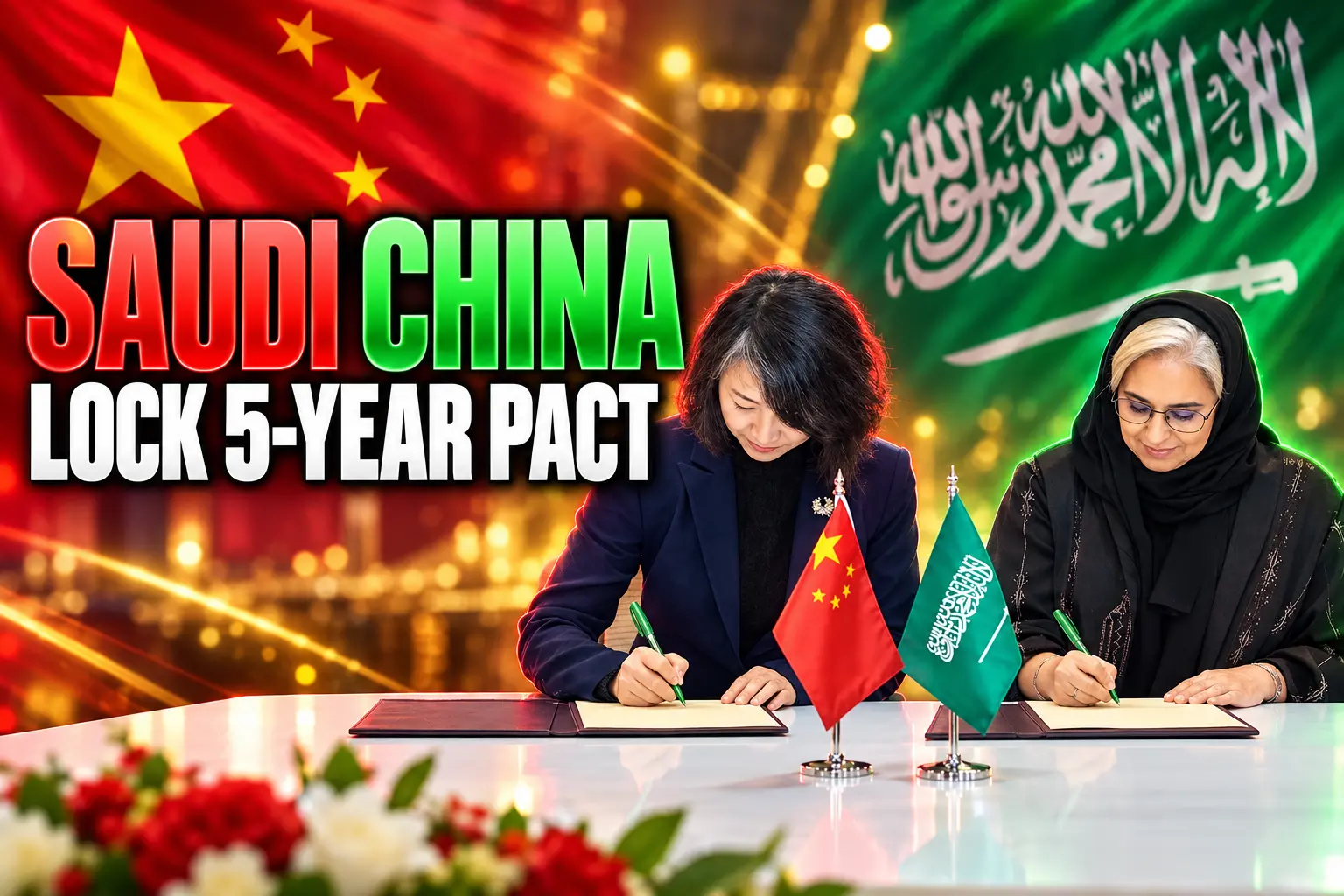
Saudi Arabia and China signed a five-year cultural research program in Diriyah on June 29, 2025, built to outlast the festival year it sat under. Deputy Minister Maha Abdullah Alsenan and Beijing International Studies University vice president Cheng Wei signed for the Ministry of Culture and the China-Arab Cultural and Tourism Cooperation Research Center.
The public calendar of the Saudi-Chinese Cultural Year closed in Riyadh in January 2026. The archives clause, the fellowships, and the Beijing think tank did not close with it.
The Diriyah Program Runs for Five Years
The Ministry of Culture signed an executive program in Diriyah at its headquarters, with Cheng Wei signing as vice president of BISU and as a member of the center’s joint committee. The university’s own note on the visit is the source for the five-year term, which the Saudi release described in duties rather than in duration.
Alsenan, the deputy minister for research and cultural heritage affairs, told the Chinese delegation she wanted long-term, practical work based on the pact, the university said after the ceremony. The paper is a research instrument, not a touring exhibition contract.
The ministry placed the signing inside the National Culture Strategy and Vision 2030, whose culture brief includes promoting culture as a way of life, using it for economic growth, and opening global cultural exchange. Those three aims were set out when the ministry published its vision on March 27, 2019, after Royal Order A/217 created the ministry on June 2, 2018, under Prince Badr bin Abdullah bin Farhan Al Saud.
WHAT THE DIRIYAH PROGRAM COVERS
- Joint studies: Both sides will run research projects meant to raise the quality of cultural work they submit.
- National archives: They will identify and compile cultural content on each country that sits in the other’s official holdings.
- Shared meetings: The ministry will work with the Chinese side to hold joint conferences on common cultural questions.
- Researcher travel: Saudi researchers get support to visit Chinese universities and centers, and Chinese researchers get the reverse path.
- Fellowships: The program offers support inside a research fellowship scheme and supplies specialists in cultural fields.
- Advice: Consultative support sits in the same package, on paper, as the travel and catalog work.
The archives line is the part that still matters after a festival ends, because catalogs do not pack out with the stage set. No public list of named fellows or of a finished joint inventory has been issued since the signing, so the duties remain the record of what was promised, not yet of what was delivered.
Signed in Riyadh by Deputy Minister for Research & Cultural Heritage Affairs Maha Alsenan and VP of @BISUoffical & Deputy Director of the Center’s Joint Committee Cheng Wei, the #SaudiMinistryOfCulture and the China-Arab Research Center for Culture and Tourism Cooperation have… pic.twitter.com/ldC243Il8L
— Saudi Arabia Ministry of Culture (@mocsaudi_en) June 29, 2025
What the Saudi-Chinese Cultural Year Put on Stage
Ambassador Chang Hua told guests in Riyadh that 2025 was the first China-Saudi Cultural Year the two states had shared. At the closing festival he put the year’s count at more than 60 events and said they had reached millions of people. The year also marked 35 years of diplomatic ties, which both governments treated as a single diplomatic season rather than a side note.
Practical cooperation has yielded rich fruits: the Belt and Road Initiative and Vision 2030 are deeply aligned; bilateral trade has exceeded $100 billion for three consecutive years; cooperation in petrochemicals, energy, infrastructure, digital economy, artificial intelligence, and green development shines brightly.
Chang Hua, Chinese ambassador to Saudi Arabia, embassy reception in Riyadh
The year opened in Shanghai with Ahmed Mater’s Antenna at UCCA Edge and closed in Riyadh with the Common Ground Festival at Al Malfa Hall in Mohammed bin Salman Nonprofit City, running from December 24, 2025, to January 6, 2026. China was guest of honor. Deputy Minister Mai AlRasheed and Chang Hua walked the pavilions. A virtual-reality walk through Beijing’s Central Axis sat beside craft stalls and a joint exhibition titled When the Wind Turns East, which the ministry said showed 84 artworks by Saudi and Chinese artists.
MAJOR STOPS ON THE 2025 CALENDAR
| Stop | Where | When |
|---|---|---|
| Antenna, Ahmed Mater | UCCA Edge, Shanghai | March 8 to July 8, 2025 |
| Art of the Kingdom | National Museum of China, Beijing | Opened July 31, 2025 |
| Sound of Harmony | National Museum, Riyadh | September 29 to December 1, 2025 |
| Carmen, China National Opera House | King Fahd Cultural Centre, Riyadh | September 4 to 6, 2025 |
| Glimpses of the Ancient North Arabian Kingdoms | Shang Dynasty Capital Site Museum, Henan | Through January 5, 2026 |
| Common Ground Festival | Misk City, Riyadh | December 24, 2025, to January 6, 2026 |
Sound of Harmony, staged with the National Museum of China, put more than 100 musical objects in Riyadh, among them bone flutes, bronze bells, and guqin. Art of the Kingdom was the third stop of a travelling show of work by over 30 Saudi artists, after Rio de Janeiro and the Saudi Arabia Museum of Contemporary Art at Jax. The AlUla exhibition in Henan sent more than 30 objects, 15 of them on public view for the first time, and hung 10 Chinese pieces beside them, including camel figurines and incense burners.
The Royal Commission for Riyadh City billed Carmen as a Cultural Year event at the King Fahd Cultural Centre. Film commissions traded screenings in Guangzhou, Shenzhen, Chengdu, and Jeddah, and Prince Badr’s China trip produced a memorandum with Bona Film Group. Handicrafts week in November put China in as guest of honor. The argument that travelled on those stages was spectacle. The Diriyah paper was not in the videos.
A Beijing Think Tank Built After the 2022 Summit
CACTCRC is not a Saudi-Chinese ministry. China’s Ministry of Culture and Tourism and the Beijing municipal government set it up, and BISU hosts it. The center opened the China-Arab research center on August 1, 2023, as a follow-through on the first China-Arab States Summit, which President Xi Jinping attended in Riyadh in December 2022 alongside a state visit and the first China-GCC summit.
Its brief is the eight cooperation initiatives from that summit: academic exchange, talent training, joint research, and industry work in culture and tourism. Cheng Wei chaired opening remarks at the China-Arab Culture and Tourism Index conference on campus on June 20, 2025, nine days before he flew to Diriyah. The 2024 index was released there, and a data alliance for China-Arab tourism research was launched on the same day.
The Diriyah signing is how a pan-Arab platform in Beijing got a five-year bilateral track with the Saudi ministry that owns heritage research. In July 2026 the center added a cooperation paper with the China-Arab Cultural Publishing Center and the League of Arab States mission in Beijing. In September 2026 it hosted an international Arab studies forum in the capital. The year of exhibitions ended; the campus structure kept adding partners.
That is the second job the June ceremony was doing. Riyadh gets a channel into Chinese archives and universities. Beijing gets a formal research door into the Saudi ministry that runs 11 cultural commissions and 16 sub-sectors, from heritage and museums to film and translation.
Chinese Pottery Keeps Turning Up at Al-Sirrain
A separate track was already in the ground. The Heritage Commission and China’s National Cultural Heritage Administration have been digging together at Al-Sirrain, a Red Sea port in Al-Lith governorate in the Makkah region, since 2016. In February 2025 they signed a five-year extension of that excavation project, months before Alsenan and Cheng Wei sat down in Diriyah.
The commission said it had finished the third season of excavation at Al-Sirrain on March 18, 2025, and folded the season into the Cultural Year. Finds included ceramic and stone vessels, a gold dinar from the mid-2nd Hijri century, Chinese ceramics, and stretches of city wall, towers, and gates. The site is read as a station on the Maritime Silk Road, busy into the 5th and 6th Hijri centuries.
On April 21, 2026, the commission reported the next season. Crews had documented houses, service rooms, storage, pottery hearths, and a wall on the south, north, and west. They had also found remains of a mosque on the southwest side, with work still open. Among the objects was a fragment of a Chinese ceramic jar from the Northern Song dynasty, dated 960 to 1127, carrying a damaged stamp in Chinese script. That shard is older than the Diriyah program by a millennium, and it sits on a different contract. It is still the physical proof both sides like to hold up when they talk about shared heritage.
The Award That Outlived the Festival Calendar
The machinery around the year is older than 2025. Prince Badr announced the Prince Mohammed bin Salman Award for Cultural Cooperation between Saudi Arabia and China in Beijing in 2019, at the King Abdulaziz Library at Peking University, during the crown prince’s visit. Nominations for a first cycle opened on October 17, 2024, at pmsa.org.sa. The secretary-general, Abdul Mohsen Al-Aqili, invited Saudi and Chinese institutions and individuals to enter.
The Prince Mohammed bin Salman Cultural Cooperation Award is a fundamental pillar for building cultural bridges and enhancing ties between China and Saudi Arabia through the arts, literature, and academic research.
Prince Badr bin Abdullah bin Farhan Al Saud, minister of culture, award launch in Beijing
On September 28, 2026, Chang Hua’s embassy marked the 77th anniversary of the People’s Republic with Chinese humanoid robots in thobes and ghutras performing the Ardah, swords in hand, for Riyadh Region Mayor Prince Faisal bin Abdulaziz bin Ayyaf Al-Muqrin. The clip moved farther than any notice of archive cataloguing. The public conversation around Saudi-Chinese culture still attaches to opera nights, festival video, and machines in national dress, not to fellowship paperwork in Diriyah.
HOW THE CULTURAL MACHINERY WAS STACKED
- July 21, 1990: Saudi Arabia and the People’s Republic of China establish diplomatic relations.
- 2016: Joint excavation begins at Al-Sirrain with China’s National Cultural Heritage Administration.
- June 2, 2018: Royal Order A/217 creates the Ministry of Culture under Prince Badr.
- 2019: The Prince Mohammed bin Salman Award for Cultural Cooperation is announced in Beijing.
- August 1, 2023: CACTCRC opens at Beijing International Studies University.
- June 29, 2025: Alsenan and Cheng Wei sign the five-year executive program in Diriyah.
- January 6, 2026: The Common Ground Festival closes the Cultural Year in Misk City.
- April 21, 2026: The Heritage Commission reports the latest Al-Sirrain season, including the Northern Song jar fragment.
The five-year research program is still inside its term. So is the Al-Sirrain extension. The award is still being presented as a living instrument, including on the edge of a translation conference in Riyadh at the end of September 2026. China also scheduled the second China-Arab States Summit and the second China-GCC summit for 2026, the diplomatic sequel to the 2022 Riyadh meetings that produced the think tank in the first place.
What Diriyah added was a ministry-level research door that does not depend on another year of guest-of-honor pavilions. If the catalogs and the fellowships arrive, they will arrive through that door. If they do not, the 2025 season will be remembered as a strong calendar with a thin paper trail.
Frequently Asked Questions
When Did Saudi Arabia and China Establish Diplomatic Relations?
The two states opened official diplomatic relations on July 21, 1990, after Prince Bandar bin Sultan travelled to Beijing with the agreement. The 2025 Cultural Year was staged as the 35th anniversary of that date, which falls on July 21, 2025, and both foreign ministries treated the anniversary as part of the same political season as the exhibitions.
When Was the Saudi Ministry of Culture Created?
Royal Order A/217 created the ministry on June 2, 2018, with Prince Badr bin Abdullah bin Farhan Al Saud as the first dedicated minister of culture. On March 27, 2019, it published a vision built on 16 sub-sectors and 11 commissions, from heritage and museums to film, music, and translation, which is the bureaucratic home of the Diriyah program.
What Are the Four Categories of the Prince Mohammed bin Salman Award?
The award’s four main branches are cultural research and studies; artistic and creative works, including literature, visual and musical arts, short films, and technical or scientific work; translations between Arabic and Chinese with ISBN-identified titles in culture, history, literature, and the arts; and cultural personality of the year, given to one person from each country. Nominees must be Saudi or Chinese, except that the personality prize is not self-nominated in the same way.
What Did the 2026 Al-Sirrain Season Add to Earlier Finds?
Beyond the 2025 gold dinar and city-wall stretches, the season reported on April 21, 2026, documented a surrounding wall on three sides, residential and storage units, pottery hearths, and mosque remains on the southwest of the site. The standout object was a Northern Song ceramic fragment dated 960 to 1127 with a damaged Chinese stamp, which the Heritage Commission treated as evidence of trade between southern China and the Red Sea coast in the Islamic period.

Ninja Theory Staff Face Redundancy After Two Xbox Sales Collapse

Amazon Sells the MacBook Air at Its Pre-Hike Price

U.S. Slows Jet Parts to Squeeze China’s Flying Fleets

PEGI Pulled the GTA 6 Age Rating After Cocaine Details

Northwestern’s Smaller Ryan Field Gave Penn State Nowhere to Hide

Aramco Crash Kills 14 Two Days After Oil Restart

Salah Captained Egypt to Their First World Cup Win

Apple Labor Day Deals Hide June’s Memory Price Hike

Palworld 1.0.4 Adds Palpedia Search After the 1.0 Launch

Zelda’s 40th Switch 2 Ships Without a Zelda Game
-
 BUSINESS3 months ago
Aramco Crash Kills 14 Two Days After Oil Restart
-
 NEWS4 months ago
Salah Captained Egypt to Their First World Cup Win
-
 NEWS1 month ago
Apple Labor Day Deals Hide June’s Memory Price Hike
-
 GAMING4 weeks ago
Palworld 1.0.4 Adds Palpedia Search After the 1.0 Launch
-
 GAMING4 weeks ago
Zelda’s 40th Switch 2 Ships Without a Zelda Game
-

 NEWS3 months ago
El Niño Puts Israel’s Needed Winter Rain on a Flood Clock
-

 BUSINESS8 months ago
Egypt Bets EGP 638 Billion Can Open Sinai to Investors
-
 BUSINESS2 months ago
Egypt Seeks Two Extra El-Dabaa Reactors Before First Power