
NEWS
KLM’s February Restart Left the Gulf Cities Parked
KLM’s February restart of Tel Aviv and Dubai lasted weeks. Tel Aviv now flies via Larnaca, while Dubai stays canceled through 24 October.

KLM said on 31 January it would resume Tel Aviv flights on 2 and 3 February, and Dubai from 1 through 6 February, on an adjusted schedule. Riyadh and Dammam, it added, were already back on the regular timetable after a pause that had begun on 24 January.
That notice was sold as a return to Israel, Saudi Arabia and the UAE. The timetable was rewritten again on 3, 4, 6 and 10 February, then the same four cities were pulled when the United States and Israel struck Iran on 28 February.
KLM Put Tel Aviv and Dubai Back on Sale in February
The Dutch carrier, part of Air France-KLM, had spent the previous week telling passengers the opposite. On 24 January it said it would not fly to Dubai, Riyadh, Dammam or Tel Aviv until further notice, and that it was staying out of Iranian, Iraqi and Israeli airspace and parts of the Gulf.
By 31 January the language had flipped. “Based on the current security situation and operational feasibility, we have decided to resume our flights to Tel Aviv on February 2 and 3 with an adjusted schedule. From February 1 through 6, we will also operate flights to Dubai, also with an adjusted schedule,” KLM said.
Adjusted, in practice, meant the dates moved every few days. The 3 February update kept Tel Aviv on that day, then from 5 through 15 February, and held Dubai only through 6 February. A day later Dubai ran through 8 February. On 6 February both cities were listed through 15 February. The 10 February note, labelled a final update at the time, said both were operating on an adjusted schedule and that Riyadh and Dammam were already restored.
Iran, Iraq and Israel Dropped Off the January Map
The pause that made the restart look like news had lasted days, not months. A KLM spokesperson said on 24 January the airline would not fly through Iran, Iraq or Israel, and would not fly over several Gulf countries, “as a precaution, given the geopolitical situation.”
That call sat on top of a regulator warning already on the books. On 16 January the European Union Aviation Safety Agency told operators to avoid Iranian airspace at all altitudes, citing a higher chance of misidentification if U.S. forces moved and a high risk from weapons and air-defence systems in FIR Tehran. On 12 February EASA extended that bulletin through 31 March, then later withdrew it.
Public debate treated the cancellations as a warning that a strike was close, not as a one-week reroute. Five weeks later that reading matched the map. The airline’s own log shows how fast the four routes moved before anyone fired.
HOW THE FOUR ROUTES MOVED IN 18 DAYS
- 24 January 2026: KLM avoids Iran, Iraq, Israel and parts of the Gulf, and stops Dubai, Riyadh, Dammam and Tel Aviv until further notice. It does not rebook passengers onto 24 or 25 January flights, saying other airlines are canceling too, and offers a voucher or a full refund.
- 26 January 2026: After a fresh safety analysis, Riyadh and Dammam return to the regular schedule from 27 January. Dubai and Tel Aviv stay under review, and canceled passengers are rebooked.
- 28 January 2026: Tel Aviv stays down “for the time being.” Dubai is expected back from 30 January.
- 31 January 2026: Tel Aviv is put on sale for 2 and 3 February. Dubai is listed from 1 through 6 February. Both carry an adjusted schedule.
- 10 February 2026: KLM says it is flying Tel Aviv and Dubai on an adjusted schedule, with Riyadh and Dammam already resumed.
The rolling Middle East situation statement is the record of that whip. Selecting “safe and optimal routes,” the phrase KLM repeats through the file, was not a slogan. It was a daily rewrite of four city pairs that share airspace they cannot control.
A Short Window, Then a Commercial Halt
On 25 February, before the strikes, KLM said it would stop Amsterdam-Tel Aviv from 1 March. A spokeswoman told Dutch paper AD that the airline “continuously adjusts its global network based on market demand and operational circumstances,” and that “at this moment, it is not commercially and operationally feasible for KLM to operate flights to Tel Aviv.”
The company used the same line in a passenger notice: operating the route was not commercially and operationally viable. It did not name Iran. It did not need to. The January file had already tied the city to airspace over Iran, Iraq and Israel, and the February product had never been a full daily restoration, only a run of dated windows.
Dubai, Riyadh and Dammam were still on the board that week. The commercial call was aimed at Tel Aviv. The war that started three days later took the other three with it.
The Iran Strikes Shut the Same Four Cities
On 28 February, a Saturday, the United States and Israel attacked Iran, and Iran fired missiles back. Israel, Iran, Iraq and Jordan closed airspace. Cirium, the aviation data firm, counted more than 1,800 canceled flights in and out of Middle East countries that day.
KLM canceled Tel Aviv, Dubai, Riyadh and Dammam for 28 February because Gulf airspace was shut. It also brought forward the Tel Aviv halt that had been set for 1 March, dropping the Saturday flight. Sister carrier Air France cut Tel Aviv and Beirut. Other airlines made the same call, and EgyptAir and Ethiopian Airlines halted flying as the region’s corridors emptied.
Marjan Rintel, KLM’s president and CEO, wrote to passengers on 1 March. The letter is the clearest statement of the rule that replaced the February sales pitch.
We will not resume flights until the airspace is confirmed safe for civil aviation. We understand this situation may significantly affect you, whether you are traveling, have plans, or are awaiting news from loved ones.
Marjan Rintel, CEO, letter to KLM passengers, 1 March 2026
The same letter canceled Tel Aviv, Dubai, Riyadh and Dammam through 5 March and said rebooking would be worked with Air France and Delta Air Lines. Those dates did not hold. Gulf flying was cut in steps through March, then on 19 March KLM canceled Dubai, Riyadh and Dammam until 16 May. Later notices pushed the same three cities to 14 June, 28 June, 12 July, 2 August, 9 August, 23 August, 6 September, and finally 24 October.
WHERE THE FOUR CITIES STAND
| City | 31 January plan | After 28 February | KLM’s latest notice |
|---|---|---|---|
| Tel Aviv | Fly 2 and 3 February, adjusted | Halted from 1 March, brought forward on 28 February | Flying from 25 August, with a stop in Larnaca |
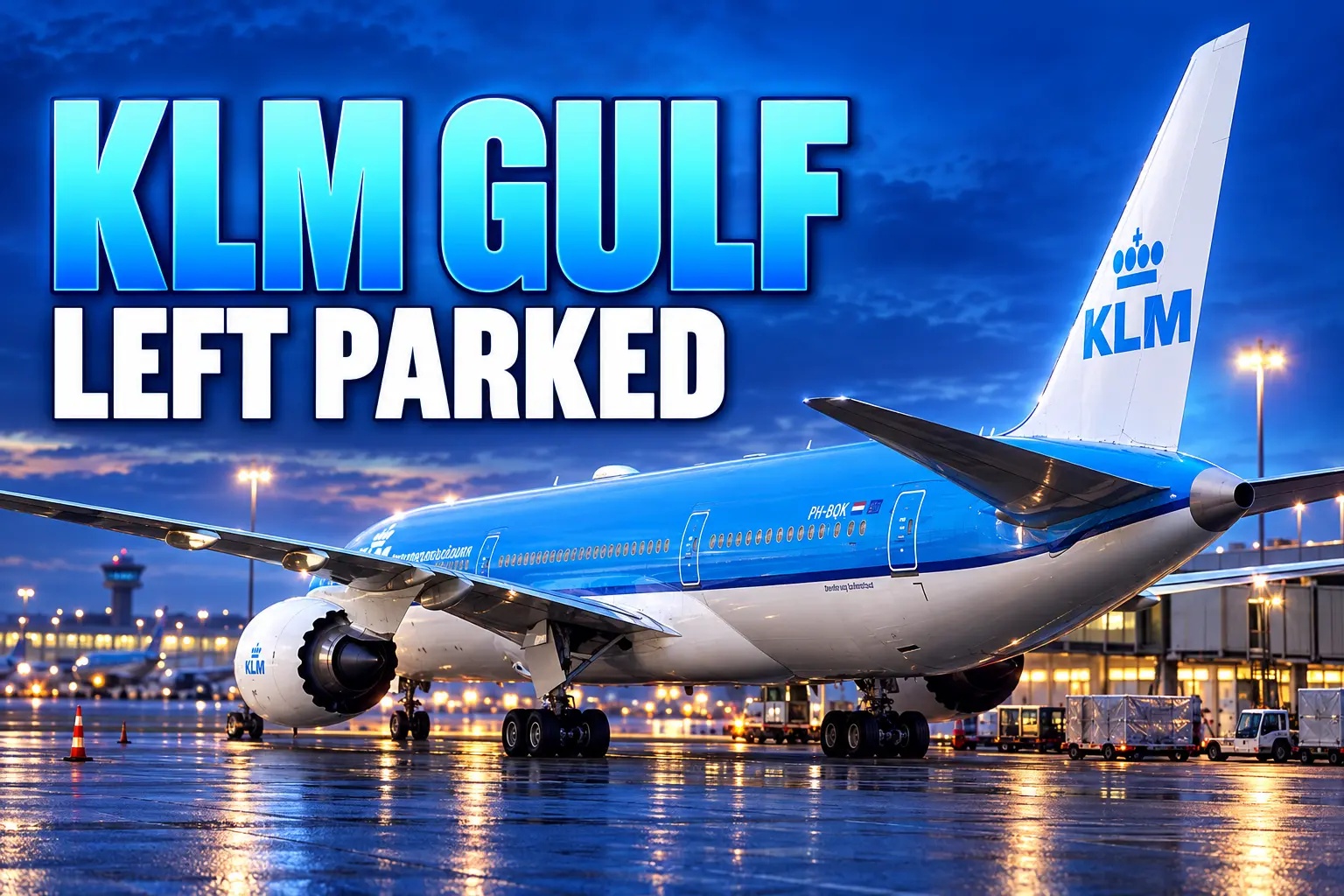
| Dubai | Fly 1 through 6 February, adjusted | Canceled; a Boeing 787 sat at the airport from 28 February | No flights until and including 24 October |
| Riyadh | Already back from 27 January | Canceled with the Gulf list | No flights until and including 24 October |
| Dammam | Already back from 27 January | Canceled with the Gulf list | No flights until and including 24 October |
The February product treated those four names as one Middle East package. The war split them. Israel became a routing problem KLM later solved with a night in Cyprus. The Gulf cities became a rolling cancelation that still has not expired.
Tel Aviv Now Flies With a Night in Cyprus
On 7 August KLM said it would resume Amsterdam-Tel Aviv from 25 August. Bookings opened on 6 August. The flight is not a straight shot. It makes a technical stop in Larnaca, and the crew stays overnight there.
Why the Crew Stops in Larnaca
KLM said it “continuously adjusts its network based on operational considerations,” and that the Larnaca call is one of those adjustments. A night in Cyprus keeps the crew legal if Israeli airspace or a duty-time squeeze would otherwise block the pairing. It also keeps overnighting crews out of Tel Aviv. The stop is the price of putting the route back on sale without pretending January’s risk model has gone away.
On 22 September, in the winter-network briefing, KLM said it intends to keep Amsterdam-Tel Aviv going through the season that starts on 25 October, after the 25 August restart. That is the only one of the four January cities that is actually flying.
Winter Timetables Still Treat Dubai as a Maybe
The same 22 September briefing is careful about the Gulf. KLM said it intends to resume Dubai, Riyadh and Dammam flights from the start of the winter schedule. “The exact timetable will depend on the situation in the Middle East at that time.”
Winter, as KLM defined it that day, runs from 25 October to 27 March. That start date is the morning after the 24 October cancelation still on the books from the 5 August update. Anyone hoping to transit through Saudi Arabia right now on a KLM metal is still waiting on that seam.
KLM’S WINTER NETWORK ON PAPER
- The map: KLM plans 164 destinations in 64 countries this winter, 93 of them in Europe and 71 intercontinental.
- The dates: The season runs from 25 October to 27 March, the day after the current Gulf cancelation ends.
- The Gulf hedge: Dubai, Riyadh and Dammam are listed as intended returns from the start of that season, subject to the situation at the time.
- The Israel line: Amsterdam-Tel Aviv is meant to keep running, after the 25 August restart with the Larnaca crew night.
Lufthansa Group is on a similar clock for Dubai, with Dubai parked through 24 October for Lufthansa, Swiss and Eurowings. The German group put Tel Aviv back from June, earlier than KLM’s 25 August return. The shared date on Dubai is the tell: European network carriers are still waiting on the same Gulf airspace, even when they disagree on Israel.
Rintel’s winter quote was about smooth journeys and being recognised on board. The Middle East paragraph underneath it is the constraint. Dubai, Riyadh and Dammam come back if the corridor allows. Tel Aviv is already in the machine, with a Cypriot night built into the duty day.
Crews Came Home Through Muscat, Not Dubai
The human cost of the 28 February shutdown showed up in Oman, not in the February sales copy. A KLM aircraft left Muscat on 3 March with stranded travellers and staff, in cooperation with the Netherlands Ministry of Foreign Affairs, and landed at Schiphol on 4 March. Another aircraft from Muscat via Cairo landed at 08:09 on 7 March. A further Muscat flight set for the night of 7 to 8 March was postponed on security grounds.
The Boeing 787 that had been at Dubai Airport since 28 February finally left for the Netherlands on 12 March. KLM said it had taken extra measures to fly the aircraft home and that carrying passengers on that sector was “not deemed responsible at this time.” The airline said it could not give a clean count of KLM passengers still in Dubai, Dammam and Riyadh, because some people had never left, some had only been transferring, and some live there.
On 2 March the company also said it did not know when it would be safe to resume, and that it was building ways to bring staff home. That is the sentence the 31 January restart did not contain. The winter list still treats Dubai, Riyadh and Dammam as routes KLM wants from 25 October, if the airspace allows. Tel Aviv is already on sale, with a night in Cyprus built into the pairing.

Cook Hands Democrats the House as Crypto’s Bill Stays Dead

Wicker’s Broken Bed Was the Short Story’s Punch Line

Nvidia’s $500 Billion Financing Plan Draws a $180 Sell

Maserati Bets the Grecale V6 Can Fill Porsche’s Gap

EV Cable Theft Follows the Old Railway Copper Playbook

Aramco Crash Kills 14 Two Days After Oil Restart

Salah Captained Egypt to Their First World Cup Win

Zelda’s 40th Switch 2 Ships Without a Zelda Game

Apple Labor Day Deals Hide June’s Memory Price Hike

Palworld 1.0.4 Adds Palpedia Search After the 1.0 Launch
-
 BUSINESS4 months ago
Aramco Crash Kills 14 Two Days After Oil Restart
-
 NEWS5 months ago
Salah Captained Egypt to Their First World Cup Win
-
 GAMING2 months ago
Zelda’s 40th Switch 2 Ships Without a Zelda Game
-
 NEWS2 months ago
Apple Labor Day Deals Hide June’s Memory Price Hike
-

 NEWS4 months ago
El Niño Puts Israel’s Needed Winter Rain on a Flood Clock
-
 GAMING2 months ago
Palworld 1.0.4 Adds Palpedia Search After the 1.0 Launch
-
 BUSINESS8 months ago
BAE’s 60-Year Saudi Franchise Now Runs Through Taif
-

 BUSINESS8 months ago
Egypt Bets EGP 638 Billion Can Open Sinai to Investors