
NEWS
The Gulf Airspace Shutdown Left a Seven-Month Bill
After eight states shut Middle East airspace on February 28, Gulf hubs reopened, but EASA warnings, war-risk premiums and Istanbul’s traffic gain did not reset.

Eight Middle East states shut their airspace on February 28, 2026, after US and Israeli strikes on Iran and Tehran’s reply across the Gulf. Aviation analytics firm Cirium logged 868 cancellations from 3,592 scheduled arrivals by 16:45 CET, a 24.16% miss rate, while Emirates, flydubai, Etihad and Qatar Airways halted or froze hub flying. Eric Schouten, head of aviation security advisory Dyami, said passengers and airlines could “expect airspace to be shut for quite some time in the region.”
The passenger crisis eased in days. The bill did not. Insurers repriced Gulf war risk, European schedules stayed short of Dubai into autumn, and the European Union Aviation Safety Agency still tells operators to stay off Persian Gulf waters until November 16, 2026.
Eight Countries Closed Their Skies on Saturday
Iran, Israel, Iraq, Jordan, Qatar, Bahrain, Kuwait and the United Arab Emirates declared closures as the first missiles moved. Syria shut part of its southern airspace along the Israeli border for 12 hours. Aircraft already airborne bent toward Larnaca, Jeddah, Cairo and Riyadh, because Russian and Ukrainian airspace was already off limits to most Western airlines and the Gulf had become the default east-west path.
WHO SHUT THE SKY
- Full closures: Iran, Israel, Iraq, Jordan, Qatar, Bahrain, Kuwait and the UAE halted civilian airspace on February 28.
- Partial shutdown: Syria closed southern airspace along its border with Israel for 12 hours.
- Hub carriers: Emirates and flydubai halted operations; Etihad froze Abu Dhabi departures until 10:00 GMT on March 1; Qatar Airways and Kuwait Airways suspended flying.
- Long-haul pullback: Air France, British Airways, Lufthansa, KLM, Cathay Pacific, Japan Airlines and a long list of other carriers cancelled or froze Middle East sectors the same day.
Turkish Airlines cancelled a sweep of Levant and Gulf routes. EgyptAir cut a string of Gulf and Levant routes from Cairo, including Dubai, Doha, Abu Dhabi, Kuwait, Bahrain, Amman and Beirut. The EgyptAir and Ethiopian Airlines groundings showed how fast a Gulf FIR closure travels down every spoke that feeds it.
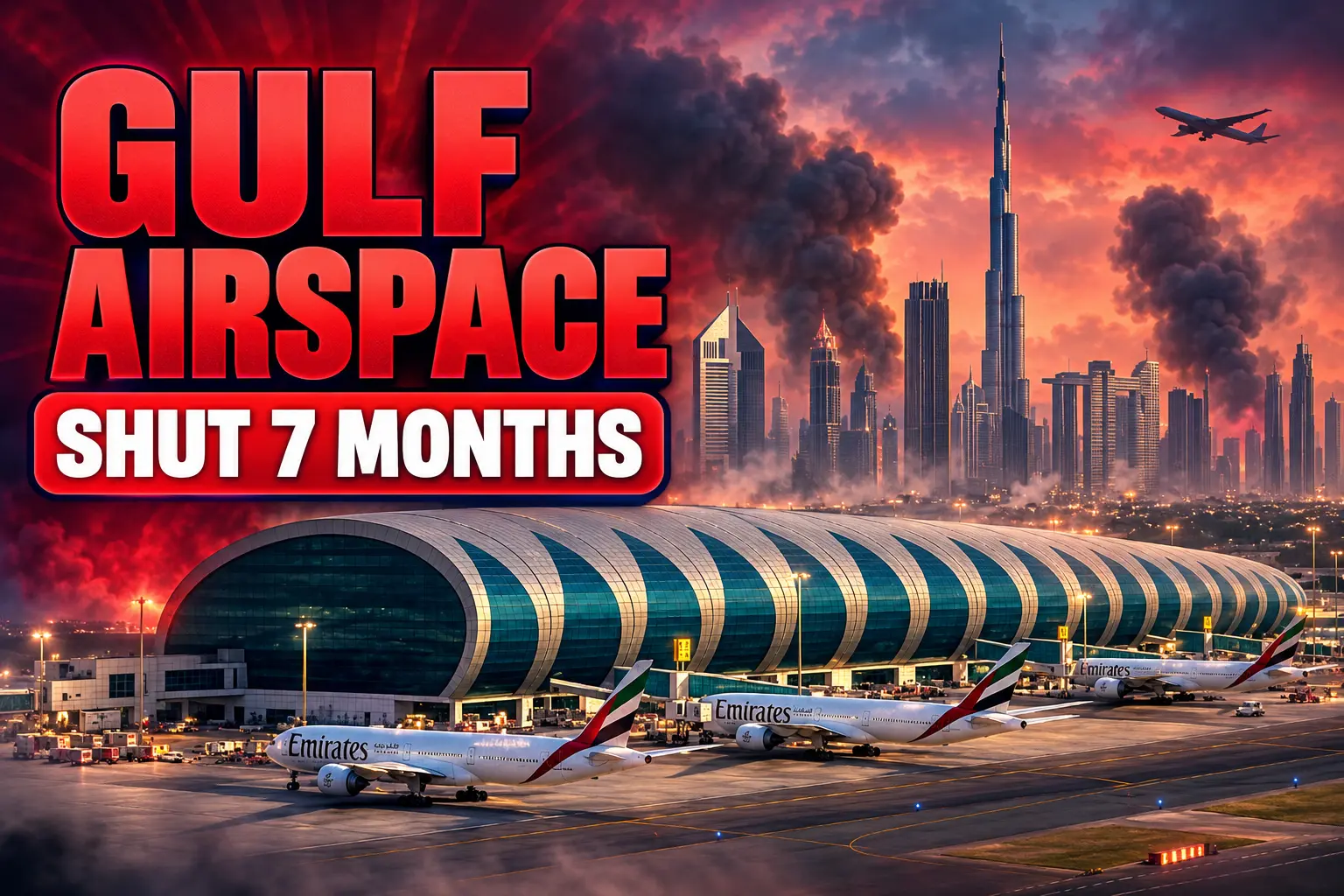
Four Injured at Dubai International
The closures were not a paper NOTAM. Dubai’s media office said a concourse at Dubai International sustained minor damage in an incident that was quickly contained, and that four people were injured. Aviation sources described damage to a terminal after an overnight Iranian attack. Abu Dhabi Airports said an incident at Zayed International killed one Asian national and injured seven.
The UAE Ministry of Defence said it detected 137 Iranian ballistic missiles, destroyed 132 and watched five fall into the sea, and detected 209 drones, intercepting 195 while 14 fell inside the country. Kuwait’s state news agency said a drone aimed at the international airport caused limited terminal damage and minor injuries to several employees. Doha, which hosts the largest US base in the region, heard explosions as well.
That is the fact insurers and safety agencies still price. The hubs that sell themselves as the shortest, safest connection between Europe and Asia took debris on day one. Flight-tracking maps that Saturday showed Iran, Iraq, Kuwait, Israel and Bahrain almost empty of airliners.
What Cirium Recorded Before Nightfall
Cirium’s afternoon snapshot is the cleanest picture of the first shock, taken while UAE and Qatari airspace were already shut. The firm noted that Emirates, Qatar Airways and Etihad move about 90,000 connecting passengers a day through those hubs, not counting people whose final stop is the Gulf. Those through-passengers had nowhere to go.
CIRIUM ARRIVAL CANCELLATIONS, 16:45 CET FEBRUARY 28
| Arrival country | Flights scheduled | Cancelled | Cancel rate |
|---|---|---|---|
| Qatar | 335 | 170 | 50.75% |
| Israel | 107 | 52 | 48.60% |
| Bahrain | 102 | 45 | 44.12% |
| United Arab Emirates | 1,067 | 373 | 34.96% |
| Kuwait | 170 | 48 | 28.24% |
| Jordan | 105 | 24 | 22.86% |
| Oman | 122 | 19 | 15.57% |
| Saudi Arabia | 1,277 | 109 | 8.54% |
| All Cirium-tracked arrivals | 3,592 | 868 | 24.16% |
Among the big Gulf operators, flydubai had 185 of 362 flights cancelled (51.10%), Qatar Airways 219 of 535 (40.93%), Emirates 197 of 512 (38.48%) and Etihad 90 of 299 (30.10%). Saudia and flynas, sitting farther from the strike path, stayed in the low single digits. Iran’s own feed was incomplete because data links were down.
IATA later put the ten-day damage in network terms: 73% of available seat kilometres to and from the Middle East were cancelled, and nearly 80% of Asia-Pacific to Europe services that had been routed through the region were pulled. In 2025, IATA said, 10% of all global international passenger kilometres connected through Middle East airports, more than 67 million people.
War-Risk Premiums Jumped 50% to 500%
Revenue from grounded flying is not an insured loss. Airlines can buy war-risk hull cover, and they cannot buy back a closed hub. Lockton said aviation war-risk premiums for Gulf and West Asian flying rose 50% to 500%, with cover still on offer but priced route by route. Aon described tighter terms and sub-limits on overflights, night stops and conflict-adjacent sectors. Underwriters can pull war cover on seven-day notice, which turns a FIR from a planning assumption into a daily permission.
The International Air Transport Association’s April traffic file is the first full month after the strike. Global demand, in revenue passenger kilometres, fell 3.4% against April 2025, the first drop since the post-Covid rebound. Strip out the Middle East and demand was up 1.2%. Jet fuel, IATA said, more than doubled in April.
IATA APRIL 2026, MIDDLE EAST VERSUS THE WORLD
- World demand: Revenue passenger kilometres down 3.4%; capacity down 2.9%; load factor 83.1%.
- Middle East region: Demand down 46.6%; capacity down 37.2%; load factor 70.6%, a 12.5 point drop.
- Middle East-based carriers: Demand down 48.1%; capacity down 38.4%; load factor 70.1%, a 13.1 point drop.
- Fuel: Jet fuel more than doubled year on year, which IATA said was pushing fares up.
The 46.6% fall in demand for carriers in the Middle East due to war in the region was so acute that it dragged overall demand down -3.4%. The situation for air transport remains highly volatile. The cost of jet fuel more than doubled in April, which is pushing airfares up.
Willie Walsh, Director General, International Air Transport Association, May 28, 2026 passenger-demand release
Airports Council International Asia-Pacific and Middle East, working with Flare Aviation Consulting, estimated 27 million passengers did not travel as planned in March and April at nine airports that had handled about 70% of Middle East traffic in 2025. That was a 54% year-on-year drop, 14 million in March and 13 million in April. Dubai International said March volume was 2.5 million passengers, down almost two-thirds. Stefano Baronci, the ACI region’s director general, called the hubs essential nodes in the global system, not only regional assets.
Istanbul Took the Connecting Traffic
Every east-west passenger who could not connect in Dubai, Doha or Abu Dhabi still had to go somewhere. Istanbul was already open, already sitting on the Europe-Asia hinge, and already used to the extra flow created when Russian airspace closed. Paul Chiambaretto, an air transport specialist at Montpellier Business School in France, called Turkish Airlines “the big winner” as European carriers cut Gulf flying.
Turkish Airlines said its customer base was up 5% from the start of the conflict, with Middle East capacity down, Europe up 6% and East Asia up 16%. March passengers rose 16% year on year to 7.2 million. In the first quarter it carried 21.3 million people, up 13% from 18.9 million a year earlier, on a fleet of 528 aircraft serving 358 destinations. Chair Murat Seker said the Istanbul base had stayed fully open from the end of February, which let the airline take a larger share of Europe-Asia traffic and move aircraft off Middle East and US flying onto Asian and African routes where demand had risen.
IATA’s April-to-June read on Middle East airlines showed passenger kilometres down 30%, and close to 50% on routes to Europe. OAG said Dubai’s scheduled seats in August were down 15% year on year, the steepest drop among the world’s top 10 airports, even as the hub still led on international seats. Direct Europe-Asia traffic, IATA said, rose 15.3% as it replaced trips that used to change planes in the Gulf.
Why Europe-Asia Flights Moved Off the Gulf
The geography did not change. The risk map did. After Russia and Ukraine closed, Gulf airspace was the remaining short path between Western Europe and East Asia. On February 28 that path ran through the same FIRs as US bases Iran had just called legitimate targets. A flight that never enters Iranian airspace can still pick up hull terms, GNSS loss and a debris field if it uses Gulf waters, Gulf alternates or a Dubai night stop.
Emirates moved first among the hub carriers. It carried about 30,000 passengers out of Dubai on March 5 and said that by March 7 it would run 106 daily return flights to 83 destinations, almost 60% of its network, with a return to 100% “within the coming days” if airspace and operations allowed. Etihad restarted a limited commercial schedule from Abu Dhabi on March 6. Qatar’s airspace stayed shut longer; Qatar Airways ran a civil-aviation-authorised relief corridor on March 7 from Hamad International to London Heathrow, Paris Charles de Gaulle, Madrid, Rome Fiumicino and Frankfurt.
European and Asian airlines treated the same reopening as a much slower event. Several kept Dubai, Tel Aviv, Bahrain and Amman cancellations on the books into late October and November, and at least one North American carrier listed a January 2027 restart for Tel Aviv and Dubai. That split is the second-order effect: Gulf carriers live in the FIR and have to fly it, while a London or Singapore network can wait out the war-risk invoice.
EASA’s Gulf-Waters Warning Runs to November
A ceasefire framework took hold around April 8. On April 9, Syria, Iraq, Bahrain and Israel had reopened; Iran and Kuwait were still closed to commercial traffic. The UAE and Qatar had already resumed limited flying in March. Qatar Airways CEO Hamad Al-Khater told the Qatar Economic Forum on September 22 that the airline had restored its pre-conflict route count for the first time since the war began, with Iran services still down and November 29 only a target. Qatar’s Civil Aviation Authority denied a fresh closure that day and pointed instead to alternative routing.
The regulator paper that still governs European operators is not a closure. It is a keep-out line over water. Conflict Zone Information Bulletin CZIB-2026-07R3, issued July 14 and extended on September 30 with no change to the advice, remains active until November 16, 2026 unless reviewed earlier. EASA says Iranian pressure on the Strait of Hormuz, attacks on commercial vessels and related US action create high risk over the waters of Bahrain, Kuwait, Qatar and the UAE, and over the Gulf of Oman west of longitude 58°E. It tells operators to avoid Persian Gulf waters except arrivals and departures, to stay out of that western Gulf of Oman slice at all levels, and to treat land territory in those FIRs with caution because of missiles, drones, air defence and falling debris.
Qatar’s own NOTAM file is the local version of the same hangover. NOTAM A0964/26 warns of potential GPS signal interference inside the Doha Flight Information Region and tells pilots to notify air traffic services if the signal drops, with an estimated end time of December 5, 2026. Hamad International still publishes backup departure instructions for the event of GNSS interference. The GPS interference warning through December 5 sits on an airspace that is open for traffic and is not operating as it did before February 28.
FROM SHUTDOWN TO A LIVE WARNING
- February 28, 2026: US and Israeli strikes on Iran, and Iranian replies, close civilian airspace in eight states.
- March 6, 2026: Etihad restarts a limited Abu Dhabi schedule; Emirates is already flying a reduced network toward 60% of routes the next day.
- March 7, 2026: Qatar Airways operates a relief corridor from Doha to five European capitals after a temporary safe-corridor authorisation.
- April 8, 2026: An uneasy ceasefire takes effect; IATA later notes April’s traffic decline slowing a little against March.
- April 9, 2026: Syria, Iraq, Bahrain and Israel reopen; Iran and Kuwait remain closed to commercial flights.
- July 14, 2026: EASA issues CZIB-2026-07 on Persian Gulf and Gulf of Oman waters.
- September 22, 2026: Qatar Airways says its route count is back to pre-war levels; Iran remains suspended.
- September 30, 2026: EASA extends the Gulf-waters bulletin to November 16, 2026, with the same recommendations.
IATA’s May file recorded a 46.6% fall in Middle East demand for April, enough to pull the whole industry negative. The route maps in Doha and Dubai filled back in through the summer. The safety bulletin, the GPS NOTAM and the extra hours of flying through Istanbul are what is left of that Saturday, and they still have printed end dates.

Ninja Theory Staff Face Redundancy After Two Xbox Sales Collapse

Amazon Sells the MacBook Air at Its Pre-Hike Price

U.S. Slows Jet Parts to Squeeze China’s Flying Fleets

PEGI Pulled the GTA 6 Age Rating After Cocaine Details

Northwestern’s Smaller Ryan Field Gave Penn State Nowhere to Hide

Aramco Crash Kills 14 Two Days After Oil Restart

Salah Captained Egypt to Their First World Cup Win

Apple Labor Day Deals Hide June’s Memory Price Hike

Palworld 1.0.4 Adds Palpedia Search After the 1.0 Launch

Zelda’s 40th Switch 2 Ships Without a Zelda Game
-
 BUSINESS3 months ago
Aramco Crash Kills 14 Two Days After Oil Restart
-
 NEWS4 months ago
Salah Captained Egypt to Their First World Cup Win
-
 NEWS1 month ago
Apple Labor Day Deals Hide June’s Memory Price Hike
-
 GAMING4 weeks ago
Palworld 1.0.4 Adds Palpedia Search After the 1.0 Launch
-
 GAMING4 weeks ago
Zelda’s 40th Switch 2 Ships Without a Zelda Game
-

 NEWS3 months ago
El Niño Puts Israel’s Needed Winter Rain on a Flood Clock
-

 ENTERTAINMENT4 weeks ago
King Charles Letter Keeps Harry and Meghan as Private Citizens
-

 NEWS3 months ago
Saudi Visa Routes Split Nigerian Travelers Into Two Speeds