
NEWS
Vivenda Leads Ganiga’s €2.5 Million Canteen Camera Round
Vivenda, a 30-million-meal Italian caterer, led Ganiga’s €2.5 million round to put cameras on canteen bins as EU law demands a 30 percent food-waste cut.

Italian contract caterer Vivenda led a €1.5 million equity round in Ganiga, taking the Pisa startup’s total funding to €2.5 million. London-based NextSTEP and three angel investors joined the share sale, and Invitalia’s Smart&Start Italia scheme added €1 million.
The buyer already cooks 30 million meals a year in schools, hospitals and staff canteens. EU law now requires member states to cut food-service waste 30 percent per capita by 2030, and Vivenda is paying for the camera that will watch its own bins.
Vivenda Puts Its Own Kitchens on the Meter
Vivenda S.p.A. is not a venture fund. It is a Rome contract caterer, set up in 2004 when Cooperativa La Cascina folded its collective catering into a joint-stock company, and it now runs over 1,000 service centres. Company filings for 2025 show revenue of €332,021,537, up 12.1 percent from €296,107,604, and 8,126 staff.
VIVENDA AT A GLANCE
- Meals: The group says it serves more than 30 million meals a year in schools, hospitals, care homes, ministries, barracks and staff restaurants.
- Network: More than 1,000 service centres, with clients that include Roma Capitale, Milano Ristorazione and the Italian defence ministry.
- 2025 accounts: €332,021,537 in revenue and 8,126 employees, according to Italian company records.
- Role in the round: Lead equity investor, and the first commercial channel Ganiga named for HooolyFood.
On 14 October 2026, six days before the round was disclosed, Vivenda was already describing a working tie-up with Ganiga in school and hospital canteens. Nicolas Zeoli, Ganiga’s founder and chief executive, said the computer-vision sensors read trays as they come back to the kitchen, then flag unpopular dishes and suggest menu changes for later days. The equity cheque turns that pilot language into a captive sales path: Ganiga said it will expand first inside contract catering with Vivenda, then move to event catering and hotels.
Fifteen to 30 Percent of the School Meal
Vivenda already knows what its bins hold. Ivan Perrone, the company’s quality manager, said Italian school canteens waste 33 to 160 grams per student per meal, equal to 15 to 30 percent of what is served. A separate 15 percent of food that is cooked never reaches the dining room and stays as kitchen scrap.
FOODS THAT HIT THE SCHOOL BIN
- Bread: Perrone said it is among the items most often left on the tray.
- Fruit and vegetables: Core to the menus Vivenda writes for the Mediterranean diet, and among the first to be thrown.
- Soups and legumes: Also named as frequent leftovers, which makes the waste a menu problem, not only a portion problem.
Those gram counts are why a caterer writes a cheque for a camera. On fixed-margin public contracts, leftover pasta is a direct hit to food cost, and a public client that must show a waste cut will ask the operator for numbers. Vivenda’s own house magazine had already tied its food-education work to the EU’s 30 percent goal. The round is the hardware layer under that claim.
A 30% Cut, Binding by the End of 2030
Eurostat, publishing 2024 figures on 29 September 2026, put EU food waste at 129 kilograms per person and 57.9 million tonnes of food waste in 2024, a 0.7 percent rise from 57.5 million tonnes in 2023. Restaurants and food services generated 12 percent of that pile, or 15 kilograms per inhabitant. Households still account for 53 percent, so canteens are not the whole problem. They are the part a contractor can meter.
EU FOOD WASTE IN 2024
| Stage | Share of EU total | Kg per person |
|---|---|---|
| Households | 53% | 69 |
| Food and drink manufacture | 19% | 25 |
| Restaurants and food services | 12% | 15 |
| Primary production | 8% | 10 |
| Retail and other distribution | 8% | 10 |
| EU total | 100% | 129 |
Directive (EU) 2025/1892, adopted on 10 September 2025 and in force from 16 October 2025, is the first EU law that sets national, binding food-waste cuts. By 31 December 2030, member states must deliver a 10 percent cut in processing and manufacturing, and a binding 30 percent per capita cut by 2030 jointly across retail, restaurants, food services and households, measured against the 2021 to 2023 average.
THE WASTE LAW CLOCK
- 10 September 2025: Parliament and Council adopt Directive (EU) 2025/1892, amending the Waste Framework Directive.
- 16 October 2025: The amendment enters into force.
- 17 June 2027: Member states must write the rules into national law.
- 17 October 2027: National food-waste prevention programmes must be updated; the Commission is also due to set a tourism correction factor.
- 31 December 2030: The 10 percent manufacturing cut and the 30 percent per capita consumption cut fall due.
The 30 percent figure is a national duty, not a kitchen quota. States will still need operators who can prove what left the tray. Zeoli put that in one line when the round closed.
For a canteen, knowing which dishes are being wasted and why provides actionable data to inform purchasing, menu planning and service delivery. The new EU directive makes food waste reduction a binding target, and you cannot reduce what you do not measure.
Nicolas Zeoli, founder and CEO of Ganiga
How HooolyFood Reads a Returned Tray
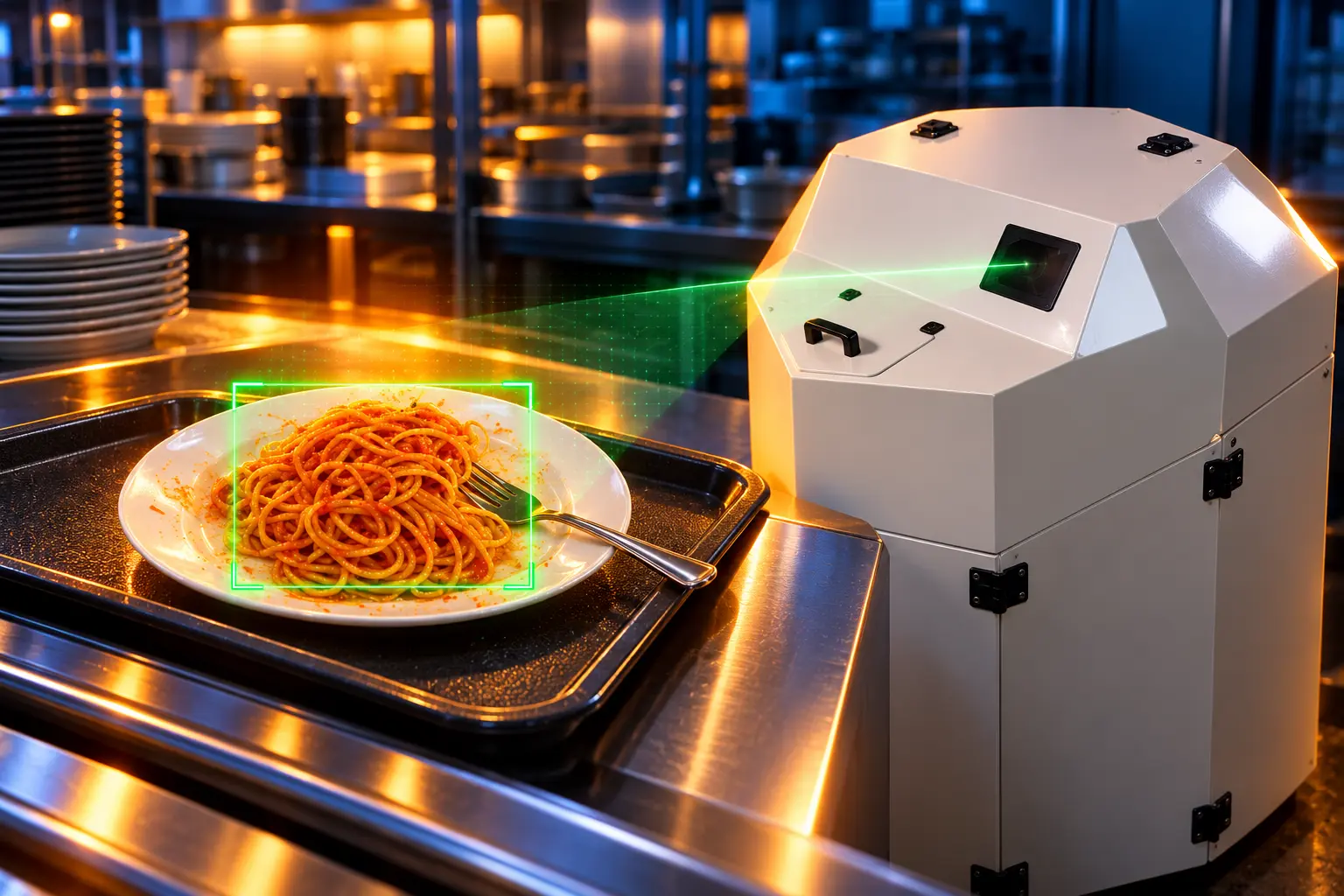
HooolyFood is a camera kit, not a new bin. Units go above existing waste containers, identify discarded dishes, and skip the weigh-station step that older kitchen systems still ask staff to perform. Ganiga built it in less than a year from images collected by its mixed-waste robots, and said it is already running in sites that serve more than 30,000 meals a day.
A single dashboard pulls those camera feeds together with fill levels from other devices, estimates cost, and shows waste patterns. For a contractor on a school or hospital tender, that file is also an audit trail. Public clients already ask for environmental, social and governance numbers; from 2027, national law will sit behind the same request.
The product is small next to Vivenda’s volumes. Thirty thousand meals a day is a slice of a group that serves more than 30 million meals a year. That gap is the point of the round: the first customer is large enough to fill the dashboard, and close enough to demand changes when the camera says the soup is coming back untouched.
Airport Bins Trained the Food Model
Ganiga started as a sorting-bin shop, not a food-tech firm. Zeoli, a software engineer who left a packaging-robot job in mid-2022, built Hoooly Indoor, a 120 or 240 litre steel unit with one hatch. Computer vision names the object, then the machine drops it into the right inner compartment. The company has sold more than 300 of those devices into airports, shopping centres and large sites in Italy, Japan, Australia and other European countries.
Named early buyers of the mixed-waste bins include Google, Autogrill and the airports in Bologna, Venice and Madrid. In October 2025, Zeoli said 2024 sales were €100,000 and that the first nine months of 2025 had already reached €700,000. Italian Trade Agency listings for 2025 put headcount at 10 to 19 people and turnover in a €0.5 million to €2.5 million band. The food camera is the second act of that same model: the bins paid for a labelled image set, then the company pointed the lens at canteen trays.
NextSTEP’s cheque fits that history. The London and Milan fund is the cleantech vehicle of NextEnergy Group, run by Claudio Colombo, and it backs waste and circular-economy tools at pre-seed and seed. The public slice is a Smart&Start Italia interest-free loan of €1 million, managed by Invitalia for the Ministry of Enterprises and Made in Italy.
Winnow, Orbisk, and a 3,500-Kitchen Head Start
The camera-over-the-bin idea is not new. London-based Winnow says its Throw & Go system runs in more than 3,500 commercial kitchens across more than 90 countries and cuts food cost by 2 to 8 percent. Dutch firm Orbisk, which also hangs a camera above the bin and skips extra logging, says it is in more than 1,000 kitchens, including more than 200 Accor hotels, with a 33 percent waste cut and about €54,000 a year saved per property on that hotel roll-out.
WHO ALREADY SELLS THE CAMERA
| System | How it captures waste | Reported footprint |
|---|---|---|
| Ganiga HooolyFood | Cameras over existing bins, no weighing step | More than 30,000 meals a day |
| Winnow | Camera plus automatic capture, Throw & Go | More than 3,500 kitchens in more than 90 countries |
| Orbisk | Camera above the bin, no extra staff logging | More than 1,000 kitchens; Accor at more than 200 hotels |
Ganiga is late into hotel groups and far smaller on site count. What it has, and what Winnow does not, is a lead investor that already runs a thousand Italian canteens and must live with the 2030 target on public contracts. The 300 sorting robots also give it a second product line in airports and malls, where food waste is not the brief. That mix is a wedge, not a global lead.
Recurring Revenue Inside Contract Catering
Ganiga said the new money will hire technical and commercial staff, push HooolyFood and the data platform further, and lift recurring revenue. The first stop is Vivenda’s contract catering. Event catering and hotels come after that. Sensors for ordinary municipal bins are also on the list, which would take the same vision stack back toward the mixed-waste work that paid for the dataset.
The commercial logic is a subscription on hardware that never leaves the kitchen. A contractor that has to show a waste cut to a city or a hospital trust will keep paying for the dashboard after the camera is on the wall. Vivenda’s 8,126-person payroll and 1,000-plus sites are the test of whether that subscription exists at scale, or only in the 30,000-meal slice already running.
Member states have until 17 June 2027 to put the directive into national law. Until then, the camera over a school bin is still a cost-saving tool and a tender extra. After that date, it is also how a caterer proves the 30 percent story that Brussels has already written down.
Frequently Asked Questions
What Food Waste Cuts Does EU Law Require by 2030?
By 31 December 2030, each member state must cut food waste 10 percent in processing and manufacturing and 30 percent per capita across retail, restaurants, food services and households, using the 2021 to 2023 annual average as the baseline, or 2020 if it notified that choice. The Commission must set a tourism correction factor before 17 October 2027, because visitors are not counted in resident population, and it must review the 2030 targets by the end of 2027, including whether to add a 2035 target and whether to cover primary production.
How Does HooolyFood Measure Waste Without a Kitchen Scale?
A high-resolution camera over the existing bin identifies dishes and estimates volume as trays return, so staff do not pause to weigh or tap a screen. Ganiga is extending that same feed to suggest ingredient orders and menu plans, and it is building add-on sensors that bolt onto ordinary containers so municipal and mixed-waste streams can report fill levels into the same dashboard.
What Is Invitalia’s Smart&Start Italia Programme?
Smart&Start Italia is a standing, no-ranking loan scheme for innovative startups no older than 60 months. Invitalia can cover 80 percent of eligible costs at zero interest, or 90 percent if the company is all women, all under 36, or includes a recent PhD based abroad, on business plans of €100,000 to €1.5 million. Startups in central and southern Italy can also receive a grant equal to 30 percent of the loan.
What Other Waste Products Does Ganiga Sell?
Hoooly Indoor is a 120 or 240 litre robotic bin with a single hatch that sorts mixed waste into inner compartments; Hoooly Small is a three-door unit that opens the right flap for paper, plastic or general waste. Those machines, not the food camera, account for the more than 300 devices already in airports and shopping centres, and they are the source of the image set behind HooolyFood.

Cook Hands Democrats the House as Crypto’s Bill Stays Dead

Wicker’s Broken Bed Was the Short Story’s Punch Line

Nvidia’s $500 Billion Financing Plan Draws a $180 Sell

Maserati Bets the Grecale V6 Can Fill Porsche’s Gap

EV Cable Theft Follows the Old Railway Copper Playbook

Aramco Crash Kills 14 Two Days After Oil Restart

Salah Captained Egypt to Their First World Cup Win

Zelda’s 40th Switch 2 Ships Without a Zelda Game

Apple Labor Day Deals Hide June’s Memory Price Hike

Palworld 1.0.4 Adds Palpedia Search After the 1.0 Launch
-
 BUSINESS4 months ago
Aramco Crash Kills 14 Two Days After Oil Restart
-
 NEWS5 months ago
Salah Captained Egypt to Their First World Cup Win
-
 GAMING2 months ago
Zelda’s 40th Switch 2 Ships Without a Zelda Game
-
 NEWS2 months ago
Apple Labor Day Deals Hide June’s Memory Price Hike
-

 NEWS4 months ago
El Niño Puts Israel’s Needed Winter Rain on a Flood Clock
-
 GAMING2 months ago
Palworld 1.0.4 Adds Palpedia Search After the 1.0 Launch
-

 BUSINESS8 months ago
BAE’s 60-Year Saudi Franchise Now Runs Through Taif
-

 BUSINESS8 months ago
Egypt Bets EGP 638 Billion Can Open Sinai to Investors