
NEWS
Sisi Withholds a Netanyahu Meeting Egypt Already Paid For
Sisi refused a Florida meeting with Netanyahu while Egypt locked in Leviathan gas and kept U.S. military aid flowing.

Egyptian President Abdel Fattah el-Sisi never took the Florida meeting Israeli Prime Minister Benjamin Netanyahu wanted in December 2025. A government official familiar with the file said Sisi had no plans to sit down, and would not do so without a basic shift in how Israel treated Egypt, even though Jerusalem and Washington both wanted the summit.
The Leviathan export permit still went through days later. U.S. military aid kept moving. Intelligence officers kept talking. The photograph did not.
Sisi Shut the Door on a Florida Handshake
Israeli television had floated a Christmas-period gathering at Mar-a-Lago, with Sisi joining Netanyahu and President Donald Trump to talk through the next stage of the Gaza plan. Netanyahu, the official said, was actively seeking a sit-down, including a possible trip to Cairo to sign a giant gas contract in person. Sisi was not.
The two men had not spoken since before the war that followed Hamas’s October 7, 2023 attack. Security coordination never fully stopped, especially between intelligence services working hostage files. What stopped was the leaders’ channel. The official added that Sisi was wary of being used as a “prop” by Netanyahu in an Israeli election year.
Netanyahu still flew to Florida at the end of December. He saw Trump, evangelical pastors in West Palm Beach, and Jewish communal leaders at The Shul of Bal Harbour, then appeared at Trump’s New Year’s Eve party at Mar-a-Lago on January 1, 2026. Sisi was not in the room. A meeting that would have made Sisi the first Arab leader to stand with Netanyahu in public since the Gaza war stayed off the schedule.
THE WEEK THE SUMMIT DIED
- December 8, 2025: Israeli television says Trump wants Sisi at Mar-a-Lago while Netanyahu is in Florida, to work a “strategic Gaza-related arrangement.”
- December 12, 2025: A government official says Sisi has no plans to meet Netanyahu and will not without a basic change in Israeli conduct toward Egypt.
- December 17, 2025: Netanyahu, on television beside Energy Minister Eli Cohen, approves the Leviathan export permit for Egypt.
- December 20, 2025: Diaa Rashwan, head of Egypt’s State Information Service, tells MBC Masr there is no arrangement of any kind for a leaders’ meeting.
- December 29, 2025 to January 1, 2026: Netanyahu is in Florida with Trump. Sisi does not come.
Washington had treated the gas file as a lever for a warmer public peace. Cairo treated the photograph as a separate, and costlier, question.
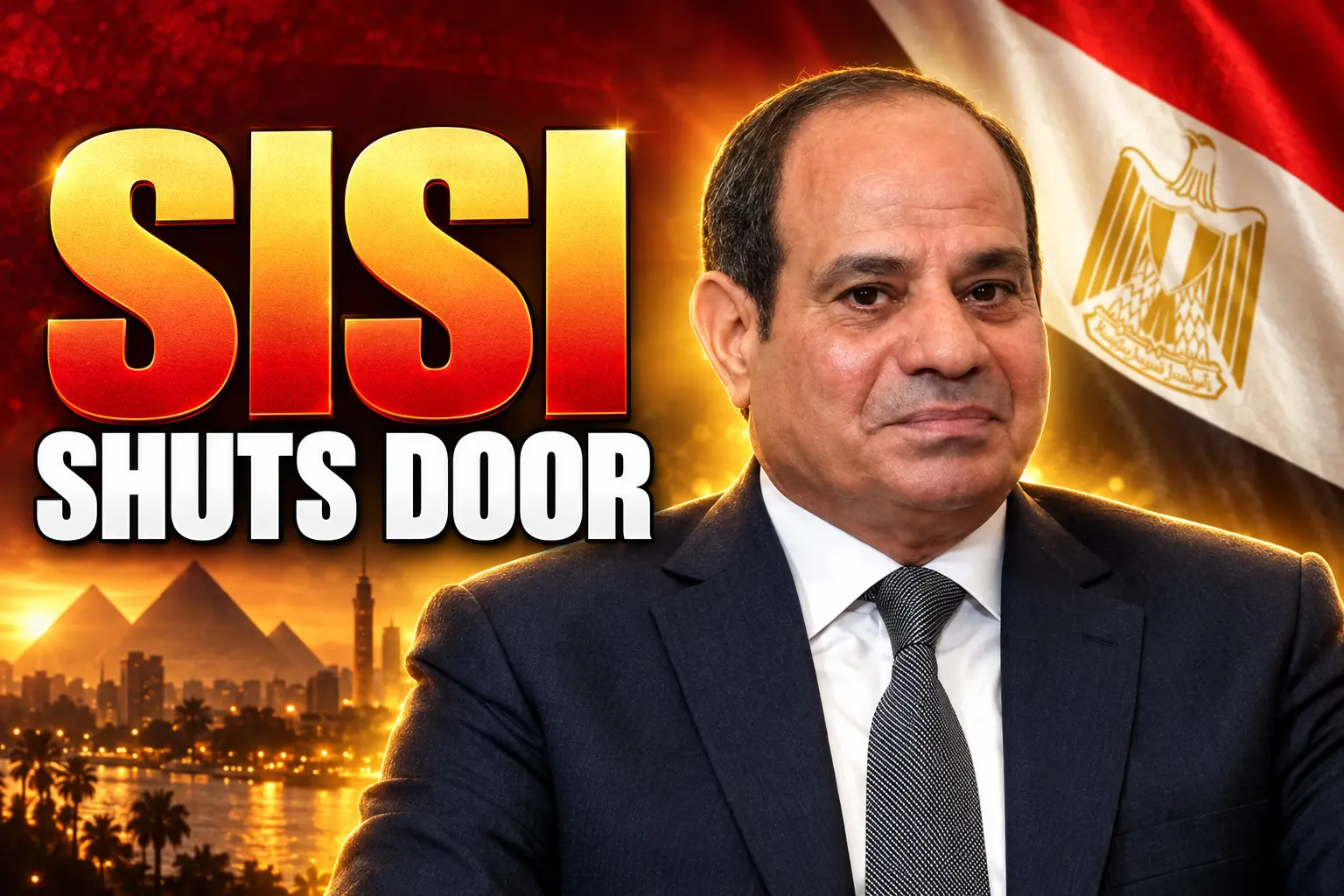
No Photograph Came With the Leviathan Contract
On December 17, Netanyahu called the export permit the largest gas deal in Israel’s history. He said he approved it only after he had secured Israel’s vital needs, including security, after Cohen had pulled out of a planned signing in October and angered both Cairo and Washington.
The commercial paper was already on the table. On August 7, NewMed Energy and its Leviathan partners, including Chevron, signed an amendment with Blue Ocean Energy, the Egyptian off-taker, adding about 130 billion cubic metres of extra gas through 2040. The December permit let that amendment run. It did not produce a Sisi-Netanyahu signing ceremony in Cairo, which would have been Netanyahu’s first official state visit to Egypt since January 2011, under Hosni Mubarak.
THE LEVIATHAN PERMIT IN FIGURES
| Item | Figure |
|---|---|
| Value Netanyahu announced | NIS 112 billion ($34.7 billion) |
| Share headed to Israel’s state coffers | NIS 58 billion ($18 billion) |
| Additional volume | about 130 billion cubic metres |
| Buyer | Blue Ocean Energy |
| Field | Leviathan |
| Contract horizon | through 2040, or until the contracted quantities are filled |
Rashwan moved the same day to strip the permit of political clothing. He said the contract was a commercial deal among energy companies, including Chevron, with no political understandings attached, and that the Egyptian government had not sat in on the contracts. Payments, he said, go to the American operator, not to Israel’s treasury. He later told MBC Masr that talk of a Sisi-Netanyahu meeting had been spread for commercial purposes around the gas announcement, and that Netanyahu was trying to politicize a commercial agreement.
There is no arrangement or planning whatsoever for such a meeting.
Diaa Rashwan, head of Egypt’s State Information Service, on MBC Masr, December 20, 2025
Netanyahu had wanted the opposite reading: a public proof that Israel was widening its peace agreements after the war, and locking long-term revenue from its offshore gas. He got the revenue line. He did not get Sisi in the frame.
Rafah, Sinai and the Lines Cairo Will Not Bargain
The official who described the freeze listed a stack of fights that, in Cairo’s telling, were still open. None of them was a polite disagreement about optics. Each one sat on Egypt’s border, its demilitarized Sinai, or its claim to speak for Palestinians who must not be pushed into the peninsula.
CAIRO’S OPEN FILES WITH ISRAEL
- Displacement south: Throughout the Gaza war, Cairo warned Israel against operations that would push Palestinians toward Sinai, which Egypt calls a red line and a national security threat, and still feared reconstruction first in Rafah along its fence.
- The Rafah gate: Israel had allowed the crossing to open only for Palestinians leaving Gaza, a policy Foreign Minister Badr Abdelatty said Cairo reads as an attempt to thin the enclave’s population, which Egypt says it will not permit.
- Sinai troops: Netanyahu, Ambassador Yechiel Leiter, and other Israeli officials accused Egypt of massing forces in Sinai in violation of the 1979 treaty; Egypt dismissed the charge outright.
- The delayed signing: Cohen’s walk-back from the gas ceremony in October deepened the strain with Cairo and with Washington, which had been pushing the deal.
- Other friction: Control of Rafah, Egypt’s refusal to take Gazan refugees, arguments over an International Stabilization Force, and drone smuggling attempts from Egypt into Israel.
Those Rafah crossing and Sinai red lines are why a Florida handshake was never a small courtesy. For Sisi, the picture would have been read at home as cover for a Gaza policy Cairo had spent two years trying to contain. For Netanyahu, the same picture would have been read in Israel as proof the old peace was warming. Only one of those readings was useful to Cairo, and it was not his.
They Have Met Before, Never on Netanyahu’s Calendar
The freeze is new. The habit of hiding the relationship is not. Egypt and Israel have had a peace treaty signed on March 26, 1979, after the Camp David summit of September 5 to 17, 1978, among Jimmy Carter, Anwar Sadat, and Menachem Begin. That treaty is why U.S. military aid scaled up, why ambassadors sit in both capitals, and why the two armies still share a Sinai file. It is also why a public Sisi-Netanyahu meeting would have carried more weight than a Gulf photo: Egypt is the Arab state that already made peace, and paid for it.
Sadat was killed in 1981. His successors kept the treaty and kept the cameras at a distance. Netanyahu’s last official state visit to Egypt was in January 2011, in Mubarak’s final weeks. Other encounters were secret, then briefly public, then gone.
WHEN THE TWO MEN ACTUALLY SAT DOWN
- February 2016: Sisi, Netanyahu, then-Secretary of State John Kerry, and Jordan’s King Abdullah II meet in Aqaba on a then-secret regional peace push that later collapsed.
- April 2016: Netanyahu and then-opposition leader Isaac Herzog fly at night to Cairo, see Sisi in the presidential palace, and return before dawn; Herzog later said the talks produced a document that would have changed the region, and that Netanyahu would not give the Palestinians what the plan required.
- September 18, 2017: The Egyptian Presidency releases a photograph of Netanyahu and Sisi meeting in New York, the last public frame of the two men together that Cairo has been willing to issue.
- October 13, 2025: Sisi co-hosts Trump at a Sharm el-Sheikh peace summit after the Gaza ceasefire. Netanyahu is invited late and does not go, with his office citing a Jewish holiday.
- December 2025: The Florida trilateral is floated and refused. The two leaders still have not spoken since before the war.
The working relationship did not travel with the presidents. From October 2025 into January 2026, during phase one of Trump’s 20-point Gaza plan, Egypt’s General Intelligence chief Hassan Rashad met Israeli officials, Hamas figures, and Palestinian Authority officers on the makeup of a 15-member National Committee for the Administration of Gaza, on Rafah, and on Hamas’s weapons. Palestinian committee staff later held sessions in Cairo. Egypt accepted a seat on Trump’s Board of Peace on January 21, 2026. The men who actually move the Gaza file still find each other. They just do not bring Sisi and Netanyahu into the shot.
Military Aid Still Moves Without a Summit
The United States has never made a Sisi-Netanyahu handshake the price of the Egypt account. Successive administrations have sold the aid as an investment in the 1979 treaty and in the Egyptian military. A Congressional Research Service report dated February 25, 2026, puts U.S. bilateral aid to Egypt at more than $90 billion since 1946, in historical dollars, and notes that Egypt, with more than 108 million people, is the most populous Arabic-speaking country.
The 2026 appropriations act provides $1.5 billion in total aid, including $1.375 billion in Foreign Military Financing, which is $75 million above the baseline Egypt had received for decades. A $320 million slice of that financing stays tied to human-rights conditions unless the secretary of state waives them. From fiscal 2020 through 2023, the Biden administration and Congress withheld or reprogrammed $750 million. In 2024, after October 7, the full allocation moved again.
THE EGYPT ACCOUNT WASHINGTON WILL NOT FREEZE
- Long-run total: More than $90 billion in U.S. bilateral aid since 1946, in historical dollars.
- Old annual baseline: About $1.3 billion a year in military aid since the late 1980s.
- Fiscal 2026 FMF: $1.375 billion, $75 million above the old baseline, inside a $1.5 billion aid total.
- The live waiver: $320 million in fiscal 2025 financing, unblocked after a September 21 letter from Secretary of State Marco Rubio.
On October 1, 2026, that waiver became public. Rubio’s letter, and a September 4 memo over his signature, said the $320 million was needed for counterterrorism, border security, or nonproliferation, or was otherwise important to U.S. national security. The memo called the waiver essential “particularly in light of Egypt’s helpful role following Operation Epic Fury,” the U.S. name for the campaign against Iran launched with Israel in late February. A State Department spokesman said the decision recognized the need to keep security cooperation with Egypt during a hard period in the region. Egypt’s Foreign Ministry had no immediate comment.
Sisi, for his part, still takes American visitors. On September 20 he met CIA Director John Ratcliffe, praised Trump’s work on regional security, and pressed for full implementation of phase two of the Gaza plan, a two-state track, and open aid routes. He did not need Netanyahu in the room to hold his own meetings with Donald Trump or with Trump’s intelligence chief. That is the hierarchy Cairo has chosen: Washington first, the Israeli prime minister later, if at all.
The Photograph He Needed Before October’s Vote
Israel votes on October 27, 2026. The “prop” warning from December now sits on a real calendar. Netanyahu has spent the year collecting foreign rooms he can show at home. Sisi would have been the rarest of those rooms, because Egypt is not a new partner. It is the old one. A Florida handshake would have let him say the post-war map included the first Arab state that made peace, standing with him after Gaza.
Sisi’s incentives run the other way. He is in a third term that ends in 2030. He governs a country that still treats Palestinian displacement into Sinai as an existential insult. He also needs the mediator franchise that makes Egypt useful to Trump: training a Gaza police track under U.N. Security Council Resolution 2803 of November 17, 2025, hosting the civilian committee in Cairo, and sitting on the Board of Peace. That franchise is harder to keep if he is photographed as Netanyahu’s guest at Mar-a-Lago in an election season.
Israeli voices spent December 11 talking as if Cairo were open to a sideline meeting at a U.S.-led gathering. The official line the next day, and Rashwan’s television denial eight days after that, shut the rumor down. Egyptian users have treated the missing picture, ever since, as the one fact the gas contract could not buy. The louder problem for Netanyahu is simpler than a social-media fight. Arab leaders will still do business with Israel. They will still take U.S. calls. They will still send intelligence chiefs. They will not easily give him a still image he can carry into a vote.
Cairo Traded a Handshake for the Mediator’s File
The irony is not that Egypt and Israel fell out. They did not. Gas will move from Leviathan. Officers will keep meeting on Rafah and hostages. American financing, including the $320 million Rubio unblocked, will keep buying U.S. kit for the Egyptian army. The 1979 treaty is intact. What broke is the fiction that a peace that old should be easy to put on camera after Gaza.
Sisi’s refusal left Netanyahu with Trump at Mar-a-Lago and no Arab president in the shot. It left Cairo with the contract, the aid waiver, the Board of Peace seat, and the claim that none of that was a political bargain with the Israeli prime minister. On the file that actually moves Gaza, that is the trade Sisi made, and it is the trade he has so far kept.

Ninja Theory Staff Face Redundancy After Two Xbox Sales Collapse

Amazon Sells the MacBook Air at Its Pre-Hike Price

U.S. Slows Jet Parts to Squeeze China’s Flying Fleets

PEGI Pulled the GTA 6 Age Rating After Cocaine Details

Northwestern’s Smaller Ryan Field Gave Penn State Nowhere to Hide

Aramco Crash Kills 14 Two Days After Oil Restart

Salah Captained Egypt to Their First World Cup Win

Apple Labor Day Deals Hide June’s Memory Price Hike

Palworld 1.0.4 Adds Palpedia Search After the 1.0 Launch

Zelda’s 40th Switch 2 Ships Without a Zelda Game
-
 BUSINESS3 months ago
Aramco Crash Kills 14 Two Days After Oil Restart
-
 NEWS4 months ago
Salah Captained Egypt to Their First World Cup Win
-
 NEWS1 month ago
Apple Labor Day Deals Hide June’s Memory Price Hike
-
 GAMING4 weeks ago
Palworld 1.0.4 Adds Palpedia Search After the 1.0 Launch
-
 GAMING4 weeks ago
Zelda’s 40th Switch 2 Ships Without a Zelda Game
-

 NEWS3 months ago
El Niño Puts Israel’s Needed Winter Rain on a Flood Clock
-

 BUSINESS8 months ago
Egypt Bets EGP 638 Billion Can Open Sinai to Investors
-

 ENTERTAINMENT4 weeks ago
King Charles Letter Keeps Harry and Meghan as Private Citizens