
NEWS
Nyuserre’s Valley Temple Opens After a Century of Water
Italian teams opened Nyuserre’s valley temple at Abu Ghurab after the Nile and the Aswan Dam dropped the water table that stopped a 1901 dig.

Italian excavators at Abu Ghurab have opened more than 1,000 square meters of King Nyuserre’s valley temple, the river gate of his Fifth Dynasty sun sanctuary. The Egyptian Ministry of Tourism and Antiquities announced the work on December 12, 2025. Nyuserre, sixth king of that dynasty, ruled circa 2420-2389 BC, more than 4,300 years ago.
The upper temple on the plateau has been known since Ludwig Borchardt dug it from 1898 to 1901. What the 2024 and 2025 seasons opened is the lower building he located in 1901 and then left, stopped by groundwater after two weeks.
Borchardt Stopped After Two Weeks
Abu Ghurab sits in the Abusir zone south of Cairo, between Saqqara and Giza. Sun temples of the Fifth Dynasty followed the same three-part plan as pyramid complexes: a valley temple near the water, a raised causeway, and an upper sanctuary on the desert rise. Borchardt spent three seasons on Nyuserre’s upper court and published the main account in 1905. He also pinned the valley temple’s position, then quit when the water table drowned the trenches.
Massimiliano Nuzzolo, associate professor of Egyptology at the University of Turin, and Rosanna Pirelli of the University of Naples L’Orientale have co-directed the Italian mission at the site since 2010, with backing from Italy’s Ministry of Foreign Affairs. Mohamed Ismail Khaled, secretary-general of the Supreme Council of Antiquities, said the team had uncovered more than half of the valley building for the first time and called it one of the largest valley temples in the Memphis necropolis. He also grouped it with Egypt’s two identified sun temples, the complexes of Userkaf and Nyuserre. The plateau sanctuary was already on the map; the new trenches are its river gate.
THE 1901 TO 2025 DIG
- 1898 to 1901: Borchardt excavates Nyuserre’s upper sun temple on the Abu Ghurab outcrop.
- 1901: He locates the valley temple and stops after two weeks when groundwater fills the cuts.
- 1905: He publishes the main excavation volume; later catalogues of reliefs follow in 1922 and 1928.
- 2010: The Italian mission resumes fieldwork at the sanctuary, later joined by Polish and Czech partners.
- 2024: Systematic digging begins on the valley temple, now reachable because the water table has fallen.
- December 12, 2025: The ministry announces that more than half the building is open.
- Spring 2026: Nuzzolo schedules a further campaign for the unexcavated half and the old Nile channel.
Popular talk about Abu Ghurab still clusters on the upper court’s alabaster basins and whether their rims look like machine parts. The 2024 and 2025 trench is lower, in hardened Nile mud, toward the line where boats once came in.
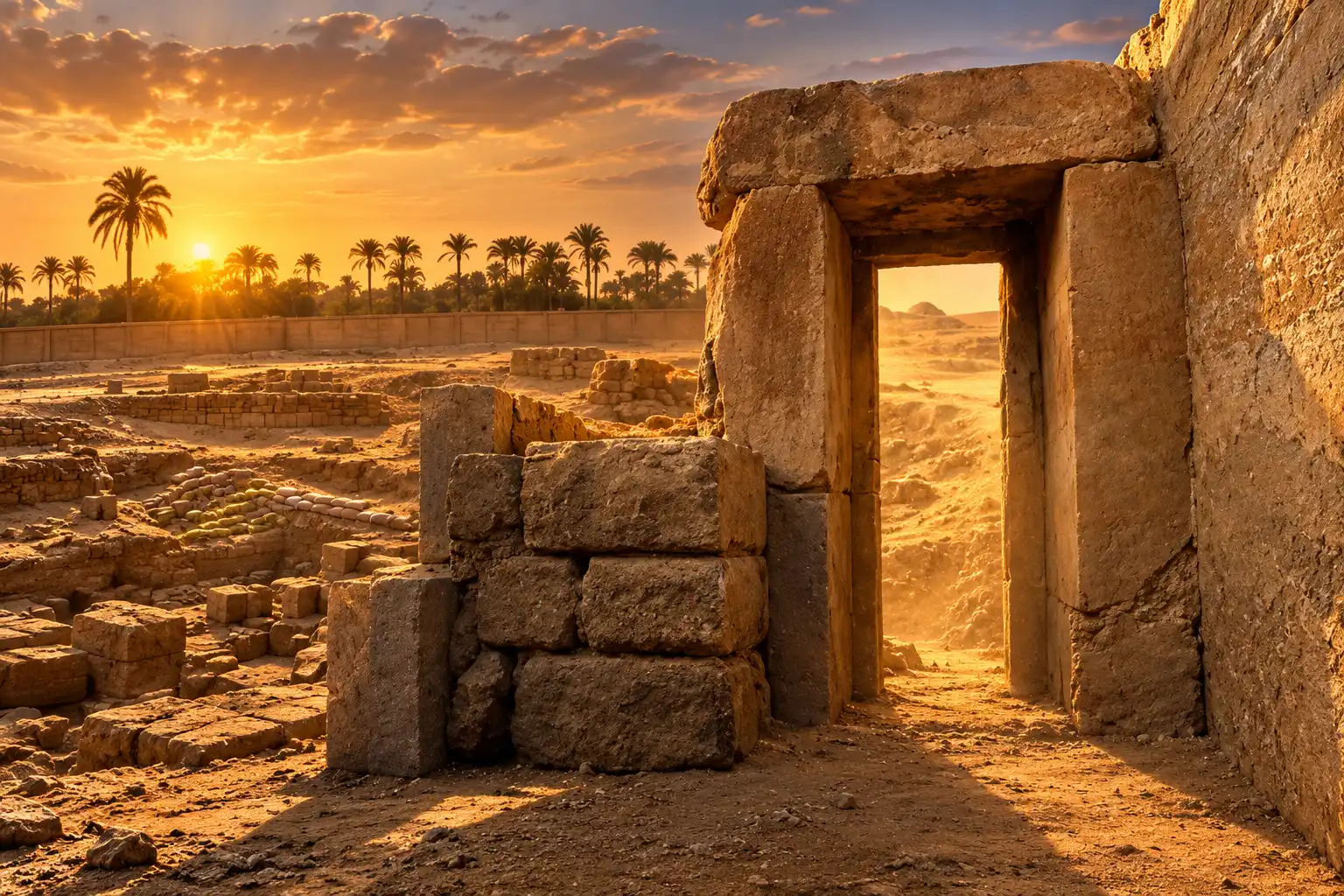
Mud, a Dam and a Wandering River
Nuzzolo said Borchardt’s two-week probe failed because the water table sat too high, and that the same ground can now be dug because the Nile has drifted east, the climate has shifted, and the Aswan Dam has pulled the aquifer down. Italy’s foreign ministry, which has funded the mission from the start, later tied that drop to the Aswan Dam and a shifting Nile, along with wider climate change, and dated the new cuts to 2024 and 2025.
Mohamed Abdel-Badie, head of the Egyptian Antiquities Sector, said the entrance had been buried under approximately 1.20 meters of Nile silt. Nuzzolo put the hardened mud at more than 1.5 meters in some points, a flood deposit laid down across later centuries, and said reaching the foundation levels was slow because the crust was so hard. The two depths describe different spots in the same trench, the doorway versus the thicker pockets of fill.
The dam that drowned temples in Nubia is the same works that finally drained this one. That is why a plan drawn in 1901 waited 124 years for a floor.
More Than Half the Sanctuary Is Now Open
The investigated area exceeds 1,000 square meters and is about half the sanctuary. The building originally stood over 5.5 meters high. Walls and fittings used pink granite, white limestone and red quartzite, according to the University of Naples L’Orientale. A white Tura limestone pavement survives in good condition. So much granite had collapsed onto the floor of the central corridor that Nuzzolo said the walls themselves must once have been sheathed in it.
That corridor ran from the facade to the causeway that climbs toward the upper temple. The upper enclosure, already mapped, is a 110 by 70 meter enclosure wall around an open court, an alabaster altar, store-rooms, a chapel of the Sed festival, a Room of the Seasons, and the stump of a masonry obelisk. The valley building was the landing and the filter. People came off the water, crossed the gate, and walked up.
FINDS FROM THE 2024 AND 2025 SEASONS
- Main portico: The original floor, a limestone column base, and the remains of a circular granite column mark a colonnaded entrance.
- Quartzite doorway: A complete red quartzite gate, found in an earlier season in the northwest, survives intact and points to a secondary entrance, with an internal stair that once rose to the roof.
- In-situ stone: Granite lintels, doorways, and patches of original wall cladding still sit in the passage between the gate and the rising causeway.
- Calendar lintel: A large inscribed threshold names Nyuserre and lists the temple’s religious festivals.
- River ramp: In the last days of the 2025 season the team freed the facade and found the start of a ramp running down toward the water.
Nuzzolo said the plan extends north, in the same Fifth Dynasty pattern as the valley temple of King Sahure’s pyramid at Abusir. A second side entrance on the southeast, typical of other valley temples, is still under the unexcavated half.
The Facade Carried Egypt’s Oldest Festival List
Pirelli pointed to the inscribed lintel as the piece that locks the building to Nyuserre. Some festival blocks had already been picked up by Borchardt in 1901, scattered around the temple. The new fragments name the same rites and were found in the entrance portico, which is why Nuzzolo argues the long calendar was cut on the outer facade, in public view.
The crucial importance of this discovery lies in the fact that this temple is one of only two examples of ‘valley temples’ of solar complexes known to exist in ancient Egypt and thus provides us with new insight into the architectural achievements of the age of the great pyramids.
Massimiliano Nuzzolo, co-director of the Italian mission at Abu Ghurab
The texts mention the feast of Sokar, the feast of Min, and the procession of Ra in the sun temple. They also list hundreds of portions of bread, beer, and meat handed out at those feasts, which Nuzzolo reads as a crowd event, not a closed priestly meal. He called this the earliest such festival calendar yet known from Egypt; later wall lists, including the famous one in the mortuary temple of Ramesses III at Medinet Habu, belong to much later reigns. The location of the blocks, he said, is the point: the calendar sat where anyone arriving from the river would see it.
Priests Left and Families Moved In
Pottery and other household goods tell a second occupation. The sanctuary served as a place of worship for about 100 years, then was abandoned, and local communities later moved in for over 300 years. Most of the pots date to the First Intermediate Period, with the run stretching from the late Old Kingdom into the early Middle Kingdom. The ware is local and coarse, made for houses, not offerings.
THE TEMPLE IN FIGURES
- Open area: More than 1,000 square meters, about half the sanctuary, now cleared.
- Original height: Over 5.5 meters, with a Tura limestone floor still in place.
- Cult span: About 100 years of royal worship after Nyuserre, then a break.
- Later town: A settlement of over 300 years, richest in First Intermediate pots.
Two wooden pieces from the board game Senet came out of that later layer, along with loom weights. Nuzzolo said this is the stretch of Memphite history that usually leaves the thinnest record, a time when central rule frayed and families reused whatever stone still stood. He also said the team cannot yet fully explain the abandonment. By the start of the Sixth Dynasty, less than a century after Nyuserre, kings were putting Pyramid Texts on burial-chamber walls and giving more weight to Osiris, a hidden, underworld god, than to the open cult of Ra. The valley temple emptied, then filled with houses.
Nuzzolo added that reused temples are common in the Memphis area, but that a case this well preserved, and lived in for so long, had not turned up before.
Sahure’s Temple Is Still a Blank on the Map
Completing Nyuserre’s river gate matters because so little of this class of building survives. Texts of the Fifth Dynasty name a sun temple for king after king. Only two have been found on the ground, Userkaf’s and Nyuserre’s, both at Abu Ghurab. The Sun Temples Project records that four more sun temples are documented in inscriptions: those of Sahure, Neferirkare, Raneferef, and Menkauhor. Neferirkare’s is the most often named, including in the Abusir Papyri and on the Palermo Stone, and its cult seems to have run at least until the reign of Pepy I. Its location is still unknown. Some scholars have even argued it never stood as a separate building and was Userkaf’s temple under a new name.
THE SIX NAMED SUN TEMPLES
| King | How the temple is known | On the ground |
|---|---|---|
| Userkaf | Standing remains at Abu Ghurab | Found |
| Sahure | Private inscriptions and seal impressions | Not found |
| Neferirkare | Abusir Papyri and the Palermo Stone | Not found |
| Raneferef | Textual mentions | Not found |
| Nyuserre | Upper temple plus the valley building now half open | Found |
| Menkauhor | Textual mentions | Not found |
A geomagnetic survey in the never-dug strip between Userkaf’s and Nyuserre’s temples has already hinted at mudbrick structures in the valley. That is the next obvious place to look, once Nyuserre’s own river plan is complete. Djedkare Isesi, later in the dynasty, appears to have stopped the whole sun-temple habit. The experiment lasted a few generations. Nyuserre’s complex is the one that can still be walked.
The Ramp Points at a Lost Nile Branch
In Egyptian building, the valley temple was the joint between the Nile and the upper sanctuary, the landing for ceremonial boats and the first controlled step from ordinary ground into the cult. Nuzzolo said priests and officials who lived in the green belt around the lower temple used that gate as the easiest way up the causeway. The same dock also tied one royal complex to another, because food offerings moved by water among the Memphis monuments.
The facade was cleared of debris in the 2025 season, and in the last days of that campaign the team found the start of the ramp that ran from the temple down to the river. Nuzzolo set the next campaign for spring 2026, with the unexcavated half of the building on the list and, above all, a search for the paleo-channel of the Nile or one of its side branches, and perhaps the exact landing for the boats. No later field report from that season has been issued.
The upper temple still holds the alabaster altar and the basins that draw most visitors. The new cut is the missing hinge: a stone gate that faced a channel the modern river no longer follows, opened because that water finally went away.

Christa Pike Survived the Execution Tennessee Would Not Pause

Musk’s Oligarch Charge Hits a Queue of Three

Circle Puts USDC and EURC Into SAP Pay Workflows

Ring’s First Smart Lock Skips Home Wi-Fi for Sidewalk

GTA 6 Puts Cash Back on the Story Path

Salah Captained Egypt to Their First World Cup Win

Aramco Crash Kills 14 Two Days After Oil Restart

Zelda’s 40th Switch 2 Ships Without a Zelda Game

Apple Labor Day Deals Hide June’s Memory Price Hike

Palworld 1.0.4 Adds Palpedia Search After the 1.0 Launch
-
 NEWS5 months ago
Salah Captained Egypt to Their First World Cup Win
-
 BUSINESS4 months ago
Aramco Crash Kills 14 Two Days After Oil Restart
-
 GAMING1 month ago
Zelda’s 40th Switch 2 Ships Without a Zelda Game
-
 NEWS2 months ago
Apple Labor Day Deals Hide June’s Memory Price Hike
-
 GAMING1 month ago
Palworld 1.0.4 Adds Palpedia Search After the 1.0 Launch
-

 NEWS4 months ago
El Niño Puts Israel’s Needed Winter Rain on a Flood Clock
-

 BUSINESS8 months ago
BAE’s 60-Year Saudi Franchise Now Runs Through Taif
-

 BUSINESS8 months ago
Egypt Bets EGP 638 Billion Can Open Sinai to Investors