
BUSINESS
The 7.40% Mortgage Average Leaves Most Shoppers Out
Freddie Mac’s 7.40% 30-year average prices a 20% down conventional loan, so FHA, jumbo and ARM shoppers need same-day quotes, not the weekly print.

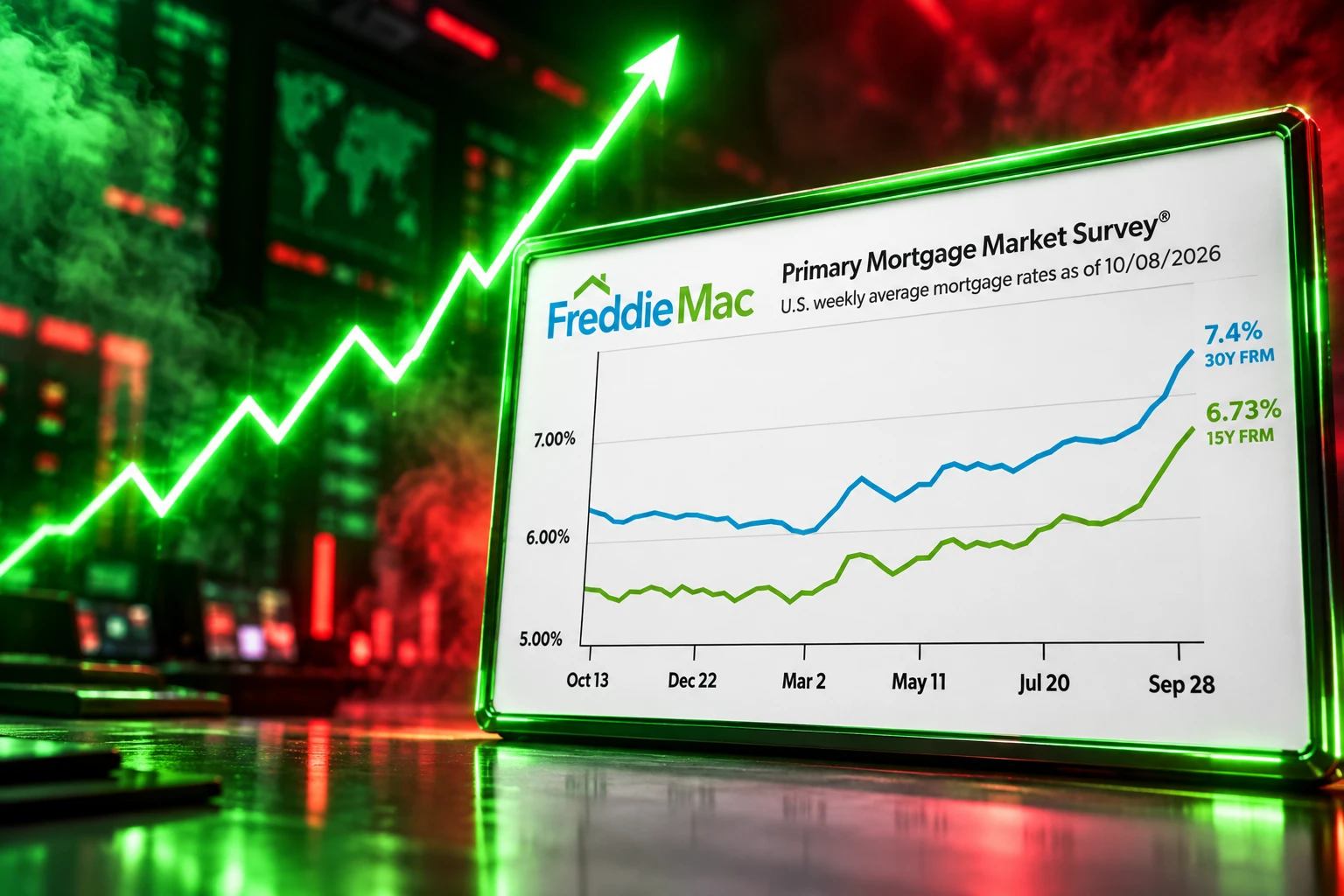
Freddie Mac’s 30-year fixed mortgage averaged 7.40% on October 8, up 1.10 percentage points from 6.30% a year earlier. Consumer guides still treat that midweek print as a menu of loans a shopper can pick from this afternoon.
The average prices a conventional purchase with 20% down and excellent credit. FHA, jumbo and ARM borrowers are already reading a different sheet.
The 30-Year Average Hits 7.40%
Freddie Mac’s Primary Mortgage Market Survey said the 30-year fixed-rate mortgage averaged 7.40% as of October 8, up from 7.28% the week before. The 15-year fixed averaged 6.73%, up from 6.60%. A year earlier those prints were 6.30% and 5.53%.
On a $400,000 30-year loan, 7.40% is about $2,769 a month in principal and interest. The same balance at last October’s 6.30% is about $2,476. That gap is about $293 a month, or about $3,516 a year, before taxes, insurance or mortgage insurance.
Sam Khater, Freddie Mac’s chief economist, did not sell the print as a product ranking. He pointed shoppers back to quotes.
As market conditions continue to evolve, borrowers should remember that shopping around for a mortgage rate and getting multiple quotes can potentially save them thousands over the loan’s lifetime.
Sam Khater, Chief Economist, Freddie Mac
Freddie Mac posted the 7.40% figure the same afternoon.
The avg. 30yr FRM increases to 7.40% https://t.co/K9HBh1pgw5 pic.twitter.com/DjkaIqHhWf
— Freddie Mac (@FreddieMac) October 8, 2026
The Mortgage Bankers Association’s Wednesday survey, covering the week ending October 2, sat even higher on the loan people actually apply for. MBA put the average contract rate on a conforming 30-year fixed at 7.49%, with 0.84 points, including the origination fee, on 80% loan-to-value loans. Joel Kan, MBA’s vice president and deputy chief economist, said that 7.49% was the highest in almost three years, as Treasury yields rose and mortgage spreads widened.
A 20% Down Payment Is Built Into the Survey
PMMS is not an average of every quote in the country. Freddie Mac limits it to conventional, conforming, fully amortizing home-purchase loans for borrowers who put 20% down and have excellent credit. Since November 17, 2022, the figure has come from applications submitted through Loan Product Advisor, the company’s automated underwriting system, rather than from a phone survey of lender rate sheets.
That filter is why the number moves cleanly week to week. It is also why a first-time buyer bringing 3% or 5% down should not treat 7.40% as the rate on the Loan Estimate. Credit score, down payment, loan size, property type, points and lender fees all reprice the same note on the same day.
The 20% screen is the part the midweek guides skip. Most first-time buyers do not arrive with a fifth of the price in cash, so the published average is a prime conventional benchmark, not a preview of their payment. Year one of a 7% handle loan is mostly interest; the headline rate sets that bill before a single extra principal dollar shows up.
Freddie Mac also stopped publishing average points and adjustable rates with the 2022 change, because those fields are not always required in the application feed. A shopper who compares only the PMMS coupon is missing the upfront cost that often decides whether a “lower” rate is cheaper.
Jumbo, FHA and ARM Quotes the Average Omits
MBA’s product tape for the week ending October 2 is the closer look at what different borrowers were actually applying at. Conforming 30-year loans at or under the 2026 conforming loan limit of $832,750 carried a 7.49% contract rate. Jumbo 30-year loans above that cap came in at 7.39% with 0.52 points. FHA 30-year loans averaged 7.14% with 1.36 points. The 5/1 ARM averaged 6.43% with 1.69 points.
MBA CONTRACT RATES, WEEK ENDING OCTOBER 2
| Loan | Contract rate | Points (incl. origination) | Week-earlier rate |
|---|---|---|---|
| Conforming 30-year fixed | 7.49% | 0.84 | 7.30% |
| Jumbo 30-year fixed | 7.39% | 0.52 | 7.27% |
| FHA 30-year fixed | 7.14% | 1.36 | 6.97% |
| 15-year fixed | 6.71% | 1.05 | 6.56% |
| 5/1 ARM | 6.43% | 1.69 | 6.47% |
Jumbo priced 0.10 percentage points below conforming and charged 0.32 fewer points. FHA’s coupon looks cheaper until the 1.36 points are counted against conforming’s 0.84. The ARM’s contract rate ticked down to 6.43% from 6.47%, but points jumped to 1.69 from 1.20, and MBA said the effective rate still rose.
FHFA set that $832,750 baseline in November 2025, up $26,250 from $806,500 in 2025, a 3.26% lift that matched the agency’s house-price index. High-cost counties cap out at $1,249,125 for a one-unit home, 150% of the baseline. Cross that line and the loan leaves the PMMS sample.
Kan said FHA purchase applications fell 6 percent, the steepest drop among purchase products, as higher rates piled onto thin down-payment budgets. The people who most need a “guide” are the ones the 7.40% conventional average was never built to quote.
Why the Weekly Print Lags the Lock Desk
PMMS posts each Thursday at noon Eastern. The window runs from 12:00 a.m. Eastern the prior Thursday through 11:59 p.m. Wednesday. A number released on October 8 is an average of applications already filed, not the rate a loan officer can lock after lunch that day. When a Thursday is a U.S. holiday, Freddie Mac publishes on Wednesday instead.
MBA’s survey lands on Wednesday and covers the prior week’s retail and consumer-direct applications, a series it has run since 1990. That is the Wednesday mortgage report shoppers are told to open. It is still a rear-view mirror. Lock desks reprice off Treasuries and mortgage-backed securities several times a day; the surveys catch that move after the fact.
THE CLIMB FROM LATE AUGUST
- August 20, 2026: Freddie Mac’s 30-year average sits at 6.65%.
- September 10, 2026: The 30-year prints 6.76%.
- September 24, 2026: The 30-year reaches 7.03%.
- October 1, 2026: The 30-year jumps to 7.28%.
- October 8, 2026: The 30-year prints 7.40%.
- October 15, 2026: The next PMMS release is scheduled at noon Eastern.
That is a 0.75 percentage point rise from August 20 to October 8. A list-price cut of a few tens of thousands of dollars does not automatically put last October’s payment back on the table once the rate has moved 1.10 percentage points. The weekly print is useful as a trend. It is a poor substitute for a same-day lock quote.
Three Loan Estimates on the Same Afternoon
The Consumer Financial Protection Bureau says homebuyers who gather several offers can save $600 to $1,200 per year. The bureau’s working method is dull on purpose: ask each lender for the same loan amount, term, down payment and rate structure, then read the Loan Estimate, which a lender must send within three business days of an application.
APR is one line on that form, not a scoreboard. It folds in some fees and still has to be read next to cash to close, discount points and the estimated payment. A rate that is 0.25 percentage points lower because the borrower is buying a point may be a bad trade for someone who expects to sell or refinance before the monthly savings recoup the upfront cost.
MATCH THESE ITEMS ON EVERY ESTIMATE
- Loan product: Same term, same fixed or adjustable structure, same occupancy.
- Note rate and points: The coupon plus any discount points in dollars, not only as a percentage.
- Cash to close: Lender fees, third-party charges, prepaids and any lender credit, lined up side by side.
- Monthly housing bill: Principal and interest plus taxes, homeowners insurance, mortgage insurance and association dues.
- Lock terms: Length, extension cost if closing slips, and whether a float-down exists if the market drops.
Send those files inside a tight window. Mortgage markets can reprice overnight, and a Monday quote next to a Friday quote is two different days dressed up as a comparison. Khater’s “thousands over the loan’s lifetime” is the same warning in plainer clothes: the survey is the compass, the Loan Estimate is the price.
Refinance Applications Run at Half Last Year’s Pace
MBA said mortgage applications decreased 4.2 percent on a seasonally adjusted basis in the week ending October 2, after a 6.0% drop the week before. The unadjusted index fell 4 percent. The Refinance Index dropped 8 percent and stood 56 percent below the same week a year earlier. The seasonally adjusted Purchase Index fell 2 percent; the unadjusted purchase reading was 15 percent lower than a year earlier.
Very few homeowners have an incentive to refinance at these rates, and the jump in borrowing costs has caused many potential borrowers to step back from the purchase market. With rates roughly a percentage point higher than a year ago, refinance applications last week were at the lowest level since 2025 and fell to less than half of last year’s pace.
Joel Kan, Vice President and Deputy Chief Economist, Mortgage Bankers Association
MBA WEEK ENDING OCTOBER 2
- Refinance share: 37.0% of applications, down from 38.3% the prior week.
- ARM share: 10.3% of applications, unchanged, as more buyers use an adjustable start rate to cut the first payment.
- FHA share: 16.4%, down from 16.7%.
- VA share: 11.8%, down from 11.9%, with USDA steady at 0.5%.
Kan said a higher share of borrowers have been choosing ARMs in recent weeks to lower the initial bill, and the 10.3% share held even as the 5/1 contract rate’s effective cost rose on heavier points. That is a payment patch, not a new favorite product. The reset after the fixed period is the cost the Wednesday average never shows, because PMMS no longer publishes adjustable rates at all.
The Lock Desk Does Not Wait for Thursday
After a lender is chosen, the next decision is whether to lock or float. A lock freezes the rate for a stated window. Floating leaves room for a decline and for a worse print if yields keep climbing. The right call depends on the closing date, the lock’s length and what an extension costs if the appraisal or title work runs long.
Ask whether a float-down exists if the market drops after the lock, and get that rule in writing. The October 8 average will not update those terms. The next PMMS release is due October 15 at noon Eastern, and it will again describe applications that have already been filed.
Use the midweek print to see that conventional 30-year money has moved from 6.65% in late August to 7.40% on October 8. Then price the loan you will actually sign: FHA with its points, jumbo if the balance clears $832,750, a 15-year if the payment fits, or a 5/1 ARM if the first-period savings are worth the reset. The average will still be there on Thursday. The cheaper quote is the one that expires this afternoon.
Disclaimer: This article is news reporting and analysis of weekly mortgage-rate surveys and related consumer rules, and it is for information only. It is not mortgage, lending, investment, tax or housing advice, and it does not recommend any loan product, lender, lock strategy or purchase decision. Readers should consult a licensed mortgage professional and, where taxes or insurance are involved, a qualified tax adviser or insurance agent before acting on any rate, payment example or product comparison. Figures, loan limits and survey results reflect the cited Freddie Mac, MBA, FHFA and CFPB materials as of the dates in those documents and will change with later weekly prints and individual underwriting.

Cook Hands Democrats the House as Crypto’s Bill Stays Dead

Wicker’s Broken Bed Was the Short Story’s Punch Line

Nvidia’s $500 Billion Financing Plan Draws a $180 Sell

Maserati Bets the Grecale V6 Can Fill Porsche’s Gap

EV Cable Theft Follows the Old Railway Copper Playbook

Aramco Crash Kills 14 Two Days After Oil Restart

Salah Captained Egypt to Their First World Cup Win

Zelda’s 40th Switch 2 Ships Without a Zelda Game

Apple Labor Day Deals Hide June’s Memory Price Hike

Palworld 1.0.4 Adds Palpedia Search After the 1.0 Launch
-
 BUSINESS4 months ago
Aramco Crash Kills 14 Two Days After Oil Restart
-
 NEWS5 months ago
Salah Captained Egypt to Their First World Cup Win
-
 GAMING2 months ago
Zelda’s 40th Switch 2 Ships Without a Zelda Game
-
 NEWS2 months ago
Apple Labor Day Deals Hide June’s Memory Price Hike
-

 NEWS4 months ago
El Niño Puts Israel’s Needed Winter Rain on a Flood Clock
-
 GAMING2 months ago
Palworld 1.0.4 Adds Palpedia Search After the 1.0 Launch
-

 BUSINESS8 months ago
BAE’s 60-Year Saudi Franchise Now Runs Through Taif
-

 BUSINESS8 months ago
Egypt Bets EGP 638 Billion Can Open Sinai to Investors