
BUSINESS
Syria and Jordan Still Hold the Hejaz Railway Revival
Turkey and Saudi Arabia signed railway deals in Riyadh, yet about 400 kilometers through Syria and Jordan still decide whether the Hejaz line is rebuilt.

On June 9, 2026, Turkey and Saudi Arabia signed two railway memorandums in Riyadh, while about 400 kilometers of track through Syria and Jordan remain to be built. Saudi Transport Minister Saleh al-Jasser said joint studies for a line through those two countries should be finished by the end of 2026. Turkish Transport Minister Abdulkadir Uraloglu said a working link could take three or four years if money and plans catch up.
The names on the paper are Ankara and Riyadh. The dirt, the broken yards, and the rails that do not match sit in Syria and Jordan.
Two Memorandums and a 400-Kilometer Hole
Uraloglu went to Riyadh to push railway and logistics work with Saudi Arabia. He said, “We are in Riyadh for contacts to further advance cooperation between Turkiye and Saudi.” The two deals that followed were not a construction contract, a route map, or a budget for the whole corridor.
WHAT THE RIYADH PAPERS COVER
- The railway deal: It covers engineering, safety, standards, signalling, digital systems, research, training, and local production of railway gear, not a bid to lay the missing track.
- The logistics deal: It sets up sharing of methods and rules across transport modes, and talks about joint logistics centres.
- The timetable: Al-Jasser put the joint studies at the end of 2026; Uraloglu said a financial plan would come later and that other Gulf states could join after the first phase.
Hannan Alghamdi, a researcher at the Gulf Research Center, wrote in a September 6, 2026 commentary that the political packing is thicker than earlier revival tries, and that the hard questions are still open.
These agreements should not yet be mistaken for a final construction programme.
Hannan Alghamdi, researcher, Gulf Research Center
Uraloglu sketched a path that starts in Saudi Arabia, crosses Jordan and Syria, and meets the Turkish network, with a later reach toward Europe and, in a longer plan, Oman. He also described a corridor drawn to miss Israel. Turkish Trade Minister Omer Bolat, speaking the same day in Gaziantep with Syrian Economy Minister Mohammad Nidal al-Shaar, cast the work as a way to cut outside leverage in the region and to lift Turkey-Syria trade from $3.7 billion last year toward $5 billion within two years.
Uraloglu said Saudi track already reaches the Jordan border and that Turkey’s approach is in place from Islahiye through Kilis and Gaziantep. That, he said, still leaves some 400 kilometers of new work between Syria and Jordan. The first build he has priced is not that whole gap. It is the Turkey-Aleppo repair, which he put at $100 million, enough in his telling to open a run toward Damascus.
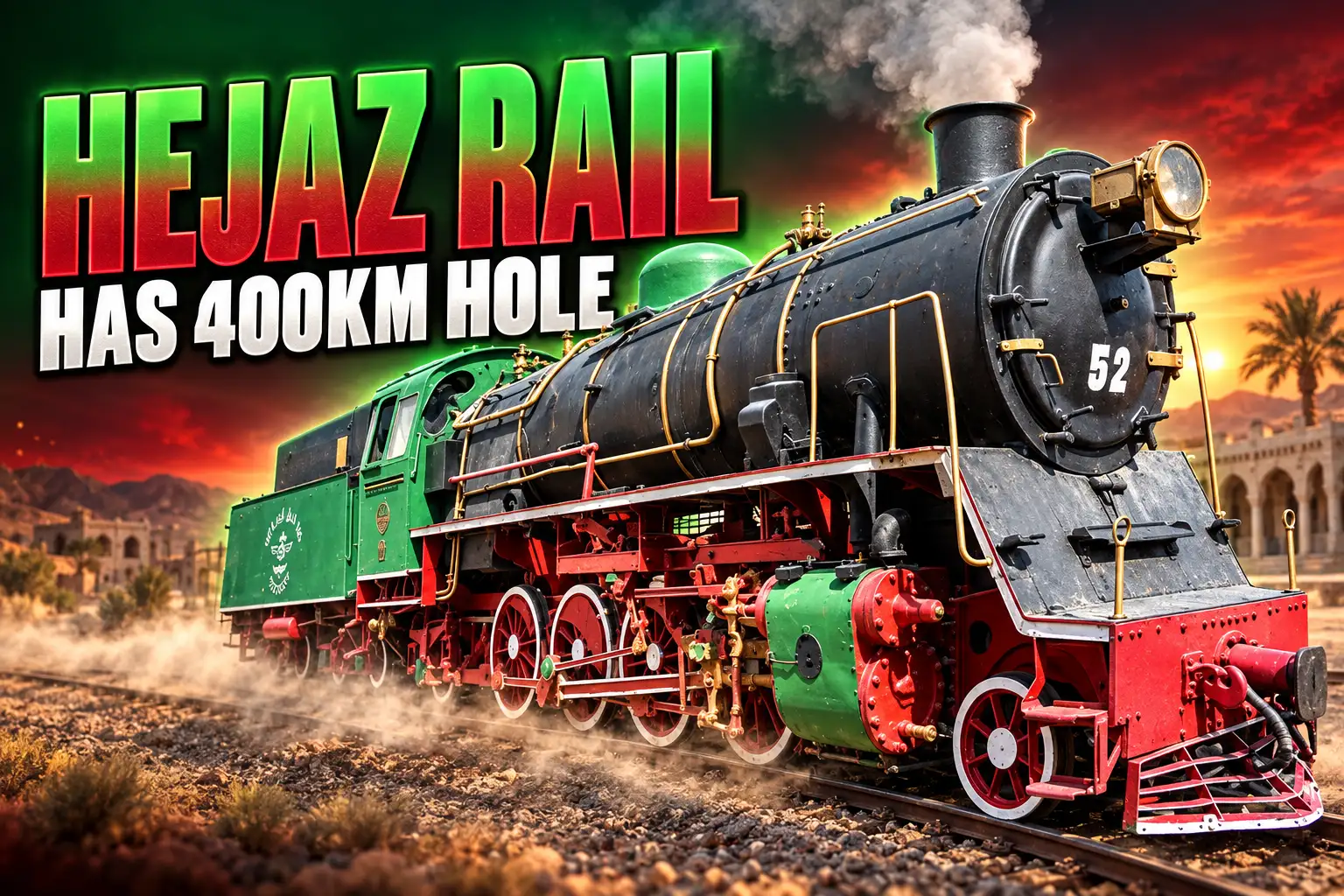
Aleppo Is the First Bill Turkey Has to Pay
Uraloglu has said the practical start is an extension of Turkey’s own rails into Aleppo, because the Aleppo-Damascus line is still there. That is a smaller claim than a full Hejaz rebuild, and it is the one that can be costed. Test runs between Aleppo and Hama resumed in August 2025 after Syrian rail services stopped in 2012. Limited trains had come back in 2020. That is not a modern freight railway ready for Gulf boxes.
In May 2026, Syria’s transport minister took a World Bank team led by Jean-Christophe Carret through plans to repair the national network and to seek outside money. Bolat said on June 9 that work to reopen the Islahiye rail crossing from Gaziantep into Syria was ready, and that Turkey would wait on Damascus before activating Nusaybin-Qamishli.
The piece of Turkish track that is actually running again is not inside Syria. It is the border line on the Turkish side. Uraloglu said the 325-kilometer Karkamis-Nusaybin route plus the 25-kilometer Senyurt-Mardin branch, 350 kilometers in all, went back to trains on March 31, 2026 after upkeep stopped between 2011 and 2024. Crews rebuilt foundations and drains, shored up 750 meters of weak ground, replaced more than 2,500 bridge sleepers, and ran machine repairs on 310 kilometers with ballast work on 100 kilometers. That corridor is also meant to feed the separate Ovakoy link toward Iraq. It does not close the Aleppo bill.
HOW THE CORRIDOR CAME BACK
- 1900 to 1908: Ottoman crews lay about 1,300 kilometers from Damascus to Medina and open the line on September 1, 1908.
- 2012: Syrian rail services halt as the civil war destroys yards, bridges, and long stretches of track.
- December 2024: Bashar al-Assad’s government falls, and cross-border talk with Turkey and Jordan resumes.
- August 2025: Test operations run between Aleppo and Hama on a line that had been dark for years.
- September 2025: Turkey, Syria, and Jordan meet in Amman; Turkey offers to fund about 30 kilometers of missing track inside Syria on the Damascus-Jordan approach, while Jordan studies locomotives and a run toward Aqaba.
- March 31, 2026: Turkey reopens the 350-kilometer Karkamis-Nusaybin and Senyurt-Mardin border lines to freight.
- April 2026: The three neighbours set a wider transport framework covering road, rail, sea, and air.
- June 9, 2026: Saudi Arabia and Turkey sign the Riyadh railway and logistics memorandums.
The 30 kilometers Turkey offered to fund in 2025 is a hole on the Damascus-Jordan approach. It is not the same figure as Uraloglu’s 400 kilometers of new work across Syria and Jordan. One is a wartime gap on an old alignment. The other is the build he says is still required before Saudi trains can run north in any modern form.
Where Jordan’s 1,050 mm Tracks Run Out
Jordan is the quiet owner of what still exists of the old Hejaz line. The Jordan Hejaz Railway Corporation, set up under a 1952 law, holds the property from the Syrian border to the Saudi border, about 452 kilometers of it, on the original 1,050 mm gauge. Passenger trains ran Amman to Damascus until 2011. Phosphate moved from Ma’an toward Aqaba until 2018. What is left is a tourist and heritage operation plus a pile of upgrade studies, not a container railway.
Saudi Arabia is already at the fence. Saudi Arabia Railways runs a 1,250-kilometer passenger line to Al Haditha near the Jordanian border, part of the North Train network, with European ETCS Level 2 signalling. Freight from Dammam and Jubail has been sent up that spine to the same crossing, with trains billed as carrying more than 400 boxes a trip. That railway is standard gauge. The old Hejaz rails in Jordan are not. A Saudi freight car cannot roll onto them.
That is why a “revival” that only restores Ottoman track would stall at the border, and why a “revival” that only extends the North Train would have to lay a new width of rail across Jordan. The June papers never choose. Until someone does, Al Haditha is the end of a modern Saudi line, not the start of a Levant land bridge.
WHERE THE LINE STANDS
| Segment | What is in place | What is still open |
|---|---|---|
| Turkey to Aleppo | Islahiye-Gaziantep approach; $100 million repair plan named by Uraloglu | The cross-border rebuild into Aleppo |
| Aleppo to Damascus | The old alignment, with Aleppo-Hama tests in August 2025 | A freight-grade overhaul after the 2012 halt |
| Damascus to Jordan | A wartime gap of about 30 kilometers that Turkey offered to fund in 2025 | The rest of Uraloglu’s 400 kilometers of new work |
| Jordan Hejaz remnant | About 452 kilometers on 1,050 mm gauge, heritage and limited freight | A standard-gauge link that can take Saudi trains |
| Saudi North Train | 1,250 kilometers of passenger railway Riyadh to Al Haditha | A matching gauge and a handoff north of the border |
People who know the Saudi map already treat the North Train as the southern fact on the ground. The Hejaz name is the political wrapper. Without a Jordan rebuild, Riyadh is offering a mineral railway that stops at Al Haditha, not a restored pilgrim line into Amman.
Sultan Abdulhamid’s Line Never Reached Mecca
The first Hejaz Railway was ordered in 1900 by Ottoman Sultan Abdulhamid II and built with donations from across the Muslim world, on purpose without foreign loans. German and Ottoman engineers, among them August Meissner and Mukhtar Bey, pushed the track south from the Damascus plain through Deraa, Amman, Ma’an, Tabuk, and AlUla. The completed Damascus-Medina run was about 1,300 kilometers. A camel caravan had taken 40 days. The train cut that to 5 days.
The inauguration ceremony for Medina Station was held on September 1, 1908, on the anniversary of the sultan’s accession, with a crowd put at more than 30,000. The line was meant to go on to Mecca. It never did. Local tribes who lived off pilgrim escorts, with backing from Sherif Hussein ibn Ali in Mecca, blocked the last stretch. World War I then tore up what had been laid. The Haifa branch from Deraa, which once tied the pilgrim railway to the Mediterranean, was later cut away from the Arab states that now want the main stem back.
The modern plan, as Turkish briefings describe it, does not relay every Ottoman sleeper. It follows a parallel corridor for freight and trade, then borrows the Hejaz name. That is a different product from the 1908 railway, and it still has to cross the same country that broke the first one.
Aqaba Already Took the Hormuz Overflow
Uraloglu tied the June deals to trouble around the Strait of Hormuz and to a search for land options after regional fighting disrupted sea lanes. Rail will not replace the oil trade that uses that strait. UNCTAD puts about 25 percent of seaborne oil through Hormuz. Existing bypass pipes, including Saudi Arabia’s East-West line and the UAE’s ADCOP, can move only 3.5 to 5.5 million barrels a day at full theoretical capacity, a fraction of what normally goes by water.
Alghamdi’s September commentary is blunt on that point: no railway stands in for the bulk that moves by tanker. The case for a Levant rail spine is narrower. It is redundancy for higher-value cargo, food, and industrial loads when a sea gate is jammed, and a way to tie Saudi factories into Turkish and European rails.
THE HORMUZ REROUTE IN NUMBERS
- Aqaba transit: Jordan’s Red Sea port recorded a 155.1 percent rise in transit cargo in the first half of 2026 as shippers left the Gulf.
- Jeddah boxes: Jeddah Islamic Port went from a pre-crisis monthly average of about 400,000 containers to about 720,000, an 80 percent jump, during the first peak of the Hormuz crisis.
- What rail is for: Those two ports already took the overflow by water and road; a northbound railway would only matter for the slice of cargo that can leave the dock for inland markets.
Aqaba’s spike is also a warning for Amman. The port is already doing the emergency job. A railway that cannot take standard-gauge trains from Al Haditha will not take the next job off the trucks. Jordan’s role in this project is not ceremonial. If the gauge is not fixed, the Saudi North Train and the Turkish Aleppo plan remain two dead ends with a tourist railway in the middle.
Who Else Wants Onto the Line?
Late in September 2026, Lebanese Transport Minister Fayez Rasamny met Turkish Ambassador Murat Lutem in Beirut to talk transport and public works. Lebanon wants its ports tied into the same Turkey-Syria-Jordan-Saudi spine. That ask arrived before the joint studies are even due, which tells you how crowded the corridor has become on paper.
Iraq is watching from the other bank. Ankara is also backing the Iraqi Development Road toward Turkey, a 1,200-kilometer rail and highway idea from the Faw area to the Turkish border. Uraloglu has talked about reaching Basra on that eastern path in the same breath as the Hejaz name. Some Iraqi voices already treat the Levant railway as a rival that could skim Gulf-to-Europe freight before Faw is ready. The two lines serve different coasts, but they compete for the same political attention in Ankara, and for the same promise that Turkey can be the land hinge of the Gulf.
Oman sits at the far end of Uraloglu’s ocean pitch: a railway that eventually reaches the Arabian Sea and offers a land way around Hormuz. That is a slogan until the 400 kilometers in Syria and Jordan exist. It is also a slogan until someone writes down whether Jordan will keep 1,050 mm rails or tear them up for the Saudi width.
Three or four years is the date Uraloglu offered. Turkish rail works at home have a habit of running long, which is why that date reads as a political target. The studies al-Jasser promised are still due by the end of 2026. Until they choose a gauge, a route, and a payer, the Hejaz revival is two signed memorandums, a $100 million Aleppo bill, and a hole that only Syria and Jordan can fill.

Ninja Theory Staff Face Redundancy After Two Xbox Sales Collapse

Amazon Sells the MacBook Air at Its Pre-Hike Price

U.S. Slows Jet Parts to Squeeze China’s Flying Fleets

PEGI Pulled the GTA 6 Age Rating After Cocaine Details

Northwestern’s Smaller Ryan Field Gave Penn State Nowhere to Hide

Aramco Crash Kills 14 Two Days After Oil Restart

Salah Captained Egypt to Their First World Cup Win

Apple Labor Day Deals Hide June’s Memory Price Hike

Palworld 1.0.4 Adds Palpedia Search After the 1.0 Launch

Zelda’s 40th Switch 2 Ships Without a Zelda Game
-
 BUSINESS3 months ago
Aramco Crash Kills 14 Two Days After Oil Restart
-
 NEWS4 months ago
Salah Captained Egypt to Their First World Cup Win
-
 NEWS1 month ago
Apple Labor Day Deals Hide June’s Memory Price Hike
-
 GAMING4 weeks ago
Palworld 1.0.4 Adds Palpedia Search After the 1.0 Launch
-
 GAMING4 weeks ago
Zelda’s 40th Switch 2 Ships Without a Zelda Game
-

 NEWS3 months ago
El Niño Puts Israel’s Needed Winter Rain on a Flood Clock
-

 BUSINESS8 months ago
Egypt Bets EGP 638 Billion Can Open Sinai to Investors
-

 BUSINESS2 months ago
Egypt Seeks Two Extra El-Dabaa Reactors Before First Power