
NEWS
Amra City’s Al-Hussein Stadium Puts State Land in Play
Jordan is digging a 46,000-seat Al-Hussein stadium on Investment Fund land in unbuilt Amra City.

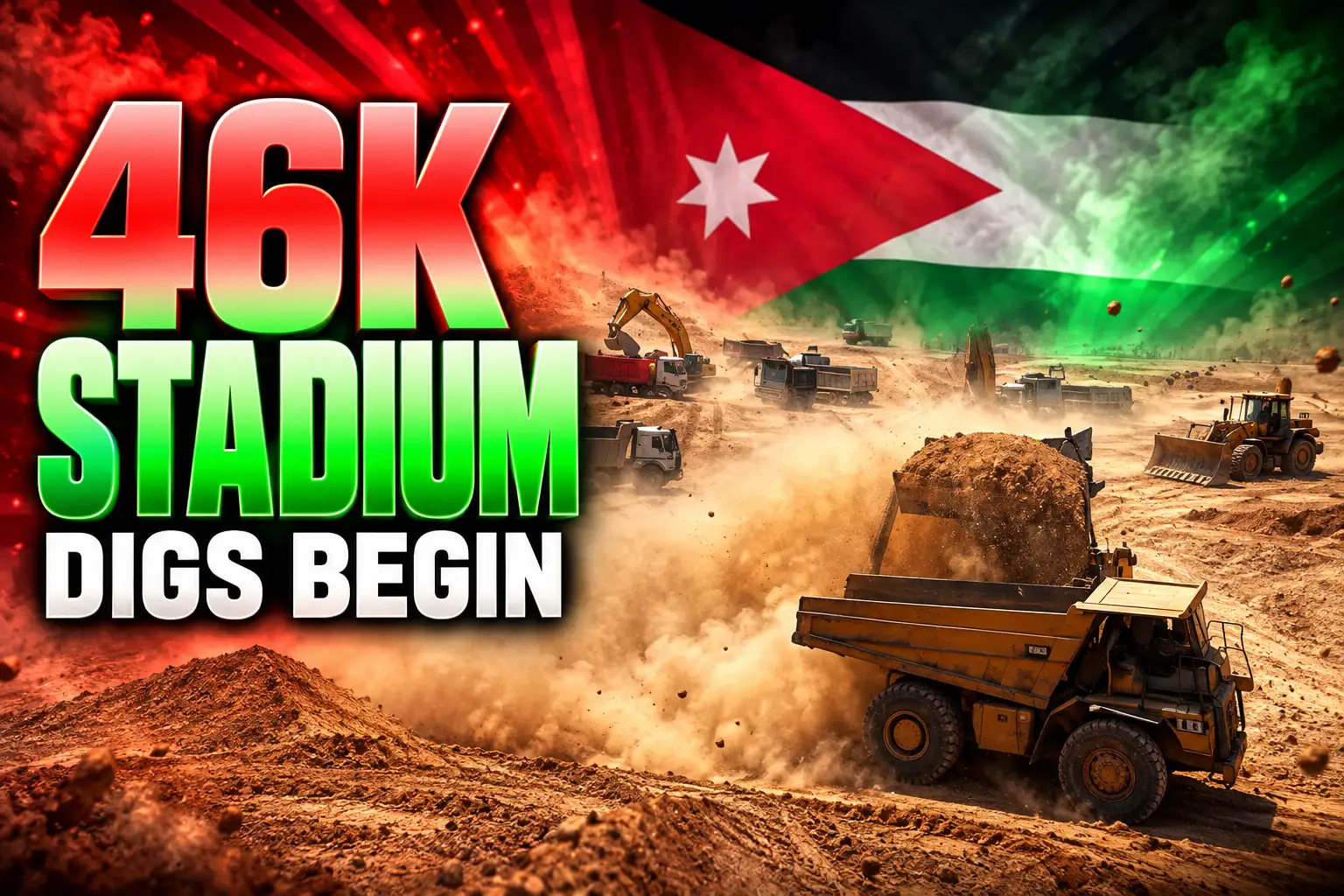
Jordan has started digging a 46,000-seat stadium in Amra City, a planned settlement on state land 40 kilometres east of Amman. The Al-Hussein bin Abdullah II International Stadium is due to open in late 2029 as the kingdom’s largest sports ground.
The Jordan Investment Fund holds the land under that bowl. The hole in the ground is how a dormant state holding starts to look like a city.
Excavators Are Working 40 Kilometres East of Amman
The Jordan Cities and Facilities Development Company, a state firm under the fund, said on Sunday, June 14, 2026, that it had begun excavation on a 1,000-dunam precinct. A dunam is 1,000 square metres, so the site is one square kilometre. Crews are grading the plot and cutting deep foundations. The stands themselves are not scheduled to rise until early 2027.
The company put seating at 46,000, with two training pitches and a transit hub of 6,000 parking spaces for cars and coaches. Plans tie the precinct into local buses and Bus Rapid Transit lanes. Design notes talk of Jordanian heritage forms, on-site energy and water systems, and a green belt of native plants around the bowl.
Project leads forecast hundreds of direct jobs in the build and in later operations, aimed at civil works, engineering contractors, and local supply chains. That is a company forecast, not a signed headcount.
THE BOWL ON THE BOOKS
- Seats: 46,000 in a football-specific bowl named for Crown Prince Al Hussein bin Abdullah II.
- Site: 1,000 dunams, about one square kilometre, with two training pitches.
- Parking: 6,000 spaces for cars and coaches, plus BRT access.
- Dates: foundations now, the structure in early 2027, opening targeted for late 2029.
The investment portal that is already shopping other Amra plots places the new city on a 30-minute drive east of Amman along the Amman-Azraq Highway. That is far enough from downtown that match-day traffic will depend on the bus lanes the company keeps promising.
The Jordan Investment Fund Holds the Land
Prime Minister Jafar Hassan launched Amra City on November 29, 2025, after King Abdullah II told the government, in the Letter of Designation, to push the project as a way to ease pressure on Amman and Zarqa. Officials said those two cities could reach 11 million people in 25 years if growth holds. They also said Amra would not be a new political capital.
The land was assigned to the Jordan Investment Fund, which then set up the cities company as its development arm. Hassan’s launch put the first phase on 40,000 dunams, 40 square kilometres, inside a holding of half a million dunums of state land, or 500 square kilometres. That is a city-scale parcel, not a stadium car park.
Musab Muhaidat, chairperson of the Jordan Company for Developing Cities and Facilities, has described the scheme in those terms, not as a football upgrade that happens to need a plot.
strategic national ambition and a key economic driver
Musab Muhaidat, chairperson, Jordan Company for Developing Cities and Facilities, Economic Forum for Diplomatic Missions, April 8, 2026
Speaking earlier in 2026, Muhaidat said the project carries no cost to the state budget. The land is a state asset moved onto the fund’s books so it can be turned from idle ground into something the sovereign vehicle can value, partner on, and, later, perhaps float. He said the company would keep at least 51 percent in joint projects so the fund’s privileges travel with the deals.
WHO CONTROLS THE DIRT
- The fund: The Jordan Investment Fund received the state land and owns the development company.
- The company: It runs procurement, investor talks, and joint ventures for Amra City.
- The lock-up: Muhaidat said the company would hold no less than 51 percent in joint projects.
- The passport clause: Cabinet rules added a citizenship track for Amra City investors who put in at least 1.5 million dinars and hire Jordanians.
By September 2026, Amra was already being discussed as plots. The health ministry talked about land allocations for staff. Private brokers pitched parcels between Amman and Zarqa. The stadium is the public object. The product on offer is titled land.
Why Jordan Wants 46,000 Seats
Jordan’s present national ground is Amman International Stadium, opened in 1968 and now listed at 17,619 seats. King Abdullah II Stadium, opened in 1999, is listed at 13,265. Together they hold 30,884. The new bowl is larger than both, and about 2.6 times the 1968 ground.
Al-Hassan Stadium in Irbid is listed at 12,301. Prince Mohammed Stadium in Zarqa is listed at 11,402. None of those four can stage the kind of crowd the cities company is selling. In January 2025, Jordan FA vice-president Marwan Juma said the country needed a new international stadium of at least 40,000 seats east of Amman, about 40 kilometres from the capital, and that the king had told the government to build it. The June 2026 figure of 46,000 sits above that floor.
JORDAN’S MAIN BOWLS BESIDE THE NEW ONE
| Venue | Listed seats | Opened | City |
|---|---|---|---|
| Al-Hussein bin Abdullah II International Stadium | 46,000 (planned) | Late 2029 (target) | Amra City |
| Amman International Stadium | 17,619 | 1968 | Amman |
| King Abdullah II Stadium | 13,265 | 1999 | Amman |
| Al-Hassan Stadium | 12,301 | 1990 | Irbid |
| Prince Mohammed Stadium | 11,402 | 1999 | Zarqa |
A 46,000-seat football bowl also matches the language the company used about regional and international events. It does not, on its own, fill those seats on a Jordanian league Saturday. That gap is why the precinct is being sold with training pitches, parking, buses, and a city that is supposed to grow around it.
Three World Cup Defeats, Zero Home Ground
Jordan’s first FIFA World Cup qualification came on June 5, 2025, in Muscat, when Ali Olwan scored in first-half stoppage time, again in the 51st minute, and again in the 64th in a 3-0 win over Oman. South Korea’s 2-0 win over Iraq the same day confirmed second place in the group. It was the country’s first finals after previous near-misses, including the 2014 play-off loss to Uruguay.
The 2026 tournament was always in North America. Jordan went to Group J with Argentina, Austria, and Algeria and came home with zero points. Austria won 3-1, Algeria 2-1, Argentina 3-1. Jordan scored three and conceded eight. Olwan, Nizar Al-Rashdan, and Musa Al-Taamari got the three goals. Lionel Messi scored in the last of those matches in Dallas.
Excavation was announced on June 14, 2026, in the same week Jordan’s first World Cup match kicked off. The late-2029 opening means the bowl was never a 2026 venue. The team that finally reached a World Cup did so from a 17,619-seat ground built in 1968, then played its three finals games in California and Texas.
That calendar is the awkward part of the fund’s timing. The political heat of a first World Cup arrived while Amra was still a graded plot. The asset that is supposed to cash in on that heat will not have stands until 2027.
Amra City Needs a Landmark Before It Has Residents
The stadium is listed as part of an integrated sports city inside Amra’s first phase, which the government timed for 2026 to 2029. Around it, the same phase is supposed to deliver an exhibitions and conferences centre, an Olympic precinct, indoor halls, a motor-racing track, a 1,000-dunam environmental park, and an entertainment city. Housing, schools, shops, and a technology hub sit on the same land-use plan.
THE FIRST-PHASE CLOCK
- June 5, 2025: Jordan beats Oman 3-0 and reaches a first World Cup.
- November 29, 2025: Prime Minister Jafar Hassan launches Amra City on fund-held state land.
- January 14, 2026: The government estimates the stadium at 200 million dinars.
- June 14, 2026: The cities company announces grading and foundation cuts.
- June 16 to 27, 2026: Jordan plays three World Cup games, loses all three, and exits on 0 points.
- Early 2027: Structural work on the bowl is due to start.
- Late 2029: Opening target for the 46,000-seat stadium.
Other first-phase dates sit beside that stadium clock. The exhibitions centre is aimed at 2027. The entertainment city is aimed at 2028. In June 2026 the cities company awarded a British-Saudi group a feasibility study for an amusement park it put at about 50 million dinars, with operations hoped for the end of 2028. Those dates only hold if the roads, power, and water arrive with them.
WHAT PHASE ONE IS SUPPOSED TO PUT ON THE MAP
- Sports city: The 46,000-seat stadium, two training pitches, and an Olympic precinct with indoor halls.
- Shows and parks: An international exhibitions centre (2027), an entertainment city (2028), and a 1,000-dunam environmental park.
- Other kit: A motor-racing track, commercial and service zones, an educational city, and an extension of the Royal Automobile Museum.
A stadium is a useful first object because it photographs well and has a royal name. It is also a stranded asset if the BRT spur, the housing, and the other halls slip. The fund’s 51 percent lock and the citizenship clause both assume partners will still want in once the dirt is a skyline.
A 200 Million Dinar Estimate With No Budget Line
In January 2026 the government put the stadium at 200 million dinars. Early papers attached to that figure still spoke of up to 50,000 seats. The company’s June statement, which is the live specification, is 46,000. The 200 million dinar tag has not been replaced in public by a signed contract price.
Muhaidat’s claim that Amra carries no cost to the budget is the political shield around that number. The land was already the state’s. The fund is supposed to bring in partners, keep majority control, and keep the Treasury off the invoice. If partners are slow, the 200 million dinars becomes a test of whether a sovereign vehicle can fund a bowl without doing what Muhaidat said it would not do.
Tenders for early works were supposed to go out in the first half of 2026. Excavation in June shows that at least the site package moved. Vertical construction in early 2027 is the next public test, because a foundation trench is cheaper to slip than a steel roof.
Club Football Still Kicks Off in 1968
Through 2026, Amman International Stadium remained the default for national fixtures and for visiting clubs. Al-Hussein SC of Irbid, whose own name now sits on the new bowl in Amra, still saw continental ties staged in Amman rather than at home. The 17,619-seat ground is what Jordan actually has while the 46,000-seat one is a trench.
Late 2029 is the date on the company statement. Early 2027 is when the bowl is supposed to leave the ground. Until those dates turn into stands, the fund’s first landmark is still a hole in a 500-square-kilometre holding, and Jordan’s football nights still end on a pitch that opened in 1968.

Cook Hands Democrats the House as Crypto’s Bill Stays Dead

Wicker’s Broken Bed Was the Short Story’s Punch Line

Nvidia’s $500 Billion Financing Plan Draws a $180 Sell

Maserati Bets the Grecale V6 Can Fill Porsche’s Gap

EV Cable Theft Follows the Old Railway Copper Playbook

Aramco Crash Kills 14 Two Days After Oil Restart

Salah Captained Egypt to Their First World Cup Win

Zelda’s 40th Switch 2 Ships Without a Zelda Game

Apple Labor Day Deals Hide June’s Memory Price Hike

Palworld 1.0.4 Adds Palpedia Search After the 1.0 Launch
-
 BUSINESS4 months ago
Aramco Crash Kills 14 Two Days After Oil Restart
-
 NEWS5 months ago
Salah Captained Egypt to Their First World Cup Win
-
 GAMING2 months ago
Zelda’s 40th Switch 2 Ships Without a Zelda Game
-
 NEWS2 months ago
Apple Labor Day Deals Hide June’s Memory Price Hike
-

 NEWS4 months ago
El Niño Puts Israel’s Needed Winter Rain on a Flood Clock
-
 GAMING2 months ago
Palworld 1.0.4 Adds Palpedia Search After the 1.0 Launch
-

 BUSINESS8 months ago
BAE’s 60-Year Saudi Franchise Now Runs Through Taif
-

 BUSINESS8 months ago
Egypt Bets EGP 638 Billion Can Open Sinai to Investors