
AUTO
Tesla Trades Full Self-Driving for Berlin’s Help in Europe
Tesla renamed Full Self-Driving to Tesla Assisted Driving in Europe after a German deal on naming, speed, and liability, chasing an EU vote.

Tesla renamed Full Self-Driving to Tesla Assisted Driving on its European websites on October 9, after offering the swap to Germany’s transport ministry. The software did not change. German Transport Minister Steffen Bilger will now press Brussels to approve the same supervised system, after Tesla agreed to a new name, a 10% speed cap, and full driver liability.
Eight EU countries already allow it. Together they hold only 12.6% of the bloc’s people. Germany alone is 18.6%, which is why a name Tesla spent years defending in California was cheap next to a minister who can move a qualified-majority vote.
Tesla Offered the Name, Berlin Offered the Vote
Bilger’s ministry published the deal on October 6, 2026. It said September talks with Tesla produced a “constructive agreement” on technical points and liability. The current FSD label, the ministry wrote, is “somewhat misleading,” because the software does not take over the full driving task. It can help with accelerating, braking, and steering. The driver still has to stay alert.
Tesla offered to rename the system Tesla Assisted Driving. Company support pages in Dutch and French already shorten that to TAD. Bilger then pledged to work for timely EU-wide approval so Tesla drivers can use Assisted Driving across the bloc as soon as possible.
We quickly found a common understanding and reached a constructive agreement. On this basis I will now work to ensure that the system is approved across Europe soon. My goal is that Tesla drivers can use the advantages of Assisted Driving throughout the EU as quickly as possible.
Steffen Bilger, German transport minister, Federal Ministry of Transport, October 6, 2026
The written ministry note is a political endorsement, not a German customer launch. Germany is still working with the Kraftfahrt-Bundesamt, the Dutch type-approval authority, and Tesla. German owners cannot turn the feature on.
THE SEPTEMBER BARGAIN
- The name: Tesla drops Full Self-Driving in European marketing and sells Tesla Assisted Driving instead.
- The speed: the system may exceed the posted limit by at most 10%, a cap Berlin says it will defend in the EU process.
- The liability: because this is driver assistance, the person behind the wheel stays fully responsible for safe driving.
At a Berlin conference the same day, Bilger said an EU deal was the sensible path, and that if that failed Germany would have to discuss what it could do on its own. That national fallback is not in the ministry’s written page, which sticks to the European procedure.
Eight Countries Cover 12.6% of Europe
The file in Brussels is not a new Tesla application. It is a Dutch exemption that other capitals have been copying. The Netherlands Vehicle Authority, the RDW, granted provisional type approval on April 10, 2026, under Article 39 of the 2018 EU type-approval law, the clause used when a system does not fit the ordinary rulebook. Other member states can recognise that Dutch decision for their own roads without running a full second test programme.
Tesla’s own Dutch support page now lists the same eight countries the national letters have reached. Country tallies put those eight at 12.6% of the EU population. An EU-wide yes still needs a qualified majority in the Technical Committee on Motor Vehicles: at least 15 of 27 states and 65% of the bloc’s people.
THE THRESHOLDS BRUSSELS STILL REQUIRES
- States now: 8 of 27 have recognised the Dutch approval.
- Population now: 12.6% of the EU, 52.4 percentage points short of 65%.
- Germany’s weight: 18.6% of the EU population, about 83.4 million people.
- Still needed: 7 more states, plus the large ones, before both bars clear.
Add Germany, France, Italy, and Spain to the current eight and the population share would reach about 70.3%. That would clear the 65% bar. It would still leave the count at 12 states, three short of 15, so a few smaller yes votes would still be required.
WHERE THE FEATURE IS ALREADY LEGAL
| Country | National recognition | Status |
|---|---|---|
| Netherlands | April 10, 2026 | RDW provisional approval |
| Lithuania | May 20, 2026 | Recognises Dutch file |
| Estonia | May 29, 2026 | Recognises Dutch file |
| Denmark | June 9, 2026 | Recognises Dutch file |
| Belgium | June 10, 2026 | Recognises Dutch file |
| Slovenia | September 7, 2026 | Recognises Dutch file |
| Czechia | September 21, 2026 | Recognises Dutch file |
| Croatia | September 29, 2026 | Recognises Dutch file |
Slovakia’s transport minister said in early October that a recognition letter to the Netherlands would go out in the coming days. As of October 12 that letter had not been confirmed, so Slovakia is not a ninth approval yet. Tesla’s support page still names the original eight, and says the system is blocked in countries that have not granted approval. If a car crosses into one of those countries with the feature on, Tesla says it shuts the system off after a border warning.
The Speed Cap Germany Will Take to Brussels
Speed, not the badge on the website, is the fight most likely to decide the vote. Some member states have treated software that sits above the posted limit as a quiet rewrite of traffic law. The ministry and Tesla settled on a simple figure: at most ten percent over the posted maximum. Berlin says small, situation-dependent overshoots can even help traffic flow, and it will back that approach in the European procedure.
That is a German-Tesla position for Brussels, not a new German speed limit and not a customer setting German owners can switch on. Tesla’s Dutch instructions already cap activation below 140 km/h, or below the local maximum, whichever is lower. Sweden and France have been among the governments pressing hardest on speed, which is why a 10% ceiling with Germany attached is more useful to Tesla than another marketing slide.
The ministry also says the system looks strong in city traffic, while questions on some functions and on who is liable were examined in detail. Liability did not move. The driver remains fully responsible, which matches how Tesla sells the product everywhere it is legal: an attentive person, ready to take over.
California Already Forced Tesla Off Autopilot
Europe is not the first regulator to treat Tesla’s labels as the product. On December 16, 2025, the California Department of Motor Vehicles found that Tesla’s use of “autopilot” and “Full Self-Driving Capability” was misleading and violates state law. The case numbers were 21-02188 and 21-02189. An administrative law judge had heard the matter from July 21 to 25, 2025, and issued a proposed decision on November 20, 2025, including 30-day hits to Tesla’s manufacturing and dealer licenses.
The DMV kept the finding and cut the penalty. It stayed the manufacturing suspension for good and gave Tesla 60 days to act on “autopilot.” If Tesla failed, a 30-day dealer-license suspension would follow. Tesla’s older ads had said the system was “designed to be able to conduct short and long-distance trips with no action required by the person in the driver’s seat.” The vehicles could not then, and cannot now, operate as autonomous cars. Tesla later added “(Supervised)” to Full Self-Driving. After the order it also stopped using Autopilot in California marketing.
The US site still sells Full Self-Driving (Supervised). Tesla’s American support page prices a monthly subscription of $99. In the Netherlands, where the feature is already legal, Tesla’s support pages list a monthly price of €99. The two figures are the same product in different markets, not a new European rate card for Germany.
US safety scrutiny did not pause for the rebrand. The National Highway Traffic Safety Administration opened preliminary evaluation PE24031 on October 17, 2024, covering an estimated 2,410,002 Teslas, over Full Self-Driving collisions in reduced roadway visibility. On March 18, 2026, it upgraded that file to an engineering analysis. The agency’s problem statement is that the system’s degradation detection failed to spot a degraded state in poor visibility and to warn the driver in time. Public summaries of the same file describe nine crashes, one of them fatal. Tesla recalled an older software version in 2023 after US authorities found it did not follow some traffic laws.
What Tesla’s European Pages Now Promise
Tesla did not issue a separate rename announcement. The change showed up on European sites, including Germany, Spain, the Netherlands, Slovakia, and the UK, which sits outside the EU. The US site is unchanged. In markets that have not approved the full package, Tesla’s German support pages now pair Autopilot with Tesla Assisted Driving Basic, the lesser driver-assist bundle under the new label.
Open the new Tesla Assisted Driving product pages and the pitch is the American one with the title swapped. The car, Tesla writes, will drive you almost anywhere with active supervision and minimal intervention. A footnote still says current features require that supervision and do not make the vehicle autonomous. The same page still claims the software is 7x safer than a human driver when it is engaged, and it still points at Robotaxi and Cybercab as the path to a fully autonomous future.
WHAT THE SOFTWARE IS ALLOWED TO DO
- The maneuvers: Tesla says it handles route navigation, steering, lane changes, and parking under active supervision.
- The speed gate: Dutch instructions let a driver switch it on below 140 km/h, or below the local limit if that is lower.
- The geofence: Tesla blocks activation where there is no approval and turns the system off after a warning if the car enters one of those countries.
- The test drive: Tesla says shoppers can try it on a supervised store drive in markets where that is offered.
That copy is why the rename is a cheap concession. Regulators got the words they wanted on the homepage. Drivers still read a promise that the car will take them almost anywhere. Tesla already dropped Full Self-Driving language on its Chinese site under local naming rules, and a version of the software reached customers in China in May 2026. Australia and New Zealand cleared the feature in 2025. The Europe page’s own footnote still groups the United States, Canada, China, Mexico, Puerto Rico, Australia, New Zealand, and South Korea with the eight EU states, 15 markets in total, even as only the European URLs carry the new name.
December Still Needs France, Italy and Spain
Tesla had pointed to October 6 as a possible EU vote. The Technical Committee on Motor Vehicles met that day in Brussels and gave the Dutch request 25 minutes of “continuation of discussions,” with no vote on the agenda. The committee is not due to meet again until December, which is now the earliest window for a decision, and even that is a window, not a booked ballot. After a yes, the Commission still has to turn the result into an implementing act before the Dutch exemption becomes valid across the bloc.
Germany, France, Italy, and Spain remain in review. France is running extra tests. Poland, which accounts for 8.2% of the EU population, has not approved the system. The fastest population path still runs through Berlin, Paris, Rome, and Madrid. Bilger’s public support is the first large-state political offer Tesla has in that queue. It is not a German recognition letter under Article 39, and it is not a KBA unlock for owners.
Elon Musk replied in German the morning after Bilger’s statement, a two-word thank-you that treated the ministry note as the breakthrough Tesla wanted on the continent.
🇩🇪 Danke Schön! 🇩🇪 https://t.co/4vQsxKQfoA
— Elon Musk (@elonmusk) October 7, 2026
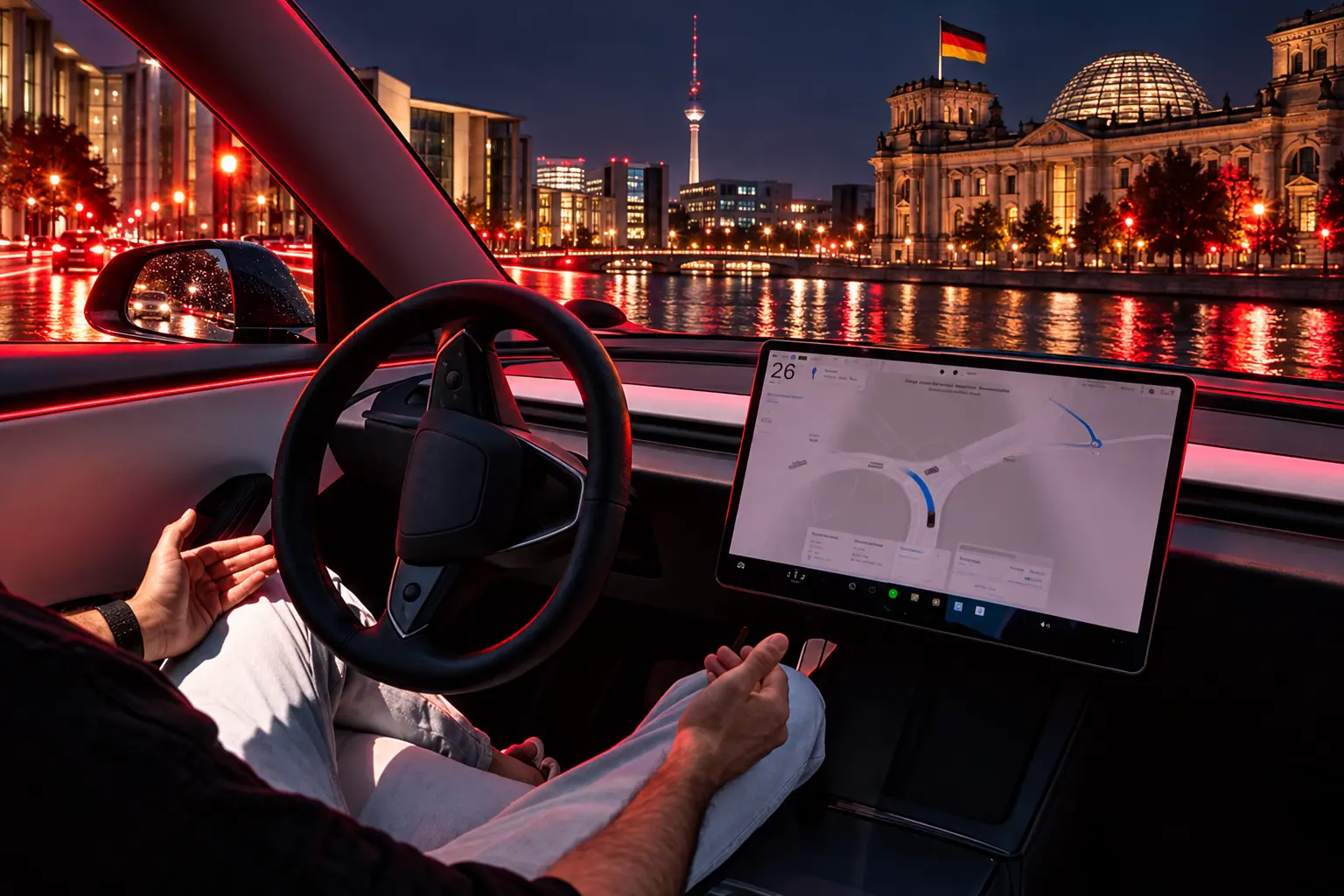
A Tesla onboarding clip that now circulates with the new name was filmed on public streets in Berlin, including the A113 toward the airport, and the display in that footage shows a 10% max speed offset. That is how a carmaker prepares a market it still cannot sell into. German drivers who want the button are still waiting. The ministry got the name. Tesla got a minister. Brussels still has the vote.

Cook Hands Democrats the House as Crypto’s Bill Stays Dead

Wicker’s Broken Bed Was the Short Story’s Punch Line

Nvidia’s $500 Billion Financing Plan Draws a $180 Sell

Maserati Bets the Grecale V6 Can Fill Porsche’s Gap

EV Cable Theft Follows the Old Railway Copper Playbook

Aramco Crash Kills 14 Two Days After Oil Restart

Salah Captained Egypt to Their First World Cup Win

Zelda’s 40th Switch 2 Ships Without a Zelda Game

Apple Labor Day Deals Hide June’s Memory Price Hike

Palworld 1.0.4 Adds Palpedia Search After the 1.0 Launch
-
 BUSINESS4 months ago
Aramco Crash Kills 14 Two Days After Oil Restart
-
 NEWS5 months ago
Salah Captained Egypt to Their First World Cup Win
-
 GAMING2 months ago
Zelda’s 40th Switch 2 Ships Without a Zelda Game
-
 NEWS2 months ago
Apple Labor Day Deals Hide June’s Memory Price Hike
-
 GAMING2 months ago
Palworld 1.0.4 Adds Palpedia Search After the 1.0 Launch
-

 NEWS4 months ago
El Niño Puts Israel’s Needed Winter Rain on a Flood Clock
-

 BUSINESS8 months ago
BAE’s 60-Year Saudi Franchise Now Runs Through Taif
-

 BUSINESS8 months ago
Egypt Bets EGP 638 Billion Can Open Sinai to Investors