
NEWS
Google Bets Free Gemini Users Will Trust Auto Routing
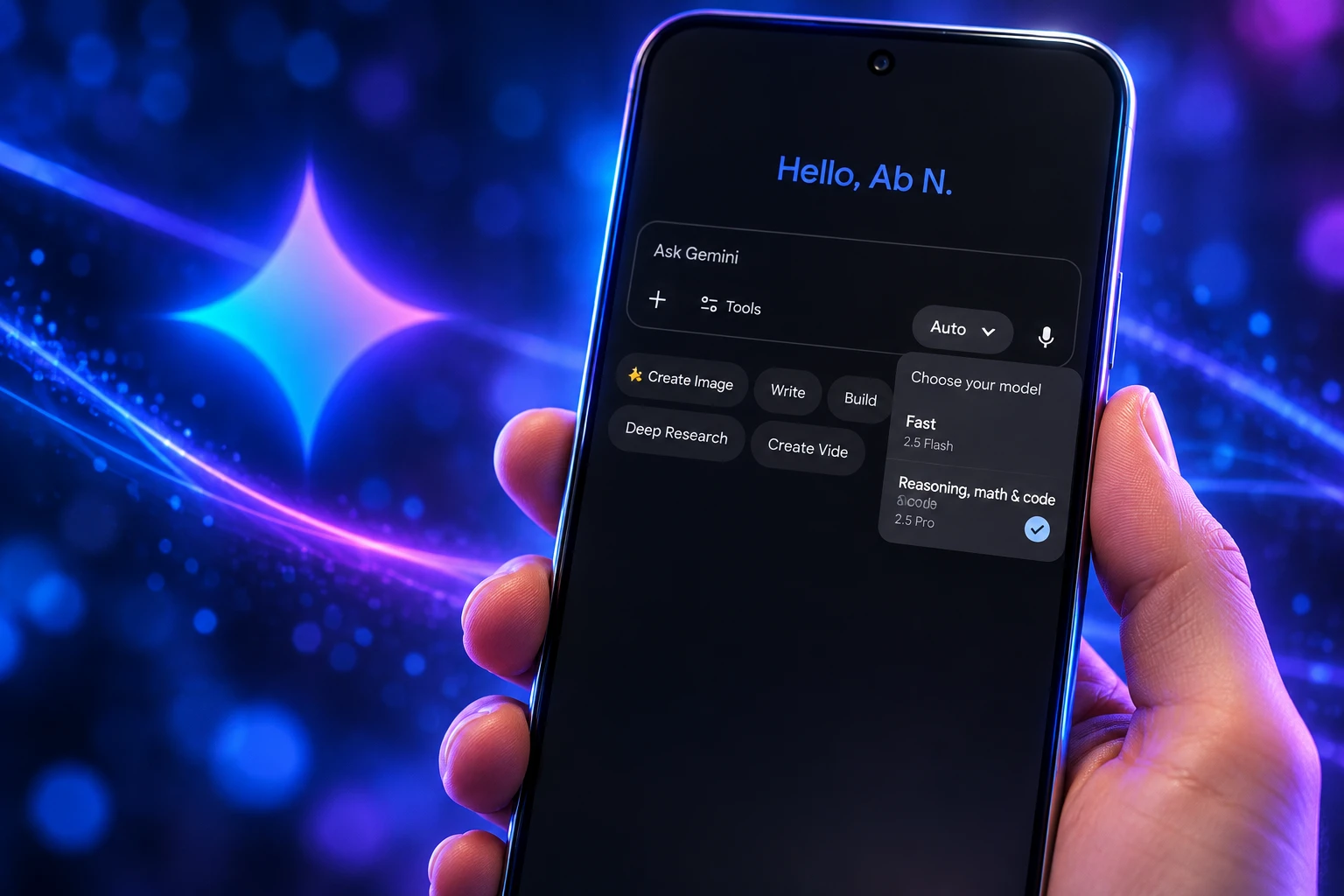
Google replaced free Gemini’s model picker with Auto, which sends most prompts to Flash-Lite. The only manual option left is the cheapest engine.

Google’s Gemini app now shows a single Auto option on free personal accounts, and most of those prompts go to Flash-Lite.
The change started reaching accounts on October 9, 2026. Auto can still send a harder question to Flash or Pro. Free users cannot pick those models, and turning smart selection off locks every reply on Flash-Lite. That is the wager: keep Auto on, or live with the cheapest engine.
Only Auto in the Free Picker
Google’s Gemini Apps help page says model availability for personal accounts changes in October 2026, and that the no-plan cutover begins on October 9. Accounts on Google AI Plus get an email with their own date instead of that Friday switch.
On a free account the old Flash / Pro menu is gone. The remaining row is Auto, and the in-app label calls it Gemini 3 models. Last week the same help page still described the free engine as Flash-Lite. The live page now describes a router, not a single named model you can tap.
An early version of that document read as a hard cap: no plan, Flash-Lite only. By October 10 the page had been rewritten around Auto. The picker people actually see matches the rewrite. Clearing cache, swapping phones, or reinstalling the app does not bring Flash and Pro back as choices. It is a plan rule.
Google Routes Most Prompts to Flash-Lite
Google’s current wording is blunt about where the traffic goes, and vague about the upgrades.
Gemini will use auto model selection to send each prompt to the Gemini model that suits it best. Most prompts will go to Flash-Lite, our fastest model. Prompts that need deeper reasoning may go to Flash or Pro.
Gemini Apps Help, Google
The help page on auto model selection for each prompt does not say how it scores “deeper reasoning,” and it does not publish a share for Flash versus Pro. Free users still reach the bigger engines only if the router decides they should.
That is a different product from the one people had when they could pin Pro for a contract, a spreadsheet, or a long PDF. Everyday chat still gets an answer. The job that used to start with a deliberate model tap now starts with a guess.
Google also never prints the chosen model on the reply. If an answer feels thin, there is no badge that says Flash-Lite missed it, and no badge that says Pro actually ran. The quality of the free tier becomes something you feel, not something you can check.
What Happens If You Turn Auto Off?
The app still offers a way to stop the router. It does not hand the old menu back.
Google says that if smart model selection is turned off, chats for users without an AI plan use Flash-Lite for all responses. There is no hidden Pro path in that setting. The off position is a lock, not a preference panel.
That is the trap already circulating among people who wanted to “force” a better model. They flip the switch, the replies get shorter or flatter, and they have just volunteered for the cheapest engine on every turn. The only remaining way for a free account to see Flash or Pro is to leave Auto on and hope the router agrees the prompt is hard.
Power users asked for a smaller ask than the old picker: put the model name on the answer. Auto can stay. The black box is the part that makes a weak reply impossible to debug. Google has not added that label.
Google AI Plus Loses the Pro Model
The free picker is the loud change. The paid ladder moves with it, just not all on October 9.
After the new rules reach an account, Google’s help table is simple. No plan gets Auto. Google AI Plus, $4.99 a month in the US, keeps Flash-Lite and Flash and drops Pro. Google AI Pro, $19.99 a month, keeps Flash-Lite, Flash, and Pro. Google AI Ultra, from $99.99 a month, keeps the same three models and a higher cap. Pro is now the cheapest plan that still lets you tap the top chat model on purpose.
WHAT EACH GEMINI PLAN CAN PICK
| Plan (US list price) | What you pick in the app | Usage vs. no plan |
|---|---|---|
| No AI plan ($0) | Auto only | Standard |
| Google AI Plus ($4.99/month) | Flash-Lite and Flash; no Pro after the emailed date | 2x |
| Google AI Pro ($19.99/month) | Flash-Lite, Flash, and Pro | 4x |
| Google AI Ultra (from $99.99/month) | Flash-Lite, Flash, and Pro | 5x or 20x vs. AI Pro |
Plus subscribers should not treat October 9 as their Pro-off date. Google says it will mail each of them the day the change hits that account. Until the mail arrives, some Plus users still see Pro; after it, they should not. Google’s public subscriptions marketing has been slower to catch up than the help page, so the help table is the rule that matches the picker.
Anyone who wants the old three-model menu back has to subscribe or change a Google AI plan. Plus restores a picker, but not Pro. The jump that restores Pro is AI Pro.
OpenAI Already Killed Its Free Router
Automatic routing is not a new idea in consumer chat. OpenAI shipped one with GPT-5 in August 2025, then spent the rest of that year walking pieces of it back.
The Router That Cost Too Much
The first week was a revolt. OpenAI had pulled older models, the autoswitcher broke on launch day, and GPT-5 looked slow and dull to people who wanted a specific voice. Within days the company restored a picker, brought back GPT-4o for paying users, and split GPT-5 into Auto, Fast, and Thinking so people could go around the router.
The deeper problem showed up later. Sam Altman, OpenAI’s chief executive, said the router raised reasoning-model use among free users from under 1 percent to 7 percent. That was billed as a quality win. It was also a bill. Reasoning models take longer and cost more to run. In December 2025 OpenAI turned the router off for Free and $5 Go accounts and sat those users on GPT-5.2 Instant, the fastest and cheapest model in that family. Reasoning is still there if they pick it by hand. OpenAI said those tiers preferred the default chat, with the slower path as an opt-in.
Chris Clark, chief operating officer at the inference firm OpenRouter, put the consumer side in one line.
If somebody types something, and then you have to show thinking dots for 20 seconds, it’s just not very engaging.
Chris Clark, chief operating officer, OpenRouter
Google’s Router Spends the Other Way
OpenAI’s free router upgraded too many people, then got removed. Google’s free Auto is built to do the opposite. Most prompts go to Flash-Lite. The upgrade to Flash or Pro is optional, silent, and unpaid. If you reject the router, you do not get Instant-plus-a-manual-Pro-button. You get Flash-Lite forever.
That is why this bet can survive a week of grumbling that would have killed a picker-delete at OpenAI. The punishment for opting out is worse than the black box. Google is not asking free users to love Auto. It is asking them to dislike the alternative more.
The split inside Google’s own tools makes the consumer choice sharper. In the Gemini chat app, free personal accounts lost the menu. In Google’s Antigravity coding agent, a model selector under the prompt box still lets people pick a reasoning model, including Gemini 3.1 Pro on the free Antigravity plan. Chat is where the company hid the names. The developer surface still shows them.
Three Effort Levels, Same Hidden Engine
While the free picker vanished, Google added a control that looks like a thinking dial. Low, medium, and high effort replace the old Extended toggle and are rolling out to subscribers as well as free accounts. The in-app glosses are “Quick and efficient,” “Balanced depth,” and “Extra thorough.”
THE NEW EFFORT LEVELS
- Low: Quick and efficient, aimed at speed.
- Medium: Balanced depth, the middle setting.
- High: Extra thorough, and it spends more of the account’s limit.
Google’s help page is clear on the trade. A higher effort level can make a model finish harder tasks and write fuller answers, and it also uses more of your limit. On a free account that limit is the standard cap. High effort on Flash-Lite is still Flash-Lite thinking harder. It does not summon Pro.
The same three rungs already exist for developers as low, medium and high thinking levels in Google AI Studio. There, Gemini 3.5 Flash-Lite defaults to a minimal think setting, while larger Flash builds default to medium. The consumer app is borrowing that language. It is not borrowing the Studio habit of naming the model next to the dial.
So free users can tell Gemini how hard to think, and they still cannot tell it which brain to use. Effort is a spend knob on whatever Auto already chose.
Pixel Trials End on the Cheap Model
The people who will feel the drop first are not the ones who never opened the picker. They are the ones who spent a month on a Pixel, or on a laptop trial, talking to Pro without paying for AI Pro. When the trial ends, the account falls back to Auto. Most of those chats then land on Flash-Lite. The app still says Gemini. The replies will not.
That hangover sits on a cap Google already tightened. Compute-based limits for users 18 and over began on May 17, 2026, and the same rules reached under-18 accounts on July 24, 2026. Usage now factors in prompt complexity, features, and chat length, and the allowance refreshes every 5 hours until a weekly ceiling. Paid plans sit above the free cap. Premium work burns the bar faster: image, video, and music generation, Deep Research, the Pro model, and Deep Think.
THE GEMINI ACCESS CALENDAR
- May 17, 2026: Compute-based limits begin for Gemini Apps users over 18.
- July 24, 2026: The same limits reach users under 18.
- October 9, 2026: Personal accounts with no AI plan move to Auto in the Gemini app.
- Date in the Plus email: Google AI Plus loses Pro and keeps Flash-Lite and Flash.
THE COMPUTE CAP
- Refresh window: Limits refill every 5 hours until the weekly ceiling.
- What counts: Prompt hardness, features used, and chat length all draw down the bar.
- Faster burn: Media generation, Deep Research, Pro, and Deep Think spend the cap sooner than a short Flash-Lite chat.
- Paid headroom: Plus is 2x the free cap, Pro is 4x, and Ultra is 5x or 20x AI Pro, depending on the Ultra tier.
October 9 did not invent the idea that free Gemini is a funnel. It changed the lever. May’s change rationed how much you could run. This one rations which engine you are allowed to ask for. Flash-Lite still answers the easy questions, so the app does not go dark. The upgrade path is a maybe, and the off-switch is a demotion.
OpenAI learned that a free router which spends up is hard to keep. Google is testing a free router that spends down, with no model name on the reply and no decent manual escape. Until the app prints which engine answered, a flat response on a free account has no audit trail, and Auto remains a bet that most people will not bother to keep score.

Cook Hands Democrats the House as Crypto’s Bill Stays Dead

Wicker’s Broken Bed Was the Short Story’s Punch Line

Nvidia’s $500 Billion Financing Plan Draws a $180 Sell

Maserati Bets the Grecale V6 Can Fill Porsche’s Gap

EV Cable Theft Follows the Old Railway Copper Playbook

Aramco Crash Kills 14 Two Days After Oil Restart

Salah Captained Egypt to Their First World Cup Win

Zelda’s 40th Switch 2 Ships Without a Zelda Game

Apple Labor Day Deals Hide June’s Memory Price Hike

Palworld 1.0.4 Adds Palpedia Search After the 1.0 Launch
-
 BUSINESS4 months ago
Aramco Crash Kills 14 Two Days After Oil Restart
-
 NEWS5 months ago
Salah Captained Egypt to Their First World Cup Win
-
 GAMING2 months ago
Zelda’s 40th Switch 2 Ships Without a Zelda Game
-
 NEWS2 months ago
Apple Labor Day Deals Hide June’s Memory Price Hike
-
 GAMING2 months ago
Palworld 1.0.4 Adds Palpedia Search After the 1.0 Launch
-

 NEWS4 months ago
El Niño Puts Israel’s Needed Winter Rain on a Flood Clock
-

 BUSINESS8 months ago
BAE’s 60-Year Saudi Franchise Now Runs Through Taif
-

 BUSINESS8 months ago
Egypt Bets EGP 638 Billion Can Open Sinai to Investors