
NEWS
Telegram Opens the Money Wallet for Gram Transfers
Telegram is putting Gram back in chat with Money, a built-in wallet, six years after the SEC halted the original token sale. GRAM rose 9%.

GRAM jumped 9% to $1.56 on Friday, October 9, after Walt said Telegram is rolling out Money, its built-in Gram wallet. The token’s market cap printed $4.12 billion in the same session, while 24-hour trading volume rose 41% to $132.4 million.
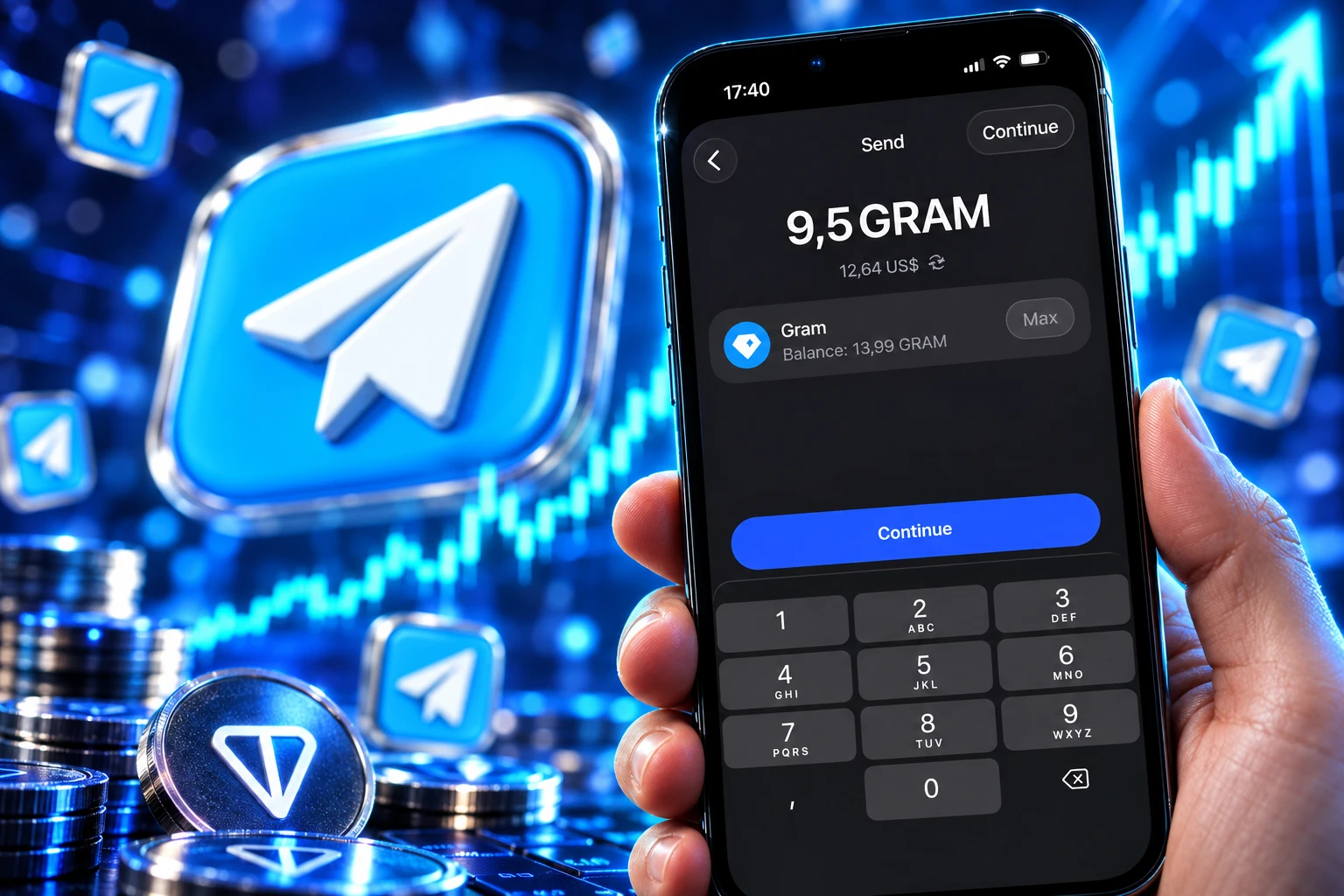
Money is a non-custodial wallet for sending Gram, buying gifts, and purchasing collectible usernames inside the messenger. Walt, which posted the update, said Telegram is opening it more widely across an audience of more than one billion people. The 2018 version of this idea never reached those chats.
Telegram Opens the Money Wallet Across a Billion Chats
Walt said the product used to sit with only some Telegram accounts. It now carries the name Money, and Telegram is rolling it out widely inside the app. Users can store and send Gram, and they can spend it on gifts and collectible usernames that already live in Telegram’s digital shop.
The Money section does not sit in settings waiting to be tapped. Walt said it appears once someone sends you a transfer. After that, a user can top up Money from Walt in a few taps. Those top-ups are described as instant and as carrying zero network fees.
That is the official split in one line from Walt: Money for Gram, Walt for the rest of a portfolio.
Telegram is launching its wallet for everyone
It used to be available to only some @telegram users. Now the wallet is called Money, and Telegram is rolling it out widely inside the messenger to its audience of over a billion people.
💎Money is Telegram’s non-custodial wallet… pic.twitter.com/0XGy03FsP7
— Walt (@walt_io) October 9, 2026
Access is still a rollout, not a completed switch. Walt’s Friday post pointed at a billion-person audience, and it also said the screen itself waits on that first incoming transfer. Feature availability can still vary by account.
The Gram Name the SEC Shut Down
Gram is not a new coin. It is the name Telegram put on its token in 2018, then lost, then took back this year. Money is the in-app rail that original plan never got to run.
A $1.2 Billion Refund Closed the First Sale
In 2018 Telegram sold about 2.9 billion Grams to 171 initial purchasers and raised about $1.7 billion for a network then called the Telegram Open Network. The U.S. Securities and Exchange Commission treated that sale as an unregistered securities offering. It filed a complaint on October 11, 2019 to stop delivery of the tokens.
On March 24, 2020, the U.S. District Court for the Southern District of New York issued a preliminary injunction that barred delivery of Grams. Telegram later dropped the project. On June 26, 2020, the SEC said a court had approved settlements with Telegram Group Inc. and TON Issuer Inc.
The judgment ordered the defendants to return more than $1.2 billion to investors, with the disgorgement figure set at $1,224,000,000, and ordered Telegram Group Inc. to pay an $18.5 million civil penalty. Telegram did not admit or deny the allegations. For three years after that judgment it also had to give the SEC notice before taking part in any digital-asset issuance.
New and innovative businesses are welcome to participate in our capital markets but they cannot do so in violation of the registration requirements of the federal securities laws.
Kristina Littman, Chief of the SEC Enforcement Division’s Cyber Unit, June 26, 2020
Toncoin Carried the Chain Until June
Independent developers kept the open-source code alive as The Open Network. They ran the token as Toncoin, a label that put distance between the live chain and the Gram name the SEC had taken to court. Telegram stayed at arm’s length for years, then moved back in 2026 as the network’s largest validator, in May, under Pavel Durov’s “Make TON Great Again” plan.
A community vote on TON Vote ran from June 1 to June 8, 2026. The TON blockchain account posted the result with 81.22 percent voting in favor of renaming Toncoin to Gram and changing the ticker from TON to GRAM. The change took effect at 12:00 UTC on June 15, 2026. The chain kept the name The Open Network. Balances, addresses, contracts, NFTs, and staking did not move. There was no swap.
That legal wrapper is not the 2018 sale. Money does not issue a new Gram to fund Telegram. It puts an already-trading token into the chat box. The consumer idea is the part that returned.
THE GRAM PATH BACK INTO TELEGRAM
- 2018: Telegram sells about 2.9 billion Grams to 171 purchasers and raises about $1.7 billion.
- October 11, 2019: The SEC files a complaint seeking to block delivery of Grams.
- March 24, 2020: A New York federal court enjoins delivery of the tokens.
- June 26, 2020: Settlement requires a $1.224 billion disgorgement and an $18.5 million penalty.
- May 2026: Telegram becomes the network’s largest validator.
- June 15, 2026: Toncoin is renamed Gram after an 81.22% community vote.
- July 21, 2026: Durov pledges a native non-custodial Gram wallet for more than a billion users.
- September 28, 2026: Wallet in Telegram is renamed Walt.
- October 9, 2026: Walt says the built-in wallet, now called Money, is rolling out more widely.
Each of those steps left the same ambition on the table: make Gram as easy to send as a chat. Money is the first time the messenger itself is the wallet for that job.
Pavel Durov’s Summer Promise Hits the App
Durov did not wait until October to describe the scale. On July 21, 2026, the Telegram founder said the company would bring a native non-custodial Gram wallet to every Telegram app that summer, and he called it the largest rollout of a non-custodial wallet yet attempted.
This summer will see the largest rollout of a non-custodial crypto wallet in human history. Instant zero-fee crypto transactions for over a billion users are about to become reality. We’re bringing a native non-custodial Gram wallet to every Telegram app!
Pavel Durov, Telegram founder, on X, July 21, 2026
The earlier steps in his 2026 plan were technical. The network got a speed upgrade described as about 10 times faster, with finality pushed toward a second, and fees cut about sixfold. The validator takeover and the Gram rename sat on top of that. Money is the piece a regular user can see without reading a roadmap.
Friday’s wider release is that summer pledge arriving as a named product, not as a finished install on every phone. Walt is still the place that sells a broader book of assets. Money is the chat-native wallet Durov promised would not ask people to download a separate crypto app.
How Money Turns a Chat Into a Transfer
Telegram’s own interface copy tells a user to open the attachment menu, choose Money, and send Gram to the person in the chat. That is a payments path, not a trading screen. The point is to make a Gram transfer sit next to a photo, a file, or a location pin.
WHAT MONEY DOES IN THE APP
- Hold Gram: The wallet stores the TON chain’s native token, now ticker GRAM, under the user’s own keys.
- Send in chat: A transfer starts from the attachment menu inside a conversation, and Walt describes those sends as instant.
- Spend on Telegram goods: Money is built to buy gifts and collectible usernames already sold inside the messenger.
- Top up from Walt: After the first incoming transfer, a user can fund Money from Walt with no network fee on that hop.
- Wait on a first send: The Money section appears once someone sends you a transfer, so a dark wallet stays dark until that payment lands.
Self-custody is the trade. Users keep the keys, which means a wrong address or a lost recovery phrase is on them, not on Telegram as a custodian. Walt’s Friday note did not publish a full regional timetable, and it did not say every account already sees the tab.
Walt Stays the Separate Trading App
Money is not a replacement for Telegram’s wider crypto desk. On September 28, 2026, Wallet in Telegram became Walt. That product still handles buying, selling, and a longer asset list. Money takes the simple Gram payment. Walt keeps the rest.
Andrew Rogozov, founder of The Open Platform, which runs Walt, set that line in advance. The split is written into Walt’s September product split letter: Gram Wallet as the simple entry point, Walt as the larger platform reached through @walt.
MONEY VERSUS WALT
| Feature | Money | Walt |
|---|---|---|
| Job in Telegram | In-chat Gram payments and collectibles | Trading and a wider portfolio |
| Custody | Non-custodial | Custodial services plus a separate DeFi wallet |
| What it holds | Gram, gifts, collectible usernames | More than 300 assets, including Bitcoin, Ethereum, Solana, tokenized stocks, metals, perpetuals, and Earn programs |
| How it opens | Appears after an incoming transfer | Through @walt, after the September 28 rename |
| Move between them | Top-ups from Walt, instant, zero network fees | Sends Gram into Money for chat use |
The two apps also differ in who they ask a user to trust. Money puts keys with the person holding the phone. Walt still offers custody for people who want a broader book without running their own keys on every asset. That is why a first Money screen can show that funds still sit in Walt: the bridge is the product.
GRAM’s 9% Jump and a $4.12 Billion Cap
Friday’s tape moved with the wallet news, then stopped being the story. GRAM last traded as Toncoin until June 15. The 9% session took it to $1.56 and lifted the cap to $4.12 billion. Volume of $132.4 million, up 41%, was the sharper tell that traders showed up for the headline.
FRIDAY’S GRAM PRINT
- Price: $1.56, up 9% on October 9.
- Market cap: $4.12 billion, also up 9% with the session.
- Volume: $132.4 million, up 41% over 24 hours.
- Trigger: Walt’s Money rollout post, not a new token issue.
A one-day bounce does not measure whether a billion chats will send Gram. It measures that a liquid token still reprices when Telegram puts the asset in the attachment menu. The rename in June already told holders they did not need to swap anything. Money tells them they may not need a separate exchange tab to move it to a contact.
That is the distribution change exchanges cannot copy. A user can receive Gram inside Telegram, see Money appear, and keep the keys. Walt remains the on-ramp if they want to buy first. The 9% is the market’s first look at that loop, not proof the loop will stick.
The Wallet Only Opens When a Friend Pays You
The design choice that will decide whether Money stays a demo is the on-switch. Walt said the section appears once someone sends you a transfer. That turns a first Gram payment into both a chat and an activation. It also means a user who never receives Gram never sees the wallet, even if the app update is on the phone.
People already using the feature treated that gate as the growth loop. They sent small amounts of Gram to contacts so the tab would light up, then those contacts could send the next hop. The mechanic is slower than flipping a server flag for a billion accounts, and it writes a real on-chain payment every time a new wallet wakes. Sending Gram is meant to feel like sending a photo, which is the test the 2018 project never got to run inside the live app.
WHAT WE KNOW
- The product: Money is Telegram’s non-custodial wallet for Gram, gifts, and collectible usernames.
- The gate: The Money section appears after an incoming transfer, per Walt on October 9.
- The desk: Walt remains the separate app for more than 300 assets and for funding Money at zero network fee.
WHAT IS UNCONFIRMED
- The timetable: Walt did not publish a full regional calendar or a date when every account will see Money with no first transfer.
- The default: It is not confirmed that Telegram will later switch the wallet on for users who never receive Gram.
- The conversion: There is no public figure yet for how many of the billion-plus accounts will fund or reuse the wallet.
Friday’s 9% move priced the headline that Gram is back in the attachment menu. The unfinished part is the same part that failed in 2020, only inverted: the token already trades, the chain already runs, and the messenger still has to make a first incoming payment land on enough accounts for Money to look like money.
Disclaimer: This article is news reporting and analysis of Telegram’s Money wallet rollout and the GRAM token’s October 9 market move. It is informational only and is not investment, trading, tax, or legal advice, and it is not a recommendation to buy, sell, or hold GRAM or any other digital asset. Readers should consult a qualified financial adviser and, where needed, a securities lawyer before acting on anything described here, including in-app transfers and self-custody. Prices, product access, and legal status reflect the cited company posts, market prints, and agency records as of the dates named above and can change with the rollout and with trading.

Cook Hands Democrats the House as Crypto’s Bill Stays Dead

Wicker’s Broken Bed Was the Short Story’s Punch Line

Nvidia’s $500 Billion Financing Plan Draws a $180 Sell

Maserati Bets the Grecale V6 Can Fill Porsche’s Gap

EV Cable Theft Follows the Old Railway Copper Playbook

Aramco Crash Kills 14 Two Days After Oil Restart

Salah Captained Egypt to Their First World Cup Win

Zelda’s 40th Switch 2 Ships Without a Zelda Game

Apple Labor Day Deals Hide June’s Memory Price Hike

Palworld 1.0.4 Adds Palpedia Search After the 1.0 Launch
-
 BUSINESS4 months ago
Aramco Crash Kills 14 Two Days After Oil Restart
-
 NEWS5 months ago
Salah Captained Egypt to Their First World Cup Win
-
 GAMING2 months ago
Zelda’s 40th Switch 2 Ships Without a Zelda Game
-
 NEWS2 months ago
Apple Labor Day Deals Hide June’s Memory Price Hike
-

 NEWS4 months ago
El Niño Puts Israel’s Needed Winter Rain on a Flood Clock
-
 GAMING2 months ago
Palworld 1.0.4 Adds Palpedia Search After the 1.0 Launch
-

 BUSINESS8 months ago
BAE’s 60-Year Saudi Franchise Now Runs Through Taif
-

 BUSINESS8 months ago
Egypt Bets EGP 638 Billion Can Open Sinai to Investors