
AUTO
The 2026 Lexus ES Hybrid Now Does Flagship Work
The 2026 Lexus ES 350h adds 40.7 inches of rear room and 46 mpg after Lexus parked the LS, then spent a spring with almost no cars to sell.

The 2026 Lexus ES 350h now sells from $51,095 with 40.7 inches of rear legroom, more than the LS flagship it is replacing in U.S. showrooms. Lexus paused that bigger sedan after a 250-car send-off, then spent a spring with almost no ES cars to hand over.
The hybrid is the version most ES buyers still want. Lexus just did not put it in stock first.
The Flagship Sedan Is Down to 250 Copies
Lexus told U.S. dealers that 2026 is the last model year for the current LS. The only new one you can order is the LS 500 Heritage Edition, 250 cars at $99,280. The LS 500h hybrid already ended after 2025.
That is not a pause in a busy line. U.S. LS sales were 1,082 in 2025, half of 2,163 the year before, and 150 from January through September 2026. The nameplate has not cleared 10,000 American cars in a year since 2013. Its best year on the books was 35,226 in 2007.
THE SEDAN LEDGER LEXUS LEFT BEHIND
- LS, 2025: 1,082 U.S. sales, down 50 percent from 2,163.
- Heritage Edition: 250 copies, $99,280, the only new LS sold here.
- ES, 2025: 39,926 U.S. sales, still the brand’s volume passenger car.
- Rear seat: 40.7 inches in the new ES, 38.9 inches in the LS 500.
The ES was never supposed to replace a flagship. It just inherited the rear-seat job, because the LS no longer has a U.S. successor on the lot.
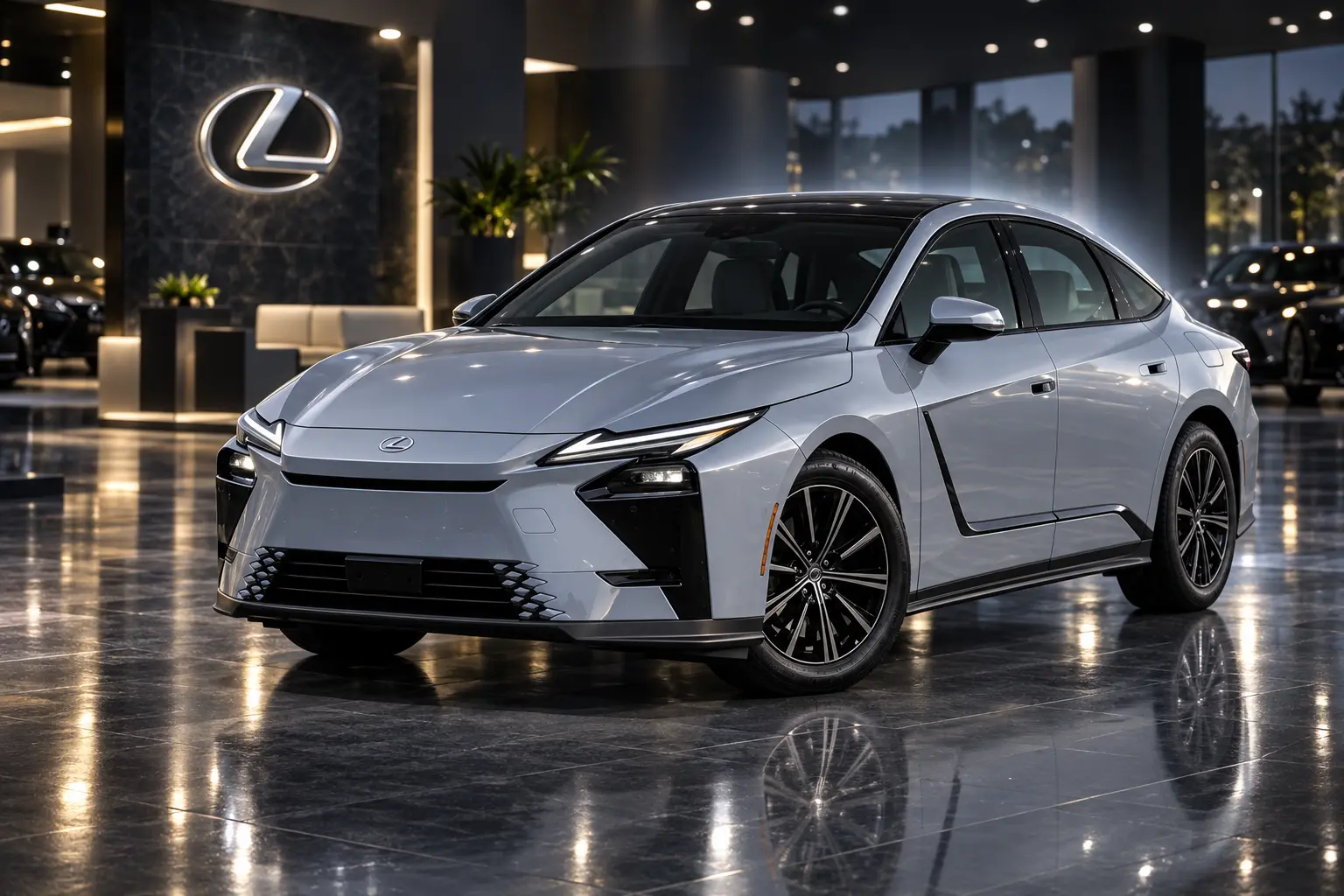
Lexus Split the ES Between Plug and Pump
Every 2026 ES shares one body and Lexus’s first multi-pathway platform, an evolution of the old TNGA-K architecture that can take a hybrid pack or a floor battery. The electric cars reached stores in April. The hybrid, using the brand’s first sixth-generation hybrid system, was due in June at a $49,700 base MSRP before a $1,395 destination fee.
Lexus.com now lists eight ES trims starting at $48,895, destination included. The cheapest car is the front-drive ES 350e, not the hybrid. That is the sequence that emptied the sedan pipeline.
2026 ES STICKER, POWER, AND EPA
| Trim | MSRP with dest. | Power | EPA combined | 0-60 (Lexus) |
|---|---|---|---|---|
| ES 350e Premium | $48,895 | 221 hp, FWD | 307 miles (19-in wheels) | 7.4 sec |
| ES 500e Premium AWD | $51,895 | 338 hp, AWD | 276 miles (19-in wheels) | 5.1 sec |
| ES 350h Premium | $51,095 | 244 hp, FWD | 46 mpg | 7.3 sec |
| ES 350h Premium AWD | $52,495 | 244 hp, AWD | 44 mpg | 7.1 sec |
| ES 350h Premium+ | $55,895 | 244 hp, FWD | 46 mpg | 7.3 sec |
| ES 350h Premium+ AWD | $57,295 | 244 hp, AWD | 44 mpg | 7.1 sec |
Luxury EV trims run $57,295 for the 350e and $60,295 for the 500e. Both electric cars share a 74.7-kWh battery. The 350e’s 307-mile EPA-estimated driving range falls to 292 miles on 21-inch wheels; the 500e is rated 276 or 272 miles the same way.
The hybrid is not a plug-in. A 2.5-liter four, now 186 hp and 173 lb-ft, works with a 201 hp front motor through a CVT. All-wheel drive, offered on an ES hybrid for the first time, adds a 54 hp rear e-Axle. Combined output is 244 hp either way, up from 215 hp on the front-drive-only 2025 ES 300h. Lean on the throttle and the gas engine comes back. Chris Davies, who drove a Premium+ AWD, called that electric-only window tiny.
Sales Fell to 183 Cars, Then Climbed Back
The seventh-generation ES was built in Georgetown, Kentucky from 2015. Toyota North America said the last U.S.-built car left that plant on February 20, 2026, after 438,133 units, a $350 million line, and 3,750 jobs. All 2026 ES 350h, 350e, and 500e cars now come from Toyota Motor Kyushu in Japan.
Old stock ran out before the new cars showed up in volume. U.S. ES sales, 39,926 in 2025 and 43,156 in 2024, fell to 10,333 from January through September 2026, down 65.3 percent from 29,788 in the same stretch a year earlier.
THE KENTUCKY TO KYUSHU HANDOFF
- February 20, 2026: The last U.S.-built ES leaves Georgetown after 438,133 cars.
- March 18, 2026: Lexus says the electric ES is on sale, with the hybrid still to come.
- April 2026: ES 350e and ES 500e are due in stores; monthly U.S. sales hit 183, the year’s floor.
- May 1, 2026: Lexus prices the 350h and points to a June arrival.
- June 2026: Hybrid dual-path cars are due; June sales are 331, down 89.3 percent from 3,089 a year earlier.
- August 2026: Deliveries rebound to 2,983, then 3,077 in September.
April through July never cleared 400 cars. That is a factory gap, not a verdict on 40.7 inches of rear seat. Once Kyushu volume and the hybrid landed, monthly sales sat close to the 3,000-to-4,000 band the old car occupied through 2025. Dealers in early October were already handing over 350h hybrids and 500e EVs, including a Peoria handover of a 350 hybrid.
How Much Rear Seat Did Lexus Add?
Lexus stretched the ES 3.1 inches in wheelbase, to 116.1 inches, and added 6.5 inches of length, 2.2 inches of width, and 4.5 inches of height. Rear legroom rose 1.4 inches, to 40.7. Front headroom is up 0.8 inch and rear headroom 0.4 inch. Hip points sit higher, so you drop in less.
The LS 500, on a 123-inch wheelbase and 206.1 inches long, still gives 38.9 inches in back. The new ES has 1.8 inches more rear legroom than the car that launched Lexus in 1989, at roughly half the Heritage Edition’s price.
REAR LEGROOM IN THE CLASS LEXUS JUST REWROTE
| Model | Rear legroom | Gap vs ES |
|---|---|---|
| 2026 Lexus ES | 40.7 in | – |
| Lexus LS 500 | 38.9 in | 1.8 in less |
| Genesis G80 | 38.7 in | 2.0 in less |
| BMW 5 Series | 37.0 in | 3.7 in less |
Davies put two adults in the second row and called it capacious. The electric Luxury trim can go further: an Executive package, 350e Luxury only, adds power, heat, ventilation, and massage for the outboard rear seats, plus a passenger-side ottoman. That is chauffeur kit on a car whose base electric sticker is $48,895.
The trade is the trunk. Hybrid cargo is 13.3 cubic feet, with the hybrid battery under the rear seat. Electric models bury the pack in the floor and pick up a smoother nose, a 0.25 drag figure, and a charge door on the passenger fender.
46 MPG Puts Genesis on a Costly Diet
The front-drive 350h is rated 48 mpg city, 44 highway, and 46 mpg combined and $1,800 a year in fuel on the EPA’s 15,000-mile mix. All-wheel drive is 47, 42, and 44 mpg, about $1,850 a year. Tailpipe CO₂ is 191 grams per mile on FWD and 200 on AWD. The EPA lists premium gasoline as recommended.
Davies saw 41 mpg in mixed driving, short of the window sticker and still a large step on a 23 mpg combined Genesis G80 2.5-liter turbo four. That G80 2.5T AWD starts at $59,945, $8,850 above the 350h Premium. At those ratings the Lexus uses about half the fuel.
WHAT THE EPA PUTS ON THE 350H WINDOW
- FWD sticker: 48 city, 44 highway, 46 combined, $1,800 a year.
- AWD sticker: 47 city, 42 highway, 44 combined, $1,850 a year.
- Five-year save: $3,000 versus the 28 mpg 2026 average car, per the FWD label.
- Petroleum: 6.5 barrels a year on FWD, 6.8 on AWD.
Lexus quotes 7.3 seconds to 60 mph for the front-drive hybrid and 7.1 for AWD. The 350e is listed at 7.4 seconds, the 500e at 5.1. Nobody is selling this as a sports sedan. Drive modes exist, including Sport, and they live in the touchscreen. The suspension is a conventional tune, fine in corners, a bit firm over broken pavement. The electric motors get the car moving, then the four-cylinder joins without a lot of drama.
The Cabin Looks Like a Spa and Feels Like Plastic
This is where the eighth-generation car stops borrowing from the old ES. A 14-inch Lexus Interface screen is standard. So is a 12.3-inch driver display set in a backlit, suede-like nook. Climate keys glow through a bar across the dash and actually click. A volume knob remains. Premium+ adds a head-up display, a digital rearview mirror, a 360-degree camera, and a 17-speaker, 1,800-watt Mark Levinson PurePlay system. Premium keeps a 10-speaker set.
The somewhat fussy aesthetic of the old ES dashboard is replaced by clean lines fit for a Japanese spa, with careful detailing that certainly looks the part.
Chris Davies, road tester, SlashGear
Seats are NuLuxe on hybrid trims, with semi-aniline leather on electric Luxury. Wavelength blue and Copper Crest red are new paints. Standard kit on every hybrid includes 19-inch alloys, rain-sensing wipers, a power trunk lid, heated and ventilated front seats, and Lexus Safety System+ 4.0: adaptive cruise, lane alerts with steer assist, Proactive Driving Assist, pre-collision with pedestrian detection, auto high-beams, blind-spot alerts, and rear cross-traffic warnings.
WHERE THE NEW CABIN STILL NICKS THE OLD LEXUS HABIT
- The wheel: It now spells L E X U S in the new font; the old L badge is gone.
- The screens: 14 inches plus 12.3 inches is the whole dashboard argument, and it still looks oversized to people who wanted wood and buttons.
- The latches: Electronic door releases confuse first-time passengers, then become normal.
- The switchgear: Pieces that look like metal are usually plastic once you touch them.
That last point is the budget showing. Davies said the car never feels flimsy, and he also said more than half the luxury fight is looking the part. Longtime owners keep circling the same complaint: the cabin now reads like a Tesla-era board, not a Lexus dashboard. The stacked screens drew that reaction as soon as the car was revealed in April 2025, and it has not faded.
Electric models add a native NACS port, a CCS adapter, an 11-kW onboard charger that Lexus says can fill in about 7 hours on Level 2, and DC charging up to 150 kW, about 28 minutes from 10 to 80 percent in ideal conditions. Lexus bundles the adapter so the car can use more than 76,000 public charging stations.
August’s 2,983 sales and September’s 3,077 are the first months that look like an ES again. The LS Heritage Edition remains 250 cars. The sedan Lexus can actually stock, with 40.7 inches in back and 46 mpg on the cheaper axle, is the hybrid that showed up late.
Frequently Asked Questions
Is the 2026 Lexus ES 350h a Plug-In Hybrid?
No. The 350h charges its small lithium-ion pack with the 2.5-liter engine and regenerative braking, and Lexus does not publish an electric-only range. The hybrid battery sits under the rear seat, which is why the trunk stays at 13.3 cubic feet, while the 350e and 500e put a 74.7-kWh pack in the floor.
What Fuel Does the 2026 Lexus ES Hybrid Take?
The EPA lists premium gasoline as recommended for both the front-drive and all-wheel-drive 350h. The FWD car is also tagged for 6.5 barrels of petroleum a year and 191 grams of CO₂ per mile; AWD is 6.8 barrels and 200 grams.
Does Any 2026 Lexus ES Get a Rear Ottoman?
Yes, but only on the ES 350e Luxury with the Executive package. That option adds a 4-way power passenger-side rear seat with recline and ottoman, a 2-way power driver’s-side rear seat, heated, ventilated, and massaging outboard rear chairs, and extra USB-C ports. It is not offered on the hybrid.
How Fast Can the Electric ES Charge?
Lexus rates Level 2 charging at about 7 hours on the 11-kW onboard charger and Level 3 charging from 10 to 80 percent at about 28 minutes, up to 150 kW, under ideal conditions. A dual-voltage cable for 120-volt and 240-volt outlets is standard on the 350e and 500e, and battery preconditioning can be set from the screen or by routing to a public charger.
Where Is the 2026 Lexus ES Built?
All 2026 ES 350h, ES 350e, and ES 500e cars are assembled at Toyota Motor Kyushu in Japan. Georgetown, Kentucky built the previous ES from 2015 until February 20, 2026, and that plant has shifted toward hybrid Camry and RAV4 work.
How Much Interior Room Does the 2026 ES Have?
The EPA lists 101 cubic feet of passenger volume and 13 cubic feet of luggage for the 350h, rounding the 13.3-cubic-foot figure Lexus uses in spec sheets. Front shoulder room grew 1.6 inches versus the last ES, and front hip room grew 1.9 inches, so the extra space is not only in the second row.

Cook Hands Democrats the House as Crypto’s Bill Stays Dead

Wicker’s Broken Bed Was the Short Story’s Punch Line

Nvidia’s $500 Billion Financing Plan Draws a $180 Sell

Maserati Bets the Grecale V6 Can Fill Porsche’s Gap

EV Cable Theft Follows the Old Railway Copper Playbook

Aramco Crash Kills 14 Two Days After Oil Restart

Salah Captained Egypt to Their First World Cup Win

Zelda’s 40th Switch 2 Ships Without a Zelda Game

Apple Labor Day Deals Hide June’s Memory Price Hike

Palworld 1.0.4 Adds Palpedia Search After the 1.0 Launch
-
 BUSINESS4 months ago
Aramco Crash Kills 14 Two Days After Oil Restart
-
 NEWS5 months ago
Salah Captained Egypt to Their First World Cup Win
-
 GAMING2 months ago
Zelda’s 40th Switch 2 Ships Without a Zelda Game
-
 NEWS2 months ago
Apple Labor Day Deals Hide June’s Memory Price Hike
-
 GAMING2 months ago
Palworld 1.0.4 Adds Palpedia Search After the 1.0 Launch
-

 NEWS4 months ago
El Niño Puts Israel’s Needed Winter Rain on a Flood Clock
-

 BUSINESS8 months ago
BAE’s 60-Year Saudi Franchise Now Runs Through Taif
-

 BUSINESS8 months ago
Egypt Bets EGP 638 Billion Can Open Sinai to Investors