
NEWS
The Volunteer Tent City Under Tel Aviv’s Dizengoff Center
Reservist volunteers turned Dizengoff Center’s minus-4 garage into overnight shelter during Iran’s June 2025 barrage.

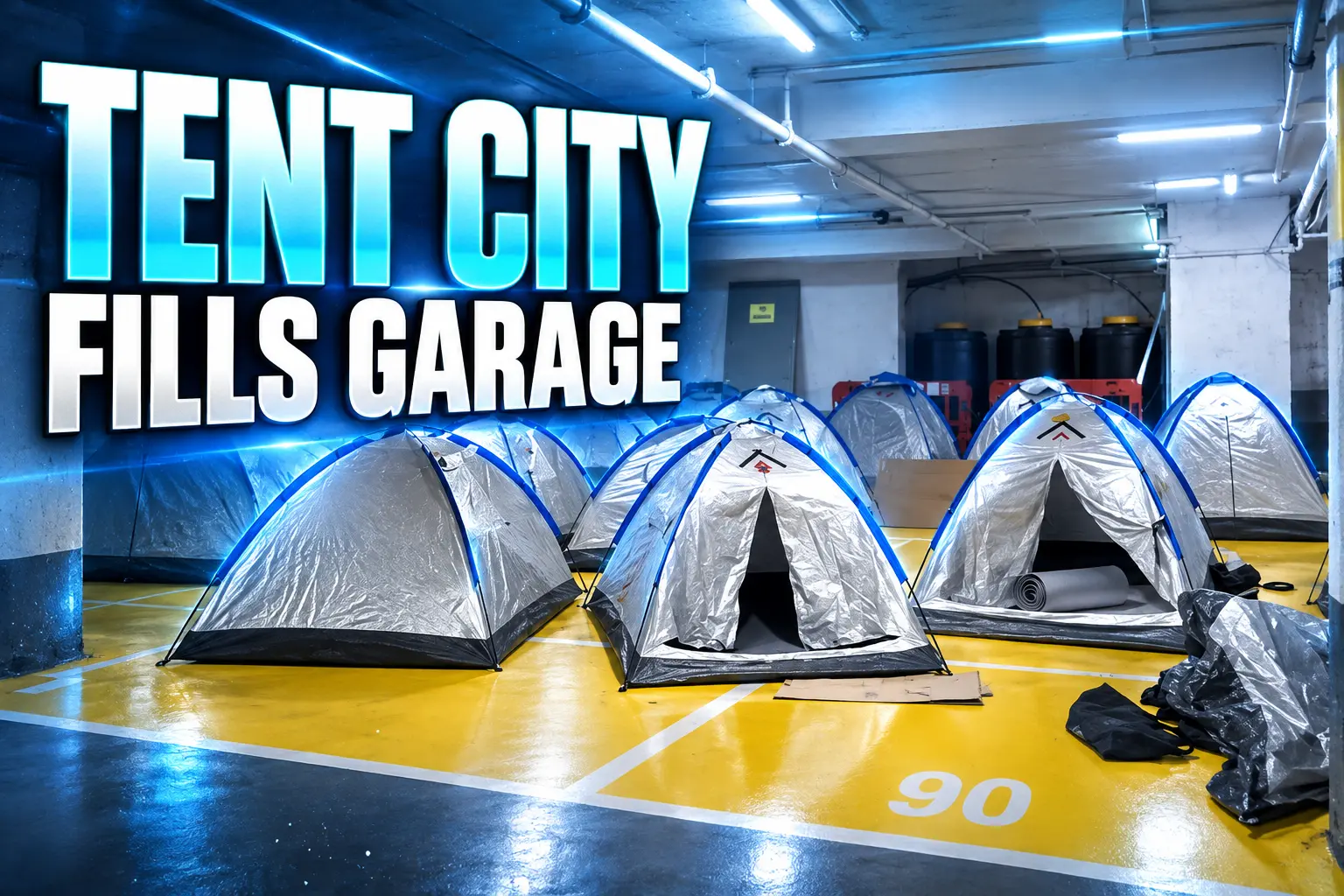
On June 22, 2025, tents already filled floor minus 4 under Tel Aviv’s Dizengoff Center as Iran fired another missile barrage. Israel’s Ministry of Health said 86 people were wounded that morning, hours after U.S. strikes on Iranian nuclear sites. The garage was not a last-minute accident. Reservist volunteers had been running it as overnight housing for neighbors whose older buildings had no safe room.
The mall sits in the city center. The people sleeping in its parking bays were covering a gap the state left in the housing stock, then doing it again the following spring.
A Tent City Four Stories Under the Mall
Dizengoff Center’s underground garage is a certified shelter. When the fighting started on June 13, 2025, the municipality told residents the floor could be used during alarms. That permission covered a place to stand when sirens sounded. It did not cover a place to live.
A resident named Efraim, interviewed in the garage, said the camp went up after a missile hit nearby Pinsker Street on Monday night, June 16. Many people in central Tel Aviv, he said, then saw that the missiles were “the real deal.” Volunteers finished the tents around 5:00 p.m. the next day. Minutes later an alarm sounded, and about 1,000 people came down from the mall and the neighborhood.
One resident said, “I feel more comfortable here because it’s a safe place, even though this is an underground parking. And here we have a lot of people helping each other.” The floor is four stories below the street. People compared it with the small rooms in their own buildings and stayed.
THE FIRST WEEK UNDER DIZENGOFF
- June 13, 2025: Israel opens the campaign later named Operation Rising Lion. Iranian ballistic missiles begin hitting Israeli cities.
- June 16, 2025: A missile strikes near Pinsker Street. Volunteers start turning the certified garage into an overnight camp.
- June 17, 2025: Tents and mattresses arrive from a Jerusalem warehouse. Hundreds are in the garage by 5:00 p.m.; about 1,000 come down during the next alarm.
- June 21, 2025: Tents line parking bays on floor minus 4. Children play in the aisles. Dogs walk the ramps.
- June 22, 2025: After U.S. strikes on Iranian nuclear sites, Iran fires another barrage. The Health Ministry records 86 wounded in Israel.
- June 24-25, 2025: A ceasefire takes hold. People begin packing the tents.
The standing population on quiet hours was in the hundreds. The 1,000-person surge was what happened when an alarm emptied the mall into the ramps. Those are two different counts from two different hours of the same camp.
Reservists Staffed the Garage Overnight
The operator was not the army and not the mall’s night shift. It was the Brothers and Sisters in Arms reservist movement, formed in 2023 by reserve soldiers during the fight over judicial change. After October 7, 2023, the group had already moved into civil aid. In June 2025 it put that machine under a shopping center.
Ronen Koehler, 61, ran the Dizengoff effort. After missiles landed near the American Embassy and wrecked homes across central Tel Aviv, he sent a runner to Jerusalem for stock.
On Tuesday morning, we sent someone to Jerusalem to collect mattresses and tents from a warehouse. By 1:00 PM, we were unloading the supplies, and by 5:00 PM, hundreds of people from the mall and the surrounding area had come in, looking for shelter.
Ronen Koehler, organizer, Brothers and Sisters in Arms
Tents went first come, first served. New people arrived every day. Pets came too. Koehler said young couples, children, and older people with nowhere else to go all settled in.
WHAT THE CAMP ACTUALLY PROVIDED
- Beds: Gray protest tents and mattresses drawn from the movement’s own warehouse, not from a government stockpile.
- Food: World Central Kitchen sandwiches, run through volunteer shifts rather than a municipal kitchen.
- Child care: A Kids Corner for play and reading, so parents were not only waiting out sirens on concrete.
- Staff: More than 200 volunteers signed up for round-the-clock shifts by June 19.
- Reach: Organizers said they were preparing the same model at Habima Square and the Central Bus Station.
Rachel, a woman in her late 70s, came on a Saturday with her caregiver Adelyn, 41, who is from the Philippines, and with Rachel’s dog Bibi. “We are safe here,” Rachel said, “but I just want to go home.” Adelyn said she had been making food at the apartment when the bombing started and had rushed Rachel into the garage because it felt safer, and because looking after an older woman was easier there than in an unstable flat.
Koehler put the mission in one line. “These are just people doing what’s needed,” he said. “We’re not waiting for threats to materialize. We’re preventing them.”
Why Older Tel Aviv Buildings Emptied Into a Mall
Israel has required a protected room, a mamad, in new homes since the early 1990s, after Iraqi Scuds in the 1991 Gulf War. The rule was not retroactive. Whole streets of walk-ups from before that date still have no in-home room. The standard protected spaces required by law are the in-home mamad, a floor-level room, a building shelter, or a public shelter. If you cannot reach one in time, the fallback is an inner stairwell with no windows.
The Israel Builders Association, using end-of-2024 stock, put the national housing count at about 2.96 million homes, with 1.67 million, or 56%, lacking a private safe room. A later State Comptroller report on early 2025 data, using a different yardstick, found 3.19 million people, about 33% of residents, had no standard protection of any kind, not a mamad, not a building shelter, and not a public shelter. Those two figures describe different things. One is homes without a private room. The other is people with nowhere standard to go.
THE GAP THE GARAGE WAS COVERING
| Measure | Figure | What it counts |
|---|---|---|
| Homes without a private safe room | 1.67 million (56%) | Israel Builders Association, end of 2024 |
| People with no standard protection | 3.19 million (33%) | State Comptroller, early 2025 data |
| Killed in Israel in the June fighting | 28 | National Public Diplomacy Directorate, June 26, 2025 |
| Treated in hospitals in that fighting | 3,343 | Same June 26 update |
Home Front Command supports dual-purpose use of public shelters so the rooms stay maintained between wars. A certified mall garage fits that logic. It does not put a mattress under every older tenant on Dizengoff Street. That is the job the volunteers took.
A home mamad is also the wrong tool for some of what Iran was firing. Noah Sander, a real estate agent, said those rooms are built for rockets of the kind Hamas uses and cannot take a direct hit from an Iranian ballistic missile, and that public shelters are the safer option for that weapon. People who could reach four stories of concrete under a mall were making that same calculation with their feet.
86 People Reached Hospitals on June 22
The CGTN dispatch from the garage went out on the morning Iran answered the United States. U.S. forces had struck nuclear sites at Fordow, Natanz, and Isfahan. Iran then launched two waves at Israel, about 22 missiles and then about five, nearly 30 in all. Sirens sounded across the center and the north.
JUNE 22 IN THE HOSPITALS
- Total wounded: 86 people, per the Health Ministry, not the death toll for the whole war.
- Condition on arrival: 2 moderate, 77 good, 4 with acute anxiety, 3 still being assessed.
- Children: Ichilov Medical Center in Tel Aviv treated two children among five people with minor injuries.
- Where: Most of the wounds were tied to impact sites in Tel Aviv and in Ness Ziona.
Those 86 people are not the 3,343 hospital patients counted for the full June fighting. Early field counts that morning were lower, in the low twenties, before the ministry’s hospital tally closed.
By June 26, 2025, the National Public Diplomacy Directorate recorded over 550 ballistic missiles and over 1,000 unmanned aircraft launched from Iran. The same update listed 28 fatalities and 3,343 hospital treatments in Israel. Of the dead, 27 were civilians, including 4 children, and one was a soldier. Of the treated, 23 were severe, 111 moderate, 3,043 mild, 144 were listed for anxiety, and 22 were not yet classed; 346 of the wounded were children. Around 240 buildings took serious damage, and more than 13,000 people were displaced.
Pinsker Street After the June 16 Hit
The missile that filled the garage was not a rumor from another city. It hit in the White City fabric around Pinsker Street, a short walk from the mall, overnight on June 16, 2025. Injuries there were light. The buildings were not.
Efraim said that strike, five days before he spoke, was when neighbors became much more afraid of what was happening in central Tel Aviv. They had already seen pictures of other parking lots and of the underground light rail, with people sitting on the floor and almost no privacy. The Dizengoff camp was built to be better than that floor.
In July 2026, more than a year after the June 16 strike, two damaged buildings on Pinsker still stood behind fencing, with broken windows and scarred fronts. Some residents were still in rented flats while reconstruction crawled. The municipality said the damage was worse because the buildings had never had structural reinforcement. Numbers 4 and 6 Pinsker sit in the historic core, which made the rebuild slower than a modern block.
That is the housing the garage was substituting for: old walls, no mamad, no retrofit, and a ballistic missile that did not need a direct kill to empty a street.
Passover Returned to Minus Four the Next Spring
The June ceasefire did not retire the floor. When Iranian missiles came back in early 2026, people went under the mall again. A CGTN crew filmed an underground parking lot in Tel Aviv on March 1, 2026, with residents waiting out repeated sirens. Clips from that week showed tent rows on mall parking levels for a second time in under a year.
On the first night of Passover in April 2026, a gathering was held four levels down. Rabbi David Benjamin, a Reform rabbi whose South Africa trip had been cancelled, led a seder there. “There are a lot of people who actually live here. They made their homes here,” he said while sirens sounded above. One woman said she had been living in the garage for almost a month because her home had no reinforced room. A child cut in: “It doesn’t have a door.”
By then the bays held tents, air mattresses, chairs, fridges, desks, and pets. The volunteer camp of June 2025 had become a known address. The law from the early 1990s still did not reach the walk-ups over the mall. The reservists had already shown that a certified parking floor, plus tents, could.
Koehler’s line from the first week still fit the second spring. They were not waiting for the next siren to invent a plan. They had already built one, four stories down, in a place designed for cars.

Ninja Theory Staff Face Redundancy After Two Xbox Sales Collapse

Amazon Sells the MacBook Air at Its Pre-Hike Price

U.S. Slows Jet Parts to Squeeze China’s Flying Fleets

PEGI Pulled the GTA 6 Age Rating After Cocaine Details

Northwestern’s Smaller Ryan Field Gave Penn State Nowhere to Hide

Aramco Crash Kills 14 Two Days After Oil Restart

Salah Captained Egypt to Their First World Cup Win

Apple Labor Day Deals Hide June’s Memory Price Hike

Palworld 1.0.4 Adds Palpedia Search After the 1.0 Launch

Zelda’s 40th Switch 2 Ships Without a Zelda Game
-
 BUSINESS3 months ago
Aramco Crash Kills 14 Two Days After Oil Restart
-
 NEWS4 months ago
Salah Captained Egypt to Their First World Cup Win
-
 NEWS1 month ago
Apple Labor Day Deals Hide June’s Memory Price Hike
-
 GAMING4 weeks ago
Palworld 1.0.4 Adds Palpedia Search After the 1.0 Launch
-
 GAMING4 weeks ago
Zelda’s 40th Switch 2 Ships Without a Zelda Game
-

 NEWS3 months ago
El Niño Puts Israel’s Needed Winter Rain on a Flood Clock
-

 BUSINESS8 months ago
Egypt Bets EGP 638 Billion Can Open Sinai to Investors
-

 ENTERTAINMENT4 weeks ago
King Charles Letter Keeps Harry and Meghan as Private Citizens