
TECHNOLOGY
Smart Watches Pros and Cons: How to Choose for Your Health
Smart watches pros and cons hinge on one rule: an alert means a cuff or a clinician, and a quiet watch does not clear you, especially after 60.

A smart watch can flag a silent heart rhythm problem or a pattern that looks like high blood pressure, and it can also miss both. If you are weighing a purchase, an alert is a prompt to get checked, and a quiet week is not a clean result.
The smart watches pros and cons that should decide the purchase are the ones a clinician can use. Those are rhythm alerts, a short heart tracing, activity, and a rough picture of sleep. Battery life, price, and the phone you already own matter next, because a feature your phone cannot enable is not a real pro.
This guide covers what the sensors measure, how to read an alert, and how to read a week with no alert at all. After that, it sorts who gets value from wearing one and which daily limits should stop the purchase.
What Health Signals a Smart Watch Can Read?
Some smart watches shine green light into the skin and read how that light changes with each pulse. The optical reading is what produces your heart rate, and on certain models it also looks for an uneven pattern that can suggest atrial fibrillation, a common irregular rhythm.
A different sensor records electricity. You rest a finger on the crown, hold still, and the watch saves about 30 seconds of rhythm, similar to one view of a hospital electrocardiogram rather than the full 12 views a clinic uses. That tracing can be shared as a file. It cannot explain chest pain.
High blood pressure is a separate job, and most watches still do not show a systolic or diastolic number. On supported Apple Watch models, a cleared notification looks at optical data in the background across 30 day stretches and, if the pattern fits, asks you to talk with a clinician. It is not offered for people under 22, during pregnancy, or for someone already diagnosed with hypertension, and it is not switched on in every country.
Both high blood pressure and atrial fibrillation can sit quietly for a long time. Left alone, they raise the risk of stroke and heart failure, which is why an early hint has value even when the hint is imperfect.
“Early diagnosis is a huge upside for wearable devices, especially in hypertension, which is an asymptomatic condition. You can be walking around with hypertension for years and not know it.”
Adam Bress, PharmD, MS, population health scientist, University of Utah Health
Jared Bunch, MD, a cardiologist at University of Utah Health, says the goal of an abnormal heart rate alert is that you go talk with your doctor, because some people with atrial fibrillation need treatment started early to lower stroke risk. Symptoms that belong in that conversation include palpitations, fatigue, dizziness, shortness of breath, chest discomfort, and a drop in what you can do during exercise.
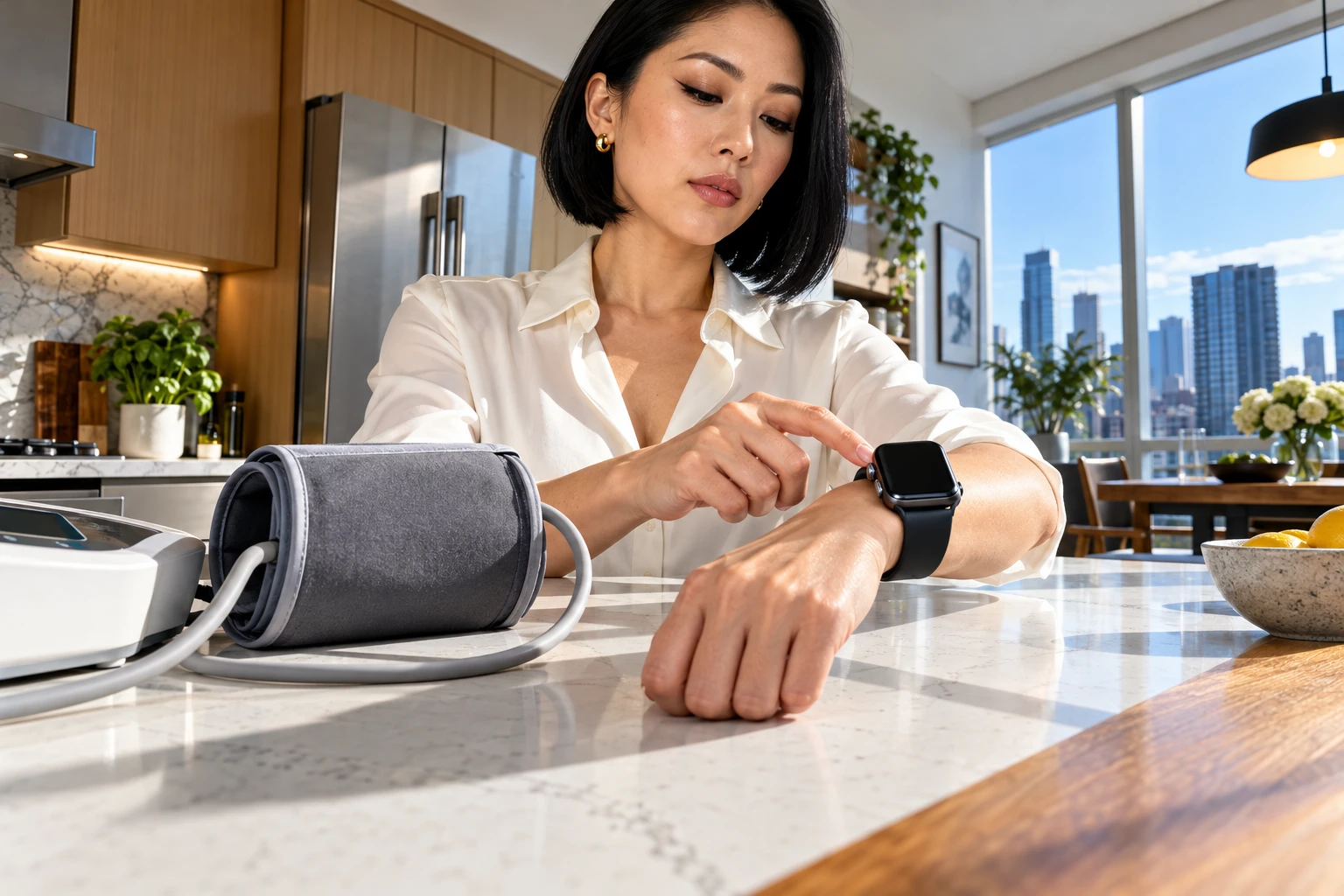
Smart Watches Pros and Cons for Daily Health
Marketing lists every sensor as if each one were a medical test. The useful sort is what the reading is good at, and where it should not change a decision on its own.
| Feature | Where it helps | Where it falls short |
|---|---|---|
| Heart rate | Rest and steady exercise such as walking or easy jogging | Hard arm motion and a loose band make the line jumpy |
| Irregular rhythm | Can flag possible atrial fibrillation when you feel nothing | University of Utah Health describes these devices as about 80 to 90 percent accurate, and the watch misses episodes while it is charging |
| ECG app | A 30 second tracing you can export for a visit | Cannot detect a heart attack, a blood clot, or a stroke |
| Hypertension notification | A background pattern over 30 days on supported watches | No blood pressure number; misses about 59 percent of undiagnosed high blood pressure, and about 8 percent of people without it still get an alert |
| Sleep | When you fell asleep and how long you stayed asleep | Weak at splitting the night into light, deep, and REM |
| Blood oxygen | A casual spot check | Not the tool to manage a lung condition; use a medical pulse oximeter |
| Steps, GPS, calories | Routes, pace, and whether you moved today | Calorie burn is the soft number; train off pace and heart rate instead |
| Fall detection and SOS | A hard fall can prompt a call for help on many models | Needs a charged watch and a phone nearby, or a cellular plan |
| Wrist notifications | Calls and messages without pulling out the phone | Easy to check all day and lose the hour you meant to protect |
Two claims that show up in online shops are not in that table because they are not cleared tools. The FDA safety communication on smartwatch glucose claims, issued February 21, 2024, says the agency has not authorized any smartwatch or smart ring to measure blood glucose on its own. Apps that only display readings from a sensor that does pierce the skin are a different product. A separate FDA warning on unauthorized blood pressure devices, issued September 16, 2025, covers wearable features that claim to measure a blood pressure number without authorization. Apple’s hypertension notification is a cleared alert, not a cuff reading, and the two should not be confused at the checkout page.
Why Does a Missing Smart Watch Alert Still Leave Risk?
Apple’s earlier test of the hypertension notification, as described by University of Utah Health, found that about 59 percent of people with undiagnosed high blood pressure would not get an alert, while about 8 percent of people without high blood pressure would. The JAMA analysis of smartwatch hypertension alerts then applied those results to U.S. adults who could use the feature: age 22 or older, not pregnant, and not already diagnosed.
The same test performance changes the odds differently once the starting rate of undiagnosed high blood pressure changes. Age rows and the race and ethnicity rows below are separate cuts of that survey, not one combined score.
| Group | Starting chance | If the watch alerts | If the watch stays quiet |
|---|---|---|---|
| Adults under 30 | 14 percent | 47 percent | 10 percent |
| Adults 60 and older | 45 percent | 81 percent | 34 percent |
| Non-Hispanic Black adults | 36 percent | 75 percent | 26 percent |
| Hispanic adults | 24 percent | 63 percent | 17 percent |
Read your own row before you decide what a quiet month means. Under 30, silence moves the chance down to 10 percent, which is more reassuring and still not zero. At 60 and older, silence only moves a 45 percent starting chance down to 34 percent, so a watch that never speaks up leaves a real chance that high blood pressure is present.
Those race and ethnicity gaps follow known differences in who is living with undiagnosed high blood pressure, not a second accuracy score for the sensor. An alert is more informative when the condition is already common in your group. A missing alert is less comforting in that same group.
Rhythm checks have a similar hole that has nothing to do with the algorithm. The watch cannot record a bout of atrial fibrillation during the hour it spends on the charger, and an irregular rhythm notification has to be turned on in the phone’s health checklist. A paired watch you never set up can look calm because the feature was never enabled. An alert with no fluttering, fatigue, or breathlessness still deserves a clinic tracing, because the watch is sometimes the first sign and the hospital monitor is the confirmation.
Routine screening does not retire when you strap on a watch. Adults under 40 with no extra risk factors are generally checked every three to five years. Adults 40 and older, and younger adults who already carry extra risk factors, are checked every year. Bress recommends a careful office cuff reading plus a reading outside the office, at home or with an ambulatory monitor, before anyone calls the alert a diagnosis.
What to Do With a Smart Watch Health Alert
Save the alert the day it arrives, including the time and any tracing the watch offers to export. Then match the next step to the kind of alert, and do not wait for a second buzz to decide whether the first one counted.
AFTER A SMART WATCH ALERT
- Rhythm alert: Save the tracing, note symptoms such as fluttering, fatigue, dizziness, or shortness of breath, and show that file to your clinician.
- Blood pressure alert: Measure with a validated upper arm cuff, morning and evening, and bring the log rather than a screenshot of the watch alone.
- Chest pain or fainting: Contact local emergency services even if the watch just classified the rhythm as normal.
Apple’s own steps for a hypertension notification say to take cuff readings over a seven-day period, with reminders you can set for morning and evening, and to discuss the notification with your clinician. A wrist band that guesses a blood pressure number is not that log. Cardiologists who manage hypertension at home still treat from a validated upper arm cuff, used the same way each time, not from a cuffless estimate on a watch.
If you want the electrical tracing, open the ECG app, rest your arm, and hold a finger of the other hand on the Digital Crown without pressing it in. The recording takes 30 seconds. You can add symptoms at the end. A result labeled sinus rhythm means the watch saw a regular pattern on that strip. If you feel unwell, that label is not a reason to stay home.
Apple’s guide states that the ECG app cannot detect a heart attack, a blood clot, or a stroke, and it also cannot detect high blood pressure, heart failure, high cholesterol, or every other rhythm problem. Pressure, tightness, or pain in the chest is an emergency on its own. So is sudden one sided weakness, trouble speaking, or a collapse. The watch does not get a vote in those minutes.
Who a Smart Watch Helps, and Who Should Wait
Bunch describes these watches as tools that can surface some heart conditions around the usual barriers to care, including cost and distance from a clinic, and he includes people whose symptoms do not look like the textbook case. That benefit shows up only if you will act on the alert. A watch that makes you collect graphs and skip the visit does the opposite job.
- Worth a look: You have risk factors for stroke or heart failure, you keep noticing palpitations, or you live where appointments are hard to get and a nudge would get you through the door.
- Worth a look: You train with heart rate zones or GPS and you will treat those numbers as workout feedback, not as a diagnosis.
- Worth a look: You live alone and you want fall detection with a way to call for help.
- Wait or choose a cuff: You already know you have high blood pressure. The Apple notification is not meant for that use; an upper arm monitor is the tool for follow up.
- Wait: You are pregnant or under 22, so the hypertension notification is outside its labeled use.
- Choose a medical monitor: You need a rhythm watch that alerts a clinician in real time. A consumer watch is a poor fit for that job; a prescribed continuous monitor is the one built for it.
People who already have atrial fibrillation are in a different lane from first time screening. Some watches can summarize how often the irregular rhythm shows up across a week, which a clinician may use while treatment is already underway. That summary still does not replace the monitor your clinician orders when the decision is urgent.
Battery, Cost, and the Phone You Already Own
How Long Do Smart Watch Batteries Last?
Full featured watches with a bright always on screen often need a charger every day or two. Watches built for long runs and hikes more often last several days, which is why sleep tracking is more consistent on those models. The health cost of a short battery is the gap, not the inconvenience.
- Always on screen: A display that never sleeps is one of the fastest drains.
- GPS workouts: Route tracking pulls more power than a day of step counts.
- Cellular standalone: Calls and streaming without the phone nearby shorten the charge.
- Overnight wear: Sleep and nighttime rhythm only exist for the nights the watch is on your wrist.
Charge the watch during a part of the day when you are awake if sleep or nighttime rhythm is why you bought it. A drawer life of half the week cannot catch a rhythm that appears on the nights it is plugged in.
Extra Costs Beside the Smart Watch Price
The sticker is only the start. You may also pay for a replacement band, a phone that matches the watch, and a monthly cellular line if you want calls when the phone stays at home. Some health apps hold the longer sleep or recovery reports behind a membership.
A basic fitness band can be enough if you want steps and a simple heart rate. Paying a premium price for an ECG or a hypertension notification only makes sense after you confirm that exact model offers the feature in your country. A shop listing that promises a blood sugar number or a blood pressure number from the wrist is the listing to walk away from.
When Should You Take a Smart Watch Off?
Take it off to charge, to let a rash calm down, and whenever the maker says water exposure is past the rating on that model. Skin needs a break if the band leaves a sore spot. Optical readings also fail when the case slides toward the hand, so the fit should be snug and flat, with room for one fingertip under the band.
CHARGING WITHOUT LOSING THE NIGHT
- The window: Charge while you shower, eat, or work at a desk, not across the whole night you hoped to measure.
- The symptom: If palpitations cluster in the evening, that is the stretch to wear the watch, not the stretch to park it on the puck.
- The rash: Switch wrists or loosen the band for a day, and skip wear until broken skin heals.
Distraction is the other reason to take it off. A wrist that buzzes for every message can undo the calm you wanted from a health tool. Silence the apps that are not safety or health, and leave the medical notifications for the checks you and your clinician agreed to watch.
Frequently Asked Questions
Do Smart Watch Heart Features Work in Every Country?
No. Rhythm alerts, the ECG app, and hypertension notifications are switched on country by country, so the same model can offer a check where you live and hide it in another region. Open the heart section in your phone’s health app and see which alerts are offered before you count on them.
How Tight Should a Smart Watch Band Be?
Snug enough that the sensor on the back stays flat against your skin and the case does not slide onto your hand, and loose enough for one fingertip under the band. A band that bounces on a run is a common reason the heart rate line looks chaotic, and an ECG needs a still arm plus a finger resting on the crown for the full 30 seconds.
Can a Basic Fitness Band Match a Smart Watch on Heart Checks?
A basic band can count steps and estimate heart rate, and many stop there. A 30 second ECG and a hypertension notification are cleared features on specific watches, not on every band in the same aisle. If those alerts are why you are shopping, confirm that exact model in your country before you pay.
What if Smart Watch Alerts Make You Anxious?
Turn off the alert that keeps pulling your eyes to your wrist, and keep one check that does not depend on the watch, such as a home cuff if blood pressure is the worry. You can disable hypertension notifications in the phone’s health checklist, then ask your clinician which signals are worth leaving on.
What Should You Bring After a Smart Watch Alert?
Bring the notification date and any saved heart tracing, and add a week of upper arm cuff readings if the alert was about blood pressure. Your clinician can treat the watch record as a clue and will still want their own measurement before changing your care.
If you are 60 or older, a watch that never alerts still leaves a 34 percent chance of undiagnosed high blood pressure in the U.S. survey groups studied, so the yearly cuff check stays on the calendar either way. For a younger buyer the quiet result is more comforting, and the purchase still has to earn its place on battery, phone fit, and whether you will follow an alert into a real visit.
Disclaimer: This article is an educational guide to smart watch health features and is meant only as general information. It is not medical advice, a diagnosis, or a recommendation to buy a device or to ignore one. Talk with a qualified clinician before you act on a watch alert, change a medicine, or skip a blood pressure screening. Figures and feature rules reflect the sources reviewed for this guide and can change as agencies and makers update them.

Cook Hands Democrats the House as Crypto’s Bill Stays Dead

Wicker’s Broken Bed Was the Short Story’s Punch Line

Nvidia’s $500 Billion Financing Plan Draws a $180 Sell

Maserati Bets the Grecale V6 Can Fill Porsche’s Gap

EV Cable Theft Follows the Old Railway Copper Playbook

Aramco Crash Kills 14 Two Days After Oil Restart

Salah Captained Egypt to Their First World Cup Win

Zelda’s 40th Switch 2 Ships Without a Zelda Game

Apple Labor Day Deals Hide June’s Memory Price Hike

El Niño Puts Israel’s Needed Winter Rain on a Flood Clock
-
 BUSINESS4 months ago
Aramco Crash Kills 14 Two Days After Oil Restart
-
 NEWS5 months ago
Salah Captained Egypt to Their First World Cup Win
-
 GAMING2 months ago
Zelda’s 40th Switch 2 Ships Without a Zelda Game
-
 NEWS2 months ago
Apple Labor Day Deals Hide June’s Memory Price Hike
-
 NEWS4 months ago
El Niño Puts Israel’s Needed Winter Rain on a Flood Clock
-

 GAMING2 months ago
Palworld 1.0.4 Adds Palpedia Search After the 1.0 Launch
-

 BUSINESS9 months ago
BAE’s 60-Year Saudi Franchise Now Runs Through Taif
-

 NEWS4 months ago
Saudi Visa Routes Split Nigerian Travelers Into Two Speeds