
TECHNOLOGY
Stop TinyTask Playback When the Computer Feels Slow
Stop TinyTask playback with Pause, Scroll Lock, or Break, then switch off continuous mode so a fast loop stops taking the mouse instead of slowing Windows.

Your mouse is moving on its own, menus are opening under the cursor, and the TinyTask window will not take a click because the pointer never stays still. That is playback: a recording of what you did with the mouse and keyboard, sent again by the program, sometimes on a loop. To stop TinyTask playback, press Pause, or Scroll Lock, or Break, one time. Those keys end the run even when TinyTask is not the window in front.
The steps below start with that keypress. After the pointer is yours again, you can find the loop setting that kept the macro going, see which speed made it too quick to catch, stop a compiled file that is its own program, and set the next run so Play does not lock you out.
What Does TinyTask Playback Do to the Mouse?
TinyTask is a small Windows recorder for a task you would rather not repeat by hand. You start a recording, do the clicks and keystrokes once, stop the recording, and press play to send that same sequence again. The home page describes the app as a 36 KB portable program, so the file itself is not what makes a PC feel heavy.
Playback only acts on windows you can see. It can sit in the foreground or the background, but it works with visible apps, because it is a screen tool rather than a script that runs out of sight. While a recording plays, the pointer and the keyboard follow that recording. A fast loop can open menus, type into whatever sits under the cursor, and shove aside the window you were trying to reach.
The machine feels slow because you are fighting those inputs. Windows is still drawing, switching apps, and taking clicks, only the clicks are no longer yours. Closing browsers and other big programs will not hand the pointer back while a macro is still sending moves.
Once you know the pointer is being driven for you, the next move is the key that cuts that off.
How to Stop TinyTask Playback With the Keyboard
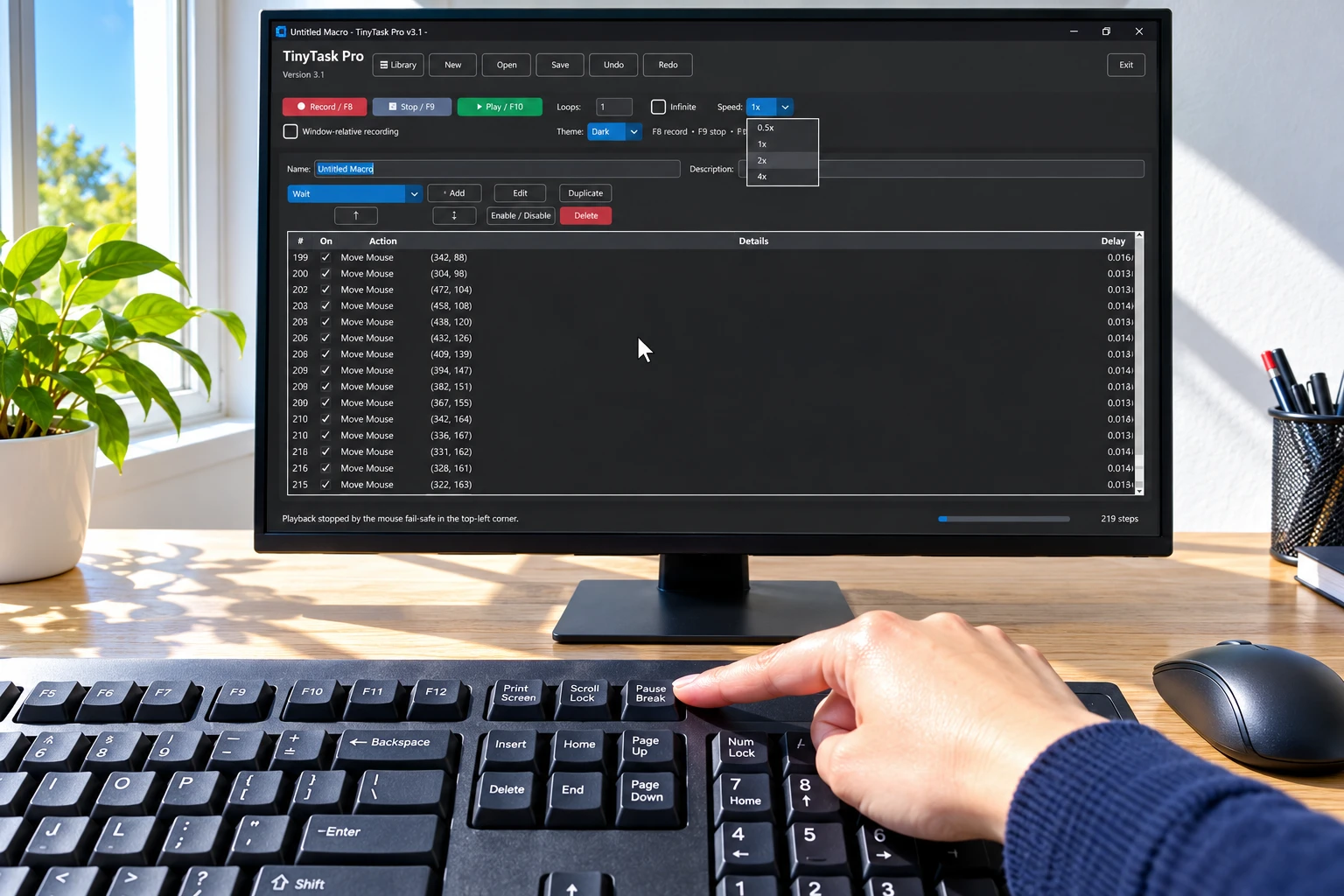
Press Pause, Scroll Lock, or Break once, firmly. Do not hold the key down, and do not hammer it, because a fast macro can steal focus between presses. On most keyboards, Break is printed on the same key as Pause, so one press covers both. You do not need to click TinyTask first, and you do not need its window in front.
Break, Scroll Lock, and Pause are the emergency stop keys on the support page, and that page also says the playback hotkey should end a run that is already going. The playback hotkey is Ctrl+Shift+Alt+P unless you changed it. The same combo is what starts playback when nothing is running, which is why it is easy to mix up with a stop control. If the pointer is racing, the single emergency keys are the ones you can land.
Open Prefs and point at Playback Hotkey when you have the mouse again. A hint at the bottom of that submenu names the emergency keys. The menu also lets you replace the four-key combo with a single key. The choices there include F8, F12, and Print Screen, which are easier to hit than four keys at once the next time a loop starts.
- Press Pause, Scroll Lock, or Break once. Watch the title bar. During playback it counts down the time left, and with a loop count it also shows which pass you are on. When the countdown is gone and the title looks normal, the run has ended. If the countdown is still there, the key did not register, so press it once more.
- Find the key on a laptop. Compact keyboards often print Pause on a shared key that needs Fn. Read the legend on the key itself, because the pairing is not the same on every model. If the key truly is not there, open the On-Screen Keyboard with Ctrl+Windows+O and click ScrLk. That keyboard sends a real key, so TinyTask treats it like the hardware key.
- Use the secure screen if nothing else lands. Press Ctrl+Alt+Delete. That screen is one a macro cannot click through, so the pointer stops doing more damage while you choose the next step. Open Task Manager, select tinytask.exe, and end the task.
Ending the task is safe for Windows. You lose a recording that was still only in memory. A.rec file you already saved stays on disk. If another program has captured the keyboard, the support page is why the stop keys can miss, and it tells you to run TinyTask as Administrator when the target is a game.
MOVES THAT DO NOT STOP PLAYBACK
- Escape: The developer left it out because that key shows up in ordinary recordings, and a stop key buried inside a macro would cut the macro short.
- The mouse cable: Unplugging the mouse does nothing. Playback sends clicks straight to Windows, so the macro still runs with no mouse attached.
- The keyboard cable: Pulling the keyboard removes the stop key and does not cancel the run. Leave it plugged in.
- Record: The record button and Ctrl+Alt+Shift+R finish a recording. They do not cancel a playback that is already going. Recording uses one control to start and the same control to stop. Playback does not work that way.
- The close box: A moving macro can click the close button away, or click somewhere else, before your cursor arrives.
- Ctrl+Shift+Alt+S: That combo does not appear in the developer’s stop instructions, so mashing it will not end the run.
With the mouse back, the setting that started the loop is still on, and it will do the same thing the next time you press Play.
Where Do Continuous Playback and Loop Counts Live?
Both controls sit in Prefs, the wrench at the right of the toolbar. Set Playback Loops takes a number, and the macro runs that many times and then stops. Continuous Playback takes no number. The macro runs until you stop it yourself. Only one of those two is in charge at a time.
The count you typed is not a one-off. It applies to every playback after that, including a different recording, until you change it. The number in brackets beside Set Playback Loops is the value in use, so you can read it without opening the box. Glance there before you press Play.
| What you see | What to change |
|---|---|
| The macro never ends, and Prefs shows a check on Continuous Playback | Clear that check after you have stopped the run |
| It repeats a fixed number of times, then stops | Open Set Playback Loops and type a smaller number, or 1 for a single pass |
| The title bar shows one pass of one, but you expected repeats | The loop count did not take. Set it again and read the brackets before you press Play |
| The second pass clicks empty space | The first pass moved the screen. Make the last action return the window to the spot the first action expects |
There is no wait setting between passes. One pass ends and the next begins at once. If a button needs a moment before the screen is ready, record that wait into the macro. At the end of the recording, sit still for as long as the gap needs to be, then stop the recording. That idle time plays back on every pass.
A macro that is perfect once and wrong on the next pass is almost always aiming at old coordinates. TinyTask repeats screen positions, not the button you thought you clicked. If the first pass opened a window, scrolled a list, or filled a field, the next pass still clicks the old spot. A confirmation that appears only the first time will throw off every pass after it. End the recording on the same screen you started from, and the repeat has a place to land.
A loop is only half of what makes the pointer hard to catch. Speed is the other half.
Which Playback Speed Makes a Macro Hard to Catch?
Speed is a choice in Prefs, at the top of the menu, not a slider on the toolbar. Guides that describe a speed slider are describing a control this program does not have. A tick marks the speed in use. Normal speed is the default, and normal means the macro replays at the pace you recorded.
| Prefs choice | What it does to the recording |
|---|---|
| Half speed | Stretches the gaps you left between actions. Use it when a window draws slowly, or when clicks land too early at normal speed. |
| Normal speed | Matches the pace of the recording. Test every new macro here before you raise anything. |
| Double speed | Shortens those gaps. Try it only after a normal-speed run has already hit the right spots. |
| Highest setting | The recorded waiting nearly disappears, and clicks go out as fast as the program can send them. |
| Set Custom Speed | Whole-number steps between normal and the top fixed choice. The box prints the range it accepts. Then choose Play Custom Speed so that multiplier is the one in use. |
Speed changes your side of the timing only. The website, the dialog, and the menu still open at their own pace. At the highest setting, a click meant for a menu item can arrive before the menu has finished drawing, and it lands on whatever was underneath. That is the macro doing what it was told, faster than the other program can answer.
The revision notes on fast playback for version 1.72 mention 100x runs that failed to end after a short recording, and the 1.74 notes record a fix for compiled programs that would not quit when stopped by hand. High speed stacked on a loop is the combination that feels like a frozen PC. Each pass starts the instant the last one ends, and by a later pass the screen can be somewhere the recording never saw. If a loop misbehaves, drop the speed before you touch the loop count.
A quick test separates a speed problem from a position problem. Run the macro at half speed and watch it. If the clicks land in the right places but too early, lower the speed and leave it there. If they land in the wrong places at every speed, the recording is aiming at coordinates that moved. A new resolution, a window you dragged, or a different display scale all do that, and no speed setting repairs it.
The speed you pick applies to the whole playback. You cannot speed up one stretch and leave the rest alone. If one step needs a pause and the next should be quick, record it that way: move fast through the easy clicks and wait where the other program needs time.
All of that assumes the run is still inside TinyTask. A file you compiled is a separate program.
How to Stop a Compiled TinyTask Program
The.exe button turns the recording into a standalone program that runs without TinyTask open. Pause, Scroll Lock, and Break stop that file the same way they stop a run inside the app. If they do not, press Ctrl+Alt+Delete, open Task Manager, and end the process by the file name you gave the compile, not by tinytask.exe. Closing TinyTask itself leaves that other program running.
The speed and the loop count are written into the compiled file and cannot be edited afterward. After you compile, the report lists them under Program attributes. Read that report before you hand the file to anyone else, because a loop count you set for a test is now what their machine will do. If the speed or the count is wrong, change the setting in TinyTask and compile again.
Test a compiled file at normal speed, with a loop count of one, before you rely on it. A fast compiled loop is the case where the pointer is hardest to recover, and you no longer have the Prefs menu of the original window sitting on screen.
Stopping one run is the urgent part. The settings you leave behind decide whether the next run traps you the same way.
What to Set Before You Press Play Again
Say you recorded a short series of clicks, left Continuous Playback checked, and chose the highest speed. Play starts, the pointer races, and the toolbar is unreachable. Scroll Lock ends it, and the countdown leaves the title bar. Open Prefs, clear Continuous Playback, set the loop count to 2, set the speed back to normal, and press Play with a finger already on Pause. You get two passes you can watch, and the mouse is yours when the count is done.
BEFORE THE NEXT PLAY
- Normal speed first: Watch one full run at the pace you recorded before you try double speed or anything above it.
- A count of two: Use Set Playback Loops with a small number while you are still testing. Continuous Playback is for a job whose length you do not know yet, not for the first trial.
- A finger on Pause: Rest it there before you press Play on anything long or fast.
- Always on Top: Turn it on so the countdown stays visible. If the macro covers the TinyTask window, you lose the clearest sign that a run is still going.
- The record hotkey: Start and stop the recording with Ctrl+Alt+Shift+R rather than a click on the toolbar. The mouse trip back to the toolbar would otherwise become part of the macro. That hotkey is left out of the recording on purpose.
- Save the.rec file: Stopping a recording keeps it in memory only. Close the program, or end the task, and an unsaved recording is gone.
Version 1.73 also changed what a double-click on a.rec file does. An earlier build could start playback as soon as you opened the file. That was put back to a plain open, for safety. If an old setup still plays the moment you double-click a recording, you are on that earlier behavior, and the emergency keys still end it.
The home page lists TinyTask 1.77 as the build to download, with the public revision history spelling out the changes through 1.75. None of those notes add a separate stop button to the toolbar. The keys above are still how a runaway run ends.
Frequently Asked Questions
How Do You Stop a TinyTask Recording?
Press the same toolbar button that started the recording, or press Ctrl+Alt+Shift+R. That shortcut is left out of the saved macro on purpose, so it does not play back later. There is no way to pause in the middle and continue. Hitting the record control a second time finishes the take, and a mistake means you record the whole task again.
Does TinyTask Run on a Mac?
TinyTask is a Windows program. The download is tinytask.exe, a self-contained 32-bit app, and the developer does not publish a Mac build. A download that advertises TinyTask for Mac is a different file.
Is a Stuck TinyTask Macro a Virus?
A macro that will not end is continuous playback or a long recording, not a sign that the file is a virus. The version 1.75 notes mention adjustments to the program file aimed at reducing false alarms from security scanners. Get the app from the developer’s own download page so you are running the file they ship.
Do You Need to Reinstall to Clear a Loop?
No. Open Prefs and turn Continuous Playback off, or set a small number under Set Playback Loops. Those choices are stored in a settings file that sits beside tinytask.exe, so they survive closing the program and they survive ending the task. Copying only the exe to a new folder starts you with fresh settings. Reinstalling is not required.
Can TinyTask Schedule a Macro on Its Own?
TinyTask has no scheduler of its own. If a compiled macro starts because you added it to Windows Task Scheduler, ending the playback does not remove that task, and it can launch again at the next trigger. Open Task Scheduler and disable the task if you do not want it to run.
After the countdown leaves the title bar, open Prefs and read the loop line and the speed tick before you press Play again. A finger on Pause, a count of two, and normal speed are enough to watch the next pass without handing the pointer back to the macro.

Cook Hands Democrats the House as Crypto’s Bill Stays Dead

Wicker’s Broken Bed Was the Short Story’s Punch Line

Nvidia’s $500 Billion Financing Plan Draws a $180 Sell

Maserati Bets the Grecale V6 Can Fill Porsche’s Gap

EV Cable Theft Follows the Old Railway Copper Playbook

Aramco Crash Kills 14 Two Days After Oil Restart

Salah Captained Egypt to Their First World Cup Win

Zelda’s 40th Switch 2 Ships Without a Zelda Game

Apple Labor Day Deals Hide June’s Memory Price Hike

El Niño Puts Israel’s Needed Winter Rain on a Flood Clock
-
 BUSINESS4 months ago
Aramco Crash Kills 14 Two Days After Oil Restart
-
 NEWS5 months ago
Salah Captained Egypt to Their First World Cup Win
-
 GAMING2 months ago
Zelda’s 40th Switch 2 Ships Without a Zelda Game
-
 NEWS2 months ago
Apple Labor Day Deals Hide June’s Memory Price Hike
-
 NEWS4 months ago
El Niño Puts Israel’s Needed Winter Rain on a Flood Clock
-
 GAMING2 months ago
Palworld 1.0.4 Adds Palpedia Search After the 1.0 Launch
-

 BUSINESS9 months ago
BAE’s 60-Year Saudi Franchise Now Runs Through Taif
-

 NEWS4 months ago
Saudi Visa Routes Split Nigerian Travelers Into Two Speeds