
NEWS
Next Google TV Streamer Adds Room Mics After Price Hike
The leaked Google TV Streamer would add room mics and occupancy sensing to a $149.99 box that already acts as a smart-home hub.

Google is building a narrower Google TV Streamer with far-field microphones and presence sensing, a source familiar with the matter said on October 9, 2026. The current box already lists at $149.99 and already acts as a Matter and Thread hub. The leak would put Nest-style listening and occupancy on that HDMI port.
Google has not confirmed the project, named a chip, or set a price or date. Until those land, the successor is still a plan, not a product.
Cutouts on the Pill for Hands-Free Voice
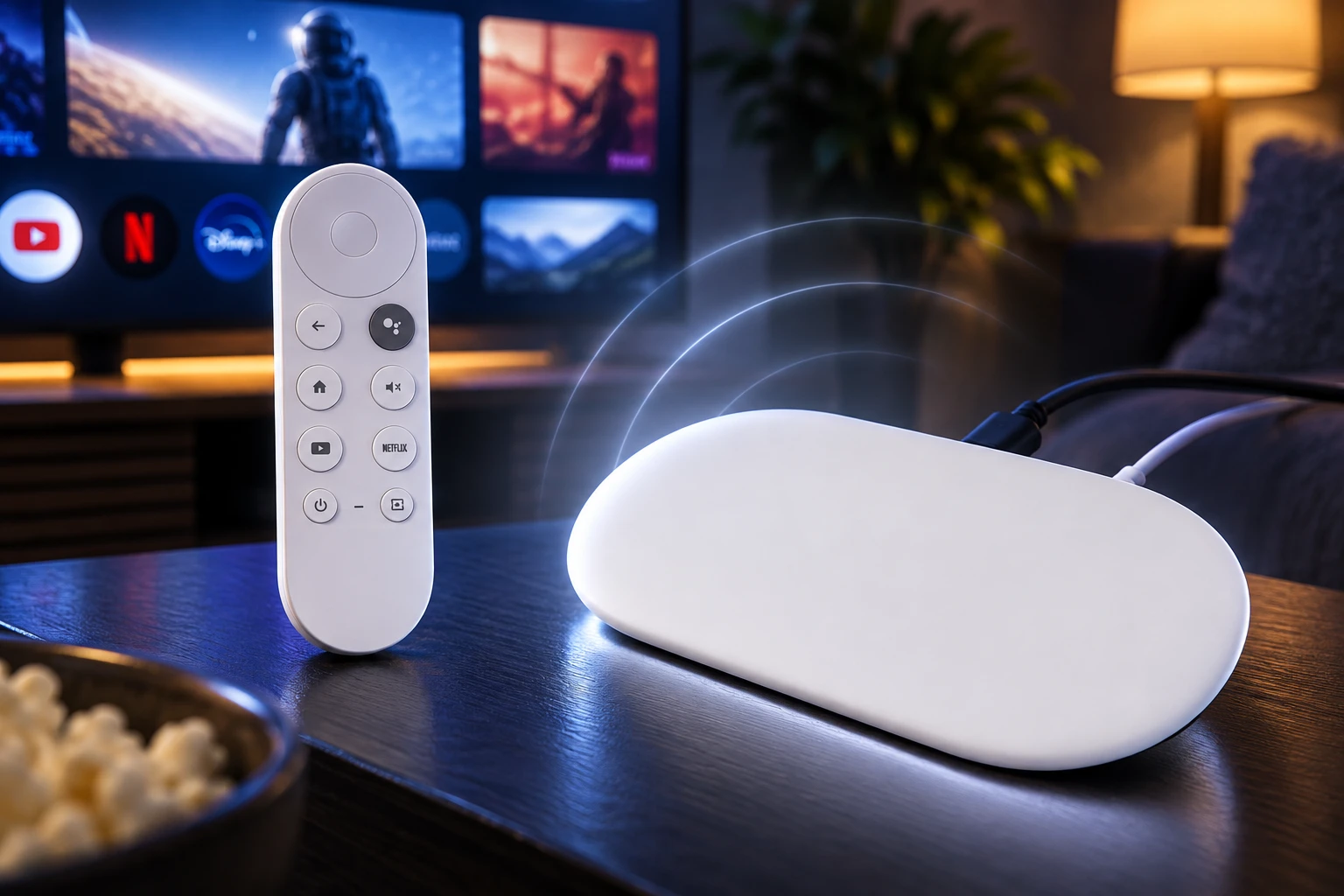
Today, “Hey Google” on a Google TV Streamer goes to the remote, because that is where the microphone lives. The next model, the source said, keeps the same general pill shape, makes the width narrower, and cuts openings into the slanted top so the box itself can hear a command from across the room.
That is the same pose as a Nest speaker, not a mute streaming stick. It also parks an always-listening array under the television, on a device that stays plugged in.
THE CHANGES IN THE LEAK
- Lid microphones: Cutouts on the slanted, pill-shaped surface would listen for “Hey Google” without the remote.
- Presence sensing: The box would notice someone entering the room and wake the TV to an ambient screen.
- Ambient screen: That screen would show a Google Photos screensaver, then time and weather if you step closer, matching the behavior TCL already ships on some Google TV sets.
- Faster chip and more storage: The leak promises a quicker processor and more than the current 32 GB, with no SKU or capacity named.
- Remote shortcuts: The included remote keeps its shape, adds two shortcuts beside the YouTube and Netflix keys, and keeps the Find My Remote button.
No photo of the unannounced unit has appeared. The source described a smaller footprint, not a new look, which is why the interesting part is what the lid would do, not how the plastic would sit on a shelf.
The Streamer Already Runs Matter and Thread
The 2024 Google TV Streamer was never only a 4K player. Google’s own spec sheet lists Matter, a Thread border router, gigabit Ethernet, HDMI 2.1, Wi-Fi 802.11ac, Bluetooth 5.1, 4 GB of memory and 32 GB of storage, and a 6.4 by 3.0 by 1.0 inch shell that weighs 5.7 ounces. Colors are Hazel and Porcelain. The plastic mix is at least 65% recycled. The HDMI cable is sold separately.
Voice still lives on the remote. Smart-home traffic already lives in the box. Pairing that hub with lid mics and occupancy sensing is how a streaming player starts answering for the whole room.
HOW THE BOX GOT TO $149.99
- 2024: Google ships the Google TV Streamer at a $99.99 U.S. list price, after a four-year gap from Chromecast with Google TV 4K, with a lower-end HD dongle in between.
- 2025: TCL ships the first Google TV sets with presence sensing, waking a Google Photos screensaver when someone walks in and showing time and weather as they come closer.
- August 31, 2026: Google raises the Streamer by $50 to $149.99, grouping it with Nest cameras and doorbells, while the Google Home Speaker stays $99.99.
- October 9, 2026: A source familiar with the matter says a narrower successor with device mics, presence sensing, a faster chip, more storage, and two extra remote shortcuts is in development.
Google put the Streamer on the same price memo as Nest cameras. The company told customers the move was about parts, not a new model.
Due to rising component costs, we are adjusting the U.S. pricing of select Google Nest cameras, doorbells and Google TV streamer 4K, effective August 31. We remain committed to providing our customers with industry-leading smart home security and continuous feature updates.
Google spokesperson, Aug. 31, 2026
Six weeks of holiday discounts of $20 had already trained shoppers to treat $99.99 as a ceiling. The August letter reset the floor at $149.99. Lid mics and occupancy are the first hardware story since that letter that tries to explain the extra $50.
TCL Built Room Sensing Into Flagship TVs First
Presence sensing is not a new Google TV idea. Last year TCL put it in flagship Google TV sets, using hardware in the television to turn the panel into an ambient display when someone entered the room and to surface time and weather at closer range.
The leak copies that sequence onto a standalone box. Walk in, and the TV would wake to family photos. Step nearer, and the same panel would show clock and forecast. The difference is the host. On TCL, the sensor sits in a large television. On the next Streamer, the sensor would sit in a plastic pill you can move from set to set.
That is useful if your TV is a dumb panel, or an older Google TV set that never got the sensor. It is a problem for anyone who bought a premium TCL specifically for that trick, because a $149.99 HDMI box would then offer the same wake-on-entry loop on almost any screen.
The leak does not say how the Streamer would detect a person. TCL’s sets use a dedicated presence sensor in the TV. Until Google names a radar module, a camera, or a simpler motion part, occupancy on the box is a behavior, not a bill of materials.
No Mute Switch in the Leak
Google already sells a living-room gadget that listens from across the room and notices occupancy. The Nest Hub Max lists at $229 on the Google Store, often as out of stock, with far-field microphones, ultrasound sensing, Gemini for Home, Matter, a Thread border router, and a hardware mic and camera switch.
The Max has a 10-inch 1280 by 800 screen of its own. The Streamer would borrow the television you already own. That is the cheaper path to an ambient display, and it is also the path with no mute hardware named in the leak.
THE CURRENT BOX VERSUS THE LEAK AND NEST HUB MAX
| Feature | Current Streamer | Leaked next model | Nest Hub Max |
|---|---|---|---|
| U.S. list price | $149.99 | Not stated | $229 |
| Far-field mics on the device | No; voice is on the remote | Yes, lid cutouts | Yes |
| Room sensing | Not listed | Yes, wake to photos, time, weather | Ultrasound sensing |
| Hardware mute | Not listed | Not stated | Mic and camera switch |
| Onboard storage | 32 GB | More than 32 GB, size unnamed | Not listed on the spec sheet used here |
| Matter and Thread hub | Yes | Not stated | Yes |
| Screen | Your TV | Your TV as an ambient display | 10-inch panel on the hub |
A Nest Hub Max can be switched off at the hardware. A streaming box with lid mics and no stated switch would keep listening unless Google adds a physical mute, a software kill, or both. That detail is missing, and it is the one that decides whether this is a speaker you chose or a microphone that arrived with 4K.
Chip, Storage, and Price Stay Blank
The leak is generous about holes in the lid and stingy about silicon. It says the next Streamer will be faster and will hold more than 32 GB. It does not name a processor, a RAM figure, a storage SKU, a Wi-Fi generation, or a U.S. price.
That gap matters because the current box already has 4 GB of memory and 32 GB of storage, and because Google just charged $50 more for those same parts. A successor that only adds mics and a sensor still has to clear $149.99 in a market full of $30 to $80 Google TV sticks from retail brands.
The remote news is smaller than it looks. Two extra shortcuts on a handset that already carries YouTube and Netflix will please people who live in four apps. They will not sell a new hub. Find My Remote staying in the kit is continuity, not a reason to open the box again.
A four-year wait separated Chromecast with Google TV 4K from the first Streamer. This follow-up is arriving on a much shorter clock, which usually means a refresh, not a new category. The mics are the exception that could still change the category if Google ships them with a mute and a price that does not climb again.
What Would Make Anyone Replace This Box?
Until Google names the chip, the RAM, and the price, the leak is a feature list, not an upgrade case. Owners who already paid $99.99, or who watched the tag jump to $149.99 in August, have no number that says the new pill is worth another checkout.
Hands-free Gemini on the television is the one job the current remote does poorly, because the remote has to be in your hand. Lid mics would fix that. Extra storage would help only if 32 GB is actually full, which is a minority complaint next to lag, HDMI handshake bugs, and the missing mute.
The replacement case is narrow. It fits people whose TV has no far-field mics, who want occupancy on a set TCL never sold them, and who already use the Streamer as a Thread border router. It does not fit anyone waiting for Wi-Fi 6E, a Tensor part, or a return to $99.99. Those items are not in the leak.
A Box Stashed Behind the TV Misses the Room
Plenty of living rooms hide the streamer behind the panel, in a cabinet, or in a rack. Presence sensing and far-field mics both need the pill in open air, with its slanted lid facing the room. Put it out of sight and the headline features stop working, which is a design conflict the leak never resolves.
Google still has not confirmed the device, the mute, the chip, or a launch window. The $149.99 Streamer on sale now remains the one you can buy, with voice on the remote and no occupancy trick of its own.

Cook Hands Democrats the House as Crypto’s Bill Stays Dead

Wicker’s Broken Bed Was the Short Story’s Punch Line

Nvidia’s $500 Billion Financing Plan Draws a $180 Sell

Maserati Bets the Grecale V6 Can Fill Porsche’s Gap

EV Cable Theft Follows the Old Railway Copper Playbook

Aramco Crash Kills 14 Two Days After Oil Restart

Salah Captained Egypt to Their First World Cup Win

Zelda’s 40th Switch 2 Ships Without a Zelda Game

Apple Labor Day Deals Hide June’s Memory Price Hike

Palworld 1.0.4 Adds Palpedia Search After the 1.0 Launch
-
 BUSINESS4 months ago
Aramco Crash Kills 14 Two Days After Oil Restart
-
 NEWS5 months ago
Salah Captained Egypt to Their First World Cup Win
-
 GAMING2 months ago
Zelda’s 40th Switch 2 Ships Without a Zelda Game
-
 NEWS2 months ago
Apple Labor Day Deals Hide June’s Memory Price Hike
-

 NEWS4 months ago
El Niño Puts Israel’s Needed Winter Rain on a Flood Clock
-
 GAMING2 months ago
Palworld 1.0.4 Adds Palpedia Search After the 1.0 Launch
-

 BUSINESS8 months ago
BAE’s 60-Year Saudi Franchise Now Runs Through Taif
-

 BUSINESS8 months ago
Egypt Bets EGP 638 Billion Can Open Sinai to Investors