
NEWS
Egypt Lifted Three Canopus Statues and Left the City
Egypt’s Canopus lift put three statues on cranes for a festival, then into tanks, while older finds filled the museum.

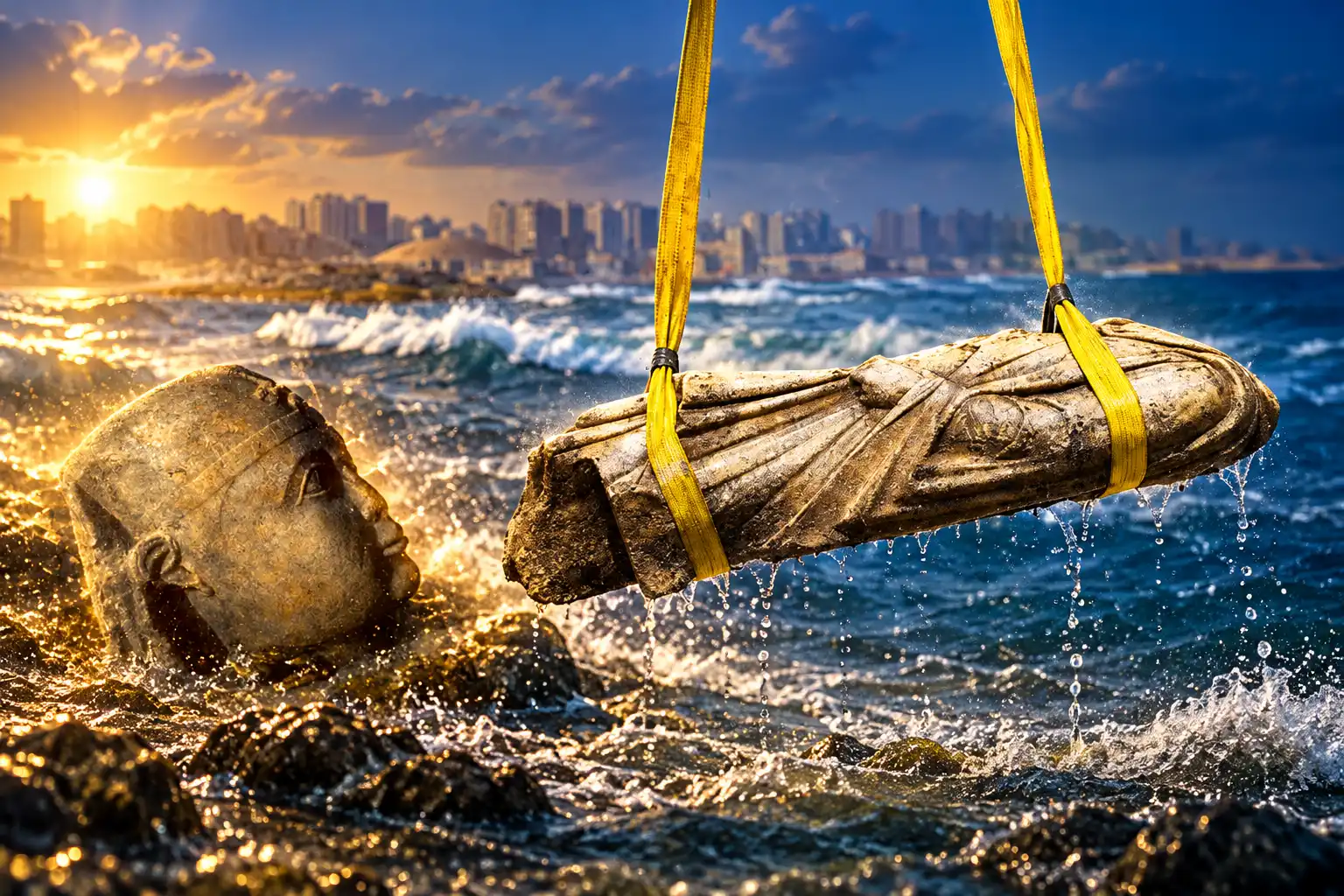
On August 21, 2025, Egyptian cranes lifted three large statues from Abu Qir Bay while cameras rolled. Officials called it the country’s first recovery of sunken antiquities in 25 years.
The lift sat inside a three-day heritage festival off Alexandria. Conservators then sent the stones toward about a year in salt-removal tanks, and most of the city stayed on the seabed.
Three Colossi Left the Water on Camera
The Department of Underwater Antiquities ran the public lift with the navy, the Armed Forces engineering arm, and a shoreline crowd of diplomats. Tourism and Antiquities Minister Sherif Fathy watched the slings come up. So did Alexandria Governor Ahmed Khaled Hassan Saeed and Mohamed Ismail Khaled, secretary-general of the Supreme Council of Antiquities.
The ministry named three pieces as the haul that mattered for the cameras. A quartzite sphinx carries the cartouche of Ramses II. A granite man from the late Ptolemaic period came up with a broken neck and broken knees. A white marble Roman nobleman is missing his lower half.
THE THREE STATUES LIFTED ON AUGUST 21
| Piece | Material | Period | Condition on the crane |
|---|---|---|---|
| Sphinx with Ramses II cartouche | Quartzite | New Kingdom royal name on a later seabed | Cartouche preserved; the political prize of the day |
| Unidentified male figure | Granite | Late Ptolemaic | Broken neck and knees |
| Roman nobleman | White marble | Roman | Lower half missing |
Divers also pointed to millstone fragments, Roman coins, and limestone rooms that may have been houses, workshops, or cult space. Fathy thanked the Sunken Antiquities Department and city hall, then framed the day as proof Egypt can guard a heritage that happens to sit under the Mediterranean and still sell the country as a destination.
Khaled called the western district a living witness to ancient Egypt and a complete Roman-era city, with temples, cisterns, fish farms, and an old port. He said it looks like an extension of western Canopus, a part of which had already been studied farther east in the bay.
The City Was Mapped a Generation Ago
Canopus was not waiting to be found in 2025. French underwater archaeologist Franck Goddio and the European Institute for Underwater Archaeology, working with Egypt, identified the city in 1999. They found neighboring Thonis-Heracleion in 2000.
The Hilti Foundation has backed that Franco-Egyptian work in Alexandria’s eastern harbour and in Abu Qir Bay since 1996. Goddio has said he has cleared only about 5 percent of the ancient city of Thonis-Heracleion, a reminder that “recovered” and “understood” are different jobs.
Earthquakes, soil that turned to slurry, a dying Canopic Nile branch, and a slow rise in the sea took both towns. A zone of about 110 square kilometers of the delta edge went under, and Islamic coins from the eighth century sit among the last datable drops on the sites. Annual IEASM seasons kept pulling wood, bronze, and stone through the 2020s. The 25-year gap Egypt advertised was a gap in state pageantry, not a quiet seafloor.
THE PATH TO THE CRANE LIFT
- 1996: Hilti begins funding Goddio’s IEASM work with Egypt on the sunken coast.
- 1999: The team identifies Canopus in Abu Qir Bay.
- 2000: Thonis-Heracleion is rediscovered nearby.
- November 2, 2001: UNESCO adopts the underwater heritage convention; it enters force on January 2, 2009.
- August 19-21, 2025: Alexandria stages a three-day festival, opens a museum show, and lifts three statues on camera.
A year after the cranes, posts still sell the bay as a city that has just risen from nowhere. A colossal Serapis head from earlier Canopus dives keeps circulating as if it came up with the 2025 sling. The festival did that work too. It reset a mapped site into a reveal.
Why Egypt Lifted Only Three Pieces
Egypt is a party to UNESCO’s 2001 Convention on the Protection of the Underwater Cultural Heritage, which tells states to treat preservation in situ as the first option before they authorize a recovery. Fathy said the operation followed those scientific limits, and that some treasures would stay in the water because of their historical context.
There’s a lot underwater, but what we’re able to bring up is limited, it’s only specific material according to strict criteria. The rest will remain part of our sunken heritage.
Sherif Fathy, Minister of Tourism and Antiquities, Abu Qir Bay
That is why a festival can look like a harvest and still leave a city in place. The three statues were chosen because they could be slung, conserved, and shown. The dock, the houses, and the fish ponds are the site. Moving them would wreck the thing the cameras were pointing at.
Conservators planned about a year in large tanks in Alexandria so salt could leave the stone slowly. The Grand Egyptian Museum’s opening night was already set for November 1, 2025, and Fathy used the Abu Qir week to talk that up as well. The crane lift had to serve science, law, and a tourism calendar at the same time.
The Show That Opened the Same Week
The museum object of the festival was not the wet sphinx. During the same program, Fathy and the governor opened “Secrets of the Sunken City” at the Alexandria National Museum, a six-month display of 86 artifacts from Canopus and Heracleion.
Officials said those pieces were going on view in Egypt for the first time, including material from 2023 work at Abu Qir. Khaled had already told guests that many of the 86 dated to discoveries in 2000 and 2001 and had toured abroad before they came home. They were not the trio on the cranes.
Fathy’s speech was a destination pitch as much as a dig report. He said Egypt had drawn more than 15.8 million visitors in 2024, asked that Alexandria be tied more tightly to the North Coast, and pointed to work at the Graeco-Roman Museum and Qaitbay Citadel. Saeed called the recovery a breakthrough and folded it into local building plans, including Abu Qir Port and the Alexandria Metro.
An underwater museum has been floated for years as a way to let visitors see what the convention says should stay put. The 2025 week chose a cheaper path: lift three photogenic stones, fill a dry gallery with 86 earlier finds, and leave the streets of Canopus where they are.
The Dock Still Holds a Merchant Ship
Survey teams documented a 125-meter quay that small boats used into the Byzantine period. Beside it they logged a merchant ship, stone anchors, and the base of a harbor crane from the Ptolemaic and Roman centuries. That is the working waterfront of a town that lived off the Canopic mouth of the Nile, not a random sculpture dump.
Limestone buildings nearby look like a mix of cult rooms, houses, and workshops. Rock-cut ponds and reservoirs fit domestic water storage and fish farming, the unglamorous plant that kept a port fed. Earlier passes across the bay have already produced stamped amphorae, ushabti figures, and coins that run from pharaonic issues through Islamic strikes, which is why Khaled could call the western ground a full city rather than a wreck scatter.
WHAT THE BAY STILL HOLDS
- The quay: A 125-meter dock used by small boats into Byzantine times.
- The working kit: A merchant ship, stone anchors, and a harbor crane left in place.
- The rooms: Limestone buildings read as houses, workshops, and possible cult space.
- The ponds: Rock-cut tanks for water storage and fish farming.
- The rest of the stone: Further statues and architectural blocks that fail the lift criteria.
Fathy said excavations would continue and that a shipwreck would be announced once study was complete. Goddio’s crews have already spent years on hulls in the next-door city. The promise that matters for Canopus is whether the western dock gets the same slow mapping, or only another camera day.
The Same Coast Is Still Going Under
Canopus did not drown in a single modern storm. Long land lowering along the Nile Delta coast, earthquakes, and the loss of Nile sediment all had a part. The living city next door is taking a different beating, and it is faster to see from a balcony than from a dive mask.
Essam Heggy, a water scientist at the University of Southern California, has measured Alexandria’s shoreline receding on average 3.5 meters a year over the last 20 years. A 2025 study he co-wrote found about 40 buildings collapsing a year across the city, up from about one a year a decade earlier, with some 7,000 old buildings at risk as saltwater works through sandy ground and eats foundations from below.
Fathy tied the ancient loss to that present danger and said the contrast should raise alarm along the Mediterranean. The policy answer on the seabed is still the convention: leave most of it down, pull a few stones that can survive a tank, and put the story in a museum that has climate control.
WHAT WE KNOW
- The lift: Three statues came up on August 21, 2025, in a navy-backed public recovery.
- The law: In situ preservation is the first option, which is why the dock and rooms stayed put.
- The show: Eighty-six earlier Canopus and Heracleion pieces ran six months at the Alexandria National Museum.
WHAT IS UNCONFIRMED
- The place-name: Whether the western district is only an extension of Canopus or a smaller town with its own name.
- The debut: Whether the three crane-lifted statues have gone on public view after their planned year in tanks.
- The next hull: Which shipwreck Fathy meant, and whether it will be lifted or mapped in place.
The 125-meter dock, the merchant ship, and the fish ponds are still in Abu Qir Bay. That is the outcome the convention asked for, and it is also why a festival had to put three broken statues on cranes to make the city visible at all.
Frequently Asked Questions
When Did Egypt Join the Underwater Heritage Convention?
Egypt deposited its instrument of ratification with UNESCO on August 30, 2017, and the treaty took effect for the country on November 30, 2017. The convention had been adopted in Paris on November 2, 2001, and entered into force worldwide on January 2, 2009, after enough states signed on.
How Does Salt Leave a Statue After a Lift?
Seawater soaks into pores in granite, marble, and quartzite. If the stone dries too fast, salt crystals grow and can split the surface. Conservators planned about a year in freshwater tanks in Alexandria so the salt could migrate out slowly before any museum air hit the three 2025 pieces.
What Was Canopus Famous for in Roman Times?
Egyptian officials describe Canopus as a cult center for Osiris and Serapis, with a Roman-era reputation for lavish festivals. Ancient writers also treated it as a holiday town. Pilgrims came to sleep in the Serapis sanctuary in hope of a healing dream, a rite known as incubation.
How Large Was the Serapis Sanctuary Goddio Found?
Goddio’s earlier Canopus dives located remains of a Serapis temple measured at 101 meters by 78 meters, along with the head of a statue that once stood over 4 meters tall. That head is an older recovery, not one of the three sculptures slung on August 21, 2025, and it is the image that still gets shared as if it were new.
What Other Name Has Been Floated for the Site?
Mohamed Abdel-Meguid, a senior archaeologist in the Underwater Antiquities Department, said the newly worked western ground may extend Canopus, or it may be Taposiris-Parva, a smaller town worn down over time. UNESCO’s rule of thumb for the category itself is simple: objects immersed for at least 100 years can count as underwater cultural heritage, which both names would satisfy.

Christa Pike Survived the Execution Tennessee Would Not Pause

Musk’s Oligarch Charge Hits a Queue of Three

Circle Puts USDC and EURC Into SAP Pay Workflows

Ring’s First Smart Lock Skips Home Wi-Fi for Sidewalk

GTA 6 Puts Cash Back on the Story Path

Salah Captained Egypt to Their First World Cup Win

Aramco Crash Kills 14 Two Days After Oil Restart

Zelda’s 40th Switch 2 Ships Without a Zelda Game

Apple Labor Day Deals Hide June’s Memory Price Hike

Palworld 1.0.4 Adds Palpedia Search After the 1.0 Launch
-
 NEWS5 months ago
Salah Captained Egypt to Their First World Cup Win
-
 BUSINESS4 months ago
Aramco Crash Kills 14 Two Days After Oil Restart
-
 GAMING1 month ago
Zelda’s 40th Switch 2 Ships Without a Zelda Game
-
 NEWS2 months ago
Apple Labor Day Deals Hide June’s Memory Price Hike
-
 GAMING1 month ago
Palworld 1.0.4 Adds Palpedia Search After the 1.0 Launch
-

 NEWS4 months ago
El Niño Puts Israel’s Needed Winter Rain on a Flood Clock
-

 BUSINESS8 months ago
BAE’s 60-Year Saudi Franchise Now Runs Through Taif
-

 BUSINESS8 months ago
Egypt Bets EGP 638 Billion Can Open Sinai to Investors