
AUTO
Mercedes Puts E-Class Shape on Its Next Electric Sedan
Nürburgring spy shots show a three-box Mercedes E-Class Electric as the EQE’s U.S. sales collapse and the EQ badge is retired.

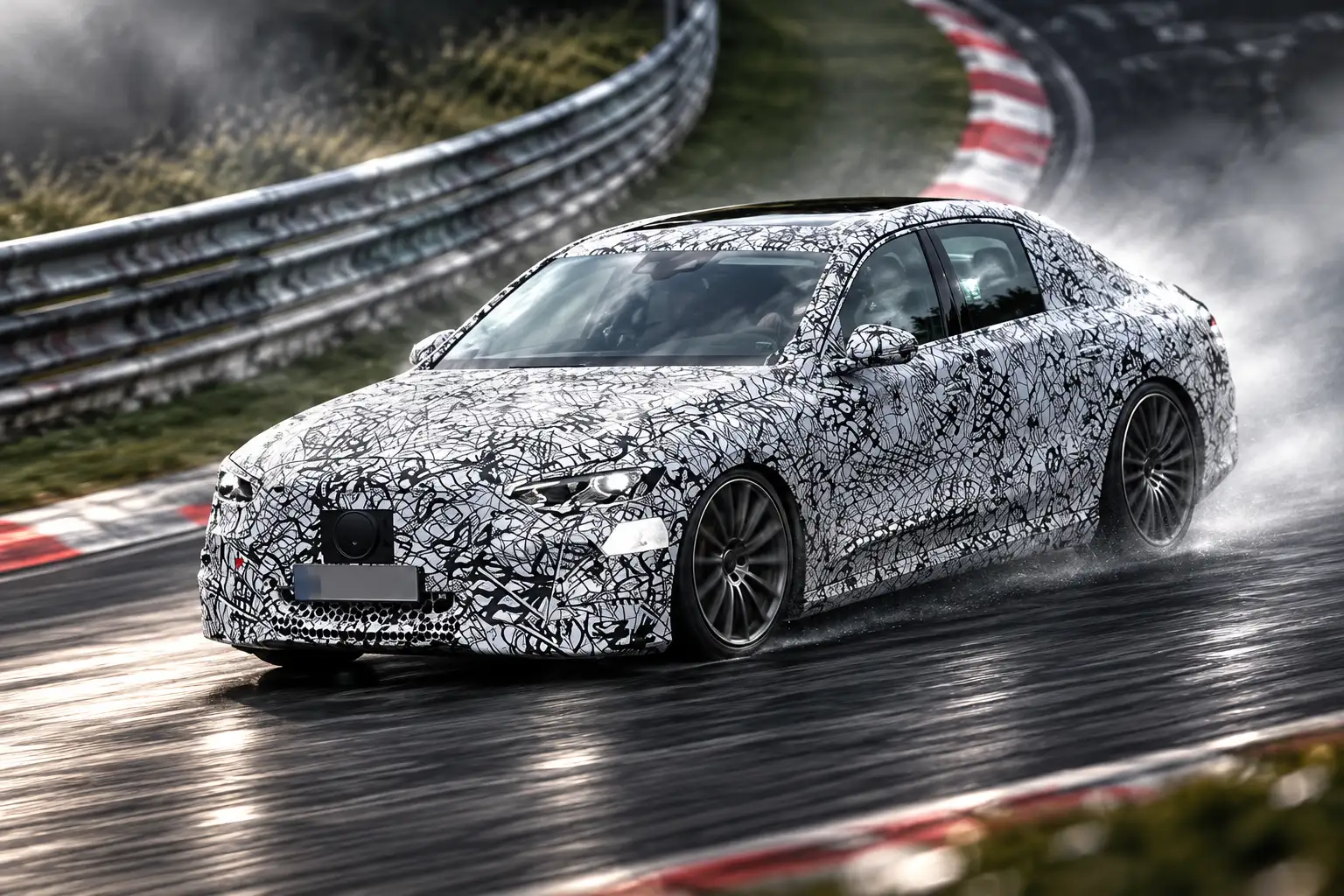
A camouflaged Mercedes sedan with no exhaust pipes has been testing at the Nürburgring, and it looks like an E-Class, not an EQE. Photographs circulating on October 13, 2026 show a three-box body, a proper trunk, and a face that reads as Mercedes first. That is the point of the mule, not a styling Easter egg.
The EQE was sold as the electric E-Class and never found the people who actually buy E-Class cars. Mercedes is now building the car those buyers would recognise, after U.S. volume for the rounded sedan fell apart and the EQ badge was retired.
A Three-Box Mule at the Nürburgring
The car spotted on the Nordschleife has no visible tailpipes, which is why photographers treat it as the electric Mercedes E-Class rather than another petrol mule. The silhouette is the current E-Class idea in three volumes: long hood, distinct cabin, and a decklid that is a decklid. It does not wear the one-bow, pill-shaped body that defined the EQE and EQS.
Earlier prototypes photographed around Nürburg in September 2026 had already shed much of the heavy plastic cladding. Those frames showed production-style headlamps with two three-pointed stars in each cluster, a cue the smaller electric C-Class does not use, and rear lamps drawn as straighter bars instead of star-in-ring graphics. An AMG-badged version with wider fenders and a lip spoiler has been seen on the same roads.
Mercedes has not confirmed the test car. Automakers still use old shells to hide new hardware, and range, motors, and price remain unpublished. The body language is still the tell. This mule is being developed as a sedan people will park next to a petrol E-Class without a second look.
WHAT THE PHOTOS SHOW
- No tailpipes: The rear bumper is closed, which is why the car is read as a battery sedan rather than a disguised combustion mule.
- Three-box body: Hood, cabin, and trunk are separate volumes, closer to the E-Class than to the EQE’s rounded one-bow shape.
- Two stars per lamp: September frames show two three-pointed daytime-running stars in each headlamp, a larger-car cue versus the single star on the electric C-Class.
- AMG mule too: A wider, lower prototype with AMG wheels has been running the same Nürburgring loop as the standard car.
Taken together, the photos look like a product plan, not a one-off experiment. Mercedes already sells electric cars that share faces with their petrol twins, and this E-Class-sized sedan is next in that queue.
EQE Sedan Sales Collapsed Before Mercedes Pulled It
A Mercedes-Benz spokesperson said the EQE sedan and the Mercedes-AMG EQE will not return in the United States for the 2027 model year. The Maybach EQS 680 SUV and the AMG S63 E Performance plug-in hybrid leave with them. The regular EQS sedan stays. The EQE’s U.S. run began in late 2022 and is ending after the 2026 model year.
The sales record is short and ugly. Good Car Bad Car, which compiles Mercedes-Benz’s quarterly U.S. reports into model tallies, puts the EQE sedan at a peak of 5,154 cars in 2023, then 2,955 in 2024 and 2,437 in 2025. U.S. EQE sedan sales of 109 cars in the first half of 2026 were 93.7% below the 1,730 sold in the same months of 2025.
U.S. EQE SEDAN SALES
| Year | U.S. units | Change |
|---|---|---|
| 2022 (Q4 only) | 384 | – |
| 2023 | 5,154 | first full year, still the peak |
| 2024 | 2,955 | down 42.7% from 2023 |
| 2025 | 2,437 | down 17.5% from 2024 |
| 2026 (January-June) | 109 | down 93.7% from H1 2025 |
Those figures are for the sedan only. The EQE 320+ uses a single motor rated at 315 hp and a 96 kWh battery; the AMG EQE uses two motors for 617 hp, or up to 677 hp with its boost function. The hardware was never the whole problem. Buyers who would pay Mercedes money still walked past a car that did not look like a Mercedes sedan, and U.S. order books for the EQ cars were already shut for months in 2025 when the federal tax credit expired.
Why Mercedes Dropped the EQ Badge
The EQ prefix was supposed to mark a separate electric family, with its own names, its own showroom presence, and a shape that advertised the battery. Configurators now put electric cars back under the familiar lines, labelled CLA Electric or C-Class Electric rather than EQA or EQE. The drive is the option. The grille still has a star.
Ola Källenius, Mercedes-Benz chief executive, has been saying the quiet part on the record. After the first EQ cars, he said, new buyers found the brand. The people who already owned Mercedes cars are the ones arriving now, and they still want a combustion engine if that is what they prefer.
We had buyers enter the brand with those first electric models in the market. They learned to love Mercedes later in their life, maybe. The traditional Mercedes customers are now coming into this. But if they still want a high-tech combustion engine, we can do that. It’s not a problem. Customers will decide when to switch at their own convenience.
Ola Källenius, chief executive, Mercedes-Benz
That is a different brief from the EQE’s. The rounded car was built to look new. The mule at the Ring is built to look like the car those traditional customers already trust. Källenius has also said the consumer is “not quite there yet” on a full switch, which is why Mercedes is still renewing petrol products while it rolls out electric twins.
The EQE’s shape is still the first thing people mention when the model is cut. The other knock is simpler, and it has nothing to do with aerodynamics: a dearer Mercedes that asks for more apps and charge cards than a Tesla, with less space for the money. Stuttgart can restyle the body. It still has to win the boring comparison on charging and cabin room.
Sold-Out CLA and GLC Show What Works
The correction is already on the road, just not in E-Class size. Mercedes-Benz said on October 7, 2026 that car BEV sales in the third quarter reached a record 68,400, up 61% from a year earlier and 29% from the second quarter. The global BEV share hit 16.8%. In Europe almost one in three Mercedes cars sold in the quarter was fully electric. Plug-in hybrids and BEVs together were 25% of global car sales.
Mathias Geisen, the board member for sales and customer experience, said the electric GLC, CLA, GLB, and GLA are sold out in Europe into 2027, with the Bremen, Rastatt, and Kecskemét plants on three shifts. Electric CLA variants rose 24% from the second quarter as the car reached the United States and Japan. The electric C 300 4MATIC opened for European orders in September 2026.
Q3 2026 BEV SNAPSHOT
- Car BEV volume: 68,400 in the quarter, the highest Mercedes-Benz Cars has recorded.
- Share of the mix: 16.8% of car sales were battery-electric, up 7.2 percentage points from Q3 2025.
- Europe: BEV sales up 78% year on year, with almost one in three cars fully electric.
- China drag: Car sales there fell 31% to 86,800, while the GLC and E-Class still made up almost two-thirds of Mercedes car volume in that market.
Those sold-out cars share a visual idea the EQE rejected. They look like Mercedes models that happen to be electric. The CLA Electric, first on the MMA platform with 800-volt charging, is the clearest small-car version of that bet. UK spec sheets put the CLA 250+ rated at 480 miles of WLTP range, with 200 kW (272 hp) and a 10-80% DC charge in 22 minutes at up to 320 kW. The CLA 200 is 165 kW (224 hp) and 328 miles.
The electric C-Class is the closer cousin to the mule. Mercedes-Benz’s April 20, 2026 launch of the C 400 4MATIC electric cited 762 kilometres of WLTP range (473 miles) from a 94 kWh usable pack, 360 kW, a 4.0-second run to 100 km/h, and up to 325 km recharged in 10 minutes on 800 volts. Källenius, riding in that C-Class, said it was “nice and quiet and feels more like an E-Class.” The real electric E-Class is still wearing tape.
THE LINEUP SHIFT
- Leaving the U.S. for 2027: EQE sedan, AMG EQE, Maybach EQS 680 SUV, and AMG S63 E Performance, per a company spokesperson.
- Staying for now: EQS sedan, plus the EQE SUV, while the EQ name itself is being wound down on new products.
- Already in showrooms: CLA Electric, electric GLC, electric C-Class, with GLB and GLA electric filling European order books.
- Still a mule: the three-box E-Class Electric, aimed at 2027 as the EQE sedan’s replacement rather than a second EQE generation.
China is the reminder that the E-Class badge still has to work as a petrol car too. Group car sales there fell hard in the third quarter, and Mercedes said the GLC and E-Class were the models that held up. An electric E-Class that scares those buyers off the lot would repeat the EQE mistake in the company’s largest single market.
Two Stars in Each Lamp Mark the Bigger Car
The lighting graphic is how Mercedes keeps the electric C-Class and the future electric E-Class from looking like the same car in a dark car park. Spy frames from September give the E-Class mule two illuminated stars in each headlamp. The electric C-Class and GLC use one. Rear lamps on the mule drop the star-and-ring motif for a cleaner horizontal bar.
The rest of the body is conservative on purpose. A large, often illuminated grille panel, a three-box profile, and a trunk that does not melt into the roof are the opposite of the EQE’s aero sculpture. Efficiency still matters on an 800-volt car, but it is no longer allowed to rewrite the side view. That is the design brief Källenius described for a future electric S-Class as well: two cars, two drivetrains, one face.
Single-motor and dual-motor 4MATIC versions are the obvious layout, because that is how Mercedes is already packing the C-Class Electric and CLA Electric. Nothing in the spy shots confirms battery size, WLTP range, or horsepower, and guesses borrowed from the VLE van do not belong on this car. The honest spec sheet is still blank except for the shape.
BMW’s i3 Took the Opposite Design Bet
BMW’s Neue Klasse i3 went the other way, with a more distinct electric identity in the same size class the electric C-Class already entered in 2026. Mercedes is doing the inverse: keep the family face, hide the battery in the badge. Lucid’s Air still sits in the long-range luxury-sedan slot Tesla left when it stopped building the Model S in 2026. That empty slot is real. It is not why this mule exists.
This car exists because the EQE did not convert E-Class money. Tesla’s departure from the big sedan business makes the timing look lucky. The product decision was made earlier, when Mercedes started selling CLA and C-Class electrics that look like CLA and C-Class cars, and when U.S. EQE volume fell from 5,154 to a rounding error.
Price will decide whether the bet pays. Mercedes has not said what the electric E-Class will cost, and the EQE never convinced enough buyers that its cabin and charging setup were worth the premium over simpler rivals. A familiar body removes one objection. It does not charge the car, and it does not make the software less fussy.
The Electric E-Class Is Aimed at 2027
Spy photographers have been calling a late-2026 reveal or an early-2027 on-sale date since the production lamps appeared. Most of the recent frames, including the October 13 Nürburgring set, point at a 2027 arrival, with an AMG version later. Källenius has described a burst of about 40 models in three years by the end of 2027, using shared platforms and the MB.OS software stack so every nut is not new each time.
FROM EQE TO E-CLASS ELECTRIC
- Late 2022: EQE sedan goes on sale in the United States and records 384 fourth-quarter deliveries.
- 2023: U.S. volume peaks at 5,154, the only year the car looks like a real E-Class alternative on paper.
- April 20, 2026: Mercedes unveils the electric C-Class as a familiar sedan with 762 km of WLTP range and 800-volt charging.
- September 2026: E-Class Electric mules run near the Nürburgring with production lamps and a three-box body; the electric C 300 4MATIC opens for orders in Europe.
- October 7, 2026: Mercedes posts record quarterly car BEV sales and says CLA, GLC, GLB, and GLA electrics are sold out in Europe for the rest of the year.
- October 2026: A spokesperson says the EQE sedan is out of the U.S. 2027 lineup, while fresh Ring photos show the replacement still in camouflage.
The mule keeps circulating the Nürburgring with a trunk lid and no tailpipes, wearing the shape Mercedes customers already know. If 2027 goes as the photos imply, the electric E-Class will finally be an E-Class that happens to plug in.

Cook Hands Democrats the House as Crypto’s Bill Stays Dead

Wicker’s Broken Bed Was the Short Story’s Punch Line

Nvidia’s $500 Billion Financing Plan Draws a $180 Sell

Maserati Bets the Grecale V6 Can Fill Porsche’s Gap

EV Cable Theft Follows the Old Railway Copper Playbook

Aramco Crash Kills 14 Two Days After Oil Restart

Salah Captained Egypt to Their First World Cup Win

Zelda’s 40th Switch 2 Ships Without a Zelda Game

Apple Labor Day Deals Hide June’s Memory Price Hike

Palworld 1.0.4 Adds Palpedia Search After the 1.0 Launch
-
 BUSINESS4 months ago
Aramco Crash Kills 14 Two Days After Oil Restart
-
 NEWS5 months ago
Salah Captained Egypt to Their First World Cup Win
-
 GAMING2 months ago
Zelda’s 40th Switch 2 Ships Without a Zelda Game
-
 NEWS2 months ago
Apple Labor Day Deals Hide June’s Memory Price Hike
-

 NEWS4 months ago
El Niño Puts Israel’s Needed Winter Rain on a Flood Clock
-
 GAMING2 months ago
Palworld 1.0.4 Adds Palpedia Search After the 1.0 Launch
-

 BUSINESS8 months ago
BAE’s 60-Year Saudi Franchise Now Runs Through Taif
-

 BUSINESS8 months ago
Egypt Bets EGP 638 Billion Can Open Sinai to Investors