
BUSINESS
Konecta’s New Cairo AI Centre Still Runs on People
Konecta opened a $100 million generative AI centre in New Cairo that still needs thousands of staff, even as its Spanish sites keep shrinking.

Konecta opened its first global generative AI centre in New Cairo on July 28, under a $100 million Egypt plan. The Madrid group still needs thousands of people to run it.
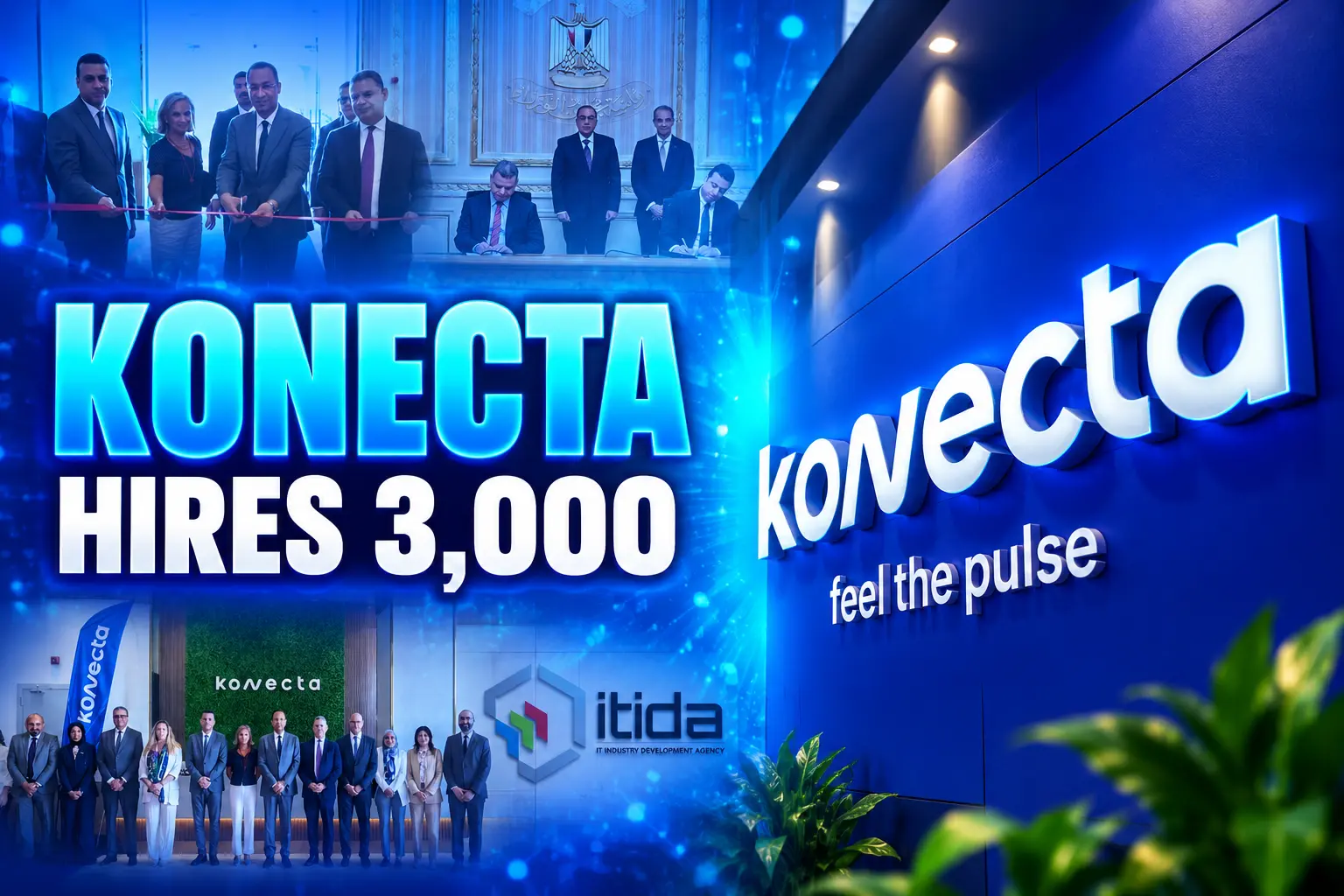
Minister of Communications and Information Technology Raafat Hendy opened Konecta’s regional office in New Cairo as the Middle East and Africa hub, and as the first Global Center of Excellence for Generative AI in the group. The pitch is automation. The staffing plan is a hiring wave.
Konecta Put Its First Global AI Centre in New Cairo
The ministry said the office will serve the Middle East, Africa, Europe and the Americas. The work list is digital customer experience, artificial intelligence, data analytics, technical support and Internet of Things. Hendy toured Kolibri, Konecta’s agentic AI platform, and credited Egyptian teams with design, testing and local development.
Konecta’s own note the next day was more precise on headcount than the ribbon. In under 18 months from the January 2025 launch, the Egypt team had grown to 600 highly skilled professionals and was on track for 800 by the end of 2026, toward a long-term goal of 3,000 people by the end of 2028.
Ahmed El Harany, vice chairman for the Middle East and Africa, used the visit to move Egypt out of the “delivery location” box.
Egypt is not just a delivery location for Konecta, it is our regional headquarters and home to our first global Center of Excellence for Generative AI. Growing to 600 professionals, and to 800 by the end of this year, reflects both the depth of Egyptian talent and the confidence our global clients place in AI-powered digital customer experience delivered from Cairo.
Ahmed El Harany, Vice Chairman for Middle East and Africa, Konecta, 29 July 2026 note
The ministry listed seven languages for the Cairo office: Arabic, English, French, German, Italian, Spanish and Dutch. Founded in Madrid in 1999, Konecta says it employs 109,000 people in 40 languages across 28 countries and four continents, with about €2 billion in sales and more than 500 clients.
Kolibri Is the Product Cairo Will Build
The CoE label is the part Egyptian officials wanted on the plaque. The centre is meant to design, build and deploy generative AI and agentic AI for the group, including Kolibri, rather than only answer phones. Konecta says Kolibri is an orchestration platform that sits between AI agents, human experts and company systems, with about 80% of its industry use cases already preconfigured.
THE CAIRO CENTRE’S BRIEF
- The product: Egyptian teams work on Kolibri and other gen-AI tools that Konecta wants to roll out across more than 500 clients.
- The live account: After a September 2025 start, the Cairo floor already runs e-commerce operations for Lenovo, with talks about CX outsourcing and AI-enabled services.
- The other work: The same hub sells digital customer experience, technical support, digital transformation, data analytics, cybersecurity and IoT from Egypt.
- The training pact: Konecta and the Information Technology Industry Development Agency are running joint upskilling so Egyptian staff can be sold as export talent, not only as a cheap bench.
That mix is the irony in plain sight. A “centre of excellence” for generative AI still has to be staffed, trained and managed like a classic offshore build, because the models do not ship themselves and the clients still want a human in the loop when a bot fails.
Spanish Sites Have Been Losing Seats for Two Years
The other half of the same company is not hiring. Union figures put Konecta’s Spanish workforce at 18,800 in late 2023 and 16,500 by early 2025, a 12% cut. Emiliano López Rodríguez, CCOO’s state secretary at Konecta, has asked for an urgent meeting and said a drip of disciplinary exits, missed targets, site moves and one-to-one departure calls is how the group is putting AI in, spread across more than 15 companies so it never quite becomes one national file.
Konecta’s Spanish job cuts have already run through Güeñes, Elche and La Carolina while Cairo was being staffed.
THE SPANISH BENCH
- The 2024 file: A group ERE started from 602 forced exits and closed on 75 forced plus 160 voluntary, after CCOO and other unions pushed the mix toward people who wanted to leave.
- Castilian in 2026: The Elche committee called a strike against an ERE for 104 Elche jobs, more than 65% of that centre, with 12 people named in Cordoba and 9 in Madrid, 125 in all, tied to a MasMovil campaign winding down.
- The inspectorate: CCOO said in February 2026 that the labor inspectorate had not accepted the productive and organizational causes Castilian used to justify that collective firing.
- Güeñes: Workers protested in Bilbao on 24 June 2026 over exits on the Iberdrola campaign, one more local fight in a national drip.
CCOO’s Konecta section put the inspectorate finding on the record itself.
🚨 INSPECCIÓN DE TRABAJO CUESTIONA EL ERE DE CASTILIAN
La Inspección de Trabajo ha sido clara:
❌ No quedan acreditadas las causas productivas y organizativas que la empresa alegó para justificar el despido colectivo en Castilian (Grupo Konecta). pic.twitter.com/jQW0I4tkyD— ccoogrupokonecta (@ccoo_konecta) February 24, 2026
Lost campaigns are real. So is the AI story management tells investors. Arantza Aretxabala, a LAB delegate, put the cheaper version in one line: the future is an app and an algorithm, because it costs less. Cairo is where some of that stack is now supposed to be built.
Why Egypt Wants the Product Work
Hendy used the visit to argue that Egypt is moving outsourcing up the value chain, from voice seats toward AI-driven exports. Ahmed Elzaher, chief executive of ITIDA, said hosting the global gen-AI centre fits a shift toward higher-value digital services and supports job quality and export growth. The opening closed a loop started by the January 2025 memorandum of understanding, signed with Prime Minister Mostafa Madbouly present, then-minister Amr Talaat in the room, and Group CEO Nourdine Bihmane on the Konecta side.
Konecta Launches Global AI Hub in Egypt
Under the auspices of H.E. Dr. Mostafa Madbouly & H.E. Dr. Amr Talaat, ITIDA, led by Eng. Ahmed El Zaher, signed an MoU with Konecta to invest $100M, create 3,000 jobs, and establish its first Generative AI Center in Egypt.#Egypt #ITIDA pic.twitter.com/q3xYZeFBWK
— ITIDA (@ITIDA) January 9, 2025
ITIDA’s own MoU note said Konecta would put about $100 million in over three years and hire nearly 3,000 specialists in digital and technical services, and that Egypt would host the group’s first Global Center of Excellence for Gen-AI. Service delivery started in September 2025. The July 2026 visit was the public confirmation, 18 months later.
EGYPT’S OFFSHORE BASE
- $5.2 billion: ITIDA put 2025 offshoring export revenue at that figure, from 252 export companies, 177 of them multinational.
- 195,000 specialists: Those export operations already employ more than that many people across 282 delivery centres.
- The giants: Teleperformance employs about 26,800 in Egypt; Concentrix runs 13 centres with 24,500 people.
Against that base, Konecta’s 3,000-person target is a specialist bet, not a mass-employment shock. The prize for Cairo is the CoE mandate and a named product, Kolibri, sitting on the global roster.
A $100 Million Plan Still Needs 3,000 People
Count the seats and the AI story looks like a labor story with a new badge. The company is still asking Egypt for a bench that, at the 2028 target, would be five times the July 2026 count of 600.
WHERE THE HEADS SIT
| Place | Staff figure | What the site is for |
|---|---|---|
| Egypt, New Cairo | 600 in July 2026; 800 by end of 2026; 3,000 by end of 2028 | MEA headquarters and first global gen-AI CoE |
| Spain (union count) | 16,500 by early 2025, down from 18,800 | Home market, split across more than 15 group companies |
| Group | 109,000 people in 28 countries | Customer experience and digital BPO in 40 languages |
End-2026’s 800 is still a live target as of October 2026. End-2028’s 3,000 is a plan, not a payroll. If both hold, Cairo becomes a few percent of group headcount and a much larger share of the group’s AI story.
Cairo’s Headcount Is Tiny Beside Egypt’s BPO Giants
Teleperformance’s Egyptian workforce is already about nine times Konecta’s 2028 target. Concentrix is about eight times. Those firms are the volume shops. Konecta is trying to arrive as the group that puts product work, not only night-shift languages, on an Egyptian contract.
That is why the Kolibri tour mattered more than the headcount slide in the ministry readout. Hendy needed a picture of Egyptians building the tool, not only speaking Dutch and German on it. Elzaher needed the same picture for a sector that is trying to keep export growth while clients install bots.
The cost side of that picture is quieter. S&P Global Ratings, writing on parent KronosNet Topco, has ICG owning 80% of the equity and management the rest. The same credit work flags nearshoring and offshoring as a weight on price even as gen-AI tools are supposed to lift productivity. Cairo sits in that squeeze: cheaper delivery, plus the team that is meant to make the software that reduces seats somewhere else.
Bihmane Says Some Jobs Will Disappear
Katalyst 2028 is the plan that ties the two geographies together. On 14 February 2025, Konecta said shareholders and lenders had put up €150 million in Katalyst 2028 funding, split 50/50 between equity and debt, to speed gen-AI at scale. The three-year map aims at €2.5 billion in revenue by 2028, with 30% to 40% from gen-AI digital services, a Konecta Digital unit, and training for 4,000 employees on advanced gen-AI tools.
The February 2025 note already listed a new multilingual hub in Egypt among the geographic moves, alongside India and a Gulf tie-up. Cairo is not a side project that wandered into the brochure. It is one of the places Katalyst is supposed to become real.
Obviously some jobs will disappear; I will not lie, but not all jobs will disappear. I think there is a false belief that you introduce artificial intelligence and it already does everything for you. That is never the case.
Nourdine Bihmane, CEO, Konecta
He has also said empathy and creativity remain human, and that angry customers still want a person, not a bot that catches half the point. That is the hybrid line the company is selling to clients. In New Cairo it funds a 3,000-person build. In Spain it arrives as a thinner roster and a string of local fights. The generative AI centre is both of those things at once.
By the end of 2028, Konecta either has a 3,000-person Egyptian hub that actually ships Kolibri, or it has another offshore campus with an AI name on the door. The Spanish sites will not get that choice. Their headcount has already moved.

Cook Hands Democrats the House as Crypto’s Bill Stays Dead

Wicker’s Broken Bed Was the Short Story’s Punch Line

Nvidia’s $500 Billion Financing Plan Draws a $180 Sell

Maserati Bets the Grecale V6 Can Fill Porsche’s Gap

EV Cable Theft Follows the Old Railway Copper Playbook

Aramco Crash Kills 14 Two Days After Oil Restart

Salah Captained Egypt to Their First World Cup Win

Zelda’s 40th Switch 2 Ships Without a Zelda Game

Apple Labor Day Deals Hide June’s Memory Price Hike

Palworld 1.0.4 Adds Palpedia Search After the 1.0 Launch
-
 BUSINESS4 months ago
Aramco Crash Kills 14 Two Days After Oil Restart
-
 NEWS5 months ago
Salah Captained Egypt to Their First World Cup Win
-
 GAMING2 months ago
Zelda’s 40th Switch 2 Ships Without a Zelda Game
-
 NEWS2 months ago
Apple Labor Day Deals Hide June’s Memory Price Hike
-
 GAMING2 months ago
Palworld 1.0.4 Adds Palpedia Search After the 1.0 Launch
-

 NEWS4 months ago
El Niño Puts Israel’s Needed Winter Rain on a Flood Clock
-

 BUSINESS8 months ago
BAE’s 60-Year Saudi Franchise Now Runs Through Taif
-

 ENTERTAINMENT2 months ago
King Charles Letter Keeps Harry and Meghan as Private Citizens