
BUSINESS
Siemens Egypt Factory Turns a Grid Crisis Into Hardware
Siemens opened a Cairo switchgear plant on July 28, 2026, a modest localization play after 14.4 GW of gas plants still left Egypt rationing power.

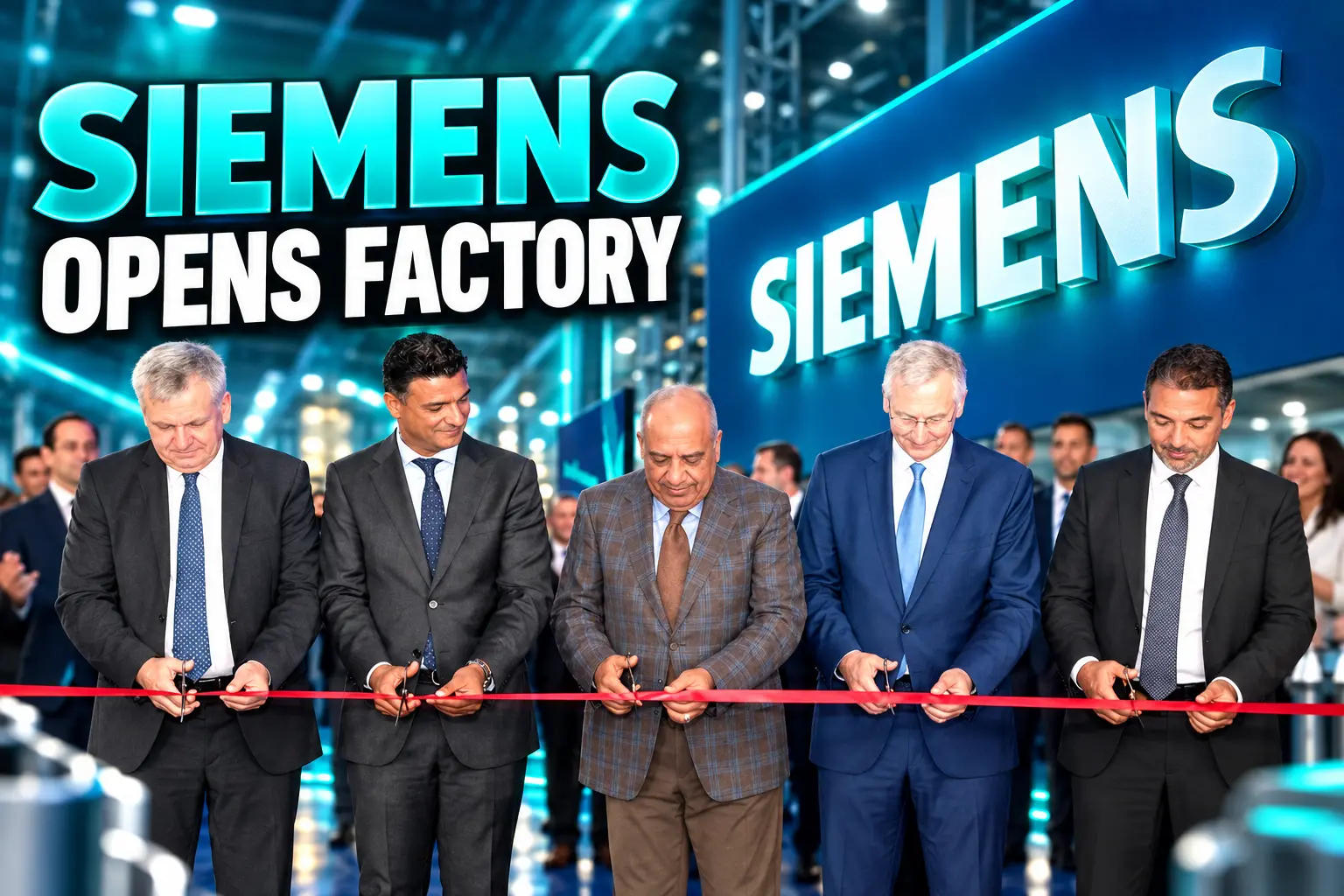
Siemens opened an Electrification and Automation factory in Cairo on July 28, 2026, to make switchgear Egypt used to import. Electricity Minister Mahmoud Esmat and Industry Minister Khaled Hashem joined Siemens AG executives at the ceremony, with German Ambassador Jürgen Schulz also in the room.
The plant is Siemens’ first wholly owned factory in the country after 125 years of working through local partners. It is a small bet next to the gas units the company already installed, and it arrives after two summers when the grid had the turbines but not the fuel.
Four Lines of Hardware Leave the Floor
The site east of Cairo is built around localizing production of critical energy technologies that transmission and distribution companies order when they add feeders, substations, or wind and solar plants. Siemens said the kit is also meant for Egyptian engineering firms working in North Africa and the wider continent.
THE FOUR PRODUCT LINES
| Product | Job on the grid |
|---|---|
| Switchgear | Breaks and isolates heavy current so a fault stays local |
| Substation control and monitoring | Watches transformers and feeders as renewable output swings |
| Protection systems | Trips a bad section in milliseconds before it spreads |
| Embedded cybersecurity | Hardens those control boxes against network attacks |
Hashem toured production and storage bays, automation test rooms, a communications lab, and a Customer Experience Center that shows digital twin and IoT tools for grid work. Those rooms are the sales floor for utilities that still buy most of this gear from abroad.
The 14.4 GW Plants Could Not Stop the Cuts
Siemens has been in Egypt since a telegraph line went in between Suez and Aden in 1859. On February 8, 2026, Roland Busch, president and chief executive of Siemens AG, marked 125 years in Cairo, and the company said it added 14.4 gigawatts of capacity at Beni Suef, Burullus, and the New Administrative Capital with Orascom Construction and Elsewedy Electric.
That megaproject went up in 27.5 months and lifted national generation by more than 40 percent, a build that ended an earlier shortage of plant. The 2023 and 2024 blackouts were a different failure. Most Egyptian power stations burn gas, the power sector takes about 60 percent of the country’s supply, and output at the Zohr field slipped from more than 2.7 billion cubic feet a day at its peak to about 1.9 to 2 billion in 2024.
Daily load shedding began in July 2023. In June 2024 the cabinet stretched scheduled cuts to three hours a day in a heatwave, and Prime Minister Mostafa Madbouly said the state would bring in mazut and gas worth about $1.18 billion to stop the programme. He declared the year-long cuts over on September 19, 2024. Households then got through summer 2025 with power largely intact, according to the electricity ministry’s own year-end account of the gas mismatch.
Localizing the production of critical energy technologies is key to building resilient infrastructure and competitive industries. With our new facility, we bring production closer to our customers, strengthening supply chains, accelerating delivery and supporting Egypt’s industrial growth and energy transition.
Stephan May, CEO of Electrification and Automation, Siemens, at the Cairo opening
May’s brief is lead time and cyber standards, not fuel. The new line does not make cubic metres of gas. It makes the panels and protection boxes a utility needs when it is adding solar and wind faster than the old import queue can keep up.
FROM CUTS TO A LOCAL LINE
- July 2023: Egypt starts daily load shedding as gas supply tightens.
- June 2024: Scheduled cuts stretch to three hours a day in a heatwave.
- September 2024: Siemens and the Industrial Development Authority agree to make electrical products in Egypt.
- September 19, 2024: Madbouly says the load-shedding programme is finished.
- May 18, 2026: President Abdel Fattah el-Sisi moves the clean-energy target to 45 percent by 2028.
- July 22, 2026: Peak demand hits 39,300 MW, Esmat says, about 2,000 MW above the same day a year earlier.
- July 28, 2026: Siemens opens the Electrification and Automation factory.
The factory’s own 2024 deal with the authority, signed by Siemens Egypt chief executive Mostafa El-Bagoury and IDA chairwoman Nahed Youssef, was about local manufacturing of low and medium voltage products, including medium-voltage panels and low-voltage breakers. Stephan May and Andreas Matthe, then Siemens’ electrical-products chief, witnessed that signing. The opening in July 2026 is that paper becoming a floor.
What Egypt’s Grid Still Has to Absorb
Egypt now wants renewable energy to supply 45 percent of electricity by 2028, three points higher and two years sooner than the old 42 percent goal for 2030. That shift was set on May 18, 2026. The International Renewable Energy Agency put installed renewable capacity at 9,258 MW at the end of 2025, up 1,542 MW from 7,716 MW a year earlier, with onshore wind at 3,028 MW, solar PV at 3,247 MW, and hydropower at 2,832 MW. That was 14.6 percent of installed capacity, up from 12.5 percent. Generation is still mostly thermal.
Esmat said the sector added more than 35,000 MW over the past decade. He also said summer 2026 ran without a return to load shedding, grid losses had fallen to 17.6 percent, and tighter plant dispatch cut fuel use to under 170 grams per kilowatt-hour, saving the equivalent of EGP 70 billion over two years. On July 22, 2026, six days before the Siemens ribbon, he put the day’s peak at 39,300 MW. The record load of 39,500 MW on August 12, 2025, had already beaten 2024’s 38,000 MW peak.
SUMMER LOADS AND THE 2028 TARGET
- 2024 peak: 38,000 MW, with rolling cuts still in living memory from that year and 2023.
- August 12, 2025: 39,500 MW, the highest load the National Energy Control Centre had logged to that date.
- July 22, 2026: 39,300 MW, with the ministry saying it had no plan for scheduled cuts.
- 2028 goal: 45 percent of electricity from green sources, against 14.6 percent of installed capacity at the end of 2025.
A plant that bolts together a few thousand panels cannot close that gap. Battery storage of about 1,100 MWh was due across 2025 and 2026, and the El-Dabaa nuclear plant’s 4,800 MW is years from full output, though Esmat said the second unit’s reactor pressure vessel went in during July 2026. The hardware Siemens is now building in Cairo is the unglamorous layer that lets those new electrons move without taking the old network down.
A $6.9 Million Plant After 125 Years
El-Bagoury told an interview the day of the opening that the factory is Siemens’ first wholly owned plant in Egypt and that it had already started production. He put the cheque at $6.9 million (EGP 350 million), initial output at about 2,000 electrical panels, and locally sourced parts at about 40 percent, with both capacity and local content meant to rise. Siemens employs over 2,000 people in Egypt, a separate headcount from those panels.
THE PLANT IN FIGURES
- Ownership: First wholly owned Siemens factory in Egypt, after a century of partner plants.
- Cheque: $6.9 million (EGP 350 million), per El-Bagoury on opening day.
- Starting output: About 2,000 electrical panels, with more product types to follow.
- Local parts: About 40 percent of components now, with a plan to lift that share.
That is assembly and localization money, not another Beni Suef. The National Industry Strategy 2024-2030 lists electrical and engineering industries as a priority, and Hashem tied the opening to a government aim of $100 billion in industrial exports by 2030. The Siemens line is one floor in that plan, not the plan itself.
Cairo Wants the Next Panels Sold Abroad
Esmat said the government is writing rules to raise local content in renewable projects, and that this factory will supply Egypt first before it sells into the Middle East and Africa. El-Bagoury said Egypt’s location and the Suez Canal are why the company wants a regional hub, and he pointed to the high-speed electric railway as a reason industrial investors still come. Siemens is also on that 2,000-kilometer rail system, which the company says will serve nearly 90 percent of the population.
Export volumes were not published at the opening. The honest sequence is domestic panels now, a sales story later. Elsewedy Electric, Siemens’ partner on the 14.4 GW gas plants, already makes electrical gear in Egypt, so the new line puts a German name on a market local groups already know. The political fight over rolling cuts has gone quiet since the ministry ran summer 2026 without a load-shedding timetable, which is the climate in which a modest factory can be sold as industrial policy rather than emergency kit.
El-Bagoury put the shift in one line at the ceremony. “The new facility represents Siemens’ latest step in a journey that combines global expertise with local empowerment, delivering cutting-edge technologies made in Egypt, for Egypt and beyond,” he said.
Training Rooms Open Onto the Factory Floor
Co-located with the line is the Siemens Power Academy, with purpose-built rooms next to live production so trainees can see panels being built while they learn to design, run, and maintain them. In its first year the academy is to train factory staff plus engineers from partners and customers. Siemens has run vocational programmes in Egypt before, including work tied to the megaproject, and this site puts that teaching beside the new products.
The Customer Experience Center sits in the same envelope, a place for utilities to walk through digital twin and IoT demos rather than fly a team to Europe. That does not change the arithmetic of 45 percent by 2028. It does change who can turn a wrench on a Siemens panel without waiting on an imported spare.
Production has started at about 2,000 panels with about 40 percent local content. The summer that framed the opening ended without scheduled cuts, on fuel, dispatch, and grid work that were already in train. The factory’s test is whether those panels, and the people trained beside them, show up in substations here and then next door.
Frequently Asked Questions
When Did Siemens First Work in Egypt?
Werner von Siemens oversaw Egypt’s first telegraph line in 1859, linking Suez and Aden, which the company treats as the start of the relationship. The 125-year celebration was held in Cairo on February 8, 2026, with Roland Busch, president and chief executive of Siemens AG, in attendance alongside German and Egyptian officials.
Who Signed the 2024 Manufacturing Deal With Siemens?
Mostafa El-Bagoury signed for Siemens Egypt and Dr. Nahed Youssef signed as chairwoman of the Industrial Development Authority. Stephan May and Andreas Matthe witnessed the memorandum, which covered local making and assembly of low- and medium-voltage electrical products, including medium-voltage panels, distribution boards, and low-voltage circuit breakers.
How Is Siemens Organized in Egypt Today?
The group operates through three companies: Siemens Industrial for electrification, automation, and digitalization; Siemens Mobility for rail, including the high-speed network; and Siemens Digital Industries Software, which runs a research and design hub on the Xcelerator platform. Combined staff is over 2,000 people, most of them Egyptian.
How Much Renewable Capacity Did Egypt Have at the End of 2025?
IRENA’s Renewable Capacity Statistics 2026 put the total at 9,258 MW, after a 1,542 MW rise from 7,716 MW in 2024. Onshore wind rose 829 MW to 3,028 MW, solar PV rose 713 MW to 3,247 MW, hydropower was unchanged at 2,832 MW, and concentrated solar (20 MW) and bioenergy (131 MW) did not add capacity that year.

Cook Hands Democrats the House as Crypto’s Bill Stays Dead

Wicker’s Broken Bed Was the Short Story’s Punch Line

Nvidia’s $500 Billion Financing Plan Draws a $180 Sell

Maserati Bets the Grecale V6 Can Fill Porsche’s Gap

EV Cable Theft Follows the Old Railway Copper Playbook

Aramco Crash Kills 14 Two Days After Oil Restart

Salah Captained Egypt to Their First World Cup Win

Zelda’s 40th Switch 2 Ships Without a Zelda Game

Apple Labor Day Deals Hide June’s Memory Price Hike

Palworld 1.0.4 Adds Palpedia Search After the 1.0 Launch
-
 BUSINESS4 months ago
Aramco Crash Kills 14 Two Days After Oil Restart
-
 NEWS5 months ago
Salah Captained Egypt to Their First World Cup Win
-
 GAMING2 months ago
Zelda’s 40th Switch 2 Ships Without a Zelda Game
-
 NEWS2 months ago
Apple Labor Day Deals Hide June’s Memory Price Hike
-

 NEWS4 months ago
El Niño Puts Israel’s Needed Winter Rain on a Flood Clock
-
 GAMING2 months ago
Palworld 1.0.4 Adds Palpedia Search After the 1.0 Launch
-

 BUSINESS8 months ago
BAE’s 60-Year Saudi Franchise Now Runs Through Taif
-

 BUSINESS8 months ago
Egypt Bets EGP 638 Billion Can Open Sinai to Investors