
NEWS
Jordan Downs Two Drug Balloons as Smugglers Take to the Air
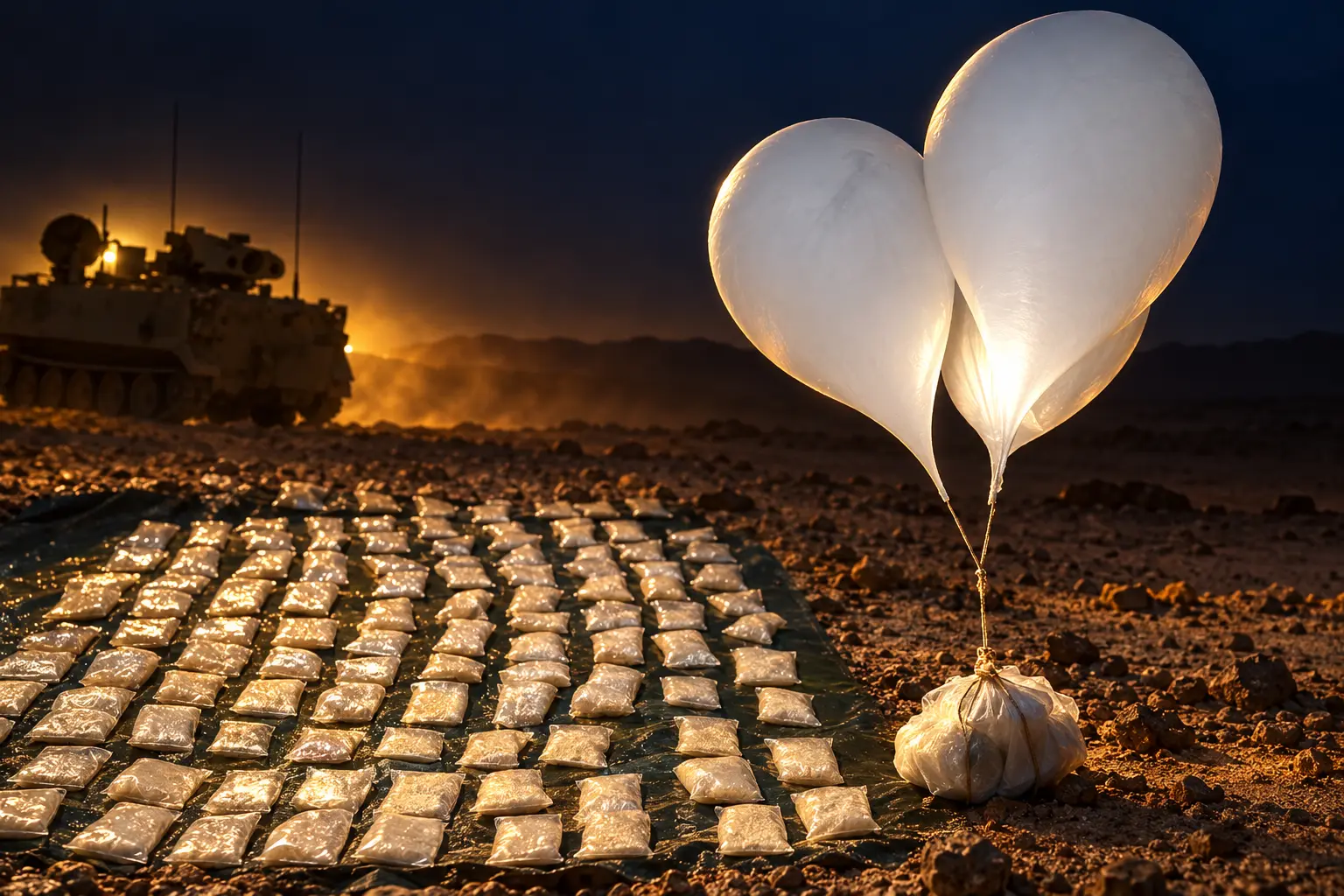
Jordan downed two guided drug balloons on August 11, as Syrian Captagon networks shifted from land routes to helium lifts.

Jordan’s Border Guard brought down two guided balloons carrying narcotics on the eastern frontier before dawn on August 11, 2026. The balloons had already crossed into Jordanian airspace. Units of the Eastern Military Region seized the cargo with military security agencies and the Anti-Narcotics Department.
The Jordan Armed Forces-Arab Army said the intercepts showed those units can spot new trafficking methods and stop them. The methods had already left the fence line for the air.
Two Balloons Came Down Before Dawn
The army gave no pill count for the August 11 loads. It described only “large quantities” of narcotics, then sent the haul to the competent authorities. A day earlier, the same eastern command had already brought down balloons on the same front.
That pairing matters more than a single night’s catch. Crews on the Syrian side were testing the same cheap lift on consecutive mornings, which is what you do when the road is no longer safe and a lost crate is priced as a cost of business.
the Kingdom’s borders will remain protected against attempts to breach or exploit them for smuggling
Jordan Armed Forces-Arab Army statement, August 11, 2026
The line is stock military language. The hardware under it is not. These were guided balloons, not weather toys that drifted off a fairground, and they were already inside Jordan when the Border Guard cut them down.
After August, the Same Trick Kept Coming
The August 11 pair did not close the file. Eastern units stopped two more guided balloons on September 8, then four separate balloon runs the next morning. That second night, the Eastern Military Zone said it seized around 500,000 narcotic pills. Southern units stopped another balloon load on September 10.
THE BALLOON WAVE AROUND THE AUGUST INTERCEPTS
- August 10, 2026: Eastern units detect and bring down guided balloons carrying a large narcotics load inside Jordan.
- August 11, 2026: The same command stops two more balloon runs after they enter Jordanian airspace.
- September 8, 2026: Eastern units again stop two guided balloon attempts on the eastern border.
- September 9, 2026: Four balloon runs are brought down; around 500,000 narcotic pills are seized.
- September 10, 2026: Southern Military Zone units stop a balloon load on a different front.
- September 24, 2026: The Anti-Narcotics Department warns helium traders and sends arrested vendors to the State Security Court.
Charles Lister, who directs the Syria program at the Middle East Institute, put the September cluster in one week’s arithmetic. He wrote that Jordan had already taken 550,000 captagon pills off GPS-guided balloons from Suwayda’s southern desert, then another four waves carrying about 500,000 pills overnight, a week’s haul he put at 1.05 million pills and about $15 million at street prices.
The Load Left the Road for the Sky
Captagon is an amphetamine-type stimulant pressed into pills. For years it moved toward the Gulf on trucks, on foot, and in armed runs at the fence. Jordan answered that land war with looser rules of engagement, airstrikes on warehouses in Suwayda, and night patrols that made a human courier a bad bet.
An October 2026 policy report from the New Lines Institute for Strategy and Policy, by Caroline Rose, Karam Shaar, and Roaa Obeid, ties the air shift to that pressure. By 2025, they found, aerial methods had become a core part of the trade because overland routes had grown more dangerous under tighter border security, lethal responses, and cross-border airstrikes. Drones and GPS-tracked balloons cut out the courier and keep the launch crew off the fence.
That is the second blow in a single intercept. A balloon that dies over Jordan is a lost crate. It is also evidence that the old road run is no longer the easy option, which is why the launches keep coming in small, frequent loads instead of one fat convoy.
The older Captagon war on the Syrian border was a ground fight: tribes, militias, and, under Bashar al-Assad, a trade that Jordanian officials said enjoyed cover from undisciplined Syrian units. Assad’s government fell in December 2024. The industrial model around it broke. The demand in the Gulf did not.
Silent Balloons Took Over From Drones
Balloons were not the first aerial tool. Military data covering January 1 to July 16, 2025, a span of 197 days, said the army downed 310 drug-carrying drones, an average of 51 a month, nearly two a day. In the same period, crews had already started sending up balloons that looked like children’s toys, fitted with crude remote gear and carrying up to 500 grams of crystal meth.
The balloon won the air war on cost and quiet. A drone has a motor, a radio signature, and a habit of drawing fire. A helium envelope can be filled in a wadi, walked to a launch point, and sent south on a GPS track with no rotor noise. Researchers who log these runs describe a timed burn on the tether that dumps the crate over a plotted point inside Jordan, so the launch crew never has to cross.
THE SHIFT INTO THE AIR
- Drone surge: Border units downed 310 drug-carrying drones between January 1 and July 16, 2025, about 51 a month.
- Balloon share: In 2025, balloons made up about 87.5% of aerial captagon intercepts on the Syria-Jordan line; drones made up about 12.5%.
- Early balloon load: Some of the first toy-like balloons carried up to 500 grams of crystal meth on primitive remote gear.
- Method on file: The army had already stopped four balloon attempts at dawn on December 13, 2025, using improvised guidance devices.
New Lines put the 87.5% share in that 2025 aerial split. The remaining 12.5% were drones. In other words, by the time the August 11 pair came over the eastern front, the silent lift was already the main aerial method, not a stunt.
HOW A GUIDED DRUG BALLOON RUN WORKS
- The gas: Helium, sometimes bought through desert middlemen, fills an envelope that can be staged far from the fence.
- The brain: A GPS unit and a basic control board steer the balloon toward a drop point inside Jordan.
- The dump: A burn-away tether or a remote release drops the crate so the envelope does not have to land intact.
- The math: Each crate is smaller than a truck load, so one intercept hurts less than a seized lorry.
Iraq has seen the same kit on its western line, which is how you know the method is a regional workaround, not a one-border gag. The launch geography still points at southern Syria.
Why the Average Haul Got So Small
Jordan is stopping more shipments and taking less per stop. New Lines found that the total volume of captagon seized in Jordan in 2025 stayed broadly comparable to 2024, while the number of seizures along the Syria-Jordan border more than doubled. The institute also logged a median seizure size falling by nearly 60% as traffickers leaned on drones and balloons that cannot match a truck.
MEDIAN CAPTAGON PILLS PER REPORTED SEIZURE
| Year | Median pills per seizure |
|---|---|
| 2022 | More than 600,000 |
| 2023 | Roughly 280,000 |
| 2024 | About 240,000 |
| 2025 | Under 100,000 |
The drop from about 240,000 in 2024 to under 100,000 in 2025 is the “nearly 60%” shift. It is not a collapse in demand. It is a change in package size. Small, frequent aerial drops replace large, rare land loads, and a lost balloon is cheaper than a lost convoy.
Through August 2026, New Lines counted 163 seizures tied to the Jaber-Nasib corridor from December 2024. Of that run, 79 captagon-related interdictions in Jordan fell in 2026, against a 2025 total of 80, which is why the institute expected 2026 to overtake the prior year. More stops, smaller bags: that is the balloon economy in a ledger.
On the Syrian side, the new authorities told a different volume story. New Lines said they thwarted more than 20 prepared smuggling shipments in the south after Assad fell, and that 2025 seizures inside Syria were 25 times the 2024 figure taken under the old regime. Caroline Rose, a fellow at The Soufan Center who has long tracked the file at New Lines, said at least 15 large industrial labs had been disrupted. Production broke into smaller rooms. Transit did not stop.
Suwayda’s Desert Turns Into a Launch Pad
The balloons Jordan is cutting down are not launched from a ministry courtyard in Damascus. They come out of the south, above all Suwayda’s desert and the Hamad expanse that runs toward the Jordan-Iraq meeting point. Launch crews can fill an envelope miles from the fence, in empty ground, and never put a gunman on the wire.
Lister wrote that trafficking from Suwayda toward Jordan had surged 380% in the 14 months after Sheikh Hikmat al-Hijri took control there. That figure is his tally, not a government release, and it sits beside a political fact Jordan cannot police from its own berm: the people sending the balloons live on the other side of a fragmented security map of factions, tribes, and criminal families.
Work on the future of the illicit Captagon trade had already located the Jordan frontier in Daraa and Suwayda, among rival networks that both competed and cooperated through the war years. The Captagon networks that survived Assad’s fall did not need the old 4th Division monopoly to keep a balloon in the air. They needed helium, a GPS board, and a stretch of desert with no checkpoint.
Syrian interior forces have been chasing the same kit on their own soil. In February they announced a southern haul of 75 balloons, more than two million captagon pills, and 610 helium canisters. In December 2025 they said they had arrested a man in the desert with balloons, batteries, and wireless gear aimed at Jordan. Those are Syrian claims, and they point at the same hardware Jordan keeps pulling out of its sky.
Helium Sales Now Carry a Court Date
By late September the air war had a domestic address in Amman. On September 24, 2026, the Anti-Narcotics Department of the Public Security Directorate warned helium importers and dealers against selling gas for balloon loads. Investigations had already found traders who supplied smugglers. Vendors and the traffickers who took the cylinders were arrested and referred to the State Security Court.
The department told suppliers to document every sale and to refuse suspicious orders. It said it was working with the army to watch new tactics, including helium-filled balloons, and that anyone who helped move drugs into Jordan or on to a neighbour would be prosecuted. The second-order effect of a successful border shot is a court file on a gas merchant who never went near the fence.
That is where the August 11 intercepts sit, seven weeks on. Two balloons came down on a Tuesday morning with no published pill count. The weeks around them filled with more envelopes, a 500,000-pill night in September, a helium warning in Jordanian shops, and a study that says the median bag is a fraction of what it was when the trade still rode on wheels. The army can keep cutting the strings. The crews who light the burn can keep sending the next crate from a wadi the patrol never sees.

Christa Pike Survived the Execution Tennessee Would Not Pause

Musk’s Oligarch Charge Hits a Queue of Three

Circle Puts USDC and EURC Into SAP Pay Workflows

Ring’s First Smart Lock Skips Home Wi-Fi for Sidewalk

GTA 6 Puts Cash Back on the Story Path

Salah Captained Egypt to Their First World Cup Win

Aramco Crash Kills 14 Two Days After Oil Restart

Apple Labor Day Deals Hide June’s Memory Price Hike

Zelda’s 40th Switch 2 Ships Without a Zelda Game

Palworld 1.0.4 Adds Palpedia Search After the 1.0 Launch
-
 NEWS5 months ago
Salah Captained Egypt to Their First World Cup Win
-
 BUSINESS4 months ago
Aramco Crash Kills 14 Two Days After Oil Restart
-
 NEWS2 months ago
Apple Labor Day Deals Hide June’s Memory Price Hike
-
 GAMING1 month ago
Zelda’s 40th Switch 2 Ships Without a Zelda Game
-
 GAMING1 month ago
Palworld 1.0.4 Adds Palpedia Search After the 1.0 Launch
-

 NEWS4 months ago
El Niño Puts Israel’s Needed Winter Rain on a Flood Clock
-

 BUSINESS8 months ago
Egypt Bets EGP 638 Billion Can Open Sinai to Investors
-

 BUSINESS8 months ago
BAE’s 60-Year Saudi Franchise Now Runs Through Taif