
BUSINESS
Syria Shut the Captagon Factories and Scattered the Trade
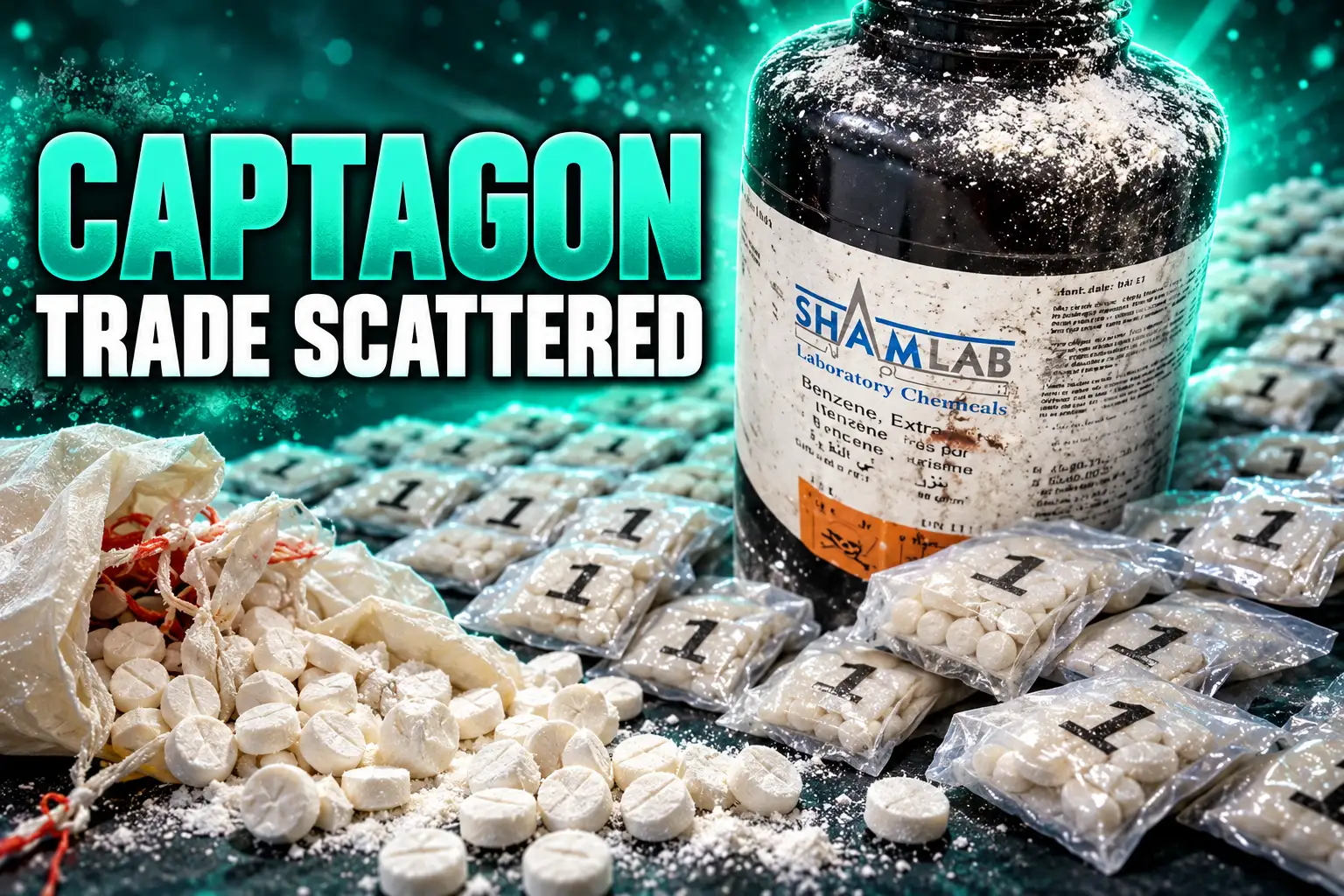
Syria closed industrial Captagon plants after Assad fell, then balloon runs, neighbor labs and methamphetamine kept Gulf supply moving.

Syria’s interior minister declared the Captagon factories dead on 4 June 2025, yet balloon loads and new labs kept the stimulant moving toward the Gulf. Anas Khattab told state television that production had been stopped and that no factory still made the amphetamine-type pills inside the country.
The plants that had sat in Fourth Division country did come down. Gulf demand did not fall with them, and the people who knew the recipe did not vanish with Maher al-Assad’s units.
Khattab Told State TV the Factories Were Finished
Khattab, speaking on Al-Ikhbariya, said the new authorities had confiscated production equipment and were hunting hidden caches. Most of the sites, which he put in the dozens, had been in the Damascus countryside, along the Lebanese border, and on the coast, ground he tied to the Fourth Division once led by Bashar al-Assad’s brother.
We can say that there no longer is any factory that produces Captagon in Syria.
Anas Khattab, interior minister, on Al-Ikhbariya
The United States had sanctioned that division in 2020 over illicit revenue schemes that included Captagon. After Assad fell on 8 December 2024, the transitional government made the abandoned plants a public exhibit, walking journalists through stockpiles in places such as Douma.
Caroline Rose, who leads the Captagon Trade Project at the New Lines Institute, said the first move was simple: seize the biggest, most obvious sites tied to officials who had already fled, and invite cameras in. The harder job, she said, is the smaller remnants along the coast and the borderlands, where the new state still struggles to buy local cooperation.
What the United Nations Counted After Assad
The United Nations Office on Drugs and Crime, in its World Drug Report 2026, said the change of government produced a profound shift in the market. Syrian authorities, in that account, dismantled 16 laboratories, mostly industrial, and 15 storage sites. The Near and Middle East had accounted for 77 percent of global Captagon seizures from 2020 through 2024, with production concentrated in Syria and Lebanon and the main buyers on the Arabian Peninsula.
A December 2025 research brief from UNODC and the Naif Arab University for Security Sciences put the older geography in hard shares. Between January 2019 and November 2025, 80 percent of regional seizures with a known origin pointed back to Syria. After the factories came apart, UNODC could still only verify a floor of 177 million tablets, about 30 tons, from individual cases across the Arab region. Syria itself reported seizing more than 500 million tablets from December 2024 through November 2025. Lebanon reported 78 million in the same window, more than its 2023 and 2024 totals combined.
SEIZURES COUNTED AFTER THE ASSAD GOVERNMENT FELL
| Who counted | How many | When |
|---|---|---|
| Syrian authorities, via UNODC | More than 500 million tablets | December 2024 to November 2025 |
| UNODC verified cases, Arab region | At least 177 million tablets (30 tons) | Since December 2024 |
| Lebanon, via UNODC | 78 million tablets | December 2024 to November 2025 |
| Jordan Anti-Narcotics Department, via New Lines | About 31 million pills | 2025 |
| Jordan Anti-Narcotics Department, via New Lines | About 27.5 million pills | 2024 |
Those piles are not proof that the presses are still running at the old rate. UNODC warned that stocks laid down before December 2024 could feed trafficking for a couple of years if they are not intercepted, and that daily output under the old system may have run to millions of tablets. Angela Me, UNODC’s chief of research and analysis, said large shipments were still moving through Jordan and that the agency was trying to see where production might be shifting.
On 12 April 2025, Syrian officials announced a warehouse raid in Latakia, the main Mediterranean port, and said about 4 million pills had been packed inside 5,000 iron bars. In the weeks that followed they said they had taken down a factory in Homs and seized another 4 million tablets in the Latakia area. In September 2025 the Interior Ministry reported 500 kg of precursor chemicals hidden in food containers outside Damascus, plus a large quantity of pills.
New Lines, in an October 2026 report by Rose, Karam Shaar and Roaa Obeid, said the new government reported seizing 25 times as much in 2025 as the Assad state had seized in 2024, and that more than 20 prepared smuggling shipments were stopped in southern Syria after the collapse. Bo Mathiasen, UNODC’s director for operations, said a market that once divided the region was now pushing governments into joint raids and shared intelligence, and that 2025 brought record seizures.
Balloons Now Carry Most of the Aerial Loads
The volume crossing into Jordan did not collapse with the factories. The shape of each load did. New Lines found a nearly 60% drop in load size as traffickers moved from truck convoys to drones and balloons, which carry less than a packed lorry. The median seizure, in that database, had peaked at more than 600,000 pills in 2022, then slipped to about 280,000 in 2023, about 240,000 in 2024, and under 100,000 in 2025. In 2025, balloons made up about 87.5 percent of aerial intercepts on that border; drones made up about 12.5 percent.
Jordan’s Anti-Narcotics Department seized about 31 million pills in 2025, against about 27.5 million in 2024. More stops, smaller packages. UNODC logged the same pattern: more attempts, thinner consignments, and new tools, including balloons and drones, sometimes covered by heavy weapons at the crossing.
FROM THE FALL TO THE BALLOON RUNS
- 8 December 2024: Assad’s government falls and industrial Captagon plants begin to be dismantled.
- 12 April 2025: Officials in Latakia report about 4 million pills hidden in 5,000 iron bars.
- 4 June 2025: Khattab says no factory in Syria still produces Captagon.
- September 2025: The Interior Ministry reports 500 kg of precursors in food containers outside Damascus.
- 22 December 2025: UNODC publishes a brief saying large-scale manufacture has been disrupted and stocks could last years.
- 9 September 2026: Jordan’s Eastern Military Zone brings down four guided balloons and seizes about 500,000 pills.
- 30 September 2026: The Anti-Narcotics Department seizes 225,000 pills smuggled from Lebanon into the Damascus countryside.
The balloon method was still in use a year after Khattab’s interview. Jordan’s state news agency said Border Guard units on 9 September 2026 intercepted four guided balloons on an eastern front and recovered 500,000 narcotic pills in guided balloons, working with military security and the Anti-Narcotics Department. Similar shoot-downs had already become a regular border task through 2026, including loads on the order of 100,000 pills.
Southern Syria is the launch pad, not a new mega-factory belt. New Lines found no evidence of large-scale local manufacture there, even as mixed armed control, weak accountability and a cash-dollar cost of living keep smuggling in work. Authority is split among factions, tribal networks, criminal families and new state units. Jordan has struck warehouses and sites in Suwayda and loosened its rules of engagement against armed smugglers, without cutting the flow in a lasting way.
The Recipe Turned Up in Yemen and Lebanon
The know-how survived the raids. Rose told interviewers that labs had already been identified in Lebanon, Egypt, Turkey, Kuwait and Germany, and that production in Iraq had spread into the north. UNODC reported a methamphetamine and Captagon lab taken down in Sulaymaniyah in 2024, and said manufacture seen in past years outside Syria was likely still running in neighboring countries, with some labs dismantled in 2025. It found no verified relocation of Syrian-style plants into Africa, despite speculation.
WHERE SMALLER LABS WERE FOUND
- Lebanon: A clandestine lab in Hermel, near the Syrian border, was dismantled in May 2025 after a truck of manufacturing gear was seized in April; New Lines counted six lab raids in 2025 and five in 2026 to date.
- Yemen: Major General Mutahhar Al-Shuaibi, Aden’s police director, accused the Houthis of setting up a Captagon factory in Al-Mahwit “similar to the factory that was in Syria,” and described the country as a transit zone toward Saudi Arabia.
- Iraq: UNODC recorded the Sulaymaniyah lab in 2024 and earlier attempts to stand up production in southern provinces.
- Turkey, Egypt, Kuwait, Germany: Rose said laboratories were identified in each, a spread she linked to moving production closer to buyers or to European transshipment points.
Yemen’s internationally recognized authorities announced in the summer of 2025 that they had captured more than 1.5 million pills from Houthi-held Sanaa that were bound for Saudi Arabia. New Lines had already watched the Yemen file swell, from 400,000 pills seized in or originating from the country in 2024 to 5.4 million in the first nine months of 2025. Those figures do not by themselves prove a Syrian-scale industry in Saada or Mahwit. They do show that the Red Sea flank is no longer a quiet edge of the trade.
Hezbollah’s share of the Lebanon route has shrunk under border pressure and arrests, according to the October 2026 New Lines paper, and 2026 seizures there were running at nearly half the 2024 total. Small family networks and local crews still press pills. On 30 September 2026, Syria’s Anti-Narcotics Department said it had seized 225,000 pills being walked from Lebanon into Rural Damascus and had arrested two suspects.
Syrian authorities seized 225,000 Captagon pills being smuggled from Lebanon into Damascus Countryside and arrested two suspects, the Anti-Narcotics Department said Wednesday.#Captagon#lebanon#SANAnews pic.twitter.com/bQrUj1yGrr
— SANA English (@SANAEnOfficial) September 30, 2026
Brigadier General Khaled Eid, who directs that department, told a Damascus conference in August 2025 that his service had coordination and training offers but “haven’t received any tangible assistance or support yet,” and that sanctions still got in the way.
A Pill That Sold for $3 Now Costs $7
The New Lines Institute, working from large seizures, put the potential street value of the trade at over $5.7 billion in 2021, up from an estimated $3.46 billion in 2020, on more than 420 million pills seized that year. That number was always a floor built from hauls, not a census of every street sale, and it described the Assad-era industrial peak. It still names the prize that keeps chemists in the business: a Gulf market that paid for containerized output and will pay for thinner loads if that is what remains.
UNODC’s 2026 World Drug Report said the price of a tablet had doubled in some places after the supply shock, and that shortages had appeared in several destination markets. Purity, where labs tested it, had slipped. Inside Syria the picture is foggier. Health workers still describe cheap pills as easy to find, and UNODC said it lacked systematic price and forensic series for the domestic market.
In the Beirut suburbs, a 28-year-old mechanic who began taking Captagon to stay awake at work said the pills were “a bit more difficult to find” and dearer, but not rare. Before, he said, a pill cost $2 or $3. “Now, some people are selling one for $5 or even $7 depending on the type. If you want something guaranteed, you’ll have to pay more. It’s still available; it’s not rare. You just want to know who’s the real deal and who’s the fraud.”
Dr Mousa Daoud Al-Tareefi, president of the Jordan Anti-Drug Society, said availability in Jordan had declined after the Syrian collapse, though some quantities were still coming through. Part of the drop in Captagon use, he said, was a shift toward crystal meth, synthetic cannabinoids sold as “Joker,” and misused prescription drugs that are easier to get or make locally.
Methamphetamine Is Moving Into the Same Markets
That substitution is the part of the crackdown that will not show up in a factory photo. UNODC’s December 2025 brief said methamphetamine seizures in the Near and Middle East and South-West Asia rose 159 percent between 2019 and 2023, against a 31 percent rise in the older markets of North America, East and South-East Asia, and Oceania. In some countries meth already accounts for the largest share of drug treatment admissions. Seizures in 2024 and 2025 increasingly mixed meth with Captagon, and some networks were swapping one for the other across borders.
METHAMPHETAMINE IN THE SAME CORRIDOR
- Seizure trend: Methamphetamine seizures in the Near and Middle East and South-West Asia rose 159 percent from 2019 to 2023.
- Older markets: The comparable rise in North America, East and South-East Asia, and Oceania was 31 percent.
- 2026 finding: The World Drug Report said methamphetamine seizures now dominate amphetamine-type stimulant hauls in that wider region, after amphetamine (including Captagon) had led until 2022.
- Risk named: UNODC warned that a tighter Captagon supply could push users toward meth, which is generally more potent and harder on health.
The 2026 report also said methamphetamine originating in South-West Asia had begun to register in the Near and Middle East, with partial 2025 seizure data pointing to likely increases in Bahrain, Iraq, Jordan, Kuwait, Oman, Saudi Arabia, Syria, the United Arab Emirates and Yemen. Traffickers, UNODC added, have layered old land corridors with diversion and repackaging points in Western and Central Europe and in North Africa, mixing maritime and land legs before the pills reach Gulf buyers.
You do still have in Syria small outfits moving around, setting up mobile laboratories, producing stuff, especially down south where the central government’s reach isn’t as strong.
Nicholas Krohley, FrontLine Advisory
Krohley, who co-authored a 2024 evidence review on Captagon in Iraq and Jordan, said those shops had always struggled to meet demand and that it was still unclear who had the power, the will, and the space to rebuild an industry. Rose has spent a year warning that production was drifting toward destination hubs and European transshipment sites to survive interdiction. The World Drug Report put the same risk in plainer UN language: with production down in Syria and Lebanon, manufacture could move to other countries in the region and beyond.
Captagon Sanctions Outlasted the Assad Government
On 6 March 2025 the UK said it was lifting asset freezes on 24 Syrian entities, including the central bank and the airline, so that reconstruction money could move. Sanctions on Assad-era figures and on people involved in the illicit Captagon trade, it said, remained in place. The old sponsors lost the state. They did not automatically lose the lists that had been written around their pills.
Damascus now wants to be treated as a partner against a trade it used to protect. Khattab said his ministry was already coordinating with Saudi Arabia and Jordan, the two neighbors that absorbed the worst of the flood, and with Turkey. Joint work has produced some of 2025’s largest hauls. It has not produced a quiet border. Four balloons on 9 September 2026, and 225,000 pills from Lebanon three weeks later, are what a fragmented market looks like when the factories are gone and the buyers are not.

Ninja Theory Staff Face Redundancy After Two Xbox Sales Collapse

Amazon Sells the MacBook Air at Its Pre-Hike Price

U.S. Slows Jet Parts to Squeeze China’s Flying Fleets

PEGI Pulled the GTA 6 Age Rating After Cocaine Details

Northwestern’s Smaller Ryan Field Gave Penn State Nowhere to Hide

Aramco Crash Kills 14 Two Days After Oil Restart

Salah Captained Egypt to Their First World Cup Win

Apple Labor Day Deals Hide June’s Memory Price Hike

Palworld 1.0.4 Adds Palpedia Search After the 1.0 Launch

Zelda’s 40th Switch 2 Ships Without a Zelda Game
-
 BUSINESS3 months ago
Aramco Crash Kills 14 Two Days After Oil Restart
-
 NEWS4 months ago
Salah Captained Egypt to Their First World Cup Win
-
 NEWS1 month ago
Apple Labor Day Deals Hide June’s Memory Price Hike
-
 GAMING4 weeks ago
Palworld 1.0.4 Adds Palpedia Search After the 1.0 Launch
-
 GAMING4 weeks ago
Zelda’s 40th Switch 2 Ships Without a Zelda Game
-

 NEWS3 months ago
El Niño Puts Israel’s Needed Winter Rain on a Flood Clock
-

 BUSINESS8 months ago
Egypt Bets EGP 638 Billion Can Open Sinai to Investors
-

 ENTERTAINMENT4 weeks ago
King Charles Letter Keeps Harry and Meghan as Private Citizens