
NEWS
A Go-Fast off Lisbon Showed How Cocaine Now Arrives
Operation Buongiorno stopped 2,627 kg off Cape Espichel, then crews pulled 2,085 kg dumped in the chase, a snapshot of Europe’s Atlantic drop-and-dash cocaine run.

Portuguese forces boarded a go-fast 50 nautical miles off Cape Espichel on 23 July 2026 and found 2,627 kg of cocaine. Four men were arrested on the hull, and the load was bound for Europe by a route that never needed a container crane in Lisbon.
Italian investigators later pulled another 2,085 kg from the water, bales thrown during the chase and matched to the same stamps. The night was one pickup on an Atlantic run that uses mother ships, GPS drops, and 70-knot taxis.
A Go-Fast Stopped 50 Miles off Cape Espichel
The Maritime Analysis and Operations Centre – Narcotics in Lisbon circulated the lead, and the Portuguese Judicial Police ran the case with the Navy, the Maritime Police, and the Air Force. They named the job Operation Buongiorno. On 23 July the target was detected, intercepted, and boarded about 50 nautical miles (about 93 km) southwest of Cape Espichel, inside Portugal’s exclusive economic zone.
MAOC-N said officers recovered approximately 2,627 kg of cocaine and arrested four suspected traffickers: two Spanish nationals, one British national, and one Albanian national. The boat did not stop on the first order. The Navy and Maritime Police had to chase it before they could put people on deck.
João Oliveira, director of the Judicial Police’s National Unit for Combating Drug Trafficking, told a Lisbon briefing on 25 July that air crews had several high-speed boats in view and picked the hull that looked loaded. Support boats on these runs usually carry fuel drums and food, he said, while one hull carries the cocaine.
Portugal’s National Maritime Authority posted video of the intercept, the rigid hull, and the packages taken off it.
A Polícia Marítima, em articulação com a Polícia Judiciária, a Marinha e a Força Aérea, intercetou uma Embarcação de Alta Velocidade (EAV) que transportava 2627 kg de cocaína, a 50 milhas náuticas (aproximadamente 93 km) a sudoeste do Cabo Espichel. pic.twitter.com/XyclLF5DAc
— Autoridade Marítima Nacional (@amn_portugal) July 25, 2026
The Crew Dumped 2,085 Kilos Overboard
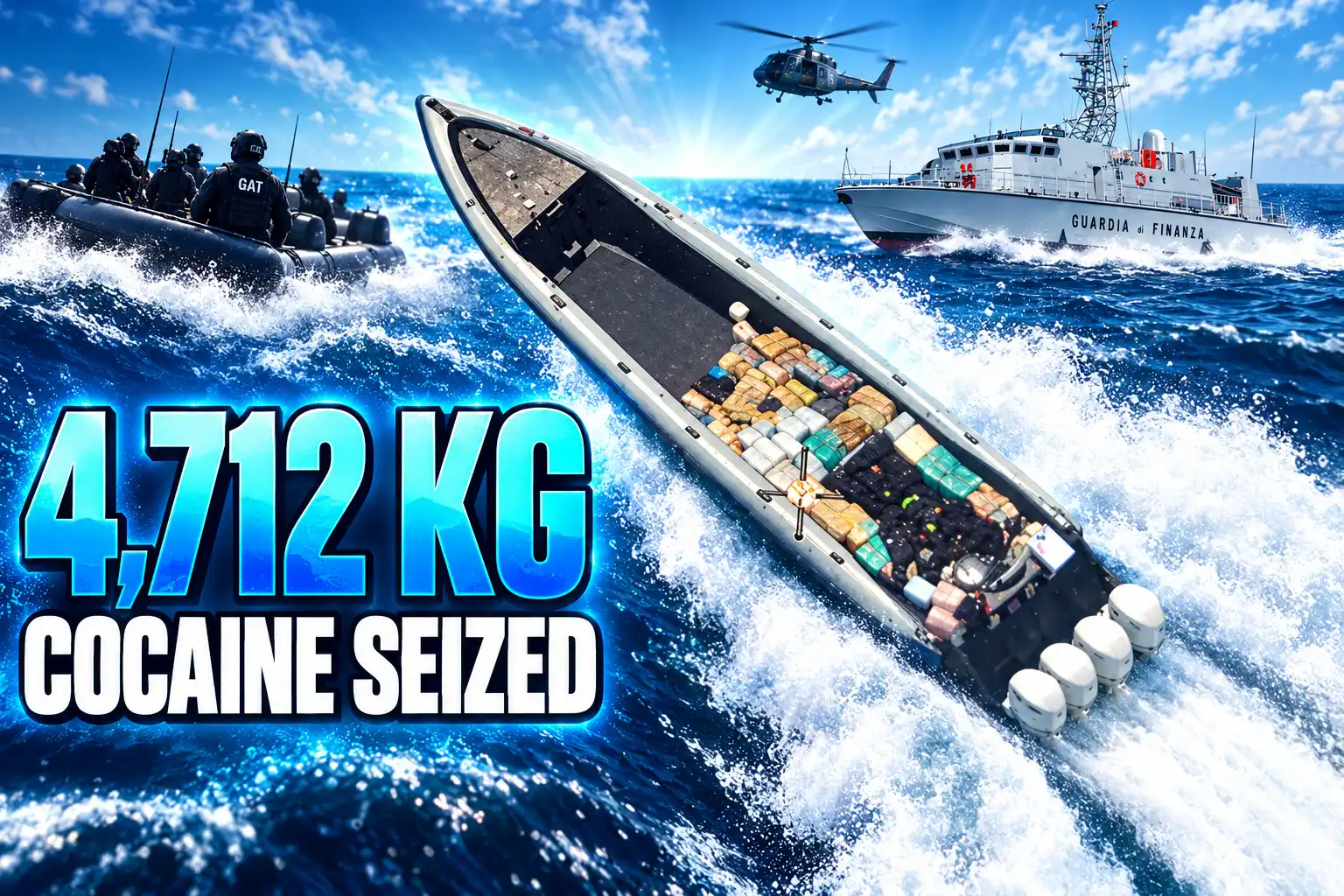
The packages on the deck were only part of the shipment. Before the boarding, the crew put more bales in the Atlantic. Guardia di Finanza units from Brescia, working with Portuguese police, tracked currents and watched the coast until they recovered 2,085 kg. The logos on those wrappers matched the ones already taken off the go-fast, which made it the same consignment.
That brought the operation to 4,712 kg, a combined haul the Italian force put at about 4.7 tonnes. The dump is built into the method. A boat that has just been lit up by a patrol aircraft can shed weight, run, and hope GPS and tide hide the rest.
THE BUONGIORNO WEIGHTS
- On the hull: 2,627 kg taken off the go-fast on 23 July.
- In the water: 2,085 kg recovered in the days after the chase.
- Boat-load price: about €78 million wholesale, about €500 million after cutting for street sale, per the Brescia statement of 27 July.
- Combined price: about €150 million wholesale and about €1 billion on the street for the 4.7 tonnes, after the dumped bales were counted.
Those two price pairs describe different piles. The July note valued only what was on the boat. The later figures value the boat load plus the jetsam.
Mother Ships, GPS Bales and 70-Knot Taxis
The Brescia Guardia di Finanza, in a statement coordinated by the city’s District Anti-Mafia Directorate, described the craft as an ocean-going ultra-fast inflatable, 10 to 16 metres long, with several high-power outboards able to pass 70 knots. Organised groups use them in drop-off mode, as sea taxis that recover dropped cargo thrown from mother ships coming from South America, then run it toward Europe.
Oliveira said the bricks carried producer marks from South America and that he would not describe them in public while the file was open. Joint Interagency Task Force South, the U.S. command that had watched the Atlantic for weeks, later said a suspect mother vessel had been seen on a run from Suriname, and that a go-fast met that ship to take the cargo. Portuguese and Italian maritime patrol aircraft then found more than one go-fast off the Portuguese coast.
🌊 MAJOR ATLANTIC DRUG BUST: 2.6+ TONS OF COCAINE SEIZED! 🚫❄️
In a powerful display of global teamwork, a massive multinational operation has successfully disrupted an international smuggling route—seizing approximately 2,627 kg of cocaine and arresting four suspects off the… pic.twitter.com/I2iNolmsik
— Joint Interagency Task Force South (@jiatfs) July 29, 2026
Europol had already mapped the same pattern in an April 2026 operation on the eastern Atlantic corridor. Networks now split a crossing into three-stage transfers across the Atlantic.
HOW THE ATLANTIC RUN IS SPLIT
- Mother vessels: Container ships, bulk carriers, or smaller craft collect cocaine in Latin America and steam hundreds to thousands of nautical miles into international water.
- Mid-ocean handoff: The cargo moves onto high-speed craft, including rigid inflatables, that can make the long last leg.
- Final landing: Smaller boats take the bales onto remote Portuguese and Spanish beaches or small marinas, away from the big ports.
Jean-Philippe Lecouffe, Europol’s deputy executive director for operations, said after that April job that the Atlantic was not big enough to hide in if police worked together, and that the work would move from crew arrests to the networks behind the crossings.
Our work proves that when law enforcement acts together, even the Atlantic is not big enough for organised crime to hide.
Jean-Philippe Lecouffe, Deputy Executive Director for Operations, Europol, 8 May 2026
Between 13 and 26 April 2026, that operation seized 11 tonnes of cocaine and 8.5 tonnes of hashish, arrested 54 people, and stopped 8 vessels in the water between the Canary Islands and the Azores. Buongiorno, three months later, sat on the same corridor, only closer to Lisbon.
How Much Cocaine Moves Through Portuguese Waters?
The European Union Drugs Agency, in the cocaine chapter of the European Drug Report 2026, said EU members seized 330 tonnes of cocaine in 2024, down from 419 tonnes in 2023, while the number of seizures rose. The agency read that as a shift in routes and methods, not a smaller flow from South America, with more work moving to smaller ports, at-sea transfers, semi-submersibles, and concealment in cargo.
COCAINE SEIZED IN 2024, EUDA
| Place | Tonnes seized |
|---|---|
| Spain | 124 |
| France | 53.5 |
| Belgium | 44.6 |
| Netherlands | 37.6 |
| Germany | 23.8 |
| Portugal | 23 |
| Italy | 11 |
| EU total | 330 |
Portugal’s Judicial Police, in its 2025 trafficking report, said it seized 25.63 tonnes of cocaine that year, 11.4% more than in 2024. Sea routes accounted for 95.1% of the weight, 24,376.60 kg in 22 seizures, for an average of 1,108.03 kg per case. The Azores accounted for 8,803 kg and Madeira for 7,526 kg. On the mainland the largest hauls were Porto at 3,122 kg, Lisbon at 3,000 kg, and Setúbal at 1,750 kg. Cape Espichel sits on that Setúbal coast.
Brazil was the main origin named in the 2025 Portuguese cases, after Colombia in 2024 and Ecuador in 2023. The geography is the point of the job: the mainland and the islands sit on the great-circle path from South America, so a mothership can drop, turn, and never enter a European pier.
Brescia’s File Ran to Lisbon
The Italian side of Buongiorno was a Brescia investigation. The Guardia di Finanza’s provincial economic-crime unit, its air-naval command, and the Central Organised Crime Investigation Service (SCICO) flew maritime-surveillance aircraft from Iberian bases under EU external-border modules. The Polícia Judiciária file on Operation Buongiorno was opened on MAOC-N traffic and on that Italian work.
The Brescia statement listed the same four men MAOC-N named, and it added two details. It called the British crewman a Gibraltar resident. It said the Albanian man lived in Mantua and was based in the province of Brescia. Italian investigators treated him as the man who was supposed to stay with the load from the Atlantic pickup through to northern Italy.
Oliveira said one of the four was already known to Portuguese police for maritime cocaine work. He also said Portuguese authorities would find it extraordinarily difficult to cut off the head of the organisation, because that leadership is not in Portugal. The men on the go-fast were the last mile, not the office.
The Next Boats Were Already in the Water
The corridor did not pause for the Lisbon briefing. MAOC-N said that in early August the Judicial Police, Navy, and Air Force stopped a container vessel and took about 5 tonnes of cocaine bound for Europe, plus gear for throwing bales overboard and picking them up later. The ship was escorted to Sines. Two stowaways and one crewman were arrested.
On 8 August the Portuguese Air Force said a high-speed boat about 110 km off Sines was carrying 421.400 kg in bales. The crew threw packages while running. No arrests were reported on that hull.
THE SUMMER FILE OFF PORTUGAL
- 23 July 2026: Operation Buongiorno boards a go-fast 50 nautical miles southwest of Cape Espichel and takes 2,627 kg, with four men arrested.
- 25 July 2026: Oliveira briefs in Lisbon and says several fast boats were in the same water that night.
- 27 July 2026: The Brescia Guardia di Finanza values the boat load at about €78 million wholesale and about €500 million after cutting.
- Early August 2026: Italian and Portuguese teams recover 2,085 kg dumped from the same shipment, taking the file to about 4.7 tonnes.
- 6 August 2026: Portuguese forces intercept a container ship and seize about 5 tonnes, with overboard-drop gear on board, then escort the ship to Sines.
- 8 August 2026: A go-fast off Sines yields 421.400 kg after a chase in which bales went into the sea.
By late September, the association representing Maritime Police inspectors and senior officers said that force had, during 2026, seized 17 high-speed boats and 5 tonnes of cocaine and detained 37 suspects, and that every one of those suspects had been released under light conditions. Association president Manuel José Serrano Faustino said that without a shared tactical approach, officers would keep arresting at sea only to release on land.
Buongiorno still took 4,712 kg off a live Atlantic taxi and put four men in Portuguese custody. The mothership had already turned. The next go-fast was already burning fuel toward Sines.
Frequently Asked Questions
Where Is Cape Espichel?
Cape Espichel is a limestone headland on the Setúbal coast south of Lisbon, in the municipality of Sesimbra, with Atlantic cliffs and a working lighthouse. The intercept was not in the Tagus approaches. It was 50 nautical miles southwest of that cape, a run that keeps a go-fast off the city radar until the last hour.
How Fast Can a Cocaine Go-Fast Travel?
The Brescia statement said the boats used on these runs can pass 70 knots, which is about 130 kilometres per hour. At that speed a 10 to 16 metre rigid inflatable can outrun most patrol craft in a short sprint, which is why air spotting and a planned intercept matter more than a harbour search.
What Is MAOC-N, and Where Is It Based?
MAOC-N is the Maritime Analysis and Operations Centre – Narcotics, a Lisbon-based forum funded with EU money so member services can share leads on drug traffic by sea and air. It does not board boats itself. It moves intelligence between partners, which is how an Italian file and a Portuguese boarding party ended up on the same hull.
When Did the Four Men First Appear in Court?
Oliveira said the four were held at Judicial Police cells and taken to court in Lisbon on 25 July 2026, the Saturday after the boarding, for a first judicial interrogation and a decision on coercive measures. Guilt still had to be proved at trial, as the Brescia statement also noted under Italy’s presumption of innocence.

Ninja Theory Staff Face Redundancy After Two Xbox Sales Collapse

Amazon Sells the MacBook Air at Its Pre-Hike Price

U.S. Slows Jet Parts to Squeeze China’s Flying Fleets

PEGI Pulled the GTA 6 Age Rating After Cocaine Details

Northwestern’s Smaller Ryan Field Gave Penn State Nowhere to Hide

Aramco Crash Kills 14 Two Days After Oil Restart

Salah Captained Egypt to Their First World Cup Win

Apple Labor Day Deals Hide June’s Memory Price Hike

Palworld 1.0.4 Adds Palpedia Search After the 1.0 Launch

Zelda’s 40th Switch 2 Ships Without a Zelda Game
-
 BUSINESS3 months ago
Aramco Crash Kills 14 Two Days After Oil Restart
-
 NEWS4 months ago
Salah Captained Egypt to Their First World Cup Win
-
 NEWS1 month ago
Apple Labor Day Deals Hide June’s Memory Price Hike
-
 GAMING4 weeks ago
Palworld 1.0.4 Adds Palpedia Search After the 1.0 Launch
-
 GAMING4 weeks ago
Zelda’s 40th Switch 2 Ships Without a Zelda Game
-

 NEWS3 months ago
El Niño Puts Israel’s Needed Winter Rain on a Flood Clock
-

 ENTERTAINMENT4 weeks ago
King Charles Letter Keeps Harry and Meghan as Private Citizens
-

 NEWS3 months ago
Saudi Visa Routes Split Nigerian Travelers Into Two Speeds