
NEWS
The Ketziot Deterrent Did Not End the Gaza Flotillas
Ben-Gvir vowed to hold Greta Thunberg in Ketziot as a terrorist. Thirteen months later, Sumud flotilla boats are being repaired to sail again.

National Security Minister Itamar Ben-Gvir told Israel’s cabinet that Greta Thunberg and the Global Sumud Flotilla would be held as terrorists in Ketziot. He wanted weeks in a Negev security prison, not a night in a cell and a flight home.
The pitch was a deterrent. Thirteen months later, fourteen damaged hulls sit in a Turkish yard being fitted to sail again.
Ben-Gvir Took the Flotilla to the Cabinet
On 31 August 2025, Ben-Gvir put the plan in front of Prime Minister Benjamin Netanyahu, Defense Minister Israel Katz, Foreign Minister Gideon Sa’ar, and Strategic Affairs Minister Ron Dermer. He had already run it past police and prison chiefs on 28 August. The convoy then leaving Barcelona was billed as 50 ships and activists from 44 countries, the largest civilian run at Gaza’s naval blockade to date.
Swedish climate campaigner Greta Thunberg was on the Spanish leg. Irish actor Liam Cunningham was too, along with former Barcelona mayor Ada Colau and Nelson Mandela’s grandson Mandla Mandela. Israel had already seized Thunberg’s smaller boat, the Madleen, in June 2025 and deported her with 11 others. People close to Ben-Gvir said that fast, quiet expulsion had not done the job, and that some of the same names would try again.
He told the cabinet the fleet was not protest. It was, in his words, an attempt to undercut Israel’s borders and help Hamas. The navy, he said, was ready.
THE DETERRENT BEN-GVIR TOOK TO THE CABINET
- The prisons: Men would go to Ketziot in the Negev and women to Damon, both used for security prisoners.
- The terms: Prolonged custody instead of an overnight hold, with no television, radio, or better food.
- The legal hook: Entry into a closed military zone, plus files built from photos with militants and alleged group ties.
- The boats: Every participating ship would be seized and reused by Israeli law enforcement, a step a legal review had already cleared.
Ben-Gvir’s public line after the meeting was blunt. “We will not allow individuals who support terrorism to live in comfort. They will face the full consequences of their actions,” he said. He added that Israel had to create a clear deterrent, and that anyone who chose to work with Hamas would meet a hard response. After weeks in those conditions, he said, they would think twice before trying another flotilla.
The Global Sumud Flotilla published his plan to brand activists as terrorists as a warning of its own. Organizers still sailed. Strong winds of 56 km/h pushed the Barcelona group back into port, and they left again on the evening of 1 September 2025.
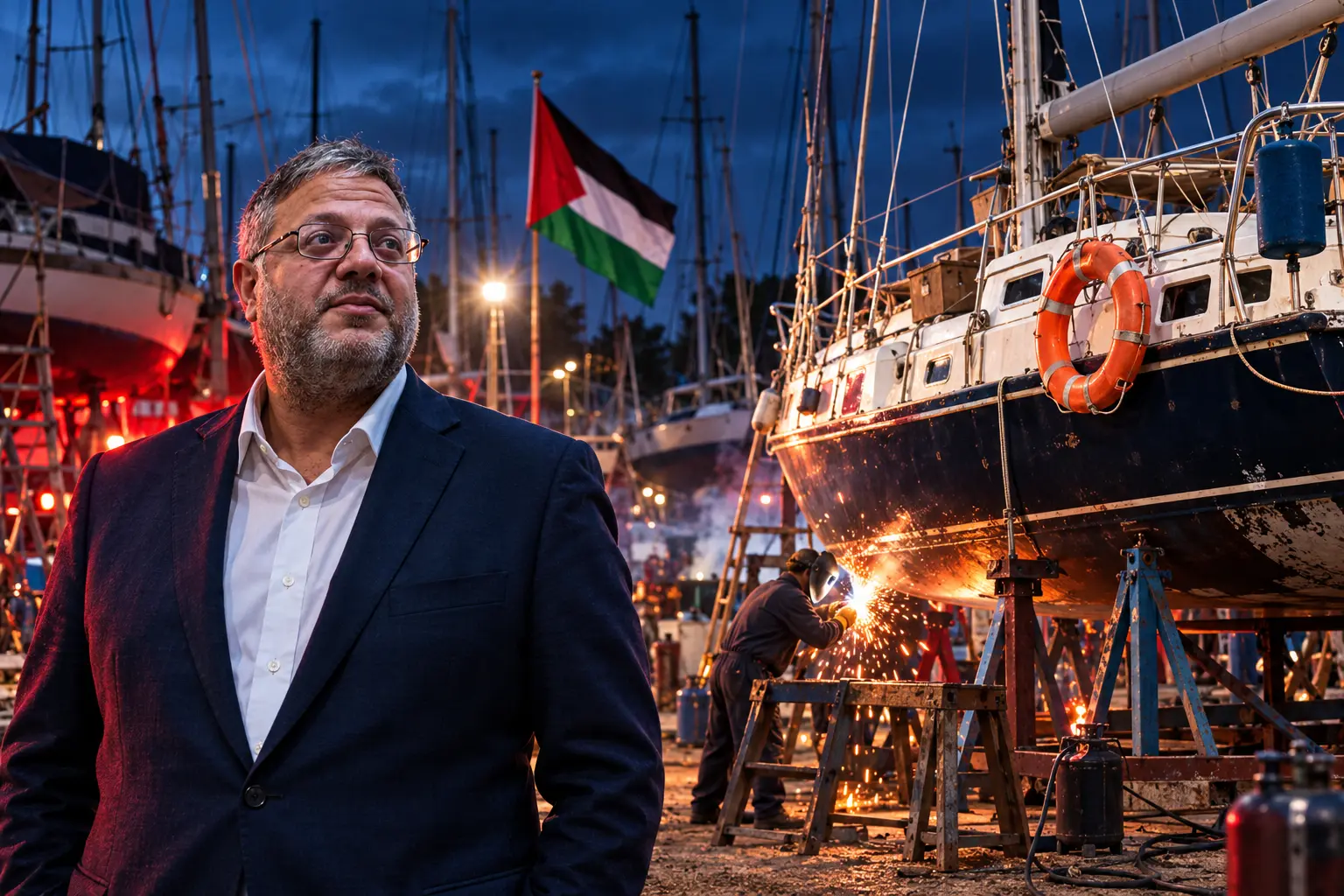
Israel Put 479 Activists in Ketziot
The navy did not wait for Gaza’s beach. Between 1 and 3 October 2025, Israeli forces took 42 boats in international waters and, Israel said, detained 479 people. Radio calls told the crews they were nearing a blockaded zone and could unload at Ashdod for inspection and transfer. The boats kept on. Shayetet 13 boarded them on the eve of Yom Kippur. Passengers were processed at Ashdod and moved to Ketziot, Israel’s largest detention site by land area at 400,000 square meters, a desert camp built for security prisoners.
Thunberg was among them. So were lawmakers, doctors, and journalists. Forty-two detainees began a hunger strike three days after the first boarding. On 5 October, Ben-Gvir walked Ketziot himself.
I was proud that we treat the ‘flotilla activists’ as supporters of terrorism. Anyone who supports terrorism is a terrorist and deserves the conditions of terrorists. They should feel what the conditions in Ketziot Prison are like, and think twice before approaching Israel again. That’s how it works.
Itamar Ben-Gvir, National Security Minister, after visiting Ketziot Prison
On 6 October, Israel said it had deported 171 more people, Thunberg among them, bringing the total then removed to 341. That left 138 still in custody that day. She landed in Athens and told a crowd she could talk for a very, very long time about mistreatment in prison, then added that was not the story. By 12 October 2025, the remaining foreign volunteers were out.
The Ketziot run did not close the season. Other boats kept leaving, and Israel kept stopping them.
FLOTILLA RUNS AFTER THE KETZIOT PLAN
| Voyage | When | Scale | What Israel did |
|---|---|---|---|
| Global Sumud Flotilla | 1 to 3 Oct 2025 | 42 boats, 479 detained | Boarded at sea, held at Ketziot, then deported |
| Freedom Flotilla / Thousand Madleens | 8 Oct 2025 | Nine sailboats and one motor ship | Stopped about 120 nautical miles off Gaza |
| Second Barcelona convoy | Late April to 1 May 2026 | About 20 boats, about 175 people | Seized off Greece; most put ashore on Crete |
| Marmaris to Cyprus run | 18 to 20 May 2026 | More than 50 vessels, 430 detained | Boarded off Cyprus; Ben-Gvir filmed kneeling detainees at Ashdod |
Israel still treats every one of these trips as an illegal run at a lawful blockade. Organizers still treat the blockade, in place since January 2009 and drawn by Israel out to 150 nautical miles, as the thing they came to break.
What Activists Describe Inside Ketziot
Released passengers described a script that matched the cabinet paper. An Oxford doctoral student who was on the October fleet said they were zip-tied, made to kneel, and denied insulin for diabetics, and that they were treated as terrorists, just as Ben-Gvir had promised. Italian journalist Lorenzo D’Agostino said he was forced to sit or kneel on concrete in front of an Israeli flag for hours, left cold with little clothing, and bound at the wrists.
Adalah, the Haifa legal group that reached detainees, said it took testimony from the October intercept and from 80 people who described overcrowded, dirty cells, poor food, and withheld medicine. Al-Haq, which also compiled accounts, said defenders were kept from water for more than 32 hours, woken every two hours, and filmed on their knees. Some said Thunberg was wrapped in an Israeli flag and paraded. A Turkish passenger, Aycin Kantoglu, said they were told “You’re in Israel, there’s no Gaza anymore,” locked in tight cages, and told to drink from the toilet after 36 to 40 hours without food.
Israel’s Foreign Ministry called the abuse claims complete lies. A spokesperson said detainees had water, food, toilets, and lawyers, and that the only violence on the state’s books was an activist biting a female medic at Ketziot. Ministry photos showed Thunberg at the airport. Officials said people still inside had refused to speed their own deportation, including by declining to sign papers that would skip a 72-hour hold.
WHAT WE KNOW
- The boarding: Israeli forces took the 42 boats in international waters and moved passengers to Ashdod, then Ketziot.
- The minister: Ben-Gvir visited the prison, called the detainees terrorists, and said the hard conditions were policy.
- The exits: Israel deported Thunberg on 6 October 2025 with 171 others; the rest of the foreign volunteers were out by 12 October.
WHAT IS UNCONFIRMED
- The flag and the cages: Claims that Thunberg was made to crawl, kiss a flag, or be shown as a trophy are alleged by fellow detainees and denied by Israel.
- Food, water, and blows: Multiple passengers describe hunger, thirst, kicks, and stress positions; the Foreign Ministry says those accounts are false.
The dispute is not academic for the people who wrote the cabinet paper. Ben-Gvir wanted the prison to be the message. The passengers who talked after Ketziot made the prison the message too, which is why the next fleets still had cameras on deck.
The Same Intercept Playbook Since Mavi Marmara
This is not a new Israeli tactic. It is a harsher edit of a script the navy has run since 2010.
FROM THE CABINET ROOM TO ANTALYA
- 31 May 2010: Israeli commandos board six ships of the Gaza Freedom Flotilla in international waters. Nine activists are killed on the Mavi Marmara and a tenth later dies of wounds. Passengers are taken to Ashdod and deported.
- June 2025: Israel seizes the Madleen. Thunberg and 11 others are deported after a short hold, the “soft” model Ben-Gvir later said had failed.
- 31 August 2025: Ben-Gvir takes the Ketziot and Damon plan to the cabinet as the Barcelona convoy casts off.
- 1 to 3 October 2025: The navy intercepts 42 Sumud boats and fills Ketziot, the first full test of that plan.
- 8 June 2026: Rome prosecutors put Ben-Gvir under investigation over the later May fleet. France has already opened a file.
- 2 October 2026: Fourteen damaged Sumud hulls are under repair in Antalya, with two already sent to Italy for another Gaza run.
The 2010 boarding is still the bloodiest night in this file. A UN inquiry into the 2010 raid found the interception unlawful and said detention at Ashdod had no legal basis, because the passengers had been brought from the high seas against their will. The later Palmer panel called the force on the Mavi Marmara excessive and said the way crew were held broke human rights law. Israel said its commandos met knives, bars, and organized resistance, and that the blockade is a lawful wartime measure.
Yuval Shany, a Hebrew University international law professor, has argued the blockade is militarily justified by the fight with Hamas. The ICRC and several UN rapporteurs have called it collective punishment. That argument has not been settled in a courtroom that both sides accept. It has been settled, repeatedly, at sea. Since 2010, the 2011, 2015, 2016, 2018, and 2025 attempts were stopped, raided, or hit. The Sumud fleet was the first unauthorized aid mission in that stretch to come within 70 nautical miles of Gaza.
Cunningham, at the Barcelona dock, had asked what kind of world lets children plan their own funerals. Thunberg said governments were failing to uphold international law. Israel’s answer, then and now, is that the boats are a political stunt dressed as aid, and that cargo can go through Ashdod if it is inspected.
Italy and France Put the Minister Under Investigation
The May 2026 intercept off Cyprus is where the cabinet paper turned into a European criminal file. More than 50 vessels had left Marmaris. Israel detained 430 people. Ben-Gvir went to Ashdod, walked among bound, kneeling detainees, and posted the video himself. “This is how we receive supporters of terror,” he wrote. One activist shouted “Free Palestine” and was pushed down. Hatikvah played.
Giorgia Meloni’s government called the treatment unacceptable and summoned Israel’s ambassador. Italy then asked the European Union to discuss sanctions on Ben-Gvir. France barred him from its territory. On 8 June 2026, a judicial source in Rome said prosecutors had put him under investigation for torture and kidnapping of Italian citizens on that fleet. ANSA said the file also looked at maritime-law breaches and, in some accounts, attempted murder. France’s national counterterrorism office had opened its own probe days earlier, at the government’s request, into alleged torture and war crimes against French passengers.
Ben-Gvir did not retreat. “I will not shy away from one investigation or another and will continue to stand proudly alongside our fighters,” he said. The Israel Prison Service has denied abuse. No charges have been filed in Rome or Paris. The videos are still public.
That is the trap the deterrent built. A quiet deportation leaves little to prosecute and little to fundraise on. A minister in the yard, calling civilians terrorists on camera, gives both sides the picture they want. The flotilla gets the stills. European offices get a named official and a timestamp. Ben-Gvir gets the applause he recorded himself walking toward.
Fourteen Damaged Ships Sit in an Antalya Yard
On 2 October 2026, Sümeyra Akdeniz Ordu, a Global Sumud Flotilla board member, said volunteers in Antalya were repairing hulls damaged in an Israeli operation in international waters. Fourteen vessels are in that yard now. Two already repaired have been sent to Italy for another Gaza-bound mission.
We are trying to recover the ships drifting at sea one by one. We are carrying out a rescue mission. We are repairing these ships so they can sail to Gaza again. If the enemy does not give up, we cannot give up.
Sümeyra Akdeniz Ordu, Global Sumud Flotilla board member, in Antalya
She said masts were broken, sails cut with knives, hoses sliced, and engines filled with surface cleaner and coffee, and that larger ships had rammed them. Türkiye, she said, had given them a safe port. The International Peace Bureau the same day named the Global Sumud Flotilla, the Freedom Flotilla Coalition, and the Nuestra América Convoy as joint winners of its 2026 Seán MacBride Peace Prize.
Israel can still stop a yacht in the eastern Mediterranean. It has done so every time since 2010, and it did so again after Ketziot. What Ben-Gvir told the cabinet he would kill was the appetite for the next attempt. The yard in Antalya is the measure of that claim. The boats that were supposed to become police hulls are being patched to leave again.

Christa Pike Survived the Execution Tennessee Would Not Pause

Musk’s Oligarch Charge Hits a Queue of Three

Circle Puts USDC and EURC Into SAP Pay Workflows

Ring’s First Smart Lock Skips Home Wi-Fi for Sidewalk

GTA 6 Puts Cash Back on the Story Path

Salah Captained Egypt to Their First World Cup Win

Aramco Crash Kills 14 Two Days After Oil Restart

Apple Labor Day Deals Hide June’s Memory Price Hike

Zelda’s 40th Switch 2 Ships Without a Zelda Game

Palworld 1.0.4 Adds Palpedia Search After the 1.0 Launch
-
 NEWS5 months ago
Salah Captained Egypt to Their First World Cup Win
-
 BUSINESS4 months ago
Aramco Crash Kills 14 Two Days After Oil Restart
-
 NEWS2 months ago
Apple Labor Day Deals Hide June’s Memory Price Hike
-
 GAMING1 month ago
Zelda’s 40th Switch 2 Ships Without a Zelda Game
-
 GAMING1 month ago
Palworld 1.0.4 Adds Palpedia Search After the 1.0 Launch
-

 NEWS4 months ago
El Niño Puts Israel’s Needed Winter Rain on a Flood Clock
-

 BUSINESS8 months ago
Egypt Bets EGP 638 Billion Can Open Sinai to Investors
-

 BUSINESS8 months ago
BAE’s 60-Year Saudi Franchise Now Runs Through Taif