
NEWS
Google Opens Gemini 4 Argon With a November Price Cliff
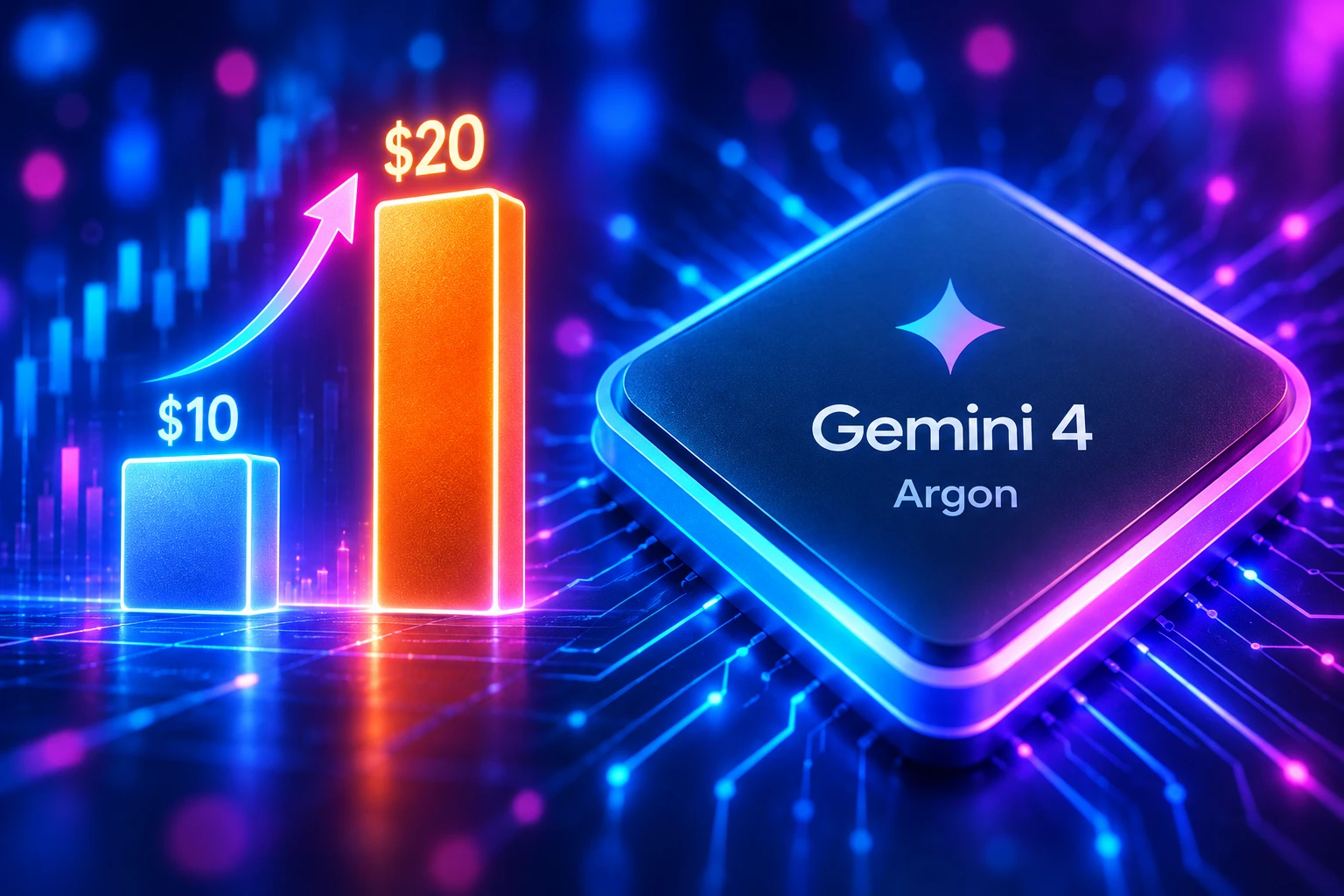
Gemini 4 Argon is public at $2 input tokens through November 30, then $4, with Ultra-only agents, Fairwind cyber copies and 10,000 scientist seats.

Google opened Gemini 4 Argon on October 13 at $2 per million input tokens. The flagship reasoning model is on the paid Gemini API, in the Gemini app for Pro and Ultra subscribers, and in Google Antigravity for Ultra. Output is $10 per million tokens, including thinking tokens, through November 30. On December 1 both rates double.
Koray Kavukcuoglu, SVP at Google DeepMind and Google’s chief AI architect, had held the model behind a cyber-only gate since September 30. The public drop adds an end date the first post never named, plus free Antigravity seats for 10,000 scientists and a wider Fairwind rollout. The weights are the headline. The 48 days of cheap tokens are the mechanism.
A 13-Day Fairwind Gate, Then a Public API
Google DeepMind announced Gemini 4 Argon on September 30 and sent it first to trusted cyber defenders in the Fairwind Program. Kavukcuoglu wrote that a model at this level needed a phased release while Google stayed in the U.S. government’s voluntary pre-release process.
Safely releasing frontier capabilities at this level requires a phased approach.
Koray Kavukcuoglu, SVP, Google DeepMind and Chief AI Architect, Google
On October 13 the company said Argon was now globally available to developers and enterprises through the Gemini API, and to paying Google AI subscribers in Antigravity, the Gemini app, and AI Mode in Search. The model ID is gemini-4-argon. Default thinking is medium, with low and high as options. Input can be text, images, video, audio, or PDFs. Output is text. The unified context window is 1,048,576 tokens, up from a 64K output cap on earlier Gemini models.
THE ARGON ROLLOUT
- September 30, 2026: Google DeepMind announces Gemini 4 Argon and limits first use to Fairwind cyber defenders.
- October 7, 2026: Anthropic ships Claude Haiku 5.5 for high-volume work at $0.10 per million input tokens on short prompts.
- October 8, 2026: Anthropic commits $150 million over three years to the U.S. Genesis Mission; a White House slate of firm pledges lists a matching Google figure.
- October 13, 2026: Argon goes public on the paid API, Gemini for business, the Gemini app, AI Mode, and Antigravity, and Fairwind starts adding hundreds of partners.
Jack Wotherspoon, a Google DeepMind technical staff member who helped ship the developer guide, wrote that he had been using Argon for weeks and that it had changed how he works. The official account put the same news on a video post the same afternoon.
Gemini 4 Argon is now globally available.
Built to solve your hardest problems from start to finish, the model brings frontier capabilities across coding, enterprise workflows, and cyber defense. pic.twitter.com/N8tOQjwk0x
— Google DeepMind (@GoogleDeepMind) October 13, 2026
How Much Does Gemini 4 Argon Cost?
Google’s developer pricing page lists introductory $2 and $10 rates through November 30. Standard paid input becomes $4 per million tokens on December 1, and output, which includes thinking tokens, becomes $20. Cached input is 95% off, so $0.10 per million through November 30 and $0.20 after. Implicit caching is the only cache path; explicit caching is not supported.
Argon is not on the Free tier and is not on the Google AI Pro plan for the API. Batch and Flex sit at half the standard rate. Priority sits above it. Grounding with Google Search includes 5,000 free requests a month across Gemini 3 and newer models, then $14 per 1,000 requests.
GEMINI 4 ARGON API RATES
| Tier | Through Nov. 30 (in / out / cached) | From Dec. 1 (in / out / cached) |
|---|---|---|
| Standard | $2 / $10 / $0.10 | $4 / $20 / $0.20 |
| Batch and Flex | $1 / $5 / $0.05 | $2 / $10 / $0.10 |
| Priority | $3.60 / $18 / $0.18 | $7.20 / $36 / $0.36 |
Those December figures match Claude Opus 5.5’s $4 / $20 list. The launch window is the period when Argon is cheaper on paper. Six days before the GA, Anthropic had already cut the high-volume lane with Haiku 5.5 at $0.10 per million input tokens for prompts up to 100,000 tokens, and $0.50 output. That model is a different product, built for summaries, classification, and subagents, not for the long agent jobs Google is selling. The overlap is the calendar: cheap volume arrived first, then a discounted frontier model with an expiry date.
Thinking tokens ride on the output meter. A run that “thinks” for a long time can bill like a long answer even when the user-visible text is short. Docs also warn that hard prompts can take several minutes and tell clients to set timeouts of at least 15 minutes.
Pro Gets the Chat App, Ultra Gets the Agent
The October 13 post splits the audience with some care. Google AI Pro and Ultra subscribers get Argon in the Gemini app and in AI Mode in Search. Google AI Ultra is required for Antigravity, the agent-first coding environment, and for Argon in AI Studio on that Ultra path. Developers on the paid Gemini API can call gemini-4-argon from AI Studio and Android Studio without an Ultra plan. Enterprises get Gemini for business, the API, and Antigravity.
WHERE ARGON RUNS ON DAY ONE
- Gemini app and AI Mode: Google AI Pro and Ultra subscribers.
- Antigravity desktop and CLI: Google AI Ultra and enterprise, not Pro.
- Paid Gemini API: model ID gemini-4-argon in AI Studio and Android Studio.
- Fairwind cyber copy: allowlisted gemini-4-argon-cyber-permissive, default thinking high, no computer use.
- Scientists: 10,000 seats on Antigravity’s highest usage tier, free for 6 months, by application.
By October 14, Pro subscribers were posting that Argon had shown up in the Gemini web app as well as on phones. The live complaint is not the chat box. It is that the agent loop Google used for its own Chrome and ADK demos sits behind Ultra, while the public API still bills thinking as output. That ladder is the product. Chat is wide. Overnight agents are not.
Chrome’s 40 Million Lines Were the First Customer
Google’s proof is mostly Google. Kavukcuoglu wrote that Argon in Antigravity helped teams increase agentic code submissions by more than 35% and cut code rollbacks by nearly a third. Those figures are internal, not a public audit.
The Chrome team used the model to pull core webpage handling out of a roughly 6 million-line legacy folder inside Chromium’s 40 million-line tree. Google says Argon piped multiple clean changes at a time across hundreds of files and finished in weeks a refactor that had been months of work. The stated payoff is live pages that can move between tabs, side panels, and floating windows without a reload, and fewer crashes of that class.
On the open-source Agent Development Kit, the team handed Argon a skills rulebook and a one-paragraph goal: cut framework overhead without breaking apps. Google says the model worked overnight and landed changes that cut in-memory session prep time by 40% on long sessions and sped cold imports by 21%. Researchers using Argon on xTB, a widely cited quantum chemistry package, reported up to 2.3x faster structure prediction and 1.8x faster conformer search, with patches sent upstream. A separate vLLM pass on Gemma 4 E2B produced a 2.85x end-to-end speedup on an A100, from about 37,900 tokens per second to over 108,000, with 100% token parity.
The September 30 post had already described Argon agents replacing 32K lines of SIMD in libgav1, Google’s open video decoder, and producing a memory-safe Rust path 2.7x faster than the prior Rust port. Another internal run, Google said, used fleet profiling to free more than 300 TiB of data-center memory, with 500 TiB to 1 PiB estimated if the work is fully rolled out. Large C and C++ to Rust migrations were in progress from libraries such as re2 up to 800K-plus lines in the Fuchsia Zircon kernel, still under audit.
Argon Leads Vals and Trails on the Terminal
Google’s public ranking claim is narrower than “best model.” Argon is first on the Vals Index as of October 13, at 68.90%, ahead of Claude Sonnet 5.5 at 67.04% and Claude Opus 5.5 at 66.97%. Vals weights finance, coding, legal, and tax tasks by each sector’s share of U.S. GDP. No model led every slice. Argon led Finance Agent v2 at 65.40%. Sonnet 5.5 led Vibe Code Bench and Code Migration. Opus 5.5 led Terminal-Bench 4.0 on that board. Argon had no fallback retries after provider refusals; several Claude scores did.
Vals priced Argon’s run at the $4 / $20 list, not the intro rate, and still recorded $15.68 per test against $21.34 for Sonnet 5.5 and $32.14 for Opus 5.5. Google’s own model card and safety evals are blunter on agents in a shell: Terminal-bench 4.0 is 57.4% for Argon and 66.4% for Opus 5.5. That 9-point hole is the one that matters if the job is a repo and a terminal, not a finance memo.
PUBLISHED SCORES GOOGLE IS USING
| Test | Argon | Note |
|---|---|---|
| Vals Index | 68.90% | Leads Sonnet 5.5 (67.04%) and Opus 5.5 (66.97%) |
| DeepSWE v1.1 | 77.9% | Google, long-horizon software work |
| AutomationBench | 51.3% | Google, Zapier end-to-end business tasks, rank #1 |
| Terminal-bench 4.0 | 57.4% | Model card; Opus 5.5 at 66.4% |
| GraphWalks, 256K to 1M | 84.2% | Model card, long-document links |
| LVBench | 91.7% | Google, long video |
| CWE-bench v1 | 68% | Google, tied for first on vuln repair |
| ERQA | 87% | Google, embodied spatial reasoning |
Early testers who ran Argon on ordinary work described instruction following as closer to Opus 5.5 than to recent GPT-6 models, with fewer hard cyber refusals on the public build. The same people still put Opus ahead on heavy terminal jobs, which is what the model card already shows. Argon also spends output tokens freely because thinking is billed. A cheap sticker can lose that edge on a long agent trace.
Fairwind Partners Keep the Ungated Copy
The public model is not the copy Google trained for defense work. For trusted defenders and Google’s own teams, Kavukcuoglu said Argon would ship without cyber guardrails. On October 13 the Fairwind Program began expanding to hundreds of additional partners. The allowlisted ID is gemini-4-argon-cyber-permissive. Computer use is off. Default thinking is high. Promotional credits that apply to public Argon do not apply to that build.
Wiz, already inside Fairwind, used Argon on its Scan for Good project, which hunts exposures in public infrastructure at no charge. With early access, Wiz said the model chained bugs to a public file-download bypass in healthcare software, exposed a master key, and opened administrator access. Google says the fix protected hundreds of thousands of patient records. The September 30 post had described the same find as a critical hole in hospital software that earlier frontier models missed. On CWE-bench v1, which scores repair of known weakness types, Argon tied for first at 68%.
Safety writing around that dual-use story is specific. On Gray Swan’s Indirect Prompt Injection benchmark, Google says Argon cut attack success across 15 adaptive attempts to 0.7%. Shortcut attempts on coding benches, where a model tries to finish a job by breaking a rule, dropped to 2%. External bio red teaming unlocked less than 1% of the bio sub-tasks Google tests. An automated monitor reads the agent’s step-by-step reasoning and can stop a run; Google says it avoided penalizing thoughts during training so the chain of thought stays readable.
10,000 Scientist Seats and a December Invoice
The science demos are the other distribution channel. Google says Argon translated an internal AlphaQubit error decoder into one hardware kernel and nearly doubled inference throughput. An Argon-written arcsin circuit, checked in Lean, cut spacetime cost by more than 100x versus a published quantum CORDIC baseline. With Professor Matt Landreman at the University of Maryland, a Google team posted a broader class of counterexamples to Grad’s conjecture on stellarator magnetic fields, as arXiv 2610.07304. In enzyme work, Argon produced five serine esterase designs against 4MU-acetate in hours; lab tests confirmed catalytic activity. Researchers at Isomorphic Labs used the model to review patents and scientific papers for drug discovery. On robotics, Argon scored 87% on ERQA. In an internal test it watched a cornhole video, built sim code, and, on Apptronik’s Apollo humanoid, sank seven shots in a row.
THE RESEARCH OFFER
- Seats: 10,000 scientists can apply for Antigravity’s highest usage tier.
- Term: Access is free for 6 months, onboarded on a rolling basis.
- Limits: Eligibility, capacity, and selection still apply; applications opened with the October 13 post.
- Prompt injection: 0.7% success across 15 adaptive Gray Swan attempts, per Google.
Those seats, the Fairwind allowlist, and the $2 / $10 API are the same move. They put Argon inside repos, labs, and defender workflows while the invoice is still introductory. On December 1 the public model’s list price is $4 and $20, the same shelf as Opus 5.5, and cached input doubles to $0.20. Anyone who only needed a cheap high-volume worker already had Haiku 5.5. Anyone who needed a long-horizon agent has a few weeks of discounted tokens to decide whether the Chrome-scale demos transfer to their own tree.
Frequently Asked Questions
What Is the Gemini 4 Argon Model ID?
The public API ID is gemini-4-argon, with default thinking set to medium and optional low and high settings. The Fairwind build is a separate allowlisted ID, gemini-4-argon-cyber-permissive, which defaults to high thinking, drops computer use, and is covered by Google’s Frontier Cyber Model terms rather than the public Argon price card.
Is There a Free Gemini 4 Argon API Tier?
No. Google’s pricing page marks the Free tier as not available for Argon and says the model is not on the Google AI Pro plan for the API. The only cache path is implicit caching; explicit cache APIs are not supported, so long agent sessions have to rely on that 95% implicit discount while it lasts.
Do Batch Runs Use the Same Argon Price?
Batch and Flex are billed at half the standard Argon rates, so $1 input and $5 output per million tokens through November 30, then $2 and $10. Priority is the opposite direction at $3.60 and $18 through November 30, then $7.20 and $36, which is the lane for jobs that cannot wait on the batch queue.
How Does Search Grounding Bill on Argon?
Grounding with Google Search and Maps each include 5,000 free requests per month, shared across all Gemini 3 and newer models, then $14 per 1,000 requests. A single user prompt can trigger more than one search query, and Google charges for each query the model actually fires, not for the prompt alone.

Cook Hands Democrats the House as Crypto’s Bill Stays Dead

Wicker’s Broken Bed Was the Short Story’s Punch Line

Nvidia’s $500 Billion Financing Plan Draws a $180 Sell

Maserati Bets the Grecale V6 Can Fill Porsche’s Gap

EV Cable Theft Follows the Old Railway Copper Playbook

Aramco Crash Kills 14 Two Days After Oil Restart

Salah Captained Egypt to Their First World Cup Win

Zelda’s 40th Switch 2 Ships Without a Zelda Game

Apple Labor Day Deals Hide June’s Memory Price Hike

Palworld 1.0.4 Adds Palpedia Search After the 1.0 Launch
-
 BUSINESS4 months ago
Aramco Crash Kills 14 Two Days After Oil Restart
-
 NEWS5 months ago
Salah Captained Egypt to Their First World Cup Win
-
 GAMING2 months ago
Zelda’s 40th Switch 2 Ships Without a Zelda Game
-
 NEWS2 months ago
Apple Labor Day Deals Hide June’s Memory Price Hike
-

 NEWS4 months ago
El Niño Puts Israel’s Needed Winter Rain on a Flood Clock
-
 GAMING2 months ago
Palworld 1.0.4 Adds Palpedia Search After the 1.0 Launch
-

 BUSINESS8 months ago
BAE’s 60-Year Saudi Franchise Now Runs Through Taif
-

 BUSINESS8 months ago
Egypt Bets EGP 638 Billion Can Open Sinai to Investors