
AUTO
Einride’s Cab-Less Lidl Truck Clears Germany’s Level 4 Gate
A 15-pallet cab-less Lidl truck now runs in Edermünde under Germany’s first KBA Level 4 permit, a copyable path rather than a fleet.

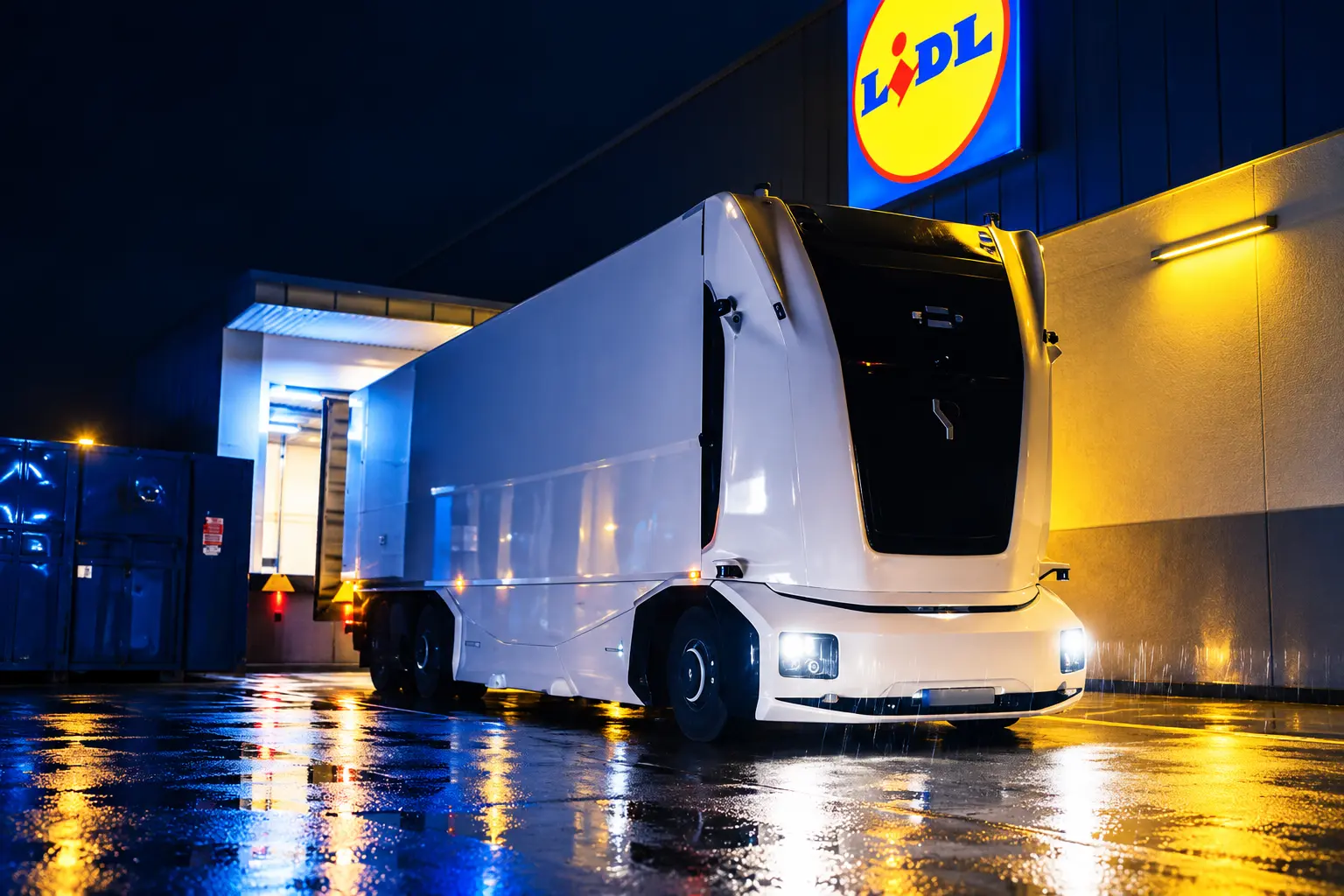
Einride and Lidl began daily public-road runs on 15 September 2026 with a cab-less SAE Level 4 truck between a warehouse in Edermünde and a nearby store. There is no driver and no safety operator on board. The companies said the Kraftfahrt-Bundesamt, Germany’s Federal Motor Transport Authority, issued the first permit of its kind in the country for that arrangement.
The vehicle is a solo electric truck on a four-month grocery clock, not a long-haul tractor. What Lidl’s parent can try to reuse is the paperwork that let a mapped store run start at all.
Fifteen Pallets on a Four-Month Route
The project sits in Edermünde, near Kassel in Hesse, and moves goods from the local Lidl warehouse and distribution centre into one nearby store. Lidl said it is the first food retailer in Germany to put a cab-less electric truck with an autonomous driving function into live store supply on public roads, inside defined operating areas.
Einride, the Stockholm firm founded in 2016 and listed on Nasdaq as ENRD, supplies the truck and the autonomy stack. Lidl, part of Schwarz Group, supplies the freight, the timetable and the store that has to be full. Einride’s own account of the roster is blunt: one shift a day, five days a week, moving real store deliveries.
THE EDERMÜNDE DUTY CYCLE
- The load: A solo electric truck with 15 Europallet slots, covering dry-goods supply on this route in full.
- The cadence: Up to three trips a day on a single weekday shift.
- The clock: A four-month project that Lidl said can move over 3,000 pallets.
- The crew on board: None. No driver and no safety operator ride with the load.
Lidl’s German release puts those figures on the record as 15 Europallet slots and 3,000 pallets across the trial window, which is the working envelope for the shuttle. That is a rigid store run, not a 40-tonne night trunk haul, and it is the shape of work German law is actually willing to stamp.
Thomas Dangelmayer, head of operational logistics at Lidl in Germany, tied the trial to on-shelf availability rather than to a headcount target.
Intelligence creates efficiency, and that is the backbone for permanently reliable product availability. We ensure that the products for our customers are always at the right place, at the right time, and in the right quality. With this innovative project, we are testing a technological milestone step by step and safely in real-world operations to examine how future-proof solutions can be optimally integrated into our site logistics.
Thomas Dangelmayer, Head of Operational Logistics, Lidl in Germany
Two Offices Share Every Level 4 Permit
The announcement treats the KBA paper as a single gate. German law splits that gate in two, which is why one grocery loop does not automatically license the next street.
In 2021 Germany amended the Road Traffic Act so a Level 4 vehicle could operate in a defined operating area. The ordinance that makes the paperwork run, the AFGBV, followed on 24 June 2022 and was amended on 12 May 2026. Under that framework the KBA issues a national type approval for level 4. A separate operating-area approval then has to come from the responsible federal state authority, or from Autobahn GmbH if the run is on a national highway.
HOW GERMANY OPENED LEVEL 4 FREIGHT
- 2021: The Road Traffic Act is amended so motor vehicles with a fully automated driving function may run in defined operating areas.
- 24 June 2022: The AFGBV ordinance takes effect and gives the KBA power to issue national type approvals for those vehicles.
- 15 February 2024: A Verkehrsblatt guideline sets a common application form and test for operating-area approvals under sections 7 to 9 of the AFGBV.
- 12 May 2026: The AFGBV is amended again.
- 15 September 2026: Einride and Lidl say a cab-less Level 4 truck has entered daily public-road service in Edermünde under a KBA permit.
The KBA is explicit that the street map is not its form. The operating area defined in section 1d of the Road Traffic Act is filed with the state, while the KBA approves the operational design domain as part of type approval. A type approval can cover several vehicles of the same design, or a single vehicle. It cannot, under the AFGBV, authorize an operating area outside the Federal Republic of Germany.
A manufacturer applying to the KBA has to file more than a brochure. The authority’s own list is the price of the stamp that Einride is now holding up as a template for Europe’s largest road-transport market.
WHAT THE KBA FILE HAS TO HOLD
- The manual: An operating manual for the fully automated vehicle.
- The safety case: A functional-safety concept, plus an IT-security concept that the Federal Office for Information Security reviews.
- The function: A description of the automated driving function and a catalogue of test scenarios.
- The weather gap: Evidence that conditions which cannot be staged in tests, but may occur in the operating area, are still handled safely.
- The supervisor: A named technical supervisor under section 14 of the AFGBV, assessed with the operating-area file rather than by the KBA itself.
- The independence test: The vehicle must perform the driving task in its target area without depending on intelligent roadside infrastructure.
That last point matters for anyone hoping cameras on lamp posts will carry a grocery pod through a town it has not mapped. Christian Hirte, parliamentary state secretary at the Federal Ministry of Transport, said autonomous and emissions-free driving is now a fact on German roads, and that the Edermünde run also drew support from the Mobility Data Space. The legal text still confines autonomous driving in defined operating areas to a cartographically bounded network the keeper has to justify, street by street.
What SAE Level 4 Allows on This Loop
SAE Level 4 means the automated system performs the whole driving task inside an approved operating domain. Inside that domain it does not need a person to take over when something goes wrong. Outside that domain it is not a Level 4 vehicle in any useful sense, which is why a permit for Edermünde is not a permit for the Autobahn.
Einride and Lidl described the truck as operating with no human on board at all. That is a harder claim than a cabbed tractor with a safety driver in the seat, and it is the claim the KBA process is built to test. The ordinance still requires a technical supervisor as a natural person, and that supervisor may appoint others to carry out the role. Driverless on the road is not the same as unsupervised as a legal matter.
Open-road driver-assist systems keep failing that German test because they ask the regulator to bless a country, not a map. A cab-less store shuttle can pass because the job has been cut down to a known warehouse, a known store, a weekday shift and a four-month window. That is also why a five-day roster looks like a shop delivery timetable rather than a robot fleet that never clocks off.
Lidl’s 39 Distribution Centers Sit Ready
Lidl in Germany already runs 39 administrative and distribution centres and more than 3,250 Lidl stores in Germany. The Edermünde truck serves one of those stores. After this first route is validated, Lidl said a second phase would extend the idea into a milkrun with several stops at another site.
Schwarz Corporate Solutions and Schwarz Digits initiated the project. Serhan Yildirim, head of Schwarz Logistics Solutions, said the group was pairing the scale of its network with Einride’s kit rather than waiting for a finished market. Further deployments with other Schwarz companies are under discussion, not signed.
ONE SHUTTLE AGAINST THE GERMAN NETWORK
| Measure | Edermünde shuttle | Lidl and Kaufland in Germany |
|---|---|---|
| Stores served | 1 nearby Lidl store | More than 3,250 Lidl stores and 790 Kaufland stores |
| Feeding sites | Edermünde warehouse and distribution centre | 39 Lidl administrative and distribution centres |
| Vehicle | 1 solo cab-less truck, 15 Europallet slots | The standing store-delivery fleet |
| Duty cycle | Up to 3 trips a day, one shift, five days a week | Daily store replenishment |
| Term | 4 months, capacity for over 3,000 pallets | A standing national network |
Schwarz Group as a whole operated 14,500 Lidl and Kaufland stores in 33 of 34 country locations in fiscal 2025, after adding 300 stores. Group revenue was 185.6 billion euros, up 5.8 percent from 175.4 billion. Lidl’s store revenue was 140.2 billion euros. The companies employed 604,000 people, 217,000 of them in Germany, and invested about 9 billion euros, 3.7 billion of that in Germany.
That is the map a copied permit would have to walk. Each new milkrun still needs its own operating-area file, because the AFGBV licenses a bounded network, not a banner. A type approval for identical vehicles can be reused. The street cannot.
WHAT WE KNOW
- The permit: Einride and Lidl say the KBA issued Germany’s first permit of this kind for a cab-less Level 4 truck in daily public-road service.
- The place: The run links the Edermünde warehouse and distribution centre with one nearby Lidl store in Hesse.
- The envelope: 15 Europallet slots, up to three trips a day, one weekday shift, four months, capacity for over 3,000 pallets.
WHAT IS UNCONFIRMED
- The milkrun: A multi-stop second phase is planned after this route is validated; no start date or stop list has been published.
- The group copy: Talks on further Schwarz company deployments are under way; no second banner, country or fleet size has been named.
- The metres: Lidl called the store nearby and did not publish route length, speed or the remote-supervision setup.
Until those three items land, the German network of more than 3,250 Lidl stores remains a planning argument, not a rollout.
The 120,000-Driver Hole in German Freight
Lidl said the project is aimed at logistics bottlenecks and a shortage of skilled people on the road. The Bundesverband Güterkraftverkehr Logistik und Entsorgung, the German road-haulage association known as BGL, has been putting a much larger number on that shortage. Dirk Engelhardt, BGL’s board spokesman, said the country currently lacks up to 120,000 truck drivers, and that 30,000 to 35,000 drivers retire each year while 15,000 to 20,000 people enter the job.
The International Road Transport Union, in its 2025 global driver-shortage survey released on 30 June 2026, counted about 2.9 million unfilled truck-driver posts across 18 markets, 11 percent of the workforce in those markets. Europe’s rate was 13 percent, or about 502,000 unfilled posts. About 20 percent of Europe’s driver workforce is expected to retire within five years. Sixty-five percent of operators in Europe named the shortage as their most pressing concern.
WHERE EXPERTS DISAGREE
- Lidl and Einride: The companies present the Edermünde run as part of a push to keep goods moving and to ease driver shortages inside Lidl’s network.
- BGL: Engelhardt has said autonomous systems that move a truck with sensors, cameras and software will not close the gap quickly, because drivers also accompany and guard the goods in their care.
A solo 15-pallet shuttle on a known Hesse loop does not crew a parked long-haul tractor. It can, if the operating-area stamp is copied, take a class of short, repetitive store runs off the roster that hauliers already struggle to fill. That is a narrower claim than the shortage figures, and it is the claim the four-month clock will actually test.
Einride Already Runs Autonomous Miles Elsewhere
Roozbeh Charli, Einride’s chief executive, used the German stamp as a scale argument, not a traffic count. The company said it had already put the first cab-less SAE Level 4 truck of this kind into daily German public-road service with Lidl.
Germany’s approval process is among the toughest in the world, and obtaining clearance there gives us a foundation to scale with confidence.
Roozbeh Charli, Chief Executive Officer, Einride, company announcement
Charli also said Einride is already running autonomous deliveries with real volumes on real schedules for customers in the United States and Europe, and that Germany is one of its key markets. The company’s first-half 2026 results put numbers on that claim. Driverless hours in contracted customer operations rose 64 percent to more than 5,400 hours as of 30 June 2026, across six autonomous deployments in the United States and Europe. First-half revenue was 273 million kronor (27 million dollars), up 26 percent on a constant-currency basis. Einride listed on Nasdaq on 10 June 2026.
In August 2026 Einride also partnered with DAF, a PACCAR company, to put the Einride Driver stack onto DAF’s vehicle platform. That is a different copy path from a second Lidl street in Hesse: same software, someone else’s cab or pod, another regulator’s form. The German AFGBV still will not let a nationally approved operating area spill across a border.
Einride and Lidl Germany have put a cab-less SAE Level 4 truck into daily operation on a German public road, under the first KBA permit of its kind. One shift a day, five days a week, moving real store deliveries. $ENRD https://t.co/a9lbbRven9 pic.twitter.com/miQN2IkhFe
— Einride (@einrideofficial) September 15, 2026
On 15 September 2026 Einride said it had received the first permit ever granted in Germany to put a Level 4 truck into daily operation on a public road, and that it had done so with Lidl. The next German copy will not be that sentence again. It will be another map, another state office, and another four-month argument about pallets, shifts and who still rides with the load.

Christa Pike Survived the Execution Tennessee Would Not Pause

Musk’s Oligarch Charge Hits a Queue of Three

Circle Puts USDC and EURC Into SAP Pay Workflows

Ring’s First Smart Lock Skips Home Wi-Fi for Sidewalk

GTA 6 Puts Cash Back on the Story Path

Salah Captained Egypt to Their First World Cup Win

Aramco Crash Kills 14 Two Days After Oil Restart

Zelda’s 40th Switch 2 Ships Without a Zelda Game

Apple Labor Day Deals Hide June’s Memory Price Hike

Palworld 1.0.4 Adds Palpedia Search After the 1.0 Launch
-
 NEWS5 months ago
Salah Captained Egypt to Their First World Cup Win
-
 BUSINESS4 months ago
Aramco Crash Kills 14 Two Days After Oil Restart
-
 GAMING1 month ago
Zelda’s 40th Switch 2 Ships Without a Zelda Game
-
 NEWS2 months ago
Apple Labor Day Deals Hide June’s Memory Price Hike
-
 GAMING1 month ago
Palworld 1.0.4 Adds Palpedia Search After the 1.0 Launch
-

 NEWS4 months ago
El Niño Puts Israel’s Needed Winter Rain on a Flood Clock
-

 BUSINESS8 months ago
Egypt Bets EGP 638 Billion Can Open Sinai to Investors
-

 BUSINESS8 months ago
BAE’s 60-Year Saudi Franchise Now Runs Through Taif