
BUSINESS
The Crypto Bill Died on Trump’s Own Profits
The Senate failed cloture on the Clarity Act 49-50, 11 votes short, after Trump’s $1.4 billion crypto year turned ethics into the veto the industry could not buy.

The Senate rejected cloture on the Clarity Act on September 15 by 49 votes to 50. The motion to proceed to H.R. 3633 needed 60 votes and received 49, all of them Republican.
Crypto companies spent more than $130 million in 2024 to elect a friendlier Congress, then watched President Donald Trump halt the Biden-era enforcement wave. His family’s $1.4 billion in 2025 crypto income became the ethics fight that froze the statute they came to collect.
A 49-50 Cloture, 11 Votes Short
This was not a vote on the bill. It was a vote on whether the Senate would even begin debating the Digital Asset Market Clarity Act, which would split oversight of digital commodities between the Securities and Exchange Commission and the Commodity Futures Trading Commission. The clerk recorded the official 49-50 cloture tally at 2:19 p.m., vote 234 of the session, with one senator not voting.
Voting started at 2:18 p.m. and the result was announced at 3:00 p.m. Senator Thom Tillis of North Carolina, who had voted no so he could sit on the prevailing side, entered a motion to reconsider one minute later. That motion keeps a second cloture attempt alive on paper. It does not add the 11 votes the first attempt lacked.
THE CLOTURE MATH ON H.R. 3633
| Bloc | Tally | What It Meant |
|---|---|---|
| Yeas | 49 | All Republican; the entire yes column |
| Nays | 50 | Every voting Democrat, both independents, four Republicans |
| Not voting | 1 | Sen. Chris Coons, D-Del. |
| Threshold | 60 | Three-fifths; the motion finished 11 short |
| GOP conference | 53 seats | A united party would still have been 7 short |
Republicans control 53 seats. Four of them voted no, which is why the yes column stopped at 49. Even if every Republican had voted yes, the bill still needed seven Democrats or independents, and it received none. Sen. Mitch McConnell of Kentucky, back after a long absence, voted yea. So did Sen. Rand Paul of Kentucky, who some vote-counters had treated as a likely no.
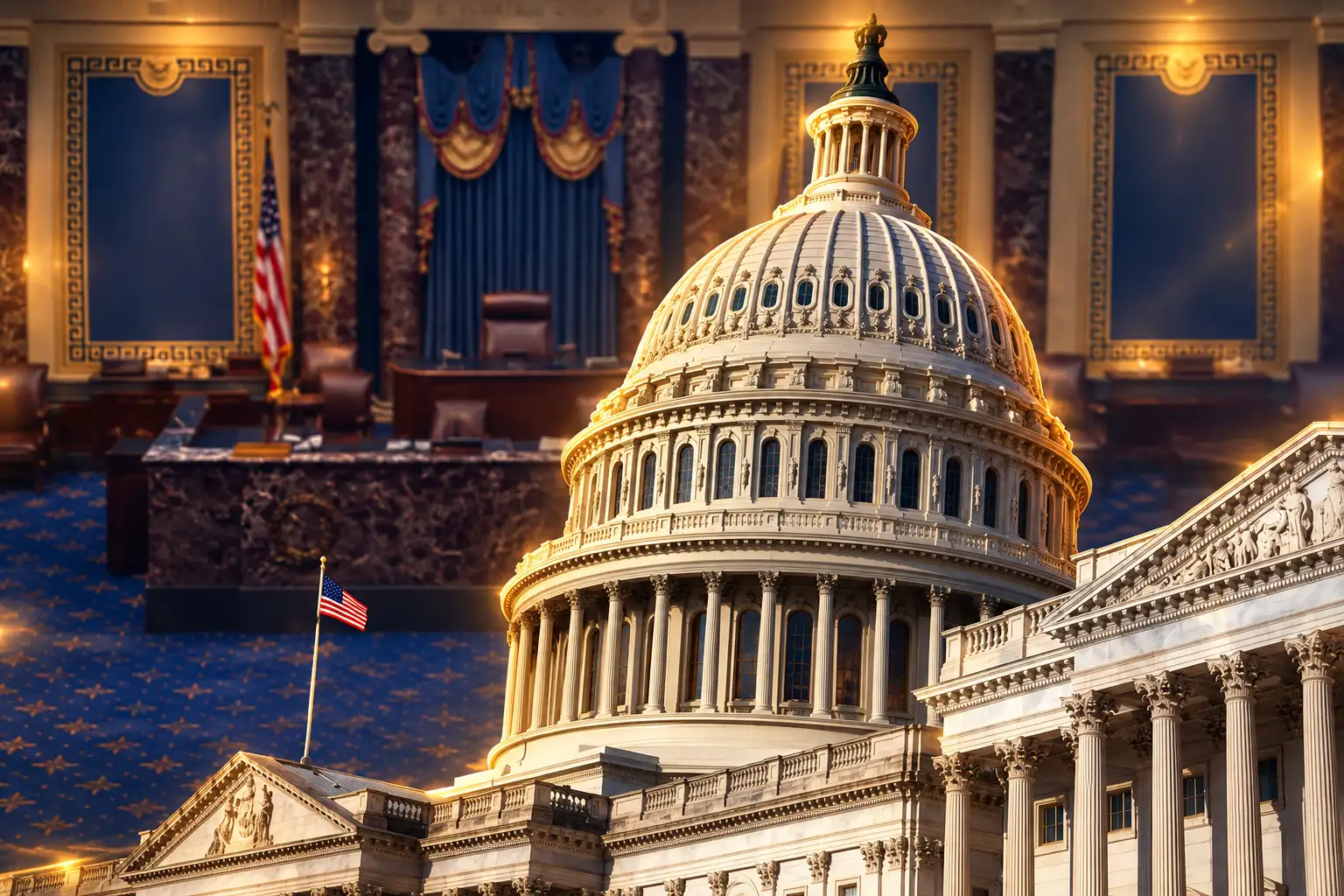
The President’s Crypto Haul Sat in the Way
Democrats did not hide the veto point. They wanted language that would stop the president, his family and other federal officials from issuing, sponsoring or profiting from digital coins while in office. Republicans released a late rewrite on Sunday that barred officials from issuing or sponsoring coins and gave state attorneys general a role in enforcing those rules. Democrats called the rewrite a loophole machine.
Sen. Elizabeth Warren of Massachusetts, the ranking Democrat on Banking, took the floor after the lunch recess and before the roll. She said Trump and his family took in $1.4 billion from crypto ventures in 2025, more than any publicly traded crypto company in America, and that people who bought the $TRUMP memecoin have lost nearly $4 billion.
Late Sunday night, the Republicans released new ethics provisions that the Republicans negotiated with the White House. They read exactly like what the most corrupt President in our history would bless: a tiny little fig leaf that claims they are doing something about corruption, but that is carefully written to make sure that it will not prevent Donald Trump from making his next $1.4 billion in crypto profits.
Sen. Elizabeth Warren, Ranking Member, Senate Banking Committee, floor remarks
Warren argued the loopholes that would spare the president run through the attorney general, whom she described as Trump’s lawyer, and through the Office of Government Ethics, which she said could issue an opinion that shuts down enforcement. She said the text would still let him keep World Liberty Financial and the memecoin, restructure those businesses, or park them in a trust that is blind only on paper.
White House spokeswoman Anna Kelly has said the president and his family have not engaged, and will not engage, in conflicts of interest, and that Trump put his businesses in a trust run by his sons. That line did not move a single Democratic vote. Staff talks on the ethics controls were still going in Tillis’s hideaway office on Tuesday afternoon. Staff for Sen. Tim Scott of South Carolina, the Banking chairman, ended the meeting, and the roll was called.
Two Committee Yes Votes Flipped on the Floor
Senate Banking had advanced the bill 15-9 on May 14, with two Democrats, Sen. Ruben Gallego of Arizona and Sen. Angela Alsobrooks of Maryland, voting yes in committee. Both voted no on cloture. Gallego, who had spent a year at the table, said Republican leaders cut off talks and forced a vote rather than finish an ethics deal he could live with.
All President Trump wants is for the Senate to give him time to crime, and I won’t support any piece of legislation that enables him. This legislation failed squarely because Republicans refuse to say no to the president.
Sen. Ruben Gallego, D-Ariz., statement after the vote
He added that it takes 60 votes, and that Republicans would not give him time to crime if they had been serious about a bill that could actually pass. Alsobrooks had said after the June disclosure that the Senate still needed an ethics agreement covering the president, the vice president and members of Congress. She did not supply the floor vote either.
Collins, Hawley and Moran Held Out
The Democratic wall was enough to kill cloture on its own. The three Republican no votes on the merits still matter, because they show the bill was leaking inside the majority for reasons that had little to do with Trump’s coins.
THE FOUR REPUBLICAN NAYS
- Susan Collins of Maine: Voted no on the merits after weeks of community-bank pressure over stablecoin rewards that could pull deposits out of local lenders.
- Josh Hawley of Missouri: Voted no on the merits on the same community-bank fight, a long-running objection to yield-like payments on payment stablecoins.
- Jerry Moran of Kansas: Voted no on the merits, grouped with Collins and Hawley in the floor log as a genuine no rather than a procedural switch.
- Thom Tillis of North Carolina: Voted no so he could enter the motion to reconsider; the Daily Press log states that purpose in terms.
Strip out Tillis and the yes column would have been 50. That is still 10 short of 60. Collins, Hawley and Moran were not the 11 missing votes. They were the proof that the banking lobby still had a Republican audience after the ethics fight had already frozen the Democrats.
Bankers Drew a Line on Stablecoin Rewards
For most of the year the loudest industry objection did not come from crypto skeptics on the left. It came from banks that already live under the Genius Act, the stablecoin statute Congress wrote in 2025, and that now want Clarity to close what they call a rewards hole.
On September 10, all 77 state bankers associations, joined by the American Bankers Association and the Independent Community Bankers of America, sent Senate leaders a letter on section 10404. They asked for a tighter ban on interest and yield, and they asked that a subsection allowing rewards tied to balance, duration or tenure of holdings be struck. The ABA speaks for a $26.5 trillion industry that holds $20.7 trillion in deposits and $13.9 trillion in loans. Four days later, eight national trade groups, including the Bank Policy Institute and the Financial Services Forum, sent a second letter to Majority Leader John Thune and Minority Leader Chuck Schumer with the same demand.
The September 10 letter warned of deposit flight to stablecoins if payment tokens start to look like a place to park cash rather than a way to pay. “Without amendment, this ambiguity could result in a flight of deposits to stablecoins with real-world consequences. Communities cannot afford that risk,” the associations wrote. Crypto lobbyists have answered that Clarity would actually narrow rewards relative to Genius, and that killing the bill leaves the broader Genius status quo in place. The banks were not satisfied, and neither were Collins, Hawley and Moran.
The House Passed the Same Bill in 2025
H.R. 3633 is not a new draft that appeared this month. The House passed it 294-134 on July 17, 2025, with 216 Republicans and 78 Democrats. That is the kind of bipartisan margin Senate sponsors kept citing while they hunted for seven Democratic crossovers they never got.
HOW THE BILL GOT TO TUESDAY
- May 29, 2025: Rep. French Hill of Arkansas introduces H.R. 3633, the Digital Asset Market Clarity Act.
- June 17, 2025: The Senate passes the Genius Act, the stablecoin bill, 68-30.
- July 17, 2025: The House passes Clarity 294-134 and Genius 308-122 on the same day.
- July 18, 2025: Trump signs Genius into law as Public Law 119-27.
- May 14, 2026: Senate Banking reports Clarity 15-9, with Gallego and Alsobrooks in the yes column.
- August 8, 2026: Thune files cloture on the motion to proceed, locking in the September 15 ripen date.
- September 15, 2026: Cloture fails 49-50. Tillis moves to reconsider. The Senate then turns to a college-sports bill.
Sen. Cynthia Lummis of Wyoming, who chairs the Banking subcommittee on digital assets and voted yea, said Democrats were never serious, that they moved the goalposts after their demands were met, and that they handed foreign competitors a win. Sen. Dave McCormick of Pennsylvania, another yes, said the text had already taken on substantive Democratic changes and that community banks in his state are worse off without it. Those statements describe a bill that sponsors thought they had already bargained into range. The roll said otherwise.
Stablecoin Rules Are Already on the Books
Clarity was the lock, not the first win. Genius is already law. It created the first federal framework for payment stablecoins, tokens designed to hold a $1 value and backed by cash-like reserves. The SEC, under Trump’s appointees, has also pulled back from the lawsuit campaign that defined the Biden years, when the commission sued Coinbase, Kraken and other large firms on the theory that many tokens were securities.
That is why the floor defeat stings in a specific way. Executives wanted a statute that would survive the next administration, a CFTC-centred market-structure law that future commissioners could not unwind with a new enforcement memo. They already have a White House that stopped the crackdown, a stablecoin law, and a friendlier SEC. They do not have the 60-vote insurance policy they spent the last two years buying.
Joseph Chalom, chief executive of the crypto firm Sharplink, called Tuesday “a real setback” that “does not take away from all of the progress that has already been made under this pro-crypto administration.” Mason Lynaugh, executive director of Stand With Crypto, called the vote “a failure of leadership” and said every day without action is a day that “American innovation, jobs, and investments continue to be shipped overseas.” Bitcoin traded under $76,000 as the roll landed. Coinbase shares fell 8% on the session.
A durable statute is still what they lack. Agency goodwill can be reversed by the next chair. Genius covers stablecoins, not the broader commodity-versus-security split that Clarity was written to settle. That gap is why the industry treated this bill, not the last one, as the main event.
Fairshake Turns $122 Million Toward November
The political machine that elected this Congress is still funded. Fairshake, the industry’s main super PAC, entered 2026 with about $193 million and, after the primaries, still had $122 million ready for the November 3 general election, spokesman Geoff Vetter said. “With dozens of wins in House and Senate races across the country, and $122 million ready for the fall, we’re not slowing down,” he said. That cash is a different pile from the more than $130 million the industry spent on the 2024 cycle. It is what is left to spend now.
Thune, speaking for the majority, put the onus on Democrats and named a constituency he said already wants rules.
More than 50 million Americans use cryptocurrency, and they overwhelmingly agree that it is time to introduce some regulations and guidance for this industry.
If Democrats do not take 'yes' for an answer, those responsible for impeding a successful result will be clear to… pic.twitter.com/Afdf4ekTma
— Leader John Thune (@LeaderJohnThune) September 15, 2026
The House is expected to leave Washington after September 17. Midterms follow in November. Tillis’s motion to reconsider is the procedural crumb on the calendar, the same kind of crumb that once let Genius come back for a second cloture after an early fail. A second try still needs 60 votes, and it still needs an ethics deal that Gallego, Warren and Alsobrooks will sign, or a new Senate that no longer requires them.
The industry got the president it paid for. His coins then became the reason the Senate would not debate the bill that was supposed to make that victory permanent. The $122 million left in Fairshake’s account is now a midterm weapon, not a floor whip.
Disclaimer: This article is news reporting and analysis of a Senate procedural vote, public financial disclosures and related official statements. It is informational only and is not investment, legal, tax or campaign-finance advice. Readers should consult a licensed financial adviser, securities lawyer or compliance professional before making decisions about digital assets, political spending or legislative strategy. Vote tallies, market prices and committee cash figures reflect the official records and named statements cited in the piece as of the dates given there, and those figures can change.

Christa Pike Survived the Execution Tennessee Would Not Pause

Musk’s Oligarch Charge Hits a Queue of Three

Circle Puts USDC and EURC Into SAP Pay Workflows

Ring’s First Smart Lock Skips Home Wi-Fi for Sidewalk

GTA 6 Puts Cash Back on the Story Path

Salah Captained Egypt to Their First World Cup Win

Aramco Crash Kills 14 Two Days After Oil Restart

Zelda’s 40th Switch 2 Ships Without a Zelda Game

Apple Labor Day Deals Hide June’s Memory Price Hike

Palworld 1.0.4 Adds Palpedia Search After the 1.0 Launch
-
 NEWS5 months ago
Salah Captained Egypt to Their First World Cup Win
-
 BUSINESS4 months ago
Aramco Crash Kills 14 Two Days After Oil Restart
-
 GAMING1 month ago
Zelda’s 40th Switch 2 Ships Without a Zelda Game
-
 NEWS2 months ago
Apple Labor Day Deals Hide June’s Memory Price Hike
-
 GAMING1 month ago
Palworld 1.0.4 Adds Palpedia Search After the 1.0 Launch
-

 NEWS4 months ago
El Niño Puts Israel’s Needed Winter Rain on a Flood Clock
-

 BUSINESS8 months ago
Egypt Bets EGP 638 Billion Can Open Sinai to Investors
-

 BUSINESS8 months ago
BAE’s 60-Year Saudi Franchise Now Runs Through Taif