
BUSINESS
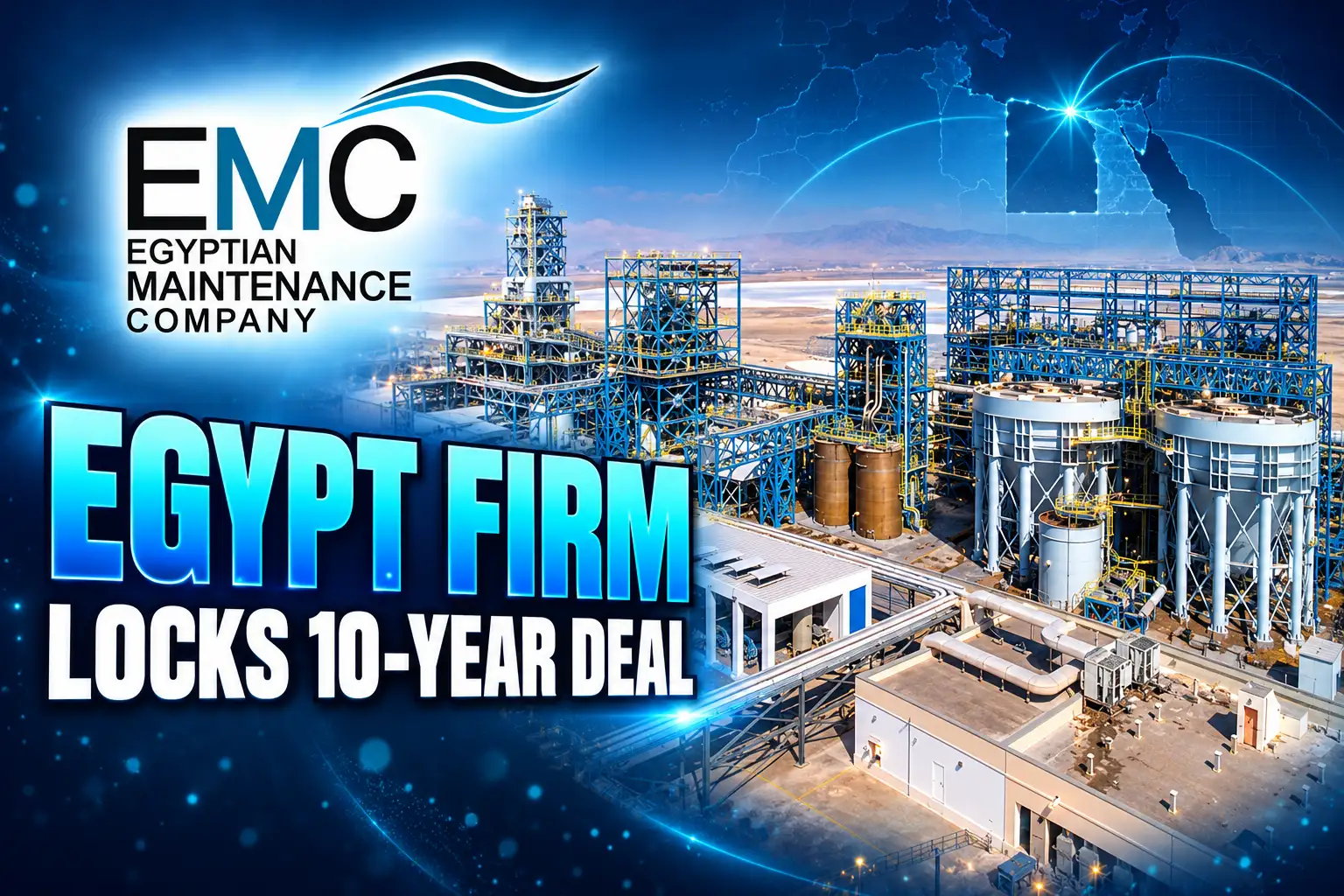
Egyptian Maintenance Company Locks a 10-Year Jordan Turbine Deal
Egyptian Maintenance Company locked a €46 million, 10-year hold on Arab Potash turbines at Ghor Al-Safi, with Siemens Energy still on the steam side.

Egyptian Maintenance Company won a 10-year, €46 million contract to maintain two Siemens Energy gas turbines at Arab Potash’s Ghor Al-Safi plant. Egypt’s petroleum ministry announced the award on June 11, 2026, after an international tender against specialist maintenance groups.
The parties signed on July 15, 2026. Siemens Energy is a cooperation partner, and the job covers heat recovery steam generators as well as the turbines.
Siemens Energy Stays on the Job
The ministry framed the tender as a hard contest with major multinational firms. That is the part that travelled. The signed work is narrower and more practical.
Arab Potash Company and Egypt’s Misr Maintenance Company, commercially San Misr, put names on a 10-year maintenance agreement in Amman in cooperation with Siemens Energy. APC chief executive Maen Nsour and San Misr chairman and managing director Mohsen Maher Qutb signed. APC chairman Shehadeh Abu Hudeib attended.
Abu Hudeib called the partnership a model of Arab industrial cooperation and a long hold on industrial assets that have to keep pace with expansion. Qutb said the award showed confidence in Egyptian engineering crews and pledged qualified teams for the power and steam system.
Nsour tied the paper to unplanned shutdowns. He said a 10-year extension would cut emergency maintenance bills and the cost of sudden stops, and would help energy efficiency and carbon goals. In the Jordan briefing he described the pact as extending the contract, not opening a cold site.
Power and Steam Keep the Fertilizer Lines Moving
The two Siemens Energy units generate 110 megawatts of electricity and 170 tons of steam per hour for the industrial complex. The ministry said that output feeds fertilizer and mineral production. Ghor Al-Safi sits at the southern Dead Sea, where Arab Potash dries and crystallizes potash.
Steam is not a by-product here. Crystallization, drying, and compaction run on heat as much as on megawatts. That is why the Jordan signing put heat recovery steam generators in the same sentence as the gas turbines.
HEAT RECOVERY STEAM GENERATOR
- The kit: An HRSG sits on turbine exhaust and turns waste heat into process steam.
- The plant effect: The complex gets electricity and steam from the same gas burn, instead of firing a separate boiler island for all heat.
- The contract point: San Misr is on both the spinning machines and the steam drums that keep the lines hot.
Siemens industrial turbines in this class are sold for cogeneration, where exhaust is meant to feed boilers with substantial steam-raising capability. The OEM staying on the job matters for parts, outage planning, and the software that times those outages.
THE GHOR AL-SAFI ENERGY HOLD
| Item | Figure |
|---|---|
| Contract value | €46 million |
| Term | 10 years |
| Gas turbines | 2 Siemens Energy units |
| Electric output | 110 MW combined |
| Steam output | 170 tons per hour |
| Site | Ghor Al-Safi, Jordan |
Ten days before the ministry named the winner, King Abdullah II opened a power-and-steam plant project at the same complex, together with a solar evaporation pond expansion. The two projects were put at about JD75 million, with the power-and-steam plant around JD58 million. Nsour said the ponds are meant to add 35,000 tonnes of potash a year.
EMC Has Been on These Turbines Since 2019
Wires treated the June award as a first landing. The site file is older. In March 2019, then EMC head Mohamed El Sheimy told the company’s general assembly that EMC had signed a 10-year agreement with Arab Potash to maintain gas turbines. He also cited a natural gas liquefaction line in the Gulf of Aqaba and operational support for Jordan Bromine Company.
By April 2026, before this tender was announced, chairman Qutb told EMC’s assembly that the company was already servicing gas turbines in Jordan. The July signing is a second decade on a relationship that never fully left the plant.
THE PATH TO THE JULY SIGNING
- March 2019: EMC signs a 10-year gas turbine maintenance agreement with Arab Potash and books other Jordan work at Aqaba and Jordan Bromine.
- April 12, 2026: Qutb reports international contracts of EGP 6.6 billion and says Jordan turbine work is already under way.
- June 1, 2026: King Abdullah II inaugurates a power-and-steam plant project and a pond expansion at Ghor Al-Safi.
- June 11, 2026: The petroleum ministry says EMC won the €46 million international tender.
- July 15, 2026: Nsour and Qutb sign in Amman, with Siemens Energy as cooperation partner, including HRSGs.
- August 12, 2026: Arab Potash starts a 30 MWp solar plant at Ghor al-Safi to add another power source beside the gas machines.
That sequence is why the dollar headline understates the job. EMC is not arriving to learn the site. It is staying through the years when APC wants more tonnes out of the same valley.
What the €46 Million Covers at the Plant
Ministry language was “integrated maintenance and technical support.” The Amman signing added immediacy and the steam side. Qutb said San Misr would put its technical and engineering cadres next to Jordanian plant crews.
THE WORK ON SITE
- Two gas turbines: Siemens Energy units that make power and feed the HRSGs.
- Steam recovery: Specialised maintenance on the heat recovery steam generators at Ghor Al-Safi.
- Call-out support: Immediate technical backup aimed at unplanned stops, which Nsour named as a cost he wants down.
- A 10-year clock: Outage planning, parts, and crew continuity through APC’s next expansion step.
Nsour said the power and heat recovery system is essential for every production plant on the site. A short outage on a 110 MW pair is an electricity problem. A short outage on 170 tons of steam per hour is a process stop.
Overseas Work Now Supplies 58% of Profit
EMC, founded in 1997, is a joint venture. The Egyptian General Petroleum Corporation holds 50%. Norwegian engineering firm Aibel holds the other 50%. The commercial name San Misr is how the firm bids in the region. On its own site, the chairman casts EMC as a partner for comprehensive maintenance solutions in energy.
The Jordan hold sits inside a books shift that was already visible at the April 12, 2026 assembly. Qutb said 2025 revenue rose 31% to EGP 16.7 billion and new contracts rose 27% to EGP 19.6 billion. Operating profit more than doubled to EGP 1.57 billion from EGP 700 million in 2024.
EMC 2025 BOOKS
| Metric | 2025 |
|---|---|
| Revenue | EGP 16.7 billion |
| New contracts | EGP 19.6 billion |
| Operating profit | EGP 1.57 billion |
| Contracts outside Egypt | EGP 6.6 billion |
| Share of pre-tax profit from abroad | 58% |
International contracts hit EGP 6.6 billion, up 85%, and supplied 58% of pre-tax profit. That is the ministry’s foreign-work strategy showing up in cash, not in slogans. In April, EMC was on a potable water unit and field maintenance in Iraq, storage work for bp, major overhauls for Sirte Oil in Libya, and technical support in Saudi Arabia, and it was lining up a first UAE bid with ENPPI.
Petroleum minister Karim Badawi used the same assembly to push a wind-energy plan with Aibel for regional and European jobs. He also pointed at EMC’s ENR listing among international contractors for a third year. The company said it logged 32 million safe man-hours without injury and took ISO 37001 anti-bribery certification.
Arab Potash Locked In a Decade of Uptime
Arab Potash publishes itself as the eighth-largest potash producer by volume and the only one in the Arab world. For 2025 it posted 2.9 million tonnes of potash, consolidated net revenues of JD726 million, and consolidated net profit of about JD173 million. Nsour told a National Defense College group in April 2026 that 2025 output was a record, up more than 21%, and that the company wants capacity at 3.7 million tonnes under a plan through 2034, with about $3.4 billion earmarked for capital projects.
German planner CAC Engineering is designing a third cold crystallization plant at Ghor Al-Safi, about 130 km south of Amman, to add around one million tons of potassium chloride toward 3.7 million tons total production. Nsour put the quality case in plain plant language.
The use of state-of-the-art technologies for crystallization, drying and granulation in the new plant enables a qualitative leap in product quality. This allows us to produce high-purity potash with minimal impurities and insoluble components
Maen Nsour, CEO and President, Arab Potash Company, on the CCP3 project
Those units need reliable steam. On August 12, 2026, APC also began a 30 MWp solar plant at Ghor al-Safi, with Philadelphia Solar and Tarkibat as the contractors, to cut the carbon load on the same industrial load. Gas turbines remain the machines that raise process steam when the sun is down and when the crystallizers cannot wait.
Qutb said San Misr would work hand in hand with Jordanian technical teams to keep the electrical and steam system in line with APC’s expansion plans. That is the job through the next decade, on a site EMC first booked in 2019.
Frequently Asked Questions
Who Owns Egyptian Maintenance Company?
EMC is a 50/50 joint venture between the Egyptian General Petroleum Corporation and Aibel, the Norwegian engineering group, and it was set up in 1997 under Egypt’s investment law. At the April 2026 assembly, petroleum minister Karim Badawi told the company to draw a cooperation plan with Aibel so it can qualify for wind projects in the region and in Europe, a different product line from the Jordan turbines.
Where Is the Arab Potash Power Plant?
The turbines and HRSGs sit at Ghor Al-Safi, APC’s main production base at the southern end of the Dead Sea, about 130 km south of Amman. Potash from the site moves by truck to Aqaba for export, so a steam or power stop at Safi shows up as delayed cargo at Jordan’s only seaport.
Had EMC Worked in Jordan Before This Tender?
Yes. Besides the 2019 10-year gas turbine agreement with Arab Potash, then chairman Mohamed El Sheimy said EMC had a contract to provide and install a natural gas liquefaction line in the Gulf of Aqaba and a separate operational-support job for Jordan Bromine Company. The 2026 award is a second decade on a corridor the company already knew.
What Does a Heat Recovery Steam Generator Do at This Plant?
An HRSG takes hot turbine exhaust and makes process steam, so the fertilizer complex can run crystallizers and dryers without building a full extra boiler plant for every tonne of heat. On this contract that steam rating is 170 tons per hour, which is why APC put the HRSGs in the same 10-year envelope as the two gas turbines.

Christa Pike Survived the Execution Tennessee Would Not Pause

Musk’s Oligarch Charge Hits a Queue of Three

Circle Puts USDC and EURC Into SAP Pay Workflows

Ring’s First Smart Lock Skips Home Wi-Fi for Sidewalk

GTA 6 Puts Cash Back on the Story Path

Aramco Crash Kills 14 Two Days After Oil Restart

Salah Captained Egypt to Their First World Cup Win

Apple Labor Day Deals Hide June’s Memory Price Hike

Zelda’s 40th Switch 2 Ships Without a Zelda Game

Palworld 1.0.4 Adds Palpedia Search After the 1.0 Launch
-
 BUSINESS3 months ago
Aramco Crash Kills 14 Two Days After Oil Restart
-
 NEWS4 months ago
Salah Captained Egypt to Their First World Cup Win
-
 NEWS1 month ago
Apple Labor Day Deals Hide June’s Memory Price Hike
-
 GAMING4 weeks ago
Zelda’s 40th Switch 2 Ships Without a Zelda Game
-
 GAMING4 weeks ago
Palworld 1.0.4 Adds Palpedia Search After the 1.0 Launch
-

 NEWS3 months ago
El Niño Puts Israel’s Needed Winter Rain on a Flood Clock
-

 ENTERTAINMENT1 month ago
King Charles Letter Keeps Harry and Meghan as Private Citizens
-

 ENTERTAINMENT3 months ago
A Thousand and One Drops Off Riyadh’s October Calendar